Automotive Rocker Panel Market SIZE AND SHARE ANALYSIS - GROWTH TRENDS AND FORECASTS (2026 - 2033)
Automotive Rocker Panel Market is segmented By Type (Lower Quarter Panels, Door Rocker Panels), By M...
Automotive Rocker Panel Market Size - Analysis
The global automotive rocker panel market is estimated to be valued at USD 60 Bn in 2026 and is expected to reach USD 78 Bn by 2033, exhibiting a compound annual growth rate (CAGR) of 4% from 2026 to 2033. From an economic perspective, rocker panels matter greatly due to their contribution to both frame strength and visual design in private, commercial, and battery-powered automobiles. The growth of the market continues at a consistent pace, fueled not only by expanding worldwide output of vehicles but also evolving buyer tendencies toward personalization, alongside strict crashworthiness standards shaping modern assembly practices.
Market Size in USD Bn
CAGR4%
| Study Period | 2026 - 2033 |
| Base Year of Estimation | 2025 |
| CAGR | 4% |
| Market Concentration | Medium |
| Major Players | Willmore, QMI Sharp, B and I Trim Products, Am Auto Body Parts, Smittybilt and Among Others |

please let us know !
Automotive Rocker Panel Market Trends
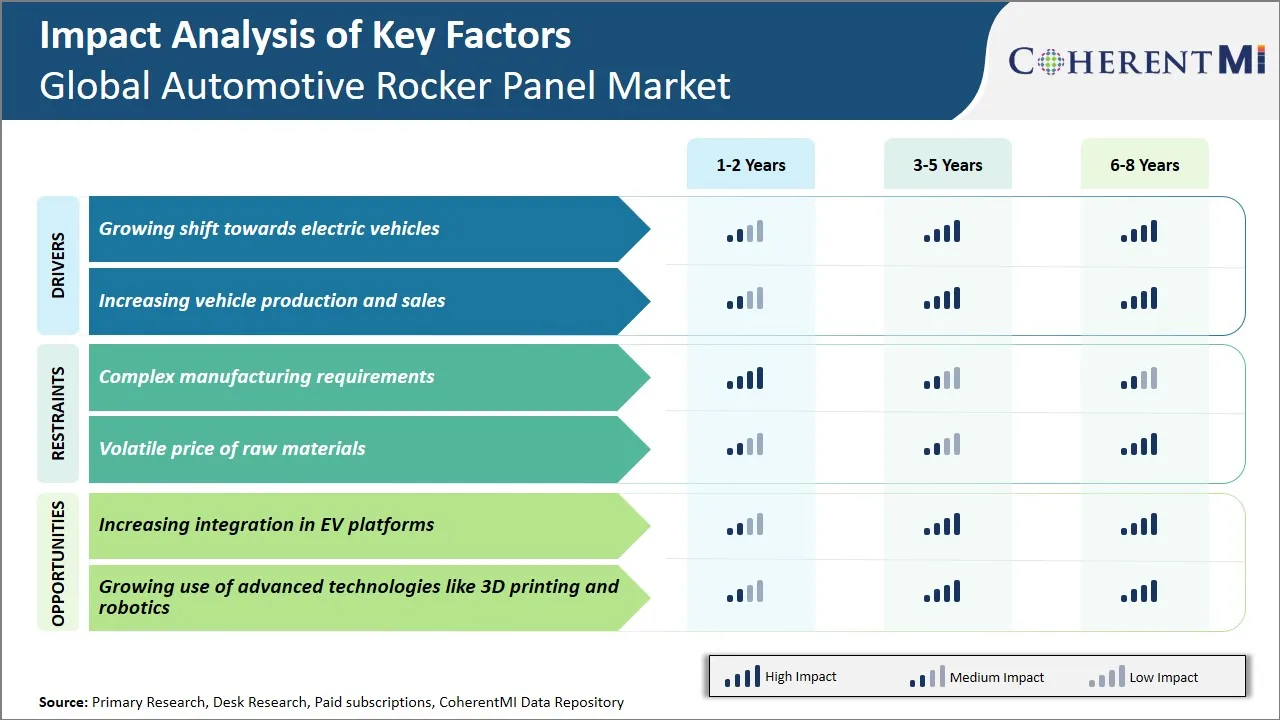
Market Driver - Growing Shift Towards Electric Vehicles
The market growth is facilitated as global producers turn to electric models, affecting how rocker panels are made and sold. Not merely swapping engines, this evolution reshapes entire vehicle structures, altering design thinking alongside factory workflows. Suppliers feel these effects clearly, since parts once standardized now demand new approaches. Service networks adapt slowly, adjusting methods shaped by decades of combustion engine dominance. Vehicle frames grow different, guided by battery placement rather than fuel tanks.
Engineers now face different challenges, yet opportunities arise when designing rocker panels for modern electric vehicles. Without an internal combustion engine, components such as exhaust systems, fuel tanks, and complex gearboxes no longer take up room under the vehicle, allowing greater flexibility in how space below the frame is used. As a result, side sections can be reconsidered, not just as structural elements, but as areas suitable for sizable battery packs, cooling mechanisms, and stronger supports required by electric powertrains.
For instance, on January 9, 2026, Hyundai Motor Company unveiled the STARIA Electric at the Brussels Motor Show, marking a bold step forward in multi-purpose vehicle (MPV) innovation. Combining zero-emission mobility with a people-centered design, STARIA Electric sets a new standard for modern lifestyles.
(Source: hyundai.com)
Market Driver - Increasing Vehicle Production and Sales
Vehicle output and purchases are growing, supporting consistent need for parts like rocker panels in every type of automobile. What lies behind this path includes city population increases, higher personal earnings in newer economies, better availability of loans for buying cars, alongside regular launches of fresh vehicle designs matching shifting buyer tastes and daily needs.
Expansion seems most evident in regions seeing a rise in industrial facilities, particularly where older production firms join newer automotive ventures. Construction goes beyond passenger vehicles, reaching delivery vans, compact trucks, and custom transport models - each needing distinct rocker panel designs based on operational needs.
For instance, on September 6, 2025, VinFast officially launched its premium electric SUVs in India, the Sleek, smart VF 6 and Sporty sophisticated VF 7. Marking VinFast’s first models introduced to India’s rapidly expanding EV market, the launch underscores the company’s strong commitment to supporting the nation’s transition toward sustainable, green mobility and positions VinFast as a key player in shaping India’s EV future.
(Source: vinfastauto.in)
 To learn more about this report, Request Free Sample Copy
Market Challenge - Complex Manufacturing Requirements
Despite rising demand, expansion stalls under pressure from evolving production needs throughout the sector. Meeting strict safety rules, lighter weight targets, and visual expectations, without raising costs, is a challenge for automakers. Advanced substances like reinforced steel, light metals, and synthetic fibers now play central roles, altering how parts take shape during assembly. Techniques such as fluid-based forming, high-heat pressing, and bonding mixed materials have become essential, though they rely on costly tools and updated skills.
Investment burdens grow heavier when training staff becomes just as critical as buying new machinery. Smaller firms find access harder; larger ones face deeper logistical layers. Standardized elements once allowed wide replication across models, yet today's model-specific layouts reduce repetition, weakening previous savings from mass output.
Market Opportunity - Increasing Integration in EV Platforms
Modern electric vehicles demand different frame layouts, altering requirements for components including rocker panels. With battery packs occupying floor areas, these structural sides must handle greater loads while protecting essential systems beneath. Placement of power elements inside the base affects their purpose significantly. Design updates open opportunities for producers to supply enhanced models featuring integrated thermal management channels.
Looking ahead, weight reduction gains importance when aiming to increase range. Driven by efficiency targets, engineers explore materials born from recent innovations. Instead of relying on legacy options, teams now adopt solutions shaped by higher loads. As requirements shift, differentiation emerges through improved processes, not cost cuts. Alongside evolving benchmarks, every phase of design adjusts its core focus.
For instance, on February 27, 2025, Kia Corporation unveiled its new PV5 at the 2025 Kia EV Day, held in Tarragona, Spain. The PV5, a mid-sized Car Derived Van (CDV), is the first production model to debut under Kia’s dedicated Platform Beyond Vehicle (PBV) global business strategy.
(Source: kianewscenter.com)
Pricing Analysis of the Global Automotive Rocker Panel Market:
|
Premium Luxury Brands |
Mid-Range Luxury Brands |
Mainstream Brands |
|
BMW: USD 450-USD 850 per panel
Mercedes-Benz: USD 500-USD 900 per panel
Audi: USD 480-USD 820 per panel
|
Lexus: USD 380-USD 680 per panel Infiniti: USD 350-USD 620 per panel Acura: USD 320-USD 580 per panel Genesis: USD 400-USD 650 per panel |
Toyota: USD 180-USD 350 per panel
Honda: USD 170-USD 340 per panel
Ford: USD 160-USD 380 per panel
Chevrolet: USD 150-USD 360 per panel Nissan: USD 155-USD 320 per panel Hyundai: USD 140-USD 290 per panel Kia: USD 135-USD 280 per panel |
Key winning strategies adopted by key players of Automotive Rocker Panel Market
- Material Innovation and Lightweight Technology Adoption: Magna International Inc invested USD 150 million in carbon fiber and advanced composites research. In addition, it developed proprietary hybrid steel-aluminum rocker panel technology. Furthermore, Magna established dedicated R&D centers in Germany and the U.S.
- Vertical Integration and Supply Chain Optimization: Gestamp Automoción acquired three key steel processing facilities in Eastern Europe and integrated hot stamping capabilities across 15 manufacturing locations. It implemented Industry 4.0 technologies for real-time supply chain visibility.
- Strategic Geographic Expansion and Localization: Aisin Corporation established manufacturing facilities in Mexico, India, and Eastern Europe. In addition, it developed region-specific product variants for local OEMs. These developments helped Aisin Corporation increase international revenue from 45% to 62% of total sales and expand presence in eight new countries.
Segmental Analysis of Automotive Rocker Panel Market
 To learn more about this report, Request Free Sample Copy
Insights, By Type: Enhanced Structural Protection and Streamlined Manufacturing Drive Lower Quarter Panels’ Dominance
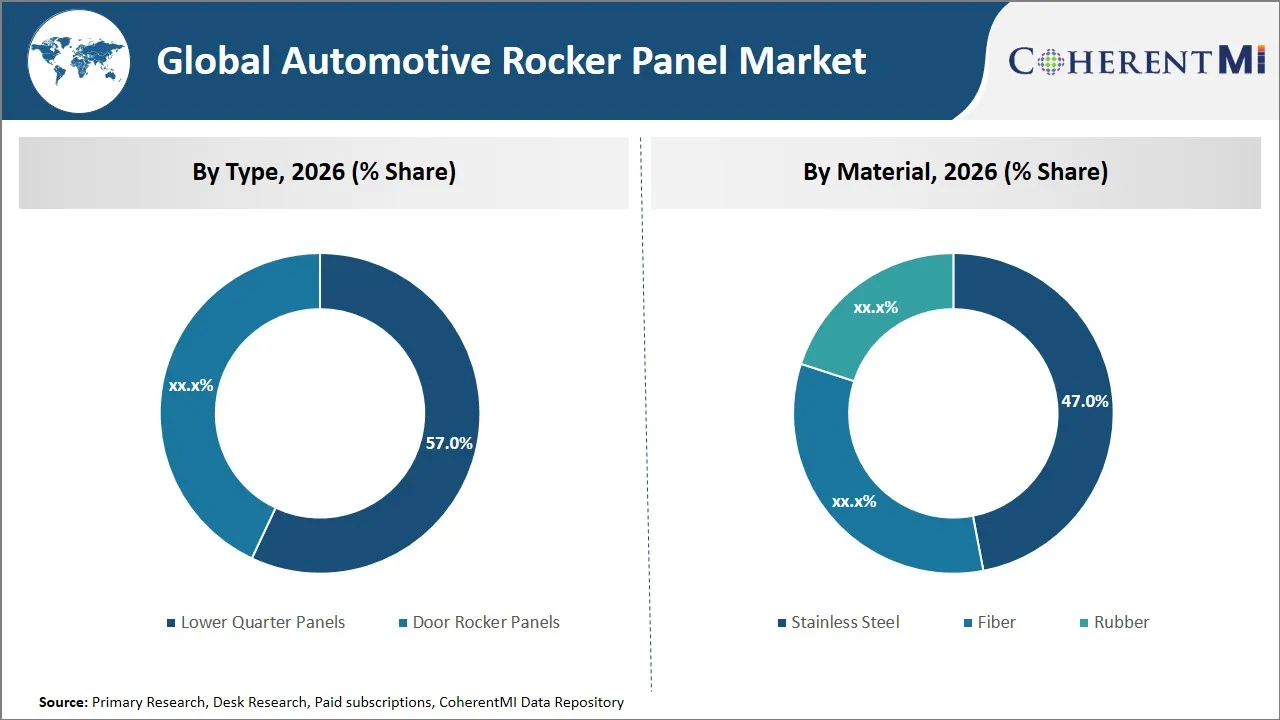
In terms of type, the lower quarter panels segment is expected to account for 57% of the market share in 2026. The growth is driven by widespread reach of low quarter panels and the structural stability lower quarter panels provide to vehicles. Protection of the undercarriage relies heavily on lower quarter panels, which stretch from the door frame toward the base line of the automobile, offering greater shield than rocker panels due to extended positioning across the side structure.
Fewer parts emerge when lower quarter sections form as one complete piece along the car’s flank. Production gains follow from such unified construction, since fewer elements enter the build process. Simplicity shapes output, influencing how quickly vehicles move through final stages. Reduced variation supports consistency across models rolling off the line.
Insights, By Material: Superior Corrosion Resistance and Structural Durability Establish Stainless Steel Material Leadership
In terms of material, stainless steel is expected to account for 47% of the market share in 2026. A major reason for the increase lies in how well it withstands corrosion, a trait critical when used in rocker panels. Stainless steel’s ability to resist rust and oxidation makes it an ideal material for rocker panels as they face constant contact with road salt and wetness. Exposure to dirt, alongside extreme weather, demands materials that endure without degrading over time. Suitability comes from stability under pressure, not just strength alone.
Despite common alternatives, stainless steel remains widely selected due to its resilience under pressure. When struck by flying stones or uneven terrain, rocker panels face relentless strain. What sets this metal apart is how it resists bending while enduring repeated shocks. Its capacity to flex without cracking supports long-term integrity in critical areas. Few materials match its performance when durability matters most.
Additional Insights of Automotive Rocker Panel Market
- Door rocker panels are expected to hold a dominant position after lower quarter panels owing to increasing demands from EV manufacturers.
- Fiber is expected to follow the stainless steel segment in terms of material, owing to the increasing use of fiber for cost purposes.
- North America is expected to lead the automotive rocker panel market with a 40% market share in 2026, driven by increasing expenditure on R&D.
- Asia Pacific is expected to witness the fastest growth in the global automotive rocker panel market due to the increasing sales of vehicles in the region.
Competitive overview of Automotive Rocker Panel Market
The major players operating in the global automotive rocker panel market include Willmore, QMI Sharp, B and I Trim Products, Am Auto Body Parts, Smittybilt, Auto Metal Direct, Innovative Creations Industries, Classic 2 Current Fabrication, Putco, Rugged Ridge, EGR Automotive, Westin Automotive Products, Omix-ADA, Gestamp, and Magna International.
Automotive Rocker Panel Market Leaders
- Willmore
- QMI Sharp
- B and I Trim Products
- Am Auto Body Parts
- Smittybilt
Recent Developments in Automotive Rocker Panel Market
- On January 17, 2025, Gestamp unveiled its innovative product lineup including the GES-GIGASTAMPING family. The GES-GIGASTAMPING family is a pioneering innovative product family of large-format components that combine multiple body parts into a single unit.
- On June 26, 2024, Shape Corp. announced the grand opening of its second Alabama facility in Tanner, a 202,306-square-foot plant focused on lightweight aluminum and steel structural components like rocker panels and EV battery trays, expanding their capacity and creating over 100 jobs for automotive innovation.
Automotive Rocker Panel Market Segmentation
- By Type
- Lower Quarter Panels
- Door Rocker Panels
- By Material
- Stainless Steel
- Fiber
- Rubber
- By Vehicle Type
- Light Duty Vehicles
- Medium Duty Vehicles
- Heavy Duty Vehicles

Would you like to explore the option of buying individual sections of this report?
Ramprasad Bhute is a Senior Research Consultant with over 6 years of experience in market research and business consulting. He manages consulting and market research projects centered on go-to-market strategy, opportunity analysis, competitive landscape, and market size estimation and forecasting. He also advises clients on identifying and targeting absolute opportunities to penetrate untapped markets.