Flexitank Market SIZE AND SHARE ANALYSIS - GROWTH TRENDS AND FORECASTS (2026 - 2033)
Flexitank Market is segmented By Layer Type (Single Layer, Multi-layer), By Application (Foodstuffs,...
Flexitank Market Size - Analysis
The global flexitank market is estimated to be valued at USD 1.42 Bn in 2026 and is expected to reach USD 6.51 Bn by 2033, exhibiting a compound annual growth rate (CAGR) of 24.3% from 2026 to 2033. This remarkable growth trajectory reflects the increasing adoption of flexible intermediate bulk containers across various industries, particularly in liquid transportation and storage applications. The substantial market expansion is driven by cost-effectiveness, operational efficiency, and growing demand from emerging economies seeking innovative bulk liquid handling solutions.
Market Size in USD Bn
CAGR24.3%
| Study Period | 2026 - 2033 |
| Base Year of Estimation | 2025 |
| CAGR | 24.3% |
| Market Concentration | Medium |
| Major Players | Qingdao BLT Packing Industrial Co., Ltd. (BLT), Nelson Global, Braid Logistics, Bulk Liquid Solutions, Büscherhoff Packaging Solutions GmbH and Among Others |

please let us know !
Flexitank Market Trends
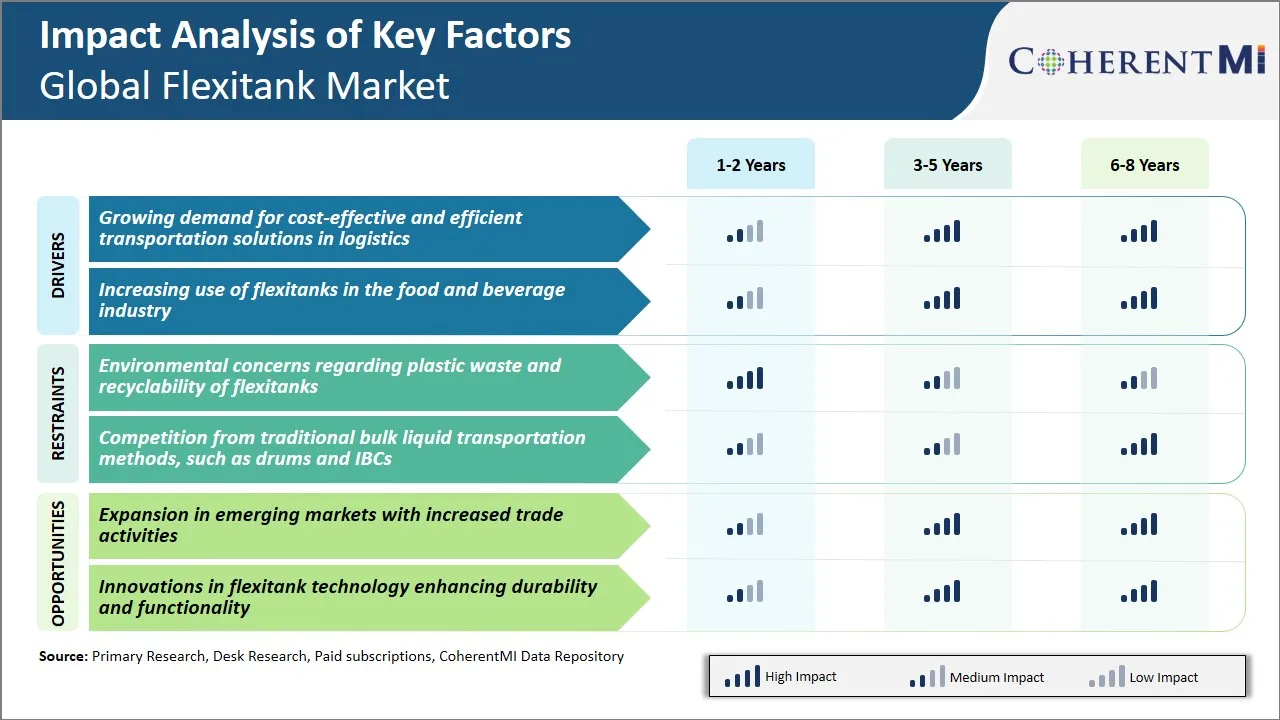
Market Driver - Growing Demand for Cost-Effective and Efficient Transportation Solutions in Logistics
The need for affordable and efficient transportation solution has been on the rise as the world logistics landscape is under such a degree of pressure to minimize the operational costs but retain the quality of service delivery. This is where the bridges of innovative transportation systems such as flexitanks are born. The conventional bulk liquid movement modes of transportation especially the use of ISO tank containers and drums have become costly in the recent past because of the increasing prices of fuel, port handling fees and the maintenance of special equipment. The solution to this picture is flexitanks, which provide an alternative to logistics providers and shippers, and responds to more than one cost center at a time.
The basic flexitank’s beauty is that it can increase the volume of cargo that is placed in the normal shipping containers and this would be equivalent to a 20 ft. container and it would be a steady liquid cargo container that can hold a maximum capacity of 24,000 liters of product. This capacity optimization has a direct relationship to lower unit costs of transportation since shippers can transport more in a single truck without the necessity of purchasing dedicated tank containers or the logistics requirement of processing drums.
Market Driver - Increasing Use of Flexitanks in the Food and Beverage Industry
Food and beverage industry is one of such dynamic and fastest growing areas of application flexitank technology as a result of changes in consumer preferences, globalization of food supply chains, and high-quality standards that flexitanks are ideally suited to meet. The use of flexitanks in this industry is based on flexitanks technology because it allows the products to retain its integrity and at the same time facilitating both the global distribution of liquid food products, oils, wines, and other beverage concentrates at cost-effective rates. The rising concerns on product traceability and contamination prevention in the industry has led to the flexitanks being quite a popular choice, since the single-use quality prevents cross-contamination that might be caused by the reusable tank containers, especially when carrying different product lines or even food versus non-food uses.
 To learn more about this report, Request Free Sample Copy
Market Challenge - Environmental Concerns Regarding Plastic Waste and Recyclability of Flexitanks
The environmental sustainability issues that are increasingly affecting flexitanks in the global market include the production of plastic waste and the lack of recycling alternatives. Flexitanks are made of polyethylene and polypropylene, which are the main components of the plastic waste crisis in the world, since they are usually used in single-use purposes. As the environmental regulations and corporate sustainability requirements continue to intensify, the end-users in all industries are becoming more stringent in their evaluation of their packaging decisions.
The Circular Economy Action Plan by the European Union and other initiatives being implemented across the world have heightened efforts to curb the use of single-use plastics and this may curtail the usage of flexitanks in the ecologically-aware markets. Also, the recycling systems of flexitank materials are not well established in the world and most of the used flexitanks are dumped in landfills or burned in pyre instead of being subjected to material recovery. The contamination factor makes this process of disposal more difficult because even flexitanks filled with either food-grade liquids, chemicals, or oils, are not easily cleanable to be recycled.
Market Opportunity - Expansion in Emerging Markets with Increased Trade Activities
The global flexitank market presents substantial growth opportunities through strategic expansion into emerging markets, driven by accelerating international trade activities and economic development in regions such as Asia-Pacific, Latin America, and Africa. Such countries as India, Vietnam, Brazil, and many African countries are rapidly industrializing and becoming more engaged in global supply chains, which leads to the fact that the demand in bulk liquid transportation solutions with high cost-effectiveness has increased. The current food and beverage sector growth in these markets especially in wine, fruit juice and edible oils sectors is a huge potential of flexitank adoption owing to their capacity to preserve the quality of products besides saving operation costs of up to 30% in comparison with conventional modes of packaging.
Import/Export & Trade Lane Volume Correlation
|
Region |
Import Volume (Tons) |
Export Volume (Tons) |
Trade Lane Volume (Tons) |
|
North America |
20,000 |
18,000 |
38,000 |
|
Europe |
25,000 |
22,000 |
47,000 |
|
Asia Pacific |
30,000 |
27,000 |
57,000 |
Key winning strategies adopted by key players of Flexitank Market
- Product Innovation: Flexitanks are looking at improving the design and life of flexitanks and providing products that have a better leak-proof and temperature-resistant feature. As an example, the launch of a new flexitank model with improved barrier technology to ensure the integrity of liquid products during long-distance transportation was introduced by Plysu.
- Market Growth: Major players are moving their presence to emerging markets. The example of Bag-in-Box has been highly successful in the Asia Pacific Region, because it has raised its production capacity in China to meet the rising demand of flexible bulk liquid transport solutions.
- Sustainability Focus: The environment is emerging as an issue with companies adopting sustainable production. Linertech has also come up with a series of flexitanks manufactured with recyclable materials and Braid Logistics has offered to use environmentally friendly packaging and minimize waste during flexitank production.
Segmental Analysis of Flexitank Market
 To learn more about this report, Request Free Sample Copy
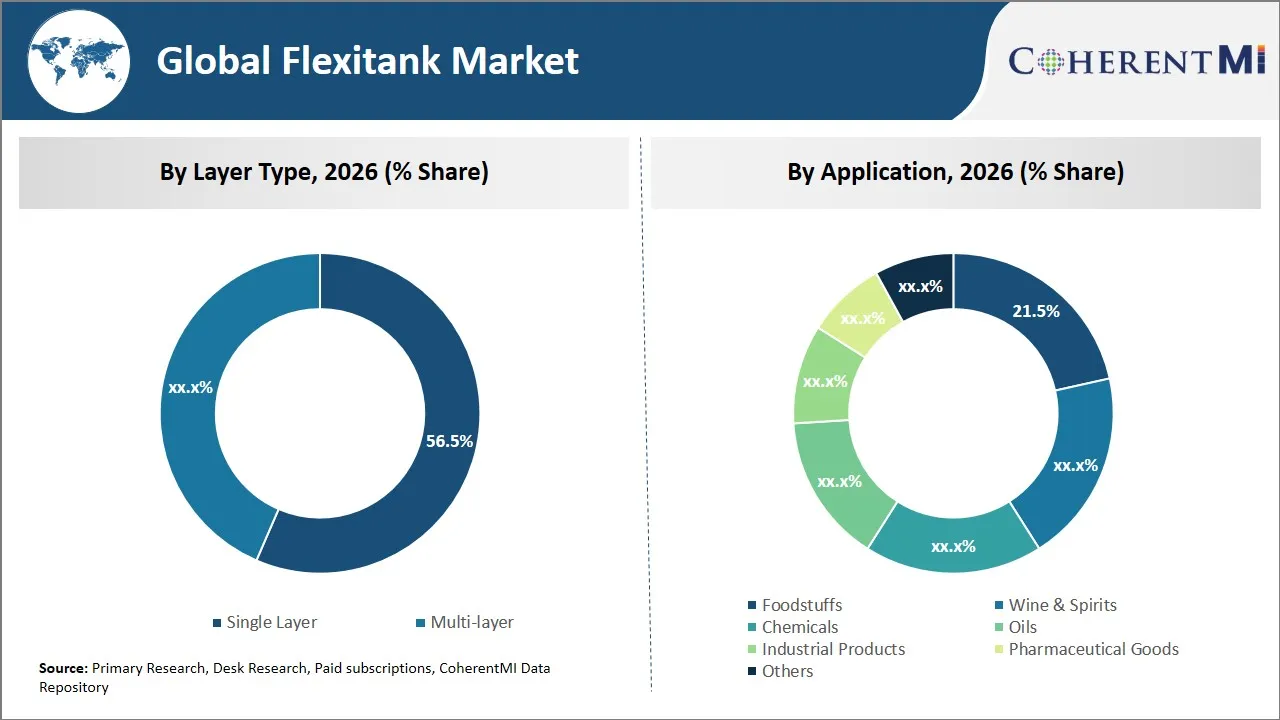
Insights, By Layer Type - Single Layer Segment Dominates the Market Due to Cost-Effectiveness and Manufacturing Simplicity
Single layer segment is expected to contribute 56.5% of the market share in 2026, due to the fact that it is more cost-effective and having a facilitated manufacturing process makes it the choice of price sensitive applications. The construction is single layer and hence it is easy to produce as it does not need so many raw materials and the manufacturing process is not as complicated as multi-layer construction. This cost saving is directly transferred to the final user and single layer flexitanks is especially appealing to bulk liquid transportation where cost is a primary consideration.
The ease with which single layer flexitanks can be manufactured allows the manufacturing of large quantities in shorter production cycles with limited complexity in quality control which makes them suitable to satisfy large scale demand. The simple nature of the production technology is less specialized and less technical in nature, which leads to a reduced overhead of the operation and a shorter time-to-market. This production efficiency is especially worthy in addressing the increased demand of flexible bulk liquid containers in the world in diverse industries.
Single layer flexitanks are good in situations where the basic containment is necessary, no extra protective layers are necessary, which are costly and have no proportional advantages. In the context of non-hazardous liquid and typical transportation conditions, the single layer construction is sufficient to offer sufficient protection and performance where the extra cost incurred due to the multi-layer technology is unnecessary. This is an effective solution that logistics companies and freight transporters would find favorable as an economical but efficient method of transporting bulk liquids on a regular basis.
Insights, By Application: Foodstuffs Segment Dominates the Market Due to Protection Requirements
Foodstuffs segment is expected to contribute 21.5% of the market share in 2026, due to the tough food safety laws and the essential requirement to avoid contamination, which demands specific bulk transportation solutions. The key issue that food industry contributes to sustaining the integrity of products through the supply chain is the motivation to use flexitanks, which offers the best safeguard against external pollution than the conventional bulk transportation systems.
The isolated environment offered by flexitanks removes the exposure of food to the ambient conditions that may affect the quality of food, and therefore the need to ensure their safety goes hand in hand with the growth of food trade and the rising demand of processed food products. Flexitanks can provide a perfect solution to the food manufacturers who are trying to streamline their chains of supply and lower the transportation expenses without compromising the quality of products since these containers can be fully utilized. Efficiency in food logistics is transformed by the fact that it is possible to transfer high volumes of liquid food stuffs that include fruit juices, edible oils, wine, and dairy products using the normal shipping containers.
Additional Insights of Flexitank Market
- The Asia Pacific region leads flexitank market operations because of its industrial growth and manufacturing expansion and the rising need for bulk liquid transport solutions. The chemical and food and beverage and oil and gas industries of China and India and Japan and South Korea create strong demand for liquid logistics services.
- The demand for flexitank technology in Asia Pacific has increased because businesses want to decrease their shipping expenses and enhance their supply chain operations. Flexitanks enable shippers to replace traditional drums and ISO tanks for non‑hazardous liquids which leads to major cost reductions and faster operational processes.
- The growing need for safe and compliant liquid transportation in Asia Pacific has led businesses to implement standardized flexitank systems which fulfill international safety and quality standards. Providers are aligning products with evolving standards (e.g., TIR, U.S. FDA/EC regulations) to support cross‑border trade and reduce the risk of contamination and spillage.
Competitive overview of Flexitank Market
The major players operating in the global flexitank market include Qingdao BLT Packing Industrial Co., Ltd. (BLT), Nelson Global, Braid Logistics, Bulk Liquid Solutions, Büscherhoff Packaging Solutions GmbH, Environmental Packaging Technologies Inc., Full-Pak Bulk Containers, K Tank Supply Ltd, Mak & Williams Flexitank Supply, MYFLEXITANK, KriCon Group, Qingdao LAF Technology Co., Ltd., SIA FLEXITANKS, and Shanghai Yunjet Plastic Packaging Co., Ltd.
Flexitank Market Leaders
- Qingdao BLT Packing Industrial Co., Ltd. (BLT)
- Nelson Global
- Braid Logistics
- Bulk Liquid Solutions
- Büscherhoff Packaging Solutions GmbH
Recent Developments in Flexitank Market
- In February 2025, The HOYER Group, a liquid bulk logistics specialist, acquired the Chilean company INTER-TANK and opened a new office in Colombia.
- In August 2021, CMA CGM Group opened its largest container depot in Indonesia. CMA CGM depots handle more than just container stuffing, cleaning, and repair, as well as pre-trip inspection, pre-cooling of containers and reefer monitoring services. They specialize in converting and outfitting standard containers into customized containers such as Garment on Hanger containers which keep garments in pristine conditions from the factory to shops. The depots also have expertise in installing Traxens devices on containers for end-to-end visibility by shippers and Flexitank in containers to transport liquids such as fish oil from Indonesia.
Flexitank Market Segmentation
- By Layer Type
- Single Layer
- Multi-layer
- By Application
- Foodstuffs
- Wine & Spirits
- Chemicals
- Oils
- Industrial Products
- Pharmaceutical Goods
- Others

Would you like to explore the option of buying individual sections of this report?
Ramprasad Bhute is a Senior Research Consultant with over 6 years of experience in market research and business consulting. He manages consulting and market research projects centered on go-to-market strategy, opportunity analysis, competitive landscape, and market size estimation and forecasting. He also advises clients on identifying and targeting absolute opportunities to penetrate untapped markets.