Gallbladder Treatment Market SIZE AND SHARE ANALYSIS - GROWTH TRENDS AND FORECASTS (2026 - 2033)
Gallbladder Treatment Market By Disease Type (Gallstones, Cholecystitis, Gallbladder Cancer, Biliary...
Gallbladder Treatment Market Size - Analysis
The global gallbladder treatment market is estimated to be valued at USD 3.98 Bn in 2026 and is expected to reach USD 5.53 Bn by 2033, exhibiting at a compound annual growth rate (CAGR) of 4.8% from 2026 to 2033. This moderate yet consistent growth trajectory reflects the increasing prevalence of gallbladder-related disorders globally, driven by factors such as sedentary lifestyles, dietary changes, and an aging population. The increased spending on healthcare, increased diagnostic capacity, and increased patient awareness of gallbladder conditions in the developed and emerging markets all over the world also contribute to the market growth.
The market of gallbladder treatment is undergoing massive technological improvement where the minimally invasive surgical procedure is becoming the mode of treatment especially laparoscopic cholecystectomy which is increasingly becoming popular as a mode of treatment as it is less invasive in nature and has lesser complication rates. The major trends are the introduction of robotic-assisted surgery systems, the evolution of the more sophisticated imaging technologies to enable improved diagnosis, and the shift of more attention to the outpatient procedures. Also, the market has been experiencing new demands of non-surgical treatment options, increasing healthcare infrastructure in the emerging economies, and increasing investments in research and development of new therapeutic solutions to gallstone dissolution and prevention.
Market Size in USD Bn
CAGR4.8%
| Study Period | 2026 - 2033 |
| Base Year of Estimation | 2025 |
| CAGR | 4.8% |
| Market Concentration | Medium |
| Major Players | Medtronic plc, Stryker Corporation, Johnson & Johnson, Boston Scientific Corporation, Cook Medical LLC and Among Others |

please let us know !
Gallbladder Treatment Market Trends
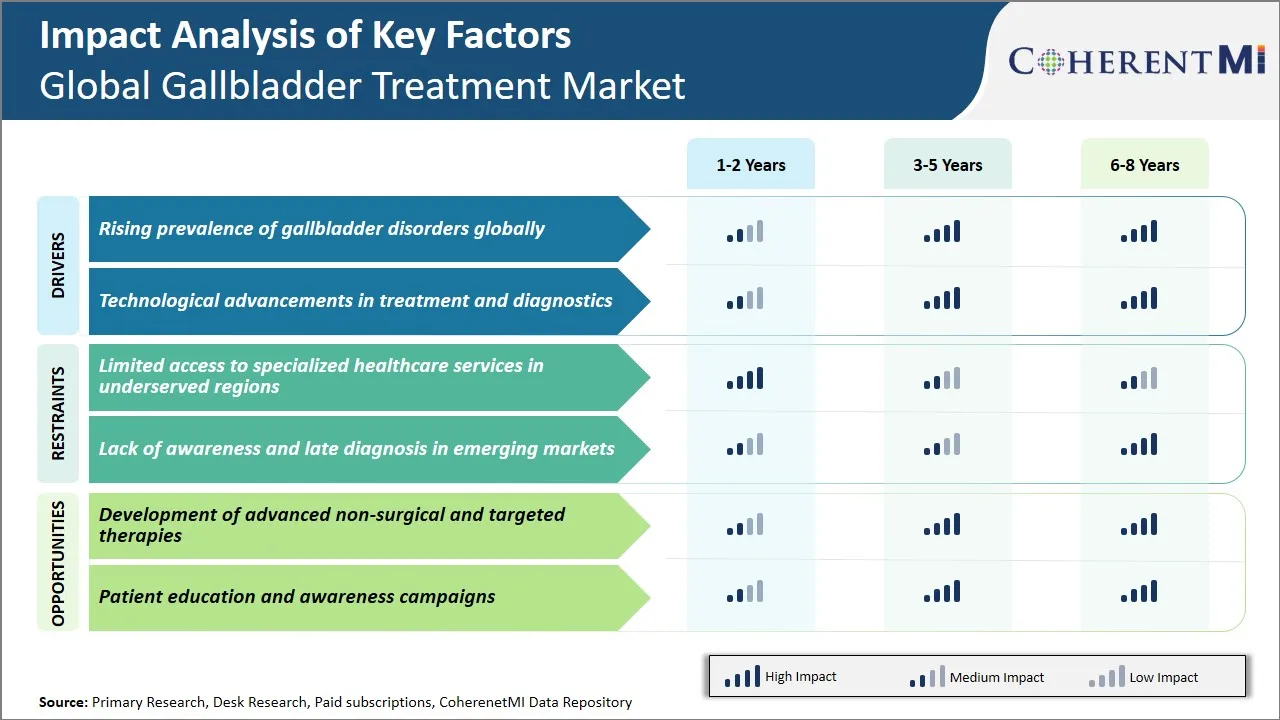
Market Driver - Rising Prevalence of Gallbladder Disorders Globally
The healthcare industry worldwide is experiencing a phenomenal increase in the number of gallbladder diseases which is essentially redefining the demand patterns of treatments and other medical procedures associated with it. This increasing trend is an urgent market force that keeps increasing the number of patients who can be addressed in various geographical areas and participative populations. The diseases of the gallbladder, a heterogeneous group of disorders, which include cholelithiasis, cholecystitis, polyps of the gallbladder, as well as biliary dyskinesia, are not only becoming widespread in both developed and emerging countries but are also causing a significant strain on the health system of any given country and, at the same time, stimulate the growth of the therapeutic market.
For instance, in the U.S., gallstones affect approximately 10–15% of the adult population, translating to over 25 million people, with more than 1 million new cases diagnosed annually. This directly drives high volumes of cholecystectomy procedures performed each year.
(Source- https://www.ncbi.nlm.nih.gov/books/NBK459370/)
Market Driver - Technological Advancements in Treatment and Diagnostics
The ever-changing medical technology is continuing to transform the gallbladder treatment scene where advanced diagnostic and treatment modalities that are minimally invasive in nature has continued to revolutionize patient outcomes and offer more opportunities in the market to new manufacturers of medical devices and pharmaceutical firms. These innovations in technologies can be seen as disruptive force into the market not only enhancing clinical performance but also improving patient acceptance and adoption rates among physicians, which in turn will lead to market growth due to increased access to treatment and decreased risks of the procedure.
 To learn more about this report, Request Free Sample Copy
Market Challenge - Limited Access to Specialized Healthcare Services in Underserved Regions
The challenges of limited access to specialized healthcare services in underserved and remote geographical areas is another major hindrance to the provision of treatment of the gallbladder in the global market. This problem is more acute in the developing economies and in the rural territories of the developed countries, where healthcare facilities are still insufficiently developed or are geographically inaccessible. Lack of qualified hepatobiliary surgeons, modern diagnostic systems and specialized treatment units pose great limitations to patients in need of gallbladder related procedures. The patients in most of the under-serviced areas have to cover hundreds of miles to reach the right care in most cases, which translates to delayed diagnosis and treatment, which can create a situation where the disease advances and causes more complications.
Market Opportunity - Development of Advanced Non-Surgical and Targeted Therapies
The advent of developed non-surgical and focused treatments is a revolution that the global gallbladder treatment market can take and will potentially revolutionize how patients are treated and be able to reach a broad market. Innovation of therapeutic modalities, such as targeted drug delivery solutions, minimally invasive interventional therapeutic approaches and customized medicine regimens, possess huge potential to overcome the modern treatment walls and enhance patient outcomes. Recent developments in the field of nanotechnology and the development of drugs have made it possible to develop gallstone dissolution therapies with greater effectiveness and fewer side effects, which are an alternative and viable alternative to a surgical intervention in certain groups of patients.
For instance, in July 2025, Jazz Pharmaceuticals’ Ziihera (zanidatamab), a HER2‑targeted therapy, received conditional marketing authorization from the European Commission for advanced HER2‑positive biliary tract cancer, marking a noteworthy advancement in precision oncology for this disease group.
Geographical Trends in Minimally Invasive vs Open Gallbladder Surgery Adoption
- High Adoption of Minimally Invasive Surgery in Developed Regions- In North America and Western Europe, more than 70-80 percent of gallbladder surgery uses laparoscopic and robotic-assisted cholecystectomy. Modern health facilities, skilled surgeons, and patient satisfaction amidst the need to have a quick recovery period are the leading factors that enhance the use of minimal techniques whereas the open surgery is excellent in complex cases or cases that are considered to be risky.
- Continued Use of Open Surgery in Emerging Regions- Open cholecystectomy is still more practiced especially in rural and resource constrained regions in Asia-Pacific, Africa and some parts of Latin America. Access to more advanced surgical equipment, less trained laparoscopic surgeon, and cost are some of the factors that slow the adoption of the minimally invasive approach, but urban centers are slowly growing laparoscopic and robotic-assisted surgery.
Key winning strategies adopted by key players of Gallbladder Treatment Market
- Expansion and Adoption of Minimally Invasive and Robotic-Assisted Surgical Solutions- The companies can develop a competitive advantage by investing in and marketing the laparoscopic and robotic-assisted cholecystectomy systems. The technologies decrease the time of the patient recovery, decrease post-operative complication, and increase the precision of the surgery. These solutions are more favored by hospitals and ambulatory surgical centers because of efficiency and patient demand, which provides a chance to the manufacturers of devices and healthcare facilities to stand out in the traditional marketplace.
- Investment in Targeted Therapies, Bile Acid Drugs, and Non-Surgical Innovations- With the emphasis on the advanced bile acid therapies, non-surgical interventions such as ERCP and ESWL, and on the use of precision-targeted therapies on gallbladder cancer, the companies can secure the patients who are not eligible to undergo the surgery and acquire the populations at the risk as well. Combining these services with patient education and awareness initiatives and incorporation of personalized medicine strategies enhances market penetration and leads to long-term revenue increase.
Segmental Analysis of Gallbladder Treatment Market
 To learn more about this report, Request Free Sample Copy
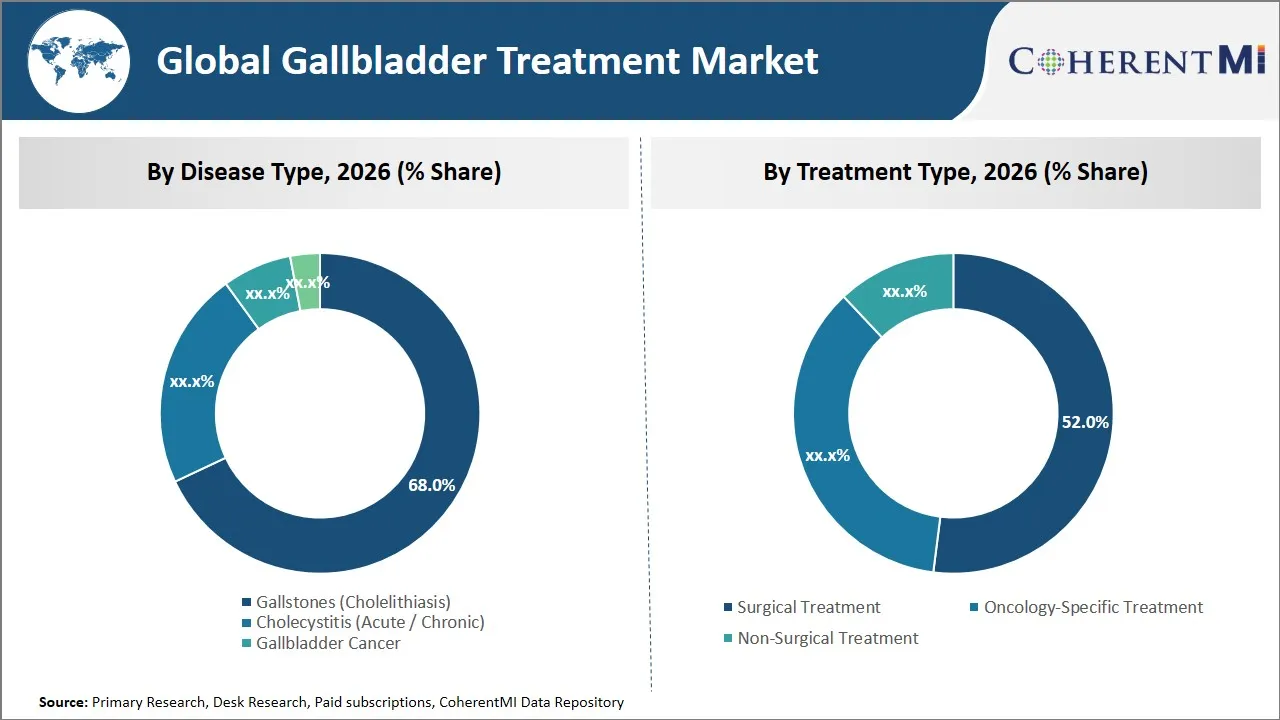
Insights, By Disease Type: Rising Prevalence and Lifestyle Factors Drive Gallstones (Cholelithiasis) Market Dominance
By source type, gallstones (cholelithiasis) is expected to contribute the highest share of 68% in 2026, owing to its widespread prevalence and the convergence of multiple risk factors in modern populations. The primary driver behind this segment's market leadership stems from the increasing incidence of gallstone formation, which affects approximately 10-20% of adults globally, making it one of the most common gastrointestinal disorders requiring medical intervention.
The trend of demographic changes towards old age in the global population is also a major contributor to the supremacy of the gallstones market segment. The physiological factors that increase the favorable conditions to the formation of the stones include age which is associated with decreased gallbladder motility and changes in the composition of the bile. With the current trend of an increase in the life expectancy of people worldwide, the number of patients in need of gallstone surgery is increasing accordingly, and hence the continued pressure on provision of therapeutic procedures.
For instance, a study published in the Lancet Gastroenterology & Hepatology (2024) highlighted that globally, the prevalence of gallstones has increased by nearly 20% over the last decade, with the fastest growth in urban populations adopting high-fat, processed diets and sedentary lifestyles.
(Sources- https://www.gutnliver.org/journal/view.html?pn=vol&uid=354&vmd=Full)
Insights, By Treatment Type: Surgical Treatment Efficacy and Technological Advancement Cement Treatment Leadership
By treatment type, surgical treatment takes the largest portion of the market with an estimated share of 52% in 2026, due to its definitive therapeutic outcomes and the evolution of minimally invasive surgical techniques. The fundamental driver behind surgical treatment's market dominance lies in its ability to provide permanent resolution of gallbladder disorders, particularly when conservative management fails or is contraindicated.
Laparoscopic cholecystectomy has revolutionized gallbladder surgery, transforming it from a major abdominal procedure to a minimally invasive intervention with significantly reduced morbidity. This technological advancement has lowered the barrier to surgical intervention, enabling treatment of patients who previously might have been considered poor surgical candidates.
Correlation of Cholecystectomy Volume with Gallstone Prevalence by Age, Gender, and Region
|
Region |
Gallstone Prevalence | Age Group Most Affected |
Gender Predominance |
Cholecystectomy Volume Trend |
| North America (U.S., Canada) |
10–15% adults |
40–60 years |
Female > Male |
~750,000 procedures/year, higher in women and middle-aged adults |
| Western Europe (Germany, Italy, France) |
8–12% adults |
45–65 years |
Female > Male |
500,000–600,000 procedures/year, laparoscopic dominant |
|
Asia Pacific (China, India, Japan) |
5–10% adults (urban) | 35–55 years |
Female > Male |
Rapidly increasing volume, particularly in urban hospitals |
| Latin America (Mexico, Chile, Brazil) |
15–30% adults |
40–60 years |
Female > Male |
High surgical volumes, ~200,000–250,000 procedures/year in high-prevalence areas |
|
Middle East & Africa |
5–12% adults |
35–55 years |
Female > Male |
Moderate volumes; open surgery still common in rural regions |
Additional Insights of Gallbladder Treatment Market
- Rising prevalence of gallbladder disorders globally due to obesity, high-fat diets, sedentary lifestyles, and metabolic disorders is a major driver of market expansion
- Technological advancements in robotic-assisted and laparoscopic surgery are improving precision, reducing complications, and shortening recovery, encouraging wider adoption in both hospitals and ambulatory surgical centers
- Non-surgical innovations such as endoscopic ultrasound-guided gallbladder drainage (EUS-GBD) and advanced bile acid formulations are opening new revenue streams for patient’s ineligible for surgery
- Oncology segment growth is accelerating with targeted therapies and immunotherapies for gallbladder cancer, representing a high-value niche within the overall market.
Competitive overview of Gallbladder Treatment Market
The major players operating in the global gallbladder treatment market include Medtronic plc, Stryker Corporation, Johnson & Johnson, Boston Scientific Corporation, Cook Medical LLC, Abbott Laboratories, Olympus Corporation, F. Hoffmann‑La Roche Ltd, Pfizer Inc., Merck & Co., B. Braun Melsungen AG, Intuitive Surgical, Baxter International Inc., GE Healthcare, and Siemens Healthineers.
Gallbladder Treatment Market Leaders
- Medtronic plc
- Stryker Corporation
- Johnson & Johnson
- Boston Scientific Corporation
- Cook Medical LLC
Recent Developments in Gallbladder Treatment Market
- In December 2025, the U.S FDA 510(k) clearance was granted to CMR Surgical’s Versius Plus robotic platform covering cholecystectomy (gallbladder removal procedures), positioning it for U.S. commercialization in 2026 with enhanced modular design and digital ecosystem to support real-time decision making in Ors.
- In December 2025, Intuitive Surgical’sda Vinci Single Port (SP) robotic system received U.S. FDA clearance for use in gallbladder removal (cholecystectomy), inguinal hernia repair, and appendectomy procedures, as announced in December 2025. This regulatory approval significantly broadens the SP platform's clinical applications, expanding its scope beyond previous urologic, thoracic, and transoral indications into common general surgical procedures.
- In October 2025, Boston Scientific has received the U.S. FDA 510(k) clearance and CE Mark approval for its Advanix Biliary Stent System, designed to improve the treatment of bile duct obstructions, including benign and malignant strictures. Featuring the NaviFlex RX Delivery System, this plastic stent offers enhanced navigation through tortuous anatomy, providing a less invasive option for biliary procedures.
Gallbladder Treatment Market Segmentation
- By Disease Type
- Gallstones (Cholelithiasis)
- Cholecystitis (Acute / Chronic)
- Gallbladder Cancer
- Biliary Dyskinesia
- By Treatment Type
- Surgical Treatment
- Open Cholecystectomy
- Laparoscopic Cholecystectomy
- Robotic-Assisted Cholecystectomy
- Oncology-Specific Treatment
- Chemotherapy
- Radiation Therapy
- Targeted Therapy
- Immunotherapy
- Non-Surgical Treatment
- Oral Dissolution Therapy (Ursodeoxycholic Acid)
- Extracorporeal Shock Wave Lithotripsy (ESWL)
- Endoscopic Retrograde Cholangiopancreatography (ERCP)
- Surgical Treatment
- By Drug Type
- Antibiotics
- Bile Acid Drugs
- Ursodeoxycholic Acid
- Chenodeoxycholic Acid
- Pain Management Drugs
- Anti-inflammatory Drugs
- Oncology Drugs
- By Surgical Device Type
- Laparoscopic Instruments
- Robotic Surgical Systems
- Energy Devices
- Suturing & Stapling Devices
- Retrieval Bags
- Endoscopes
- By End User
- Hospitals
- Ambulatory Surgical Centers (ASCs)
- Specialty Clinics
- Oncology Centers
- By Distribution Channel
- Hospital Pharmacies
- Retail Pharmacies
- Online Pharmacies
- By Age Group
- Pediatric
- Adult
- Geriatric

Would you like to explore the option of buying individual sections of this report?
Shivam Bhutani has 6 years of experience in market research and strategy consulting. He is a Market Research Consultant with strong analytical background. He is currently an MBA candidate specializing in Business Analytics from BITS Pilani.
He is adept at navigating diverse roles from sales and marketing to research and strategy consulting. He excels in market estimation, competitive intelligence, pricing strategy, and primary research. He is skilled at analysing large datasets to provide precise insights, helping clients in achieving strategic transformation across various industries. He is skilled in leveraging data visualization techniques to drive innovation and enhance business processes.