Placenta Market SIZE AND SHARE ANALYSIS - GROWTH TRENDS AND FORECASTS (2026 - 2033)
Placenta Market is segmented By Source (Human Placenta, Animal Placenta, By Product Type, Placenta E...
Placenta Market Size - Analysis
The global placenta market is estimated to be valued at USD 724.4 Mn in 2026 and is expected to reach USD 1,358.6 Mn by 2033, exhibiting a compound annual growth rate (CAGR) of 9.4% from 2026 to 2033. This robust growth trajectory reflects the increasing recognition of placental-derived products' therapeutic potential across multiple medical applications, including regenerative medicine, wound healing, and cosmetic procedures. The market expansion is primarily driven by rising healthcare expenditure, growing awareness about advanced treatment options, and increasing adoption of placenta-based therapies in developed and emerging economies worldwide.
The placenta market is drastically undergoing a change due to the technological change in processing techniques and the increasing application in stem cell therapy and tissue engineering. The main trends are a rise in regulatory approvals of products with placenta components, an increase in the number of research and development activities, and a rise in the demand of minimum invasive surgical procedures. Placental tissues are also becoming of great interest to pharmaceutical and biotechnology companies that are willing to use the placenta tissues to develop drugs and use them as therapeutic agents. Also, the use of placenta as the ingredient in anti-aging and skin rejuvenation products in the cosmetics industry is generating new revenue and market opportunities worldwide.
Market Size in USD Mn
CAGR9.4%
| Study Period | 2026 - 2033 |
| Base Year of Estimation | 2025 |
| CAGR | 9.4% |
| Market Concentration | Medium |
| Major Players | Japan Bio Products Co., Ltd., Melsmon Pharmaceutical Co., Ltd., Albert David Limited, ICHIMARU PHARCOS Co., Ltd., Snowden Co., Ltd. and Among Others |

please let us know !
Placenta Market Trends
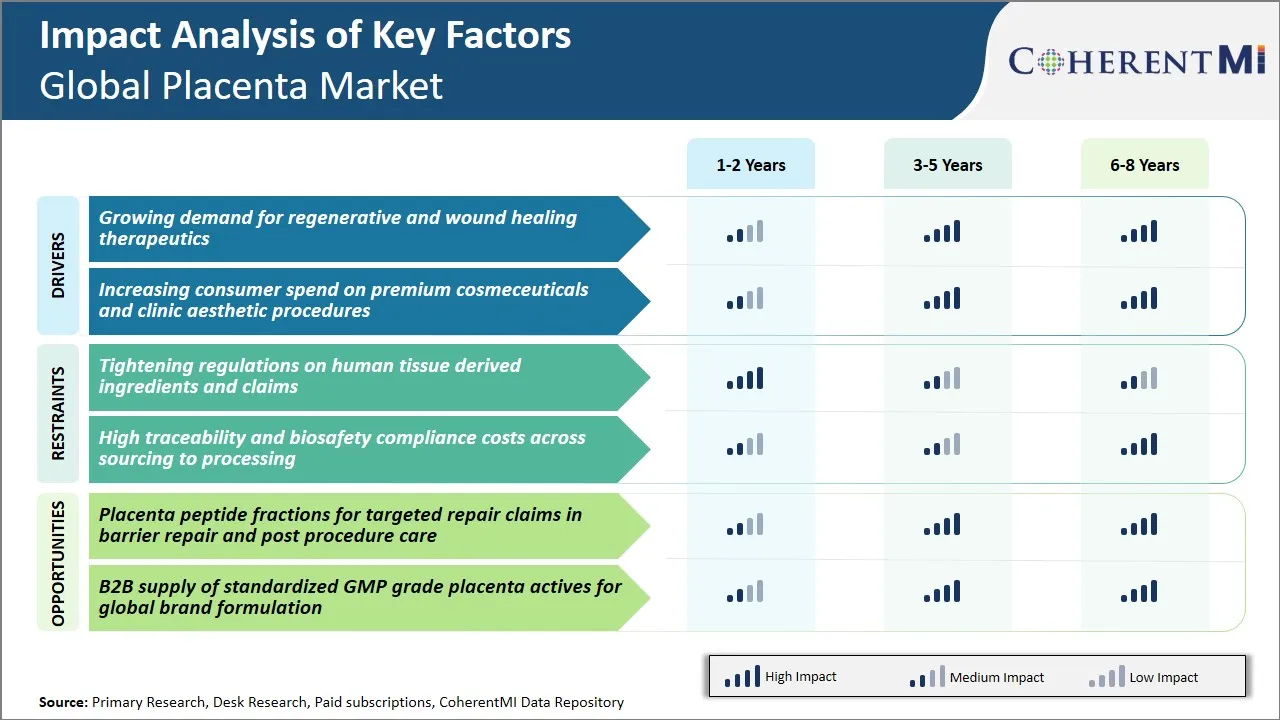
Market Driver - Growing Demand for Regenerative and Wound Healing Therapeutics
The global healthcare environment is undergoing a paradigmatic turn towards regenerative medicine, and placental-derived products are becoming a pillar of the change. The increasing need of regenerative and wound healing therapeutics can be viewed as one of the main drivers that are driving the placental market forward since medical professionals and patients are becoming more aware of the potential of therapeutic use inherent in the placental tissues and their derivatives.
The reason behind this process of increased demand is that the placenta has exceptional biological features that allow it to be highly concentrated with growth factors, cytokines, extracellular matrix proteins, and stem cells, all of which combine to provide an optimal microenvironment upon which tissue regeneration and wound healing mechanisms operate. The increasing knowledge of the biological functions of the placental tissues by the medical community has unveiled that these tissues have incredible anti-inflammatory, antimicrobial, and angiogenic potentials that have made them especially useful in healing complex wounds, burns, diabetic ulcer, and other complicated medical conditions that have been hitherto challenging to heal through the use of conventional therapeutic methods.
For instance, DHC Corporation and Rohto Pharmaceutical Co., Ltd. have expanded placenta-based supplements and dermaceutical lines across Asia, reflecting strong consumer demand for anti-aging and skin repair solutions.
(Source - https://www.theworldfolio.com/news/dhc-leads-japans-beautyhealth-revolution/5222)
Market Driver - Increasing Consumer Spend on Premium Cosmeceuticals and Clinic Aesthetic Procedures
The modern beauty and aesthetics market is experiencing an unprecedented influx of consumer dollar on high end cosmeceuticals and aesthetic treatments at clinics that is serving as a powerful driver of demand on placental-derived products and treatments that will radically transform the market landscape in a major way. This tendency indicates a significant change in the spirit of consumers towards skincare and aesthetic improvement as more people are ready to spend a lot of resources on quality products and procedures that are scientifically supported and have specific anti-aging and skin rejuvenating effects.
The advanced knowledge of skincare science by the modern consumer and the increased awareness about the efficacy and safety of the ingredients have given rise to a high-end market segment, the members of which actively pursue to seek the most innovative formulations of bioactive compounds based on placental tissues, including growth factors, peptides, amino acids, and the stem cell-derived compounds that have better anti-aging effects than the conventional cosmetic formulations.
 To learn more about this report, Request Free Sample Copy
Market Challenge - Tightening Regulations on Human Tissue Derived Ingredients and Claims
The placenta market around the world is exposed to some serious headwinds in the form of stricter regulatory frameworks with regard to human tissue-derived ingredients and related therapeutic claims. The regulatory authorities of the world such as the U.S. FDA, EMA and Health Canada have stepped up the investigation of placenta-based products, mainly those promoted as cosmetic and nutraceutical agents. The main issue revolves around safety measures, standardization of the extraction processes and health claims substantiation.
It has become the practice in many jurisdictions to provide a long clinical documentation and pre-market approval of the products which have human placenta components, significantly extending development time and cost. The absence of harmonized international standards further complicates the matter because the manufacturers have to deal with different regulatory environments in different markets.
Market Opportunity - Placenta Peptide Fractions for Targeted Repair Claims in Barrier Repair and Post-Procedure Care
The creation of specialized placenta peptide fractions is an interesting growth prospect in the targeted therapeutic segment, especially in applications of barrier repair and care after the procedure. The development of high-tech bioprocessing methods has made it possible to isolate and purify individual bioactive peptide sequences, which are found within placental tissue, and provide superior therapeutic specificity than crude placenta extracts. These peptide fractions have shown outstanding effectiveness in enhancing cellular regeneration, collagenation and inflammatory control- major processes involved in efficient barrier repair.
The market of post-procedure care, which is estimated at several billion dollars in the world, is especially promising to attract as consumers are willing to use recovery options backed by scientific evidence following aesthetic surgeries, surgical procedures, and dermatological treatment. The clinical evidence of the use of placenta peptides in increasing the speed of wound healing, lowering the level of inflammation, and the extent of scarring fits the needs of this market perfectly. Peptide fraction specificity also mitigates regulatory issues since it allows making more specific claims with substantiation than the general wellness claims that whole placenta products are known to make.
For instance, Pluri announced the completion of the first phase of a program to develop scalable placenta-derived, collagen-rich biomaterials for regenerative medicine and aesthetics, signalling growing biotech interest and commercial feasibility in placenta-derived products.
Segmental Analysis of Placenta Market
 To learn more about this report, Request Free Sample Copy
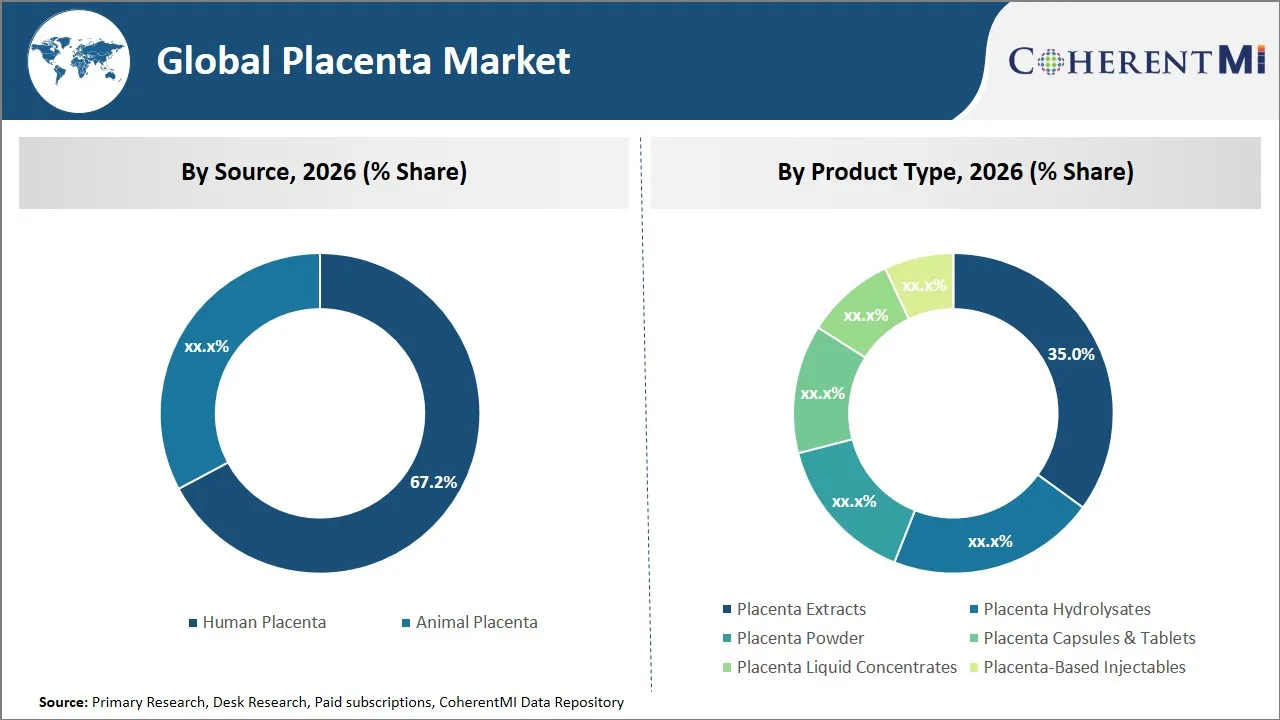
Insights, By Source: Superior Biological Compatibility and Therapeutic Efficacy Drive Human Placenta Market’s Dominance
By source, the human placenta segment is expected to hold the largest portion of the market with an estimated share of 67.2% in 2026, owing to its exceptional biological compatibility and superior therapeutic properties compared to animal-derived alternatives. The inherent benefit of human placenta is its molecular form and bioactive make up which resembles the natural physiological setting of human cells, rendering it much more efficient in diverse applications such as cosmetics to drug formulations.
Growth factors, cytokines and proteins found in human placental extracts are naturally compatible with the human skin and cell structure, and are unlikely to cause allergic reactions and adverse effects. Such compatibility advantage will be especially vital in high-end cosmetic formulation where safety of consumers and effectiveness are the most important. In contrast to animal placenta, which can provoke immune responses under the influence of differences of the species-specific proteins, human placenta provides the natural affinity promoting better absorption of product and therapeutic effects.
For instance, Japan Bio Products Co., Ltd. produces human placenta-based injectable products like Laennec that are commonly used in Japan and various Asian markets to treat liver dysfunction, fatigue relief, and regenerative treatments because human placenta-based therapeutic products are biologically compatible and have been shown to be effective.
(Source - https://jbpglobal.placenta.co.jp/medical_products/laennec/)
Insights, By Product Type: Versatility and Concentrated Bioactivity Establish Placenta Extracts as Market Leader
By product type, the placenta extracts segment takes the largest portion of the market with an estimated share of 35% in 2026, due to their exceptional versatility across multiple applications and superior concentration of bioactive compounds. Placenta extracts are the most advanced and strongest derivatives of the placental to provide manufacturers with the greatest product development flexibility and provide quality therapeutic advantages that are appealing to the varied households in the Cosmetics, Pharma and Nutraceutical industry.
The production flexibility of placenta extracts is the key driving force of growth because it allows the smooth adoption in the different packaging types and delivery channels of products. Extracts can be easily integrated into liquid preparations, creams, serums and injectable preparations without involving other processing steps as is the case with solid substances like powders or capsules.
For instance, Melsmon Pharmaceutical Co., Ltd. manufactures placenta extract-based preparations that are commonly used as aesthetic treatments and wellness therapies designed to rejuvenate the skin and provide anti-aging therapy to consumers that illustrates how concentrated placenta extracts can be utilized in diverse applications in the cosmetic and therapeutic industries.
(Source - https://westcoastpartners.com/products/melsmon-placenta)
Regulatory Tightening Reshaping Human Placenta Sourcing and Processing Practices
- In many countries, enforcement of health, safety, and ethical standards that control the collection, consent, handling, and processing of human placenta as an ingredient in cosmetic and therapeutic products is becoming stricter, adding to compliance costs and restricting the availability of unregulated sources to manufacturers.
- Consequently, firms are moving to certified sources of animal placenta, and other bioactive compounds in place of these to ensure continuity in supply and regulatory compliance, both shaping product reformulation solutions and transforming sourcing behavior through the placenta market.
Stricter Regulations Transforming Human Placenta Sourcing and Market Dynamics
- The governments and health regulators are enhancing regulations on collection, consent, storage, and processing of human placenta to ensure ethical sourcing and biosafety standards to be met in the use of the provenance in cosmetic and medical products. This has heightened compliance standards and minimized the accessibility of raw materials sources which are unregulated by the manufacturers.
- The companies are responding by increasing the use of certified animal placenta materials or coming up with alternative bioactive materials to ensure that there is regulatory compliance and stability in supply. This change is slowly affecting product development and source policies in the global placenta market.
Additional Insights of Placenta Market
- Regulatory bodies in several key markets updated guidelines for ethical sourcing and processing of human tissue materials, prompting manufacturers to strengthen compliance and adopt certified animal placenta alternatives.
- Leading skincare and cosmeceutical brands expanded placenta extract product lines, particularly targeting anti-aging and regenerative segments in Asia Pacific and Middle East markets.
- Biotech firms advanced research into placenta-derived peptides and growth factor fractions, filing new patents and partnering with wellness clinics to develop high-performance bioactive formulations.
- E-commerce and direct-to-consumer distribution channels reported increased sales of placenta-based nutraceuticals and functional beauty supplements, reflecting rising global consumer acceptance and digital market expansion.
Competitive overview of Placenta Market
The major players operating in the global placenta market include Japan Bio Products Co., Ltd., Melsmon Pharmaceutical Co., Ltd., Albert David Limited, ICHIMARU PHARCOS Co., Ltd., Snowden Co., Ltd., BIOFAC A/S, Horus Co., Ltd., North Life Co., Ltd., Japan Natural Laboratories Co., Ltd., CHARITES LAB Co., Ltd., Morechem, Korea Genetic Pharm Co., Ltd., SUNMARINE BIOTECH, Yamakawa & Company, Ltd., and Shin Nippon Yakugyo Co.,Ltd.
Placenta Market Leaders
- Japan Bio Products Co., Ltd.
- Melsmon Pharmaceutical Co., Ltd.
- Albert David Limited
- ICHIMARU PHARCOS Co., Ltd.
- Snowden Co., Ltd.
Recent Developments in Placenta Market
- On January 22, 2026, Pluri, Inc. completed the first phase of its collaboration with Resbiomed to develop scalable placenta-derived collagen-rich biomaterials, moving toward manufacturing readiness for regenerative medicine and other applications, signaling investment in new product capabilities.
- In June 2025, Holistic Way introduced placenta-infused collagen drink shots and premium supplement formulations Bio-Elixir Rose Placenta aimed at enhancing skin hydration, elasticity, and anti-aging benefits while also supporting overall vitality and wellness, targeting consumers seeking convenient ingestible beauty and functional nutrition solutions within the growing inner-beauty and wellness supplement market.
- In November 2025, Snowden Co., Ltd. expanded its placenta extract skincare range in late 2025, unveiling new serums and ampoules enriched with high-potency animal placenta bioactives formulated to improve skin regeneration and firmness, responding to rising demand for advanced anti-aging cosmetics in Asia Pacific and premium global markets.
Placenta Market Segmentation
- By Source
- Human Placenta
- Animal Placenta
- By Product Type
- Placenta Extracts
- Placenta Hydrolysates
- Placenta Powder
- Placenta Capsules & Tablets
- Placenta Liquid Concentrates
- Placenta-Based Injectables
- By Application
- Cosmetics & Personal Care
- Pharmaceuticals & Therapeutics
- Nutraceuticals & Dietary Supplements
- Veterinary Applications
- By Form
- Liquid
- Powder
- Gel
- Capsule/Tablets
- Injectable Formulations
- By Distribution Channel
- Online
- Offline
- By End User
- Cosmetic Manufacturers
- Pharmaceutical Companies
- Nutraceutical Companies
- Hospitals & Clinics
- Research & Biotechnology Institutions

Would you like to explore the option of buying individual sections of this report?
Sakshi Suryawanshi is a Research Consultant with 6 years of extensive experience in market research and consulting. She is proficient in market estimation, competitive analysis, and patent analysis. Sakshi excels in identifying market trends and evaluating competitive landscapes to provide actionable insights that drive strategic decision-making. Her expertise helps businesses navigate complex market dynamics and achieve their objectives effectively.