Stucco Market SIZE AND SHARE ANALYSIS - GROWTH TRENDS AND FORECASTS (2026 - 2033)
Stucco Market is segmented By Material (Cement-Based Stucco, Acrylic Stucco, Lime-Based Stucco, Othe...
Stucco Market Size - Analysis
The global stucco market is estimated to be valued at USD 15 Bn in 2026 and is expected to reach USD 22.30 Bn by 2033, exhibiting a compound annual growth rate (CAGR) of 4.8% from 2026 to 2033. This consistent upward trend shows a stronger need for stucco in homes and buildings around the world. As cities are expanding, more projects are being built; as a result, long-lasting outer coatings that look good are gaining favor. With nations at different economic levels investing in modern structures, demand rises steadily over time. Development efforts push material choices forward - durability paired with visual quality stands out clearly. Urban change shapes construction decisions slowly but surely.
Market Size in USD Bn
CAGR4.8%
| Study Period | 2026 - 2033 |
| Base Year of Estimation | 2025 |
| CAGR | 4.8% |
| Market Concentration | Medium |
| Major Players | The Quikrete Companies Inc, Sika AG, BASF SE, DuPont DE Nemours, Omega Products International and Among Others |

please let us know !
Stucco Market Trends
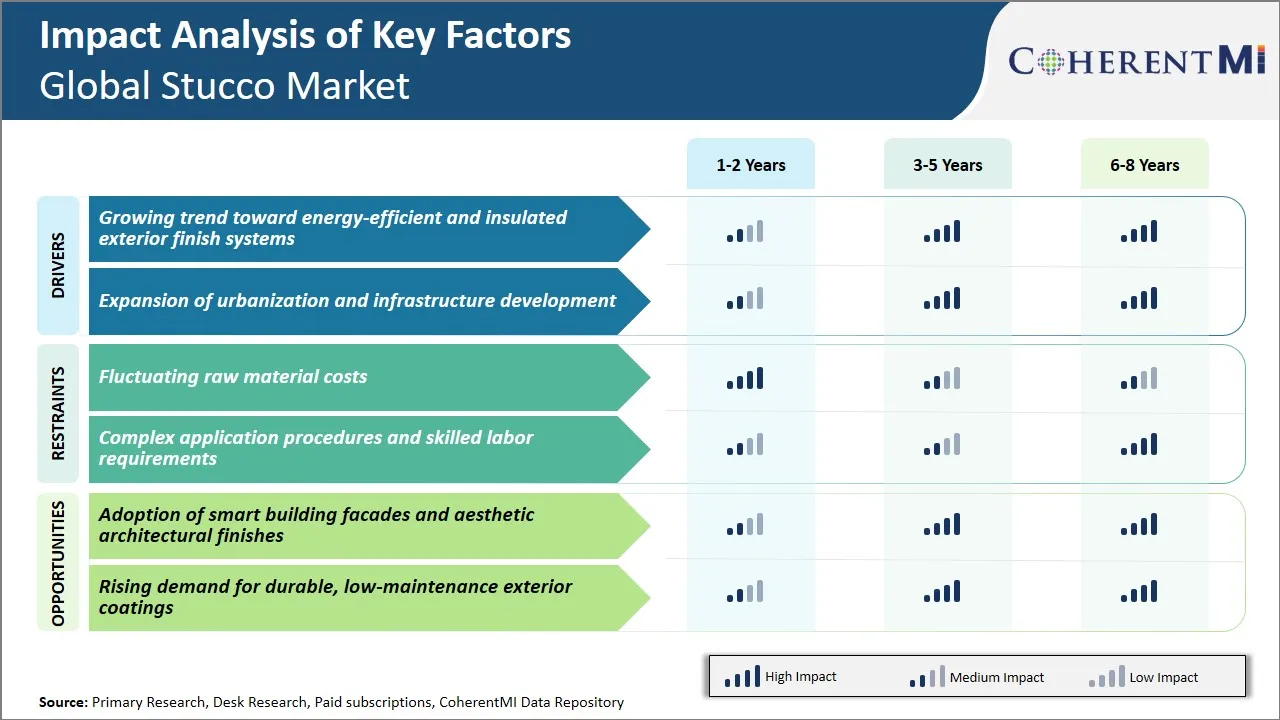
Market Driver - Growing Trend Toward Energy‑Efficient and Insulated Exterior Finish Systems
An evolution marks how buildings now come together, where saving energy shapes much of today's architecture. Owing to this, stucco finds new purpose, not by trend but through necessity. Its role grows not from preference but from shifting expectations in performance and impact. What once served only surfaces now contributes to broader outcomes. Change does not announce itself loudly; it appears in material choices. Stucco adapts because structures must do more than stand - they must respond.
As standards tighten worldwide, fresh demands define how structures manage warmth. Since requirements evolve, architects pay greater attention to exterior walls, emphasizing insulation strength along with appearance and resilience when pressured. With higher targets set, selections lean into substances offering steady performance without sacrificing shape or purpose over time.
For instance, on June 10, 2025, the EIFS Industry Members Association (EIMA) announced the addition of five new Associate Members in 2025. The new members, BASF, National Gypsum, Quikspray, Inc., Rokamat, and Specified Technologies Inc bring a wealth of innovation, experience, and commitment to advancing the exterior insulation and finish systems (EIFS) industry.
Market Driver - Expansion of Urbanization and Infrastructure Development
World cities expand faster than ever, altering how buildings go up while opening room for more stucco use. With movement from countryside to city showing no slowdown, demand climbs, not because of trends, but due to basic shifts in where people choose to live. Economic paths, daily comforts, plus updated infrastructure pull individuals toward dense zones. These areas need walls, exteriors, surfaces, materials shaped by practical needs rather than style alone.
City growth moves fast in lower-income nations, where upward building joins outward sprawl due to rising numbers of residents and shifting work patterns. In these areas, homes must be built at scale - simple dwellings alongside high-end towers - leading to differing needs in outer wall materials across separate property types.
For instance, on February 6, 2026, a consortium including Acciona and ACS won a USD 4 billion contract for a major railway line project in Queensland, Australia, connecting Logan and the Gold Coast to support projected travel demand ahead of the 2032 Brisbane Olympics.
(Source: reuters.com)
 To learn more about this report, Request Free Sample Copy
Market Challenge - Fluctuating Raw Material Costs
Unexpected shifts in raw material costs challenge the worldwide stucco sector, squeezing profits while complicating logistics forecasts. Cement, sand, lime, along with manufactured binders, core components of stucco - show sharp value swings since 2021. Energy market instability plays a role so do strained international shipping lanes due to political unrest. Lingering interruptions from recent health crises add further strain on availability patterns.
Under increased strain, companies find it hard to pass higher costs to customers in construction fields where budgets are fixed well ahead of project start. Although material acquisition flows smoothly in a given area, logistical hurdles disrupt timelines elsewhere - largely due to availability of raw materials and transport pathways. Where international deliveries dominate supply chains or geography blocks movement, limitations grow more severe, with few viable options nearby.
Market Opportunity - Adoption of Smart Building Facades and Aesthetic Architectural Finishes
A focus on design fuels demand for high-end stucco in commercial projects. Architects pair stucco with hidden sensors due to which lighting adjusts based on surroundings. Climate-sensitive layers add function beyond weather resistance. These updated exteriors preserve classic benefits while adopting new tech quietly. Growth follows where form meets subtle innovation.
With newer stucco technologies, light-triggered reactions help clear airborne pollutants, reduce surface dirt buildup, while improving heat management, features fitting modern eco-certified structures. Customization gains ground across building sectors; here, stucco stands out due to broad options in finish appearance unmatched by many exterior materials.
For instance, on July 23, 2025, NEXT Energy Technologies, Inc. announced that it has accomplished another significant milestone toward commercialization of NEXT’s BIPV solution, with the first installation of a commercial facade Powered by NEXT transparent OPV coatings.
(Source: nextenergytech.com)
Global Stucco Market - Green & Low-VOC Stucco Adoption by Region
|
Region |
Green / Low-VOC Adoption Drivers |
|
North America |
|
|
Europe |
|
|
Asia Pacific |
|
|
Middle East & Africa |
|
|
Latin America |
|
Key winning strategies adopted by key players of Stucco Market
- Product Innovation and Technology Enhancement: Dryvit Systems Inc. launched the Outsulation Plus MD system with enhanced moisture management, invested USD 15 million in R&D facilities and incorporated advanced polymer technology. Dryvit Systems Inc. achieved 18% increase in market share in the EIFS segment, generated USD 45 million additional revenue and reduced customer complaints related to moisture issues by 65%.
- Strategic Acquisitions and Market Consolidation: Sika AG acquired Parex Group for USD 2.5 billion to strengthen position in mortars and stucco. Sika integrated Parex's distribution network and product portfolio. The results were increased global market share from 8.5% to 14.2%, expanded presence in 23 new countries and achievement of synergies worth USD 120 million annually.
Segmental Analysis of Stucco Market
 To learn more about this report, Request Free Sample Copy
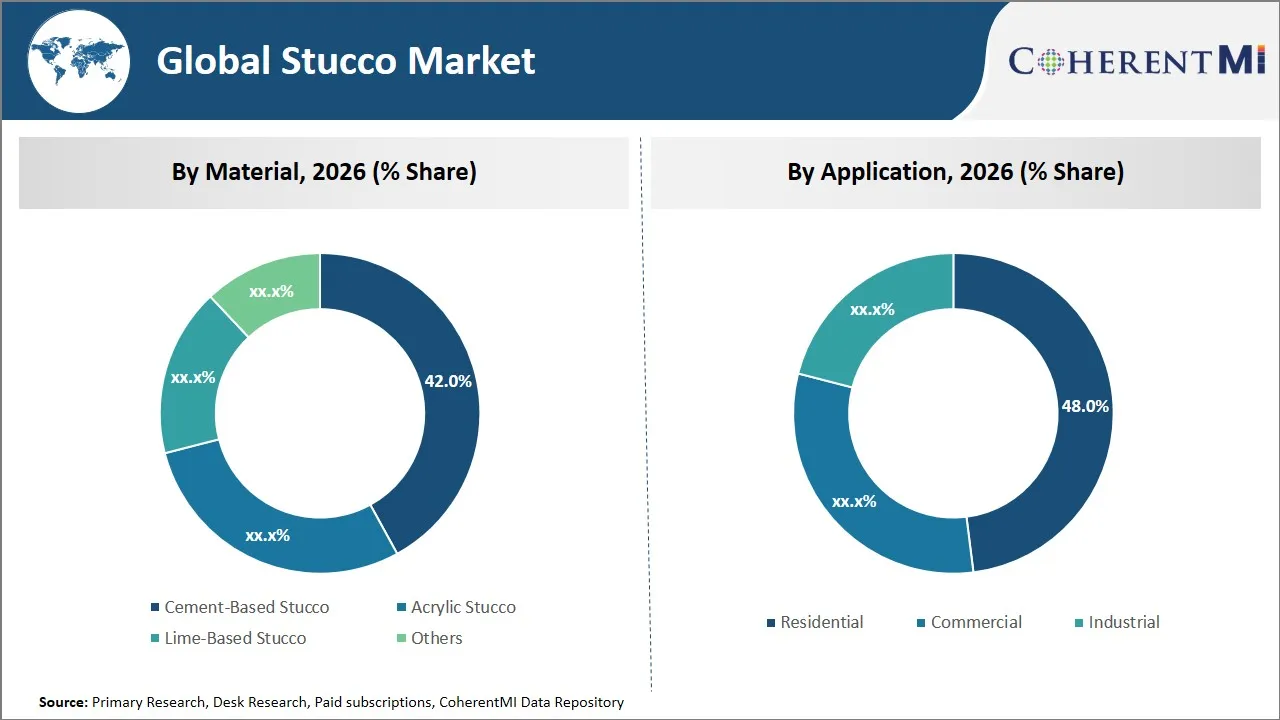
Insights, By Material: Cement-Based Stucco Dominates Material Segment Owing to Superior Performance and Cost-Effectiveness
In terms of material, the cement-based stucco segment is expected to account for 42% of the market share in 2026. Despite varying conditions, performance remains consistent because of long-lasting qualities, ease of access, yet favorable pricing across many building uses. Cement-based stucco holds a leading position due to core traits fitting closely with what builders need and users anticipate during projects.
Beginning with strength, cement-based stucco holds top position due to lasting performance under stress. Because of tight bonding behavior, it adheres firmly to surfaces like concrete, brickwork, or wire frames without exception. Owing to broad compatibility, special methods or extra glues become unnecessary during installation. For builders focused on predictable results, such consistency proves valuable over time.
For instance, on January 20, 2026, U‑STUCCO showcased its integrated cement‑based system that combines fireproofing, thermal insulation, and water resistance in a single engineered stucco solution at industry events like World of Concrete 2026.
(Source: ustucco.com)
Insights, By Application: Residential Sector Leads Application Segment Driven by Housing Growth and Aesthetic Preferences
In terms of application, the residential segment is expected to account for 48% of the market share in 2026. Expansion stems from rising homebuilding volume, alongside shifting buyer tastes toward rough-surface outer walls. Texture gains favor because it offers visual interest while serving practical roles in current house design patterns.
New housing projects drive most of the rising need for stucco among homes. As it shapes unique looks - Mediterranean, Spanish Colonial, even modern builders choose it more often on single houses and apartment complexes alike. Appearance options explain part of its growing role outdoors.
Additional Insights of Stucco Market
- In the EU, stringent energy efficiency codes encourage the use of Exterior Insulation and Finish Systems (EIFS), often stucco-based, to meet thermal insulation targets.
- In North America, energy regulations and fire safety codes elevate the use of stucco for its insulation and fire-resistance credentials.
- Green building certifications and model codes, such as LEED, BREEAM, International Green Construction Code (IgCC), and local green standards like California’s CALGreen, influence material selection by promoting low-VOC, sustainable exterior finishes.
- Environmental regulations in many regions limit VOC emissions from construction products (paints, coatings, sealants), prompting stucco manufacturers to innovate low-VOC and eco-friendly formulations.
- Trade measures such as import tariffs on raw materials (cement additives, polymer modifiers, etc.) impact stucco production costs and the competitiveness of imported stucco systems.
Competitive overview of Stucco Market
The major players operating in the global stucco market include The Quikrete Companies Inc, Sika AG, BASF SE, DuPont DE Nemours, Omega Products International, Sto SE, California Stucco Products Corp, Western Blended Products, DRyvit, Parex Inc, Merlex Stucco, LaHabra Stucco, Arcat Inc, Cemex S.A.B and Fosroc International Ltd.
Stucco Market Leaders
- The Quikrete Companies Inc
- Sika AG
- BASF SE
- DuPont DE Nemours
- Omega Products International
Recent Developments in Stucco Market
- On November 17, 2025, Sika announced a new collaboration with Quikrete companies. This collaboration combines the expansive reach of Quikrete’s Stucco Base products with the proven, code-compliant performance of Sika’s Senergy, Parex, and LaHabra Stucco Systems.
- On July 16, 2025, AB Stucco officially announced its expansion into the Calgary region. With over a decade of experience delivering quality craftsmanship in stucco and exterior solutions, the company is now offering a full suite of services tailored to both residential and commercial properties throughout Calgary.
- On September 16, 2024, Outdoor Living Supply, a distribution platform with a focus on outdoor living products and solutions, announced that it has acquired Majestic Stone Landscape & Stucco Supply, a full-service distributor of manufactured and natural stone, hardscape and landscape products.
- On August 2, 2024, Sika announced that it had completed the acquisition of Vinaldom. The acquisition strengthens Sika’s position in the fast-growing Dominican market and offers significant cross-selling opportunities throughout the Caribbean region.
- On May 1, 2024, RWC Building Products announced the acquisition of New Mexico Plaster and Supply, a leading supplier of plaster and concrete materials based in Albuquerque, New Mexico. This acquisition, effective May 1, 2024, marks another strategic expansion for RWC Building Products, following the successful acquisition of Henry Products Inc.
Stucco Market Segmentation
- By Material
- Cement-Based Stucco
- Acrylic Stucco
- Lime-Based Stucco
- Others
- By Application
- Residential
- Commercial
- Industrial

Would you like to explore the option of buying individual sections of this report?
Gautam Mahajan is a Research Consultant with 5+ years of experience in market research and consulting. He excels in analyzing market engineering, market trends, competitive landscapes, and technological developments. He specializes in both primary and secondary research, as well as strategic consulting across diverse sectors.