Electric Fireplace Market SIZE AND SHARE ANALYSIS - GROWTH TRENDS AND FORECASTS (2026 - 2033)
Electric Fireplace Market is segmented By Type (Wall Mounted, Insert, Free Standing), By Category (O...
Electric Fireplace Market Size - Analysis
The global electric fireplace market is estimated to be valued at USD 6.55 Bn in 2026 and is expected to reach USD 13 Bn by 2033, exhibiting a compound annual growth rate (CAGR) of 6.8% from 2026 to 2033. This steady rise comes from more people choosing efficient heating options along with a shift toward homes that use connected technology. Expansion happens because cities grow, concern for nature increases, while electric models offer simpler operation than those burning wood. Despite differences in approach, both factors shape how the trend moves forward.
Market Size in USD Bn
CAGR6.8%
| Study Period | 2026 - 2033 |
| Base Year of Estimation | 2025 |
| CAGR | 6.8% |
| Market Concentration | Medium |
| Major Players | Glen Dimplex Group, Twin‑Star Home, Napoleon Fireplaces, Hearth and Home Technologies, Empire Comfort Systems and Among Others |

please let us know !
Electric Fireplace Market Trends
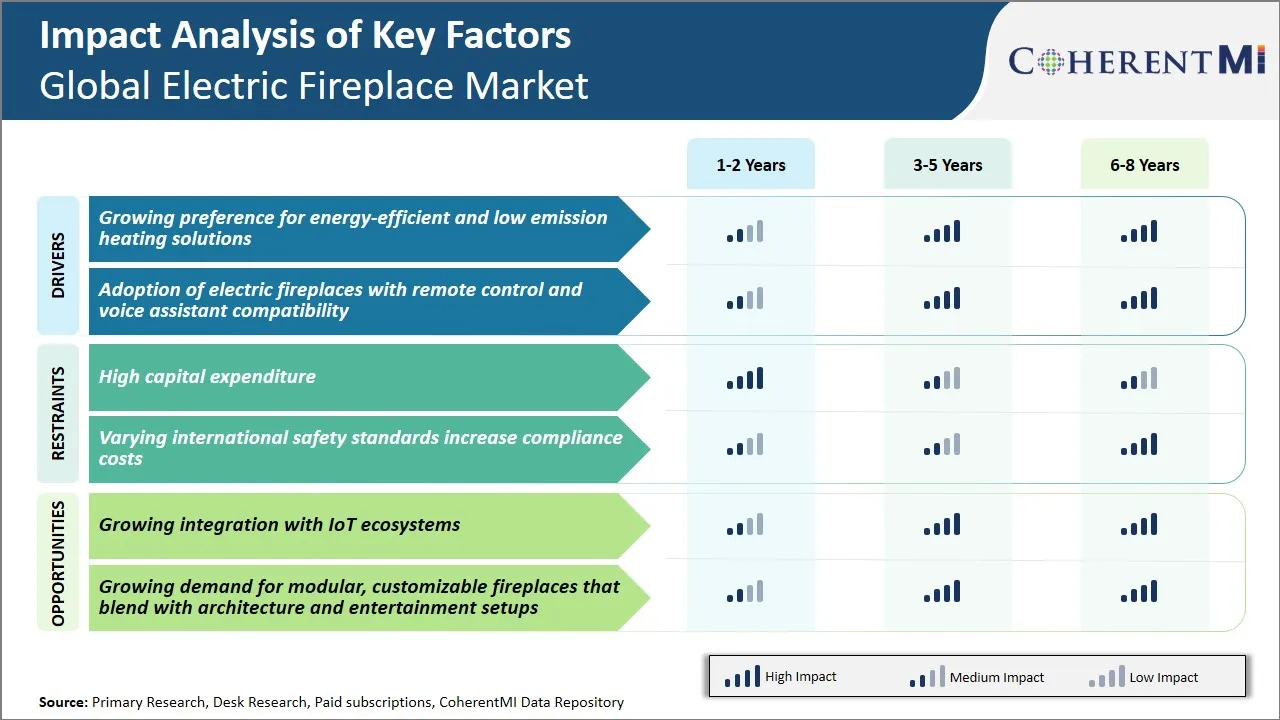
Market Driver - Growing Preference for Energy‑Efficient and Low Emission Heating Solutions
Electric fireplaces now draw interest as households rethink how they heat spaces. Because of rising concern over emissions, many look beyond oil, gas, or timber-based methods. Shifts in behavior stem not only from policy but also personal accountability toward planetary conditions. Fewer individuals now adopt old systems without examining outcomes. Information flows through alternative channels help shape decisions over time. As effectiveness holds importance, ease of use plays an equal role, guiding products to settle unobtrusively within homes. Today's selections go beyond function, each reveals a purpose behind the choice. Awareness grows not through slogans, but daily decisions made differently.
With rising utility expenses worldwide, attention has turned to how homes use power - electric fireplaces fit within this shift due to effective performance. While older fireplace designs release much warmth through exhaust paths, these units retain almost all generated heat. Because nearly every bit of electricity becomes usable output, less energy slips away unused. Savings appear clearly on monthly bills, placing such devices among practical choices for main or added room warming. Their role grows where economy meets steady indoor comfort.
Market Driver - Adoption of Electric Fireplaces with Remote Control and Voice Assistant Compatibility
Smart home progress moves fast, shifting how people view household devices - now electric fireplaces often include advanced links to digital networks, fitting today’s living patterns. Not long ago, operating appliances from a distance felt like excess; now it is simply what most assume will work without effort, adjusting heat levels, light brightness, timing sequences remotely across rooms. Ease matters more lately among working adults and parents managing tight routines, where warming up a room ahead of arrival, or changing modes while staying seated, makes daily flow smoother.
Voice-controlled operation defines current electric fireplace functionality, aligning with automated living environments. With support for systems like Alexa, Google Assistant, or Siri, manual input gives way to verbal cues. In households filled with connected gadgets, expecting flames on command seems ordinary rather than advanced. Individuals deep within tech-integrated routines accept this capability as standard equipment response, not special feature.
For instance, on March 7, 2025, Touchstone expanded its Sideline Elite electric fireplaces with Wi‑Fi enabled models that support Amazon Alexa and Google Assistant voice control. These units allow users to turn the fireplace on/off, adjust heat settings, change flame colors, and monitor settings via voice commands through Alexa or Google Home without needing a separate smart speaker in some models.
(Source: touchstonehomeproducts.com)
 To learn more about this report, Request Free Sample Copy
Market Challenge - High Capital Expenditure
Even with rising curiosity, electric fireplaces see little adoption because starting prices are steep, limiting access especially where incomes are low. Above USD 1,500, and sometimes past USD 5,000, premium units sit out of range for typical households. These higher-end versions include realistic flame effects, targeted heating zones, along with app-based controls. Extra features drive price upward, making hesitation common among those considering a purchase. Cost grows alongside capability, slowing acceptance despite clear appeal. Higher specifications bring steeper tags, making access uneven across income groups. Where budgets constrain choices, even desirable innovations may go unused. Cost shapes decisions more than feature sets in most residential settings.
Where financing remains limited, people face greater difficulty managing upfront expenses. Without access to installment plans, the full cost must be paid immediately. This immediate payment pressure often intensifies demand for durability and consistent operation. When devices fail early, repair needs rise accordingly. Manufacturers then bear higher servicing demands due to these raised assumptions about lifespan. Expectations grow tighter where money is spent heavily at first.
Market Opportunity - Growing Integration with IoT Ecosystems
Despite common assumptions, electric fireplaces now link to broader home systems via internet networks, altering how they fit within modern living spaces. Remote operation appears possible not just by mobile apps but also through spoken commands tied to well-known virtual helpers such as those made by Amazon, Google, or Apple. Rather than running constantly, heating cycles adjust themselves because information flows in from motion detectors alongside local climate conditions. Such features shift perception - these units are no longer simple heaters but nodes in an interconnected environment where timing, presence, and external factors shape function.
When homes grow smarter, fireplaces might respond to a person's location through geofencing. As someone nears their residence, adjustments occur without manual input. Connection to security setups allows coordinated responses during emergencies. Instead of one-time purchases, companies may offer ongoing access to upgraded functions. Features like curated lighting scenes appear via cloud platforms. Remote troubleshooting helps maintain performance over time.
Global Electric Fireplace Market - Residential vs Commercial / Hospitality Adoption and Primary Use Case
|
Aspect |
Residential |
Commercial / Hospitality |
|
Share of Total Installations |
~65.4 % of global electric fireplace installations |
~34.6 % of total installations |
|
|
Decorative |
Primary Heating |
|
Purpose-Driven Use |
~43 % of households with electric fireplaces report aesthetic/ambience as their primary purpose |
~23 % report primary heating as the main purpose. |
Key winning strategies adopted by key players of Electric Fireplace Market
- Product Innovation and Technological Advancement: Dimplex North America invested USD 12 million in R&D and launched Opti-myst 3D flame technology using ultrasonic misting. It integrated Wi-Fi connectivity and voice control compatibility and developed mobile app for remote operation. These initiatives resulted in market share increase from 18% to 24% and premium product sales grew by 85% within two years of Opti-myst launch.
- Strategic Partnerships and Distribution Network Expansion: Napoleon Products formed exclusive partnerships with Home Depot and Lowe's and launched direct-to-consumer e-commerce platform and established relationships with 500+ independent retailers. These resulted in distribution points increasing from 800 to 2,100 locations and online sales growing by 320%.
Segmental Analysis of Electric Fireplace Market
 To learn more about this report, Request Free Sample Copy
Insights, By Type: Revolutionizing Home Aesthetics Through Space-Efficient Design Solutions Drive the Demand for Wall Mounted Electric Fireplaces
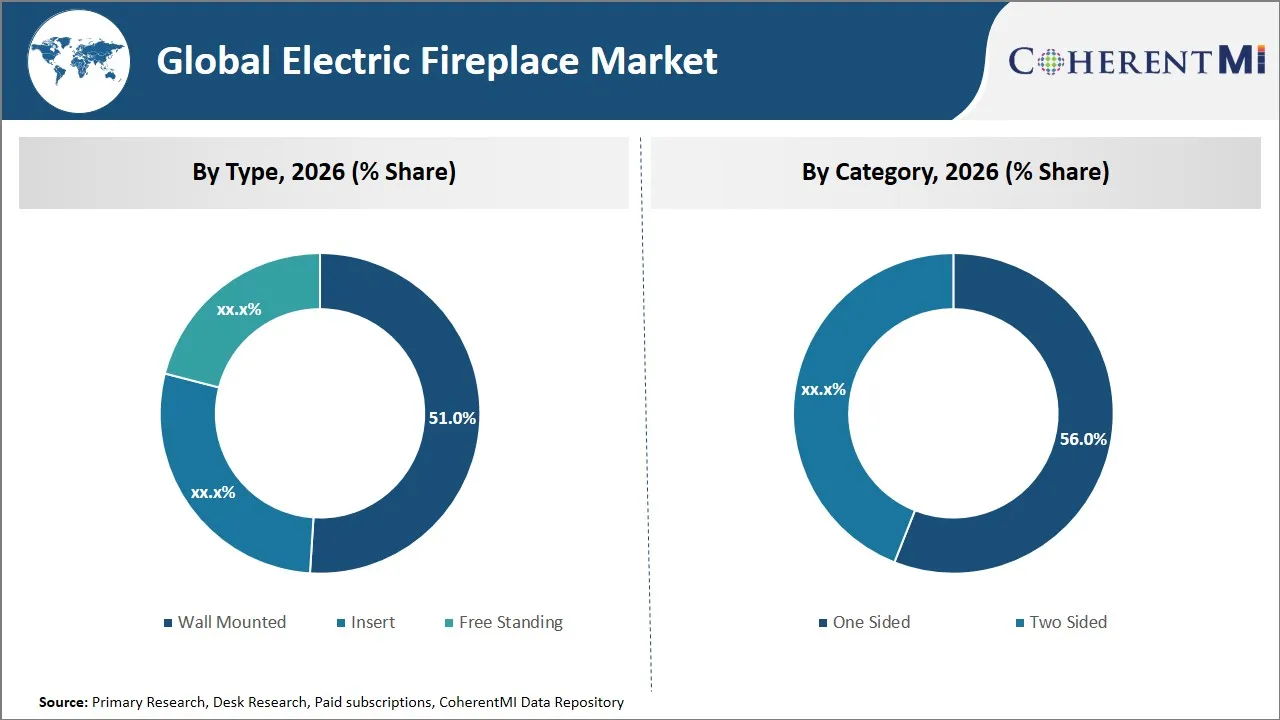
In terms of type, wall mounted is expected to account for 51% of the market share in 2026. Space efficiency now drives choices in home and office layouts, favoring designs that prioritize openness. What sets wall-mounted electric fireplaces apart is how they free up room area without sacrificing elegance. Their rise comes not just from function but from fitting seamlessly into current taste for minimal clutter. Appearance matters less than integration - these units blend where others intrude. A key reason behind their spread lies in balancing practicality with a clean, updated look people prefer today.
With cities growing denser, room-saving designs have become essential. Instead of taking up floor area, wall-mounted electric fireplaces attach directly to vertical surfaces. Where space comes at a high cost, such efficiency proves valuable. These units fit naturally within tight layouts like studios or downtown lofts. Their rise aligns closely with shifts in how people inhabit urban housing today.
For instance, on April 19, 2025, Evolution Fires announced the launch of its 22 new Signature Media Wall Fireplace Packages. These all-in-one, energy-efficient fireplace solutions blend contemporary design, advanced heating technology, and space-saving functionality, offering the ultimate focal point for modern homes.
(Source: menafn.com)
Insights, By Category: Meeting Traditional Consumer Preferences Through Focused Heat Distribution Drive the Demand for One-Sided Electric Fireplaces
In terms of category, the one sided segment is expected to account for 56% of the market share in 2026. A major reason behind the rise lies in how people favor classic looks of fireplaces while also wanting effective warmth and easier setup. What stands out is that single-face electric models lead because they fit well within typical home structures, guided by familiar decorating ideas centered on forward-facing comfort and directed warmth.
One reason these electric fireplaces appear frequently in homes lies in how they match current building layouts. Walls in many houses follow older plans built for front-facing fireboxes, so single-panel models fit without changes. Instead of demanding new arrangements, such units work within familiar setups where seating circles a central point. Over time, movement through living areas has adapted to this setup, guiding choices even today. With little need to reconfigure spaces, replacements align easily into what already exists.
Additional Insights of Electric Fireplace Market
- Electric fireplaces convert almost all electrical input into usable heat, achieving up to ~99% energy efficiency because there’s no combustion or venting loss.
- In contrast, traditional wood fireplaces often convert just 15–30% of fuel heat into room warmth due to huge heat losses up chimneys, and even gas units are typically 70–85% efficient at best.
- Electric fireplaces produce zero direct emissions at the point of use whereas, Traditional wood fireplaces can emit up to 28 lbs/hr of CO₂ and significant particulates, while gas units still emit combustion byproducts.
- Around 74% of electric fireplace buyers consider environmental concerns important in their purchase decision, and 79% look for eco-friendly brands.
- Additionally, 59% associate eco-friendly products with better well-being, and 88% prioritize ethical sourcing in product choice.
Competitive overview of Electric Fireplace Market
The major players operating in the global electric fireplace market include Glen Dimplex Group, Twin‑Star Home, Napoleon Fireplaces, Hearth and Home Technologies, Empire Comfort Systems, Amantii Electric Fireplaces, European Home, Real Flame, Modern Flames, Touchstone Home Products, BFM Europe, Regency Fireplace Products, Art Flame, Superior Fireplaces, and GHP Group Inc.
Electric Fireplace Market Leaders
- Glen Dimplex Group
- Twin‑Star Home
- Napoleon Fireplaces
- Hearth and Home Technologies
- Empire Comfort Systems
Recent Developments in Electric Fireplace Market
- On October 23, 2025, Twin Star Home announced a major expansion of its long-standing collaboration with Duraflame with the launch of a brand-new line of duraflame branded electric fireplaces. For more than 15 years, Twin Star Home has offered consumers trusted duraflame stoves, heaters, and compact electric fireplaces, under brand license.
- In July 2024, Flamerite Fires launched the E-FX SL1000 and SL750s models. These slimline, zero-recess electric fires featured innovative flush-back designs, AeroFlame technology for realistic flames, and multiple control options, including app control. They offered seamless integration into mantelpieces and fireplaces, redefining standards in electric fire solutions.
Electric Fireplace Market Segmentation
- By Type
- Wall Mounted
- Insert
- Free Standing
- By Category
- One Sided
- Two Sided
- By Heating
- With Heater
- Without Heater
- By Application
- Indoor
- Outdoor
- By End User
- Residential
- Commercial

Would you like to explore the option of buying individual sections of this report?
Yash Doshi is a Senior Management Consultant. He has 12+ years of experience in conducting research and handling consulting projects across verticals in APAC, EMEA, and the Americas.
He brings strong acumen in helping chemical companies navigate complex challenges and identify growth opportunities. He has deep expertise across the chemicals value chain, including commodity, specialty and fine chemicals, plastics and polymers, and petrochemicals. Yash is a sought-after speaker at industry conferences and contributes to various publications on topics related commodity, specialty and fine chemicals, plastics and polymers, and petrochemicals.