Commercial Air Fryer Market SIZE AND SHARE ANALYSIS - GROWTH TRENDS AND FORECASTS (2026 - 2033)
Commercial Air Fryer Market is segmented By Device Type (Manual, Digital), By Wattage (Below 1200 Wa...
Commercial Air Fryer Market Size - Analysis
The global commercial air fryer market is estimated to be valued at USD 1,034 Mn in 2026 and is expected to reach USD 1,628.1 Mn by 2033, growing at a compound annual growth rate (CAGR) of 6.7% from 2026 to 2033. This robust growth trajectory reflects the increasing adoption of healthier cooking technologies across commercial foodservice establishments, including restaurants, quick-service restaurants, hotels, and institutional kitchens, driven by rising consumer demand for healthier food options and operational efficiency improvements in commercial cooking processes.
Market Size in USD Mn
CAGR6.70%
| Study Period | 2026 - 2033 |
| Base Year of Estimation | 2025 |
| CAGR | 6.70% |
| Market Concentration | Medium |
| Major Players | Philips Electronics, Cuisinart, Breville, Ninja Kitchen, GoWISE USA and Among Others |

please let us know !
Commercial Air Fryer Market Trends
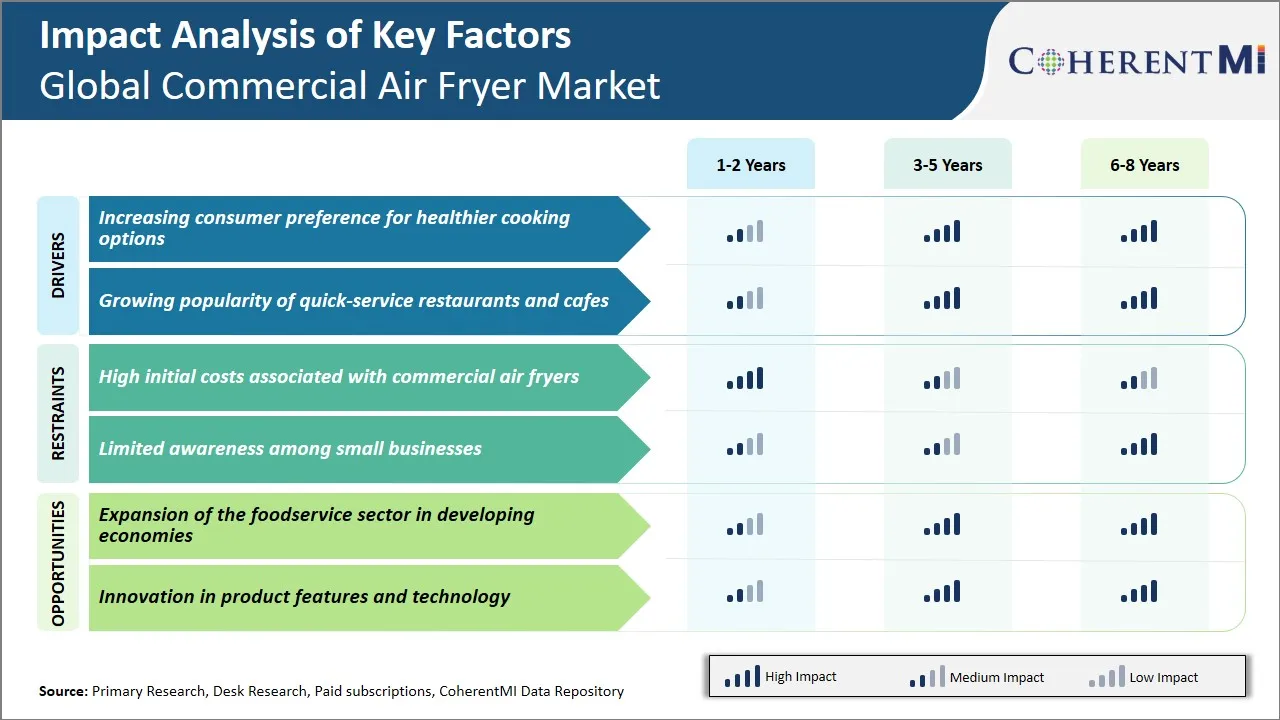
Market Driver - Increasing Consumer Preference for Healthier Cooking Options
The commercial air fryer industry is enjoying an unprecedented momentum with a radical change in consumer perception on healthy food preparation practices. This change is not merely a fad, it is a fundamental shift in the way food service restaurants are devising cooking techniques to satisfy the needs of the growing numbers of health-conscious consumers. Commercial, modular kitchen of different sectors are realizing that the conventional deep-frying techniques, though they provide the required taste profiles, are losing relevance to the current consumer needs on healthy food selections. Air fryers have become a new-gen solution that allows fulfilling between taste satisfaction and a healthy lifestyle and relying on the rapid circulation of air, providing the products with crispy textures and abundant flavors traditionally linked with deep-fried dishes and using little oil.
Market Driver - Growing Popularity of Quick-Service Restaurants and Cafes
The growing exponential growth of fast-food restaurants and other casual dining restaurants across the world has offered an immense market potential to the manufacturers of commercial air fryers given that these restaurants are looking to purchase cooking equipment that is more efficient yet does not compromise the quality of food served to the customers. The fast growth of fast casual concept, coffee shop, and food truck venues, and grab-and-go format of dining establishments, has fundamentally changed the landscape of commercial kitchen equipment such that there is a need to provide appliances that are able to produce consistent results under space and staffing limitations characteristic of these establishments. Commercial air fryers have now become the perfect answers to these operational challenges, as they enable one to cook rapidly which fits perfectly with the fast service demands of quick service establishments, and offer quality food production according to the ever-growing and sophisticated consumer demands.
 To learn more about this report, Request Free Sample Copy
Market Challenge - High Initial Costs Associated with Commercial Air Fryers
The high initial investment of high-quality equipment is a huge headwind to the commercial air fryer market that is a significant barrier to a small and medium-sized foodservice establishment entering the market. Home versions of commercial air fryers are priced with an average cost of between 3,000 and 15,000 per unit with some having more sophisticated multi-basket models that fetch even higher prices. The intensity of capital is especially hard on individual restaurants, food trucks, and new quick-service businesses that have limited finances and entry into financing. The cost implication is not only limited to the initial purchase of the equipment but also includes the cost of installation, training and integration with the current kitchen infrastructure. Small operators may have a very hard time justifying the return on investment, particularly when traditional deep fryers are only a small part of the expense given their limitations in terms of operations.
Market Opportunity - Foodservice Sector Expansion in Emerging Markets
The fast growth rate of foodservice industry of the emerging economies offers a growth transformer to the commercial air fryer industry due to urbanization, increasing disposable income and new consumer dining habits. The Asian-Pacific, Latin American and African nations are witnessing an unprecedented rise in the number of restaurant chains, quick-service restaurants and cloud kitchens, which poses a high demand on efficient cooking equipment. The rising middle-income groups in these areas are also demanding healthier food, at ease and this factors have placed the air fryers in an ideal position as a differentiating factor to operators seeking to move away with the conventional offers.
Total Cost of Ownership (TCO) for Commercial Air Fryers vs. Deep Fryers
|
Cost Factor |
Commercial Air Fryer |
Deep Fryer |
|
Energy Consumption |
Lower, as air fryers use hot air circulation |
High, as deep fryers require oil heating |
|
Maintenance Cost |
Lower, fewer moving parts |
Higher, regular oil filtration & replacement |
|
Operating Costs |
Lower, energy-efficient |
Higher due to oil and energy consumption |
Key winning strategies adopted by key players of Commercial Air Fryer Market
- Product Innovation: Companies are enhancing air fryer features with advanced technology, offering healthier cooking options. Ninja, in 2022, introduced a smart air fryer with a built-in food thermometer, providing precision cooking for various dishes.
- Market Expansion: The air fryer market is expanding in regions with rising health-consciousness, particularly in North America and Europe. Philips, in 2023, increased its footprint in North America by launching a new line of high-performance air fryers tailored to American cooking styles.
- Sustainability Focus: Brands are focusing on energy-efficient products and sustainable materials. Cosori, in 2021, unveiled an air fryer made from recyclable materials and features an energy-saving mode to reduce consumption during cooking.
Segmental Analysis of Commercial Air Fryer Market
To learn more about this report, Request Free Sample Copy
Insights, By Device Type - Manual Segment Dominates the Market Leadership Through Operational Simplicity and Cost-Effectiveness
Manual segment is expected to contribute 55.5% of the market share in 2026, owing to the fundamental preference for straightforward operational control and cost-conscious purchasing decisions across commercial establishments. This is because of the predisposition of the manual commercial air fryers to simplicity which also translates into various operational strengths which appeal greatly to the various commercial kitchen set-ups.
The main force that can propel the market leadership of manual air fryers is the ease-of-use mechanism of operation that needs very little staff to train. The use of equipment that can be efficiently worked without requiring a lot of technical expertise is beneficial in commercial kitchens, especially in small to medium-sized restaurants, cafes, and food service establishments. Manual controls are also characterized by the presence of simple temperature and timer dials, where the kitchen employees can learn the cooking process easily without having to work with a complicated digital interface and programming language.
Insights, By Wattage - Below 1200-Watt Air Fryers Capture Market Leadership Through Energy Efficiency and Versatile Applications
Below 1200-Watt segment is projected to contribute 32.5% of the market share in 2026, owing to the compelling combination of energy efficiency benefits and operational versatility that aligns with diverse commercial kitchen requirements. The prevalence of lower wattage commercial air fryers indicates the increased focus of the industry on sustainability of operations and cost-efficient cooking technologies that provide good performance without consuming much energy.
The first motivation factor of the market leadership of commercial air fryers of below 1200 watts is energy efficiency. Such units use much less power to operate than the higher wattage counterparts, and this directly affects the cost plans of operations in business facilities. In the case of restaurants, cafes, and food service businesses that have a narrow profit margin, the saving in the energy used amounts to significant savings in monthly utility bills. The reduced amount of power consumed means that multiple units can be run by an establishment without overloading of the electrical infrastructure and the demand charges that may happen as a result of overloading power infrastructure can significantly raise the cost of energy.
Additional Insights of Commercial Air Fryer Market
- North America is a leading regional market in both air fryers and commercial air fryers, supported by high adoption in foodservice and rising consumer demand for healthier cooking solutions.
- Health-conscious consumers are also driving product innovation within the commercial air fryer market. As demand for healthier cooking options grows, manufacturers are increasingly offering air fryers with oil-free or low-oil cooking capabilities, making it easier to prepare "healthier fried" foods. These innovations meet consumer desires for both convenience and quality, with advanced air fryers featuring touchscreen controls, precise heat profiles, and programmable cooking.
- The functional benefits of air fryers contribute to their growing market presence. In commercial kitchens, air fryers offer substantial advantages over traditional fryers, such as reduced oil dependency, improved energy efficiency, and faster cooking times. These features not only help foodservice operators meet growing consumer demand for healthier eating but also improve kitchen throughput and cost efficiency.
Competitive overview of Commercial Air Fryer Market
The major players operating in the global commercial air fryer market include Philips Electronics, Cuisinart, Breville, Ninja Kitchen, GoWISE USA, Cosori, DeLonghi, Sharp, Tefal, Hamilton Beach, Proctor Silex, and Maxi-Matic.
Commercial Air Fryer Market Leaders
- Philips Electronics
- Cuisinart
- Breville
- Ninja Kitchen
- GoWISE USA
Recent Developments in Commercial Air Fryer Market
- In January 2024, Versuni, a Koninklijke Philips NV-owned small appliances manufacturing company, opened its second 25,000-square-meter factory in Ahmedabad, India. The factory has an annual production capacity of 500,000 air fryers, 200,000 garment steamers, and hand mixers in India.
- In June 2023, Versuni, a Koninklijke Philips N.V.-owned company, established a partnership with SAP SE, a European software company, to utilize the SAP Sustainability Control Tower to monitor the recycling process of used air fryers in Sao Paulo, Brazil.
- In February 2023, Tovala, a meal-kit and oven company, launched cloud-connected technology-based smart ovens and Tovala Smart Oven Air Fryer in a sleek stone-gray finish in the U.S. market.
Commercial Air Fryer Market Segmentation
- By Device Type
- Manual
- Digital
- By Wattage
- Below 1200 Watt
- 1200-1500 Watt
- 1500-1800 Watt
- 1800-2200 Wattage
- 2200 Wattage & Above
- By Price Range
- Below USD 25
- USD 25 - USD 100
- USD 100 - USD 200
- USD 200- USD 300
- USD 300 & Above
- By Sales Channel
- Direct Sales
- Supermarket/Hypermarket
- Department Stores
- Specialty Stores
- Online Retailers
- Other Sales Channel

Would you like to explore the option of buying individual sections of this report?
Ramprasad Bhute is a Senior Research Consultant with over 6 years of experience in market research and business consulting. He manages consulting and market research projects centered on go-to-market strategy, opportunity analysis, competitive landscape, and market size estimation and forecasting. He also advises clients on identifying and targeting absolute opportunities to penetrate untapped markets.