Fidget Spinner Market SIZE AND SHARE ANALYSIS - GROWTH TRENDS AND FORECASTS (2026 -2033)
Fidget Spinner Market is segmented By Material Type (Plastic, Metal, Wood, Others (e.g., silicone)),...
Fidget Spinner Market Size - Analysis
The Global Fidget Spinner Market is estimated to be valued at USD 1.41 Bn in 2026 and is expected to reach USD 2.52 Bn by 2033, exhibiting a compound annual growth rate (CAGR) of 8.7% from 2026 to 2033. This robust growth trajectory reflects the sustained demand across diverse consumer segments including stress-relief seekers, individuals with attention disorders, and recreational users. The market's expansion is further bolstered by continuous product innovations, enhanced manufacturing capabilities, and strategic distribution partnerships that have successfully maintained consumer interest beyond the initial trend phase.
Market Size in USD Bn
CAGR8.7%
| Study Period | 2026 -2033 |
| Base Year of Estimation | 2025 |
| CAGR | 8.7% |
| Market Concentration | Medium |
| Major Players | ZURU, Spin Master Ltd., Toysmith, Waboba Inc., Fidgetland and Among Others |

please let us know !
Fidget Spinner Market Trends
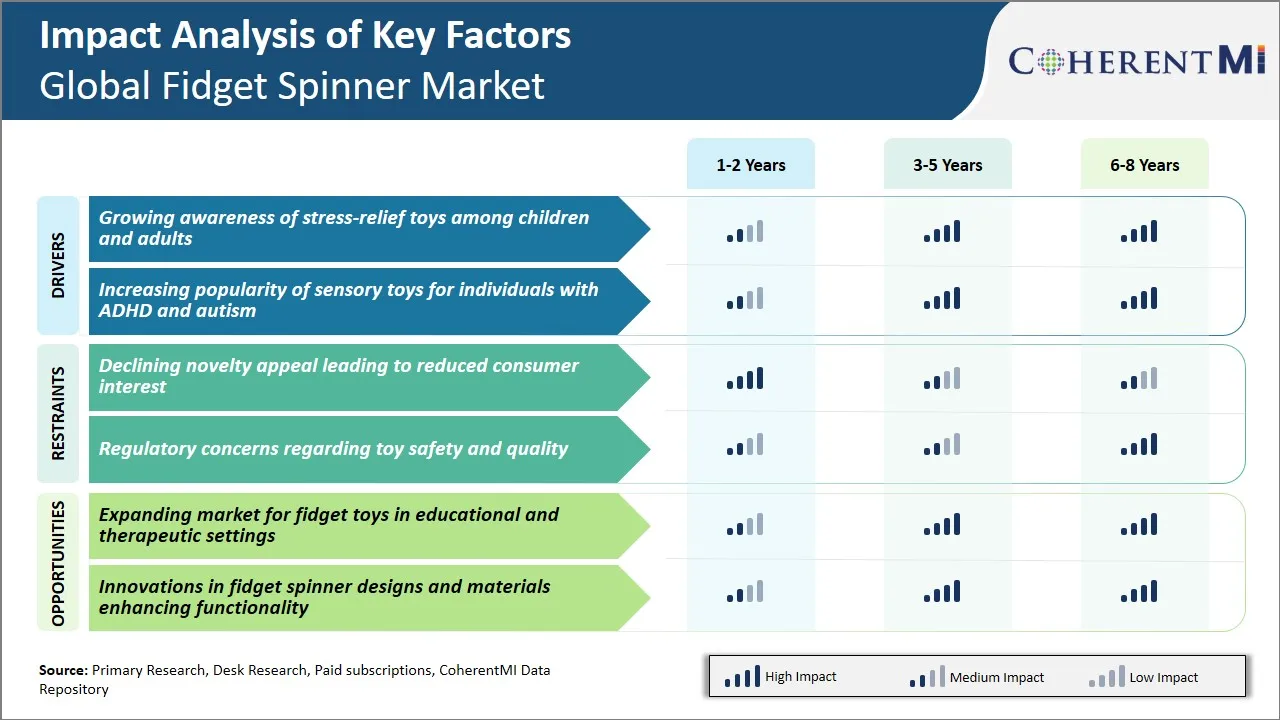
Market Driver - Growing Awareness of Stress-relief Toys Among Children and Adults
The neurological diversity movement has drastically changed the way society perceives and embraces disorders like Attention-deficit/hyperactivity disorder (ADHD) and autism spectrum disorders, and it has also generated a demand for special tools and interventions to help the people with the neurological difference. Fidget spinners have achieved significant success among neurodivergent communities as important sensory regulation aids and provide the socially acceptable way of coping with sensory processing issues and attention challenges.
Fidget spinners have become a more common part of the therapeutic repertoire of occupational therapists and special education professionals, who have found them capable of offering proprioceptive input and assisting in the maintenance of over- or under-stimulated sensory systems. The modular movement and regular sensory feedback offered by fidget spinners is fully compatible with sensory requirements of most people with ADHD and autism and provides an autoregulative tool that can be utilized in reliance on different settings.
Market Driver - Increasing Popularity of Sensory Toys for Individuals with ADHD and Autism
The neurological diversity movement has drastically changed the way society perceives and embraces disorders like ADHD and autism spectrum disorders, and it has also generated a demand for special tools and interventions to help the people with the neurological difference. Fidget spinners have achieved significant success among neurodivergent communities as important sensory regulation aids and provide the socially acceptable way of coping with sensory processing issues and attention challenges.
Fidget spinners have become a more common part of the therapeutic repertoire of occupational therapists and special education professionals, who have found them capable of offering proprioceptive input and assisting in the maintenance of over- or under-stimulated sensory systems. The modular movement and regular sensory feedback offered by fidget spinners is fully compatible with sensory requirements of most people with ADHD and autism and provides an autoregulative tool that can be utilized in reliance on different settings. The advocates of fidget spinners have become stronger parents and caregivers of children with ADHD and autism, sharing their experiences of better behavior, fewer meltdowns, and increased focus when using the tools in everyday life.
 To learn more about this report, Request Free Sample Copy
Market Challenge - Declining Novelty Appeal Leading to Reduced Consumer Interest
The global fidget spinner market faces a significant headwind in the form of rapidly diminishing novelty appeal, which has fundamentally altered consumer purchasing patterns and market dynamics. Having first started as a viral phenomenon that gained immense popularity among the representatives of various demographic groups, fidget spinners witnessed an unprecedented demand in 2016-2017. But the market has since faced a significant downsizing in that the novelty factor that was the initial impetus to initial adoption is now mostly vaporized. Consumer behavioral analysis perfectly shows that fidget spinners have gradually moved to the list of the trendy items and the purchase intentions among both children and adults as the central customer population have decreased drastically. This is also compounded by the saturation in the market with the oversupply of the product by a lot of manufacturers flooding the market with the same product thus commoditizing and eroding the price.
Market Opportunity - Expanding Market for Fidget Toys in Educational and Therapeutic Settings
The international fidget spinner market is an attractive growth area due to strategic market expansion in the thriving educational application and therapeutic uses where evidence-based advantages are facilitating institutional use and professional approval. Fidget toys are being considered by more healthcare professionals, occupational therapists, and educational professionals as helpful resource in attention deficit disorder management, anxiety, autism spectrum disorders, and stress related conditions.
Research in the field of clinical studies has proved that controlled fidgeting does increase concentration, lower stress levels and improve mental performance especially in people with ADHD and sensory processing disorders. Such scientific authentication has created massive avenues in the market with the school, therapy clinics, hospitals, and special care centers serving as the main avenues that emphasize evidence-based interventions.
Age Group vs Purchase Frequency & Repeat Buy Rate
|
Age Group |
Purchase Frequency (per year) |
Repeat Buy Rate (%) |
|
0-12 years |
3 |
25% |
|
13-17 years |
2 |
30% |
|
18-24 years |
1 |
20% |
|
35-44 years |
0.5 |
10% |
Key winning strategies adopted by key players of Fidget Spinner Market
- Product Innovation: Firms are engaging in product differentiation in terms of product features and product material to suit the changing consumer needs. An illustration of this is how brands are introducing ergonomic designs, LED-built spinners and multi-functional spinners that can merge the integration of stress-relief with entertainment. The therapeutic market is also being exploited by manufacturers with spinners that they claim will help in focus and anxiety relief. One of the major brands created a high-end version with adjustable LED lights and a more flowing bearing to achieve better performance in 2021.
- Expansion in trade markets: With the changes in the market where the mainstream toy stores are being replaced by the niche markets, the companies are exploring the emerging markets having high disposable incomes like the Asian Pacific and Latin America. Other major players, such as SpinMaster, have strengthened their operations in these markets through collaborations with local stores and use of e-commerce. Also, businesses are accessing the wellness among adults sector, where the demand to use stress and mental health gadgets is on the increase.
Segmental Analysis of Fidget Spinner Market
 To learn more about this report, Request Free Sample Copy
Insights, By Material Type – Plastic Segment Dominates due to Cost-Effectiveness and Manufacturing Scalability
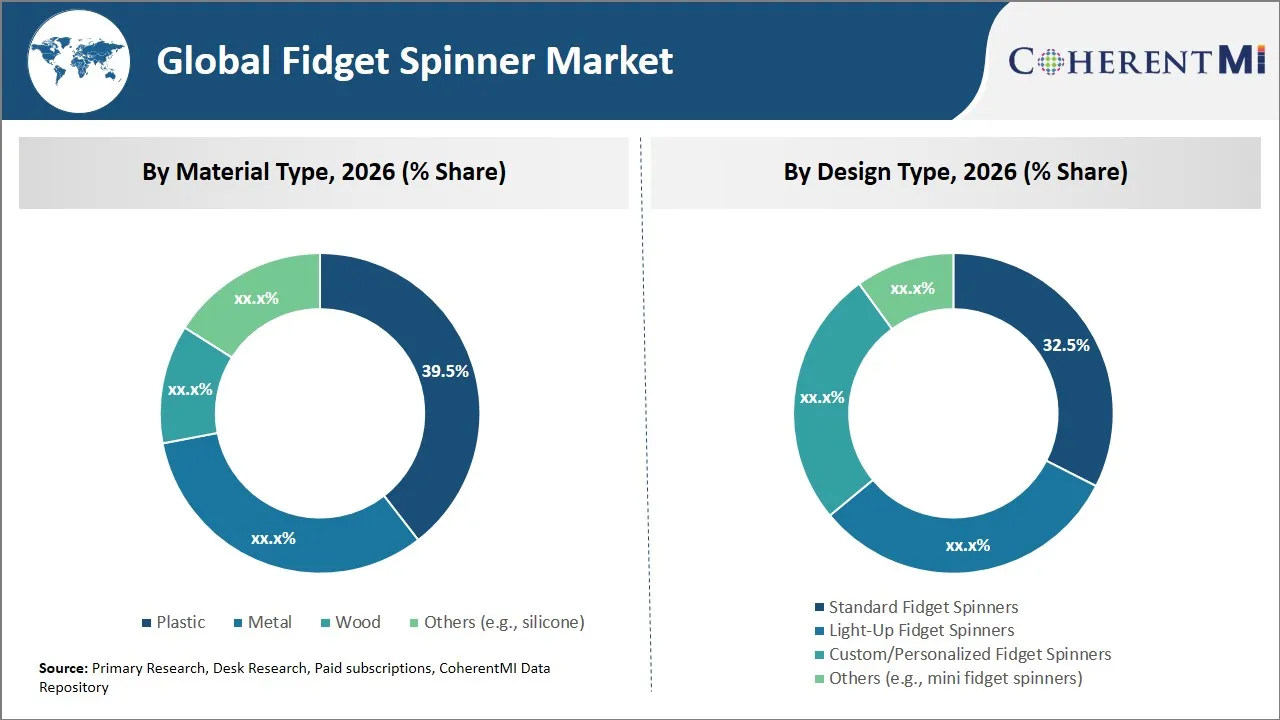
Plastic segment is expected to hold 39.5% share of the market in 2026, owing to its exceptional cost-effectiveness and superior manufacturing scalability that aligns perfectly with mass market demands. The domination of plastic in the fidget spinner market is due to a number of causes which are linked in such a way that they give the business, the retailers and the consumers a strong value proposal.
Fidget spinners made of plastic can be manufactured at much lower prices than those of metal or wood, or specialty materials and manufacturers can realize economies of scale that are passed on to the final consumer as competitive prices. This pricing advantage is especially important in a market where price sensitivity is a key factor in the purchasing decision making, particularly when considering the traditional core market of children, teenagers, and young adults who usually possess low amounts of disposable income.
Insights, By Design Type - Standard Fidget Spinners are Leading due to Universal Appeal and Accessibility
Standard fidget spinners segment is projected to hold 32.5% share of the fidget spinner market in 2026, owing to their universal functionality and broad demographic appeal that transcends age, cultural, and socioeconomic boundaries. Fidget spinners have universal functionality and demographic appeal that crosses across age, cultural, and socioeconomic lines. Domination of the market by generic designs depicts the underlying consumer tendencies in simplicity, reliability, and the known performance traits that owe part of its objective to the essence of the fidget spinning activities.
The main aspect that contributes to the market leadership of standard fidget spinners lies in the fact that they are well balanced in terms of functionality and simplicity.
Additional Insights of Fidget Spinner Market
- The Asia Pacific region leads the global fidget spinner market, driven by large population centers such as China and India, where the market benefits from high e-commerce penetration and a robust manufacturing infrastructure. This has made the region the largest and fastest-growing market.
- Consumer Behavior & Product Innovation: The demand for fidget spinners is increasingly being driven by consumers seeking stress relief, focus enhancement, and sensory engagement, particularly among students, office workers, and those with neurodivergent conditions. In response, manufacturers are innovating, introducing products that cater to these specific needs. Fidget spinners are no longer limited to the traditional toy form; today, they are being designed with features such as LED lights, ergonomic grips, and multi-tool variants to appeal to a broader consumer base.
- E-commerce Influence: The growth of online marketplaces has been crucial for the fidget spinner market, as it enables manufacturers to reach niche consumer segments directly. E-commerce platforms remain the dominant distribution channel, supporting both mass-market and specialized, therapeutic-focused products.
Competitive overview of Fidget Spinner Market
The major players operating in the Global Fidget Spinner Market include ZURU, Spin Master Ltd., Toysmith, Waboba Inc., Fidgetland, HyperFidget, Funware, Kingsley, Infinity Cube, SMLZ 3D, Ebay Inc., Hasbro Inc., and Vortx Inc.
Fidget Spinner Market Leaders
- ZURU
- Spin Master Ltd.
- Toysmith
- Waboba Inc.
- Fidgetland
Recent Developments in Fidget Spinner Market
- In January 2026, Mattel, Inc. launched a groundbreaking Barbie doll, developed with guidance from the autistic community, to reflect how autistic individuals experience, process, and communicate with the world. The doll, which provides representation for more children, comes with a pink finger clip fidget spinner, noise-cancelling headphones, and a tablet. The spinning pink finger clip fidget spinner offers a sensory tool to help reduce stress and enhance focus, highlighting its potential in the fidget spinner market.
Fidget Spinner Market Segmentation
- By Material Type
- Plastic
- Metal
- Wood
- Others (e.g., silicone)
- By Design Type
- Standard Fidget Spinners
- Light-Up Fidget Spinners
- Custom/Personalized Fidget Spinners
- Others (e.g., mini fidget spinners)
- By Distribution Channel
- Online Retail
- Offline Retail
- Toy Stores
- Supermarkets/Hypermarkets
- Specialty Stores

Would you like to explore the option of buying individual sections of this report?
Pankaj Poddar is a seasoned market research consultant with over 12 years of extensive experience in the fast-moving consumer goods (FMCG) and plastics material industries. He holds a Master’s degree in Business Administration with specialization in Marketing from Nirma University, one of India’s reputed institutions, which has equipped him with a solid foundation in strategic marketing and consumer behavior.
As a Senior Consultant at CMI for the past three years, he has been instrumental in harnessing his comprehensive understanding of market dynamics to provide our clients with actionable insights and strategic guidance. Throughout his career, He has developed a robust expertise in several key areas, including market estimation, competitive analysis, and the identification of emerging industry trends. His approach is grounded in a commitment to understanding client needs thoroughly and fostering collaborative relationships. His dedication to excellence and innovation solidifies his role as a trusted advisor in the ever-evolving landscape of not only FMCG but also chemicals and materials markets.