Marine Radar Market SIZE AND SHARE ANALYSIS - GROWTH TRENDS AND FORECASTS (2026 -2033)
Marine Radar Market is segmented By Product Type (X-Band, S-Band), By Component (Transmitter, Receiv...
Marine Radar Market Size - Analysis
The Global Marine Radar Market is estimated to be valued at USD 1.50 Bn in 2026 and is expected to reach USD 2.35 Bn by 2033, exhibiting a compound annual growth rate (CAGR) of 5% from 2026 to 2033. This notable rise in market size stems from growing needs within commercial fleets, military operations, and leisure craft for better route guidance and obstacle detection. Progress continues at a consistent pace due to firm funding toward safer sea travel, shaped not only by tighter global shipping rules but also rising cargo movement that demands sharper oversight of ship positions.
Market Size in USD Bn
CAGR5%
| Study Period | 2026 -2033 |
| Base Year of Estimation | 2025 |
| CAGR | 5% |
| Market Concentration | Medium |
| Major Players | Raymarine Marine Electronics, SAAB AB, Northrop Grumman Corporation, Furuno Electric Co Ltd, Lockheed Martin Corporation and Among Others |

please let us know !
Marine Radar Market Trends
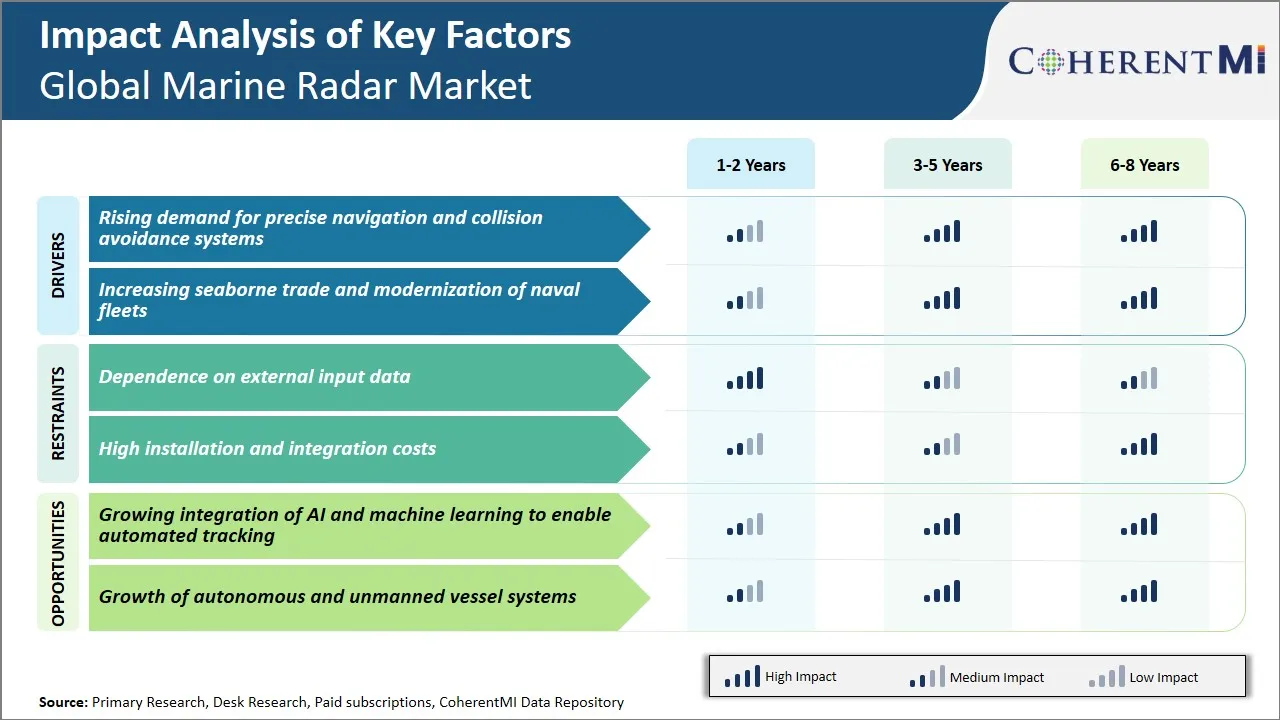
Market Driver - Rising Demand for Precise Navigation and Collision Avoidance Systems
A shift unfolds across sea transport, sparked by rising needs for advanced tools that guide ships and prevent collisions. Complexity grows within worldwide shipping paths, pushing the necessity for better safety in crowded channels. Today's large freighters, alongside niche craft serving offshore zones, face tougher conditions at sea. Outdated steering techniques falter under current expectations for secure and efficient voyages. Performance demands now exceed what conventional approaches can deliver.
Despite differing regional approaches, global regulations increasingly shape how ships equip themselves for safe travel. Because maritime authorities demand higher safety levels, vessel operators now install complex radar technologies as standard practice. Safety improvements often follow tragic events at sea, which explains why oversight bodies push for consistent technical requirements. When new rules emerge, they typically reflect lessons learned from past navigational failures.
For instance, on September 15, 2025, Arbe Robotics Ltd. announced that Sensrad has received an order from WATCHIT for the Sensrad Hugin D1 Radar for its collision prevention system for recreational boats. Sensrad's Radar solution was chosen to provide reliable perception and navigation support in all weather and lighting conditions.
(Source: prnewswire.com)
Market Driver - Increasing Seaborne Trade and Modernization of Naval Fleets
Growth in worldwide sea trade alters how vessels move across oceans, making high-tech radar essential under current conditions. As supply networks link distant regions, paths grow heavier with goods, filling key passages beyond prior levels. Unrelenting flow of ships demands sharper tracking tools, adapted to handle crowds mixed with varied vessel types. Navigational precision rises in importance when waterways face pressure from constant movement and tight spacing. Modern fleets rely on enhanced sensing methods simply due to sheer numbers sharing limited ocean space.
Even when silent, radar stations influence harbor operations, directing choices while staying unseen. At meeting points of maritime routes, officials focus on improvements - less about longer piers, more about precision in motion and timing. Rather than waiting, technology predicts ship arrivals, relying on constant surface scans to sync timetables ahead of ignition. Behind-the-scenes alignment begins with echoes returning from distant vessel forms.
For instance, on December 29, 2025, HD Hyundai Heavy Industries announced a new contract with the Philippine Department of National Defense to provide two 3,200-ton frigates for the Philippine Navy. HHI and the Philippine Department of National Defense (DoD) signed the contract for the Philippine Navy Frigate Second Acquisition Program.
(Source: navalnews.com)
 To learn more about this report, Request Free Sample Copy
Market Challenge - Dependence on External Input Data
Even with progress, current marine radar systems show vulnerability because they rely on external data sources. When navigational instruments depend too much on uncontrollable inputs, weaknesses appear. Signals originating from satellite transmissions, weather updates, digital charts, ship identification systems, and positioning networks have become routine additions. Though these feeds improve maritime awareness, instability follows should interruptions occur.
Managing multiple data stores at once creates added pressure, particularly when different tech setups must interact without interruption - an ongoing challenge that weighs more heavily on smaller freight operators. Even so, supervision grows tougher under stricter international rules requiring dependable logs and resilient infrastructure, forcing enterprises to adopt improved safeguards alongside routine checks merely to remain operational.
Market Opportunity - Growing Integration of AI and Machine Learning for Automated Tracking
With artificial intelligence now part of marine radar, new possibilities emerge across global markets through smarter automation. Instead of manual monitoring, these systems process streams of live information to detect vessels, distinguish types, then follow movements, all at once. Because decisions rely on continuous analysis, crew workload decreases while clarity increases during complex navigation. What results is sharper perception of surroundings without constant human oversight.
What stands out is how machine learning allows these systems to refine function steadily by drawing from accumulated exposure, adjusting gradually to regional sea environments along with distinct usage rhythms across global waterways. Shifting trends now favor vessels that operate without crew members on board or require minimal human oversight - this shift, covering everything from floating drones to digitally managed harbors - opens fresh opportunities where radar powered by artificial intelligence becomes more relevant.
For instance, on December 19, 2025, Hefring Marine & SEA.AI announced a partnership to integrate AI machine‑vision and onboard analytics for real‑time collision avoidance and enhanced situational awareness on vessels.
(Source: sea.ai)
Global Marine Radar Market - AIS Integration & Fusion Radar Adoption Rate
|
Adoption Indicator |
Value |
|
Integration of Radar with AIS/GPS |
~60–80% of new systems |
|
Operators Upgrading to Integrated Bridge Systems (Radar + AIS + ECS) |
80% of SOLAS class vessels |
|
Recognition of AIS Integration as Critical Feature |
~70% marine radar users |
|
AIS paired with ECDIS & Radar |
37% of AIS installations |
|
Digital & Solid-state Radar Adoption |
~42–45% new systems |
|
AI-enabled Target Tracking Radar Adoption |
~30% of ship radar installations |
|
VTS Systems Deployment (Radar + AIS data fusion) |
>1,000 stations worldwide |
|
Solid-State Radar Adoption Rate |
~45% of deployments |
|
AIS Satellite Integration Growth |
~30% increase in satellite-AIS deployments |
Key winning strategies adopted by key players of Marine Radar Market
- Technology Innovation and R&D Investment Strategy: Furuno Electric Co., Ltd invested over USD 85 million in R&D (representing 8.5% of annual revenue) to develop its revolutionary DRS-NXT solid-state Doppler radar series. Furuno also introduced pulse compression technology and advanced signal processing algorithms. Furuno captured 23% market share in commercial marine radar segment by 2022, achieved 15% revenue growth in FY2022 and won 12 industry awards including the NMEA Technology Award.
- Strategic Acquisitions and Vertical Integration: FLIR Systems acquired Raymarine for USD 200 million and integrated thermal imaging expertise with marine radar technology. The combined entity achieved USD 1.9 billion in revenue and expanded market presence in luxury yacht segment by 45%. FLIR Systems also created synergies worth USD 35 million annually through integrated product offerings.
Segmental Analysis of Marine Radar Market
 To learn more about this report, Request Free Sample Copy
Insights, By Product Type: Resolution and Weather Penetration Drive Market Leadership for X-Band
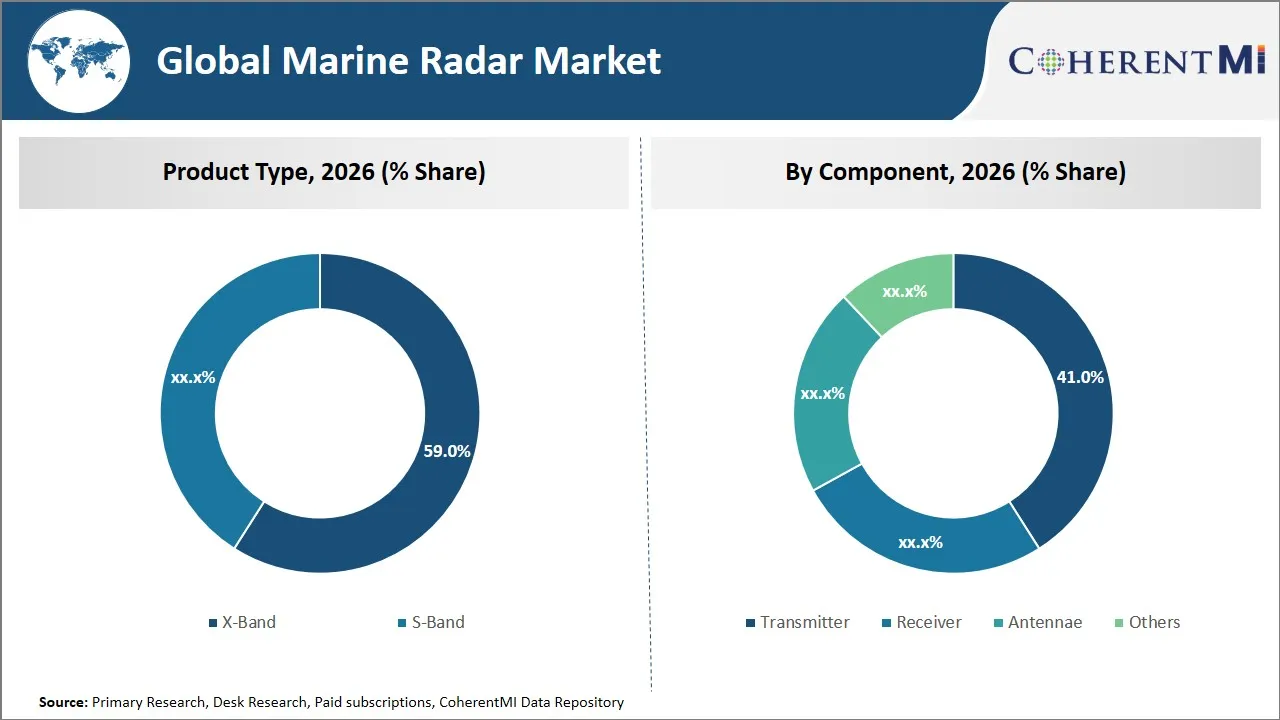
In terms of product type, the X-Band segment is expected to account for 59% of the market share in 2026. Despite varying sea environments, precise targeting stands out as a key factor behind increased adoption. Operating near 9.4 gigahertz on average, these radars achieve finer detail detection than their lower-frequency counterparts. Because clarity improves under challenging weather, many vessels rely on such systems without explicitly stating preference. Higher frequency does not always guarantee better results; yet here it supports consistent image sharpness. Navigation tools of this type remain common where obstacle separation matters most.
What sets X-Band apart begins with sharp target separation and reliable guidance through busy sea lanes. As traffic density rises, clarity in spotting nearby objects matters more. Small boats, drifting hazards - these show up clearly when the system operates under tight conditions. Shorter wavelengths make such results possible by boosting sensitivity to tiny structures. Coastal edges, port layouts, surrounding ships - all gain sharper outlines as a result.
For instance, on September 26, 2025, the US Navy announced it is moving forward with plans to solicit proposals for its Future X-Band Radar (FXR), a next-generation sensor system designed to enhance the surface fleet’s ability to detect and track incoming missile threats.
(Source: thedefensepost.com)
Insights, By Component: Power Management and Signal Generations Excellence Drives the Growth of Transmitters
In terms of component segmentation, the transmitter segment is expected to account for 41% of the market share in 2026. As it shapes how well radar systems perform, growth ties closely to the need for sophisticated signal creation technology. At the core of marine radar lies the transmitter, which produces and strengthens radio waves necessary for spotting objects. Detection, distance measurement, and support during movement rely on these signals under varying sea conditions. Its importance drives both development pace and resource allocation decisions.
Optimization of power output underpins growing interest in sophisticated transmitters within marine radar setups. Because modern seafaring demands dependable detection at great distances, efficient energy use becomes essential alongside resilience. Steady transmission strength is expected regardless of environment - whether near shorelines or amid turbulent ocean stretches. Instead of relying on older magnetron designs, many now turn to solid-state solutions for more predictable results over time. These newer systems offer durability, less need for servicing, and uniform performance where stability matters most.
Additional Insights of Marine Radar Market
- International conventions, particularly the International Maritime Organization’s (IMO) Safety of Life at Sea (SOLAS), require certain classes of vessels (e.g., commercial ships over ~300 GT, all passenger vessels) to install certified radar equipment.
- Flag states and regional inspection regimes (e.g., Paris MoU on Port State Control) enforce compliance with radar and navigation equipment standards. Non-compliant vessels face detentions, fines, or operational restrictions, making regulatory adherence a commercial priority rather than optional.
- Recent amendments to safety standards extend beyond simple installation mandates. Modern regulations increasingly require enhanced performance, such as better target detection in adverse conditions, improved integration with charting systems (ECDIS), and cybersecurity safeguards. Radar manufacturers must innovate to comply.
- Meeting regulatory requirements involves more than installation, it includes certification, compliance documentation, and sometimes customization for different flag states.
- In addition to IMO conventions, regional agencies and national frameworks enforce maritime radar use and standards (e.g., European Maritime Safety Agency rules).
Competitive overview of Marine Radar Market
The major players operating in the Global Marine Radar Market include Raymarine Marine Electronics, SAAB AB, Northrop Grumman Corporation, Furuno Electric Co Ltd, Lockheed Martin Corporation, Simrad, Hexagon AB, HENSOLDT, BAE Systems plc, Rockwell Collins, Terma, Garmin Ltd, GEM Elettronica, General Dynamics Corporation, and Wärtsilä Corporation.
Marine Radar Market Leaders
- Raymarine Marine Electronics
- SAAB AB
- Northrop Grumman Corporation
- Furuno Electric Co Ltd
- Lockheed Martin Corporation
Recent Developments in Marine Radar Market
- On February 13, 2026, Simrad Marine Electronics announced the launch of the NSO 4 multifunction display as part of its 80th anniversary year. Built on the revolutionary NEON operating system (OS) and designed to be the world’s most intuitive chart-plotter, NSO 4 is the latest premium chart-plotter and fish-finder in the Simrad portfolio.
- On January 16, 2026, Leonardo, through its subsidiary Leonardo US Corporation, announced it has signed an agreement to acquire Enterprise Electronics Corporation (EEC), a U.S.-based company specializing in developing, manufacturing and servicing weather radar instruments, and satellite receiving stations for meteorology, hydrology, research and aviation for applications in the military and civilian sectors.
Marine Radar Market Segmentation
- Product Type
- X-Band
- S-Band
- By Component
- Transmitter
- Receiver
- Antennae
- Others
- By Application
- Fishing Vessel
- Recreational Boat
- Merchant Marine
- Others

Would you like to explore the option of buying individual sections of this report?
Yash Doshi is a Senior Management Consultant. He has 12+ years of experience in conducting research and handling consulting projects across verticals in APAC, EMEA, and the Americas.
He brings strong acumen in helping chemical companies navigate complex challenges and identify growth opportunities. He has deep expertise across the chemicals value chain, including commodity, specialty and fine chemicals, plastics and polymers, and petrochemicals. Yash is a sought-after speaker at industry conferences and contributes to various publications on topics related commodity, specialty and fine chemicals, plastics and polymers, and petrochemicals.