Yeast Extract Market SIZE AND SHARE ANALYSIS - GROWTH TRENDS AND FORECASTS (2026 - 2033)
Yeast Extract Market is segmented By Technology (Autolyzed, Hydrolyzed), By Form (Powder, Paste, Fla...
Yeast Extract Market Size - Analysis
The global yeast extract market is estimated to be valued at USD 2.13 Bn in 2026 and is expected to reach USD 3.44 Bn by 2033, growing at a compound annual growth rate (CAGR) of 7.1% from 2026 to 2033. This robust growth trajectory reflects the increasing demand across multiple industries, particularly food and beverage manufacturing, pharmaceuticals, and biotechnology sectors.
Market Size in USD Bn
CAGR7.1%
| Study Period | 2026 - 2033 |
| Base Year of Estimation | 2025 |
| CAGR | 7.1% |
| Market Concentration | Medium |
| Major Players | Lesaffre, Kerry Group plc, AngelYeast Co., Ltd., Leiber, Lallemand Inc. and Among Others |

please let us know !
Yeast Extract Market Trends
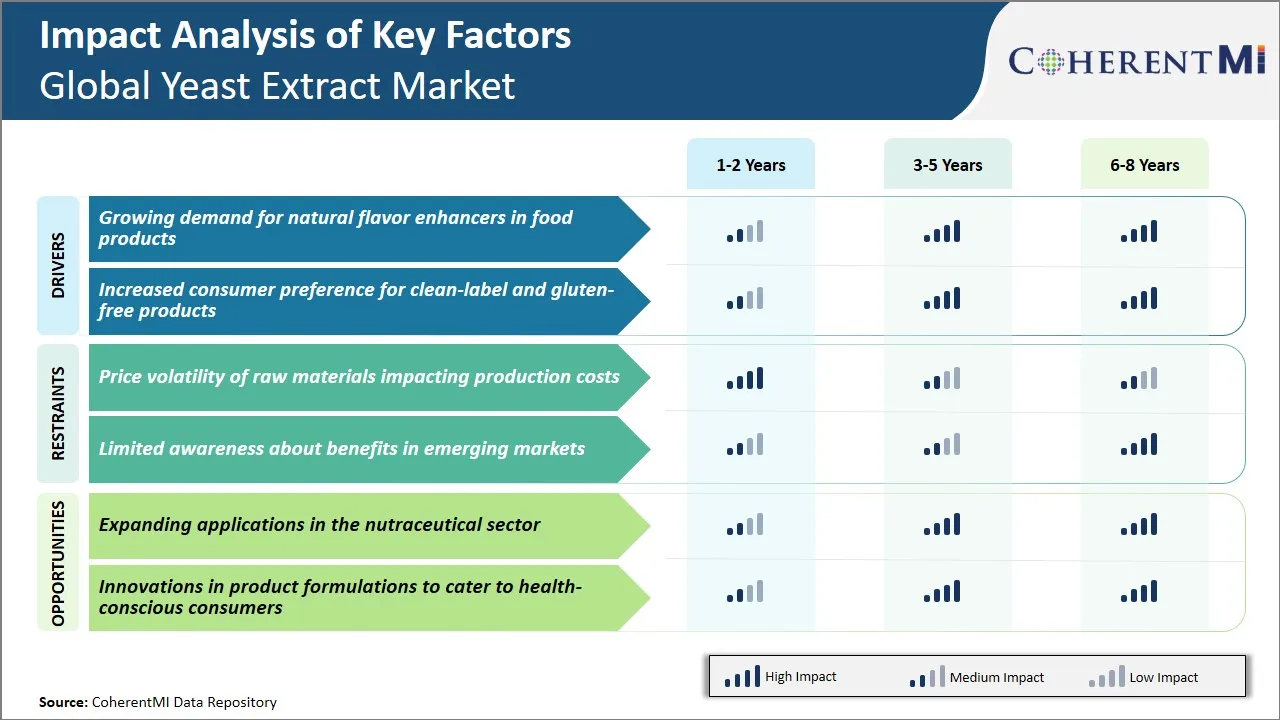
Market Driver - Growing Demand for Natural Flavor Enhancers in Food Products
The global food industry is experiencing a paradigmatic shift toward natural ingredients, with yeast extract emerging as a cornerstone solution for manufacturers seeking to enhance flavor profiles while maintaining clean ingredient lists. The main driver of this transformation is the changing consumer awareness of the artificial additives and their possible health effects, which opens up a massive market potential to the suppliers of yeast extract.
The common artificial flavor enhancers, such as monosodium glutamate and artificial flavoring, food flavor are becoming questionable by health-aware people who are actively questioning the labels of products and are demanding alternative products that are in line with their wellness goals. The natural fermentation process to extract yeast provides the manufacturers with an excellent option that imparts richness, savory depth, and complexity of flavor without undermining consumer confidence and regulatory security in a wide range of markets in different countries.
Market Driver - Increased Consumer Preference for Clean-Label and Gluten-Free Products
The current consumer buying patterns are characterized by a high level of transparency in ingredients and dietary considerations, with yeast extract appearing as a vital ingredient in clean-label formulations that comply with the strict requirements of consumers to purchase products with recognizable and pronounceable ingredients.
The clean-label movement is not merely a marketing positioning strategy, but is a core consumer need of products that have a minimal number of processing aids, artificial preservatives, and synthetic compounds, and that have the functionality and sensory characteristics that the modern lifestyle demands. Naturally, the uncontrolled production of yeast extract is in line with these expectations because its production by using a controlled fermentation process is just a recreation of traditional food preservation and flavor development technologies that consumers intuitively know and trust, forging natural links between contemporary manufacturing and ancient food preparation technologies.
 To learn more about this report, Request Free Sample Copy
Market Challenge - Price Volatility of Raw Materials Impacting Production Costs
The yeast extract market is also experiencing major headwinds based on the continuous fluctuating prices of major raw materials specifically molasses, sugar beet pulp and corn steep liquor which are major substrates used in the production of yeast. Such volatility is attributable to various interrelated factors such as seasonal agro related variations, weather related crop failure, geopolitical tensions related to agricultural trade and fluctuating energy prices that affect the agricultural production as well as transportation. The agricultural commodities markets have been subjected to unparalleled volatility in the last several years, where even the molasses prices have been subjected to variability on a 25-40 percent scale in quarterly times, which directly corresponds to the contracted margins of the yeast extract manufacturers.
Market Opportunity - Expanding Applications in the Nutraceutical Sector
The nutraceutical sector presents a compelling growth avenue for the yeast extract market, driven by the increasing consumer shift toward natural, functional ingredients that offer health benefits beyond basic nutrition. Yeast extracts, especially Saccharomyces cerevisiae, are rich in B-vitamins, amino acids, nucleotides and beta-glucans making it a high-quality dietary supplement, functional foods and wellness product. Major areas of application are immune support supplements where yeast beta-glucans have shown clinically proven benefits and sports nutrition products that utilize the complete amino acid profile and natural B-vitamin content to support a better recovery and performance.
Flavor Intensity vs Cost Optimization Curve
|
Yeast Extract Dosage Level |
Flavor Intensity (Sensory Impact) |
Cost Impact |
Cost Efficiency |
|
Low |
Noticeable umami enhancement |
Low |
Moderate |
|
Medium |
Strong, rounded umami; flavor depth |
Moderate |
High |
|
High |
Marginal intensity improvement |
High |
Declining |
Key winning strategies adopted by key players of Yeast Extract Market
- Product Innovation: The players are introducing clean-label, low-sodium and application specific yeast extract (savory, umami, bio-nutrition). Lesaffre also increased its range of yeast extracts in plant-based food and salt-reduction formulations (2021 to 2023).
- Market Expansion: Firms are furiously increasing capacity and partnerships in the high-growth markets of Asia Pacific. Angel Yeast consolidated its presence in China and Southeast Asia by an increase in the production of yeast extract to be used in food and feed.
- Sustainability Focus: Sustainability is being transformed to branding, recyclable feedstocks, cyclical fermentation and environmentally friendly factories. The fermentation processes are making DSM-Firmenich and AB Mauri more efficient in terms of energy and water consumption, and less damaging to the environment.
Segmental Analysis of Yeast Extract Market
 To learn more about this report, Request Free Sample Copy
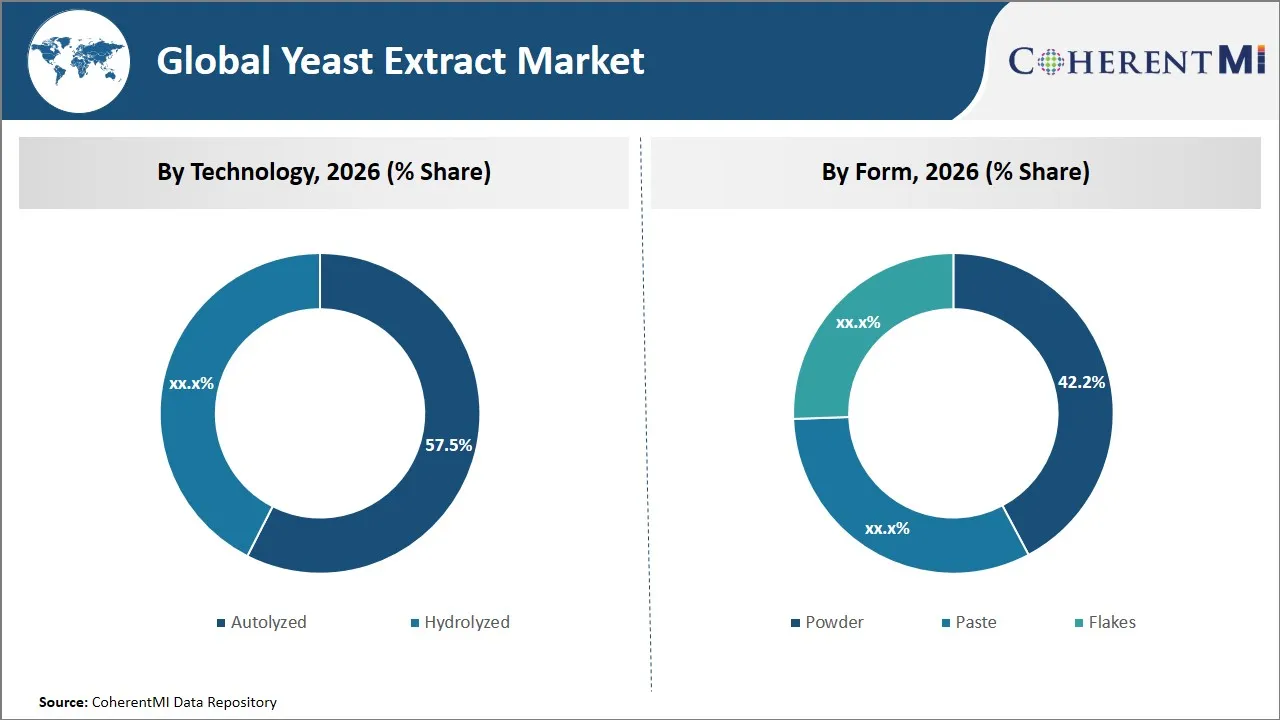
Insights, By Technology – Autolyzed Segment Dominates due to Superior Enzymatic Efficiency
Autolyzed segment is expected to contribute 57.5% of the market share in 2026, owing to its superior enzymatic processing capabilities that deliver consistent quality and enhanced flavor profiles. The extraction process of the autolyzed yeast takes advantage of the enzymatic systems inherent in the yeast ingredients. This natural enzymatic process produces a more regulated degradation process to produce yeast extracts with excellent taste qualities and better solubility features, that are greatly appreciated in many applications.
The dominance of the autolyzed technology is explained by the capacity to retain the necessary amino acids and vitamins and minerals in the extraction. Also, in contrast to severe chemical processes, autolysis preserves bioactive compounds so that the resulting product is more nutritionally balanced and more functional.
Insights, By Form - Enhanced Solubility and Processing Convenience Establishes Powder Form Leadership
Powder segment is projected to contribute 42.2% of the market share in 2026, due to its exceptional solubility characteristics and superior processing convenience that streamline manufacturing operations across diverse applications. Powdered yeast extract has unsurpassed dissolution characteristics and therefore can be easily incorporated into diverse recipes without involving a rigorous dose of mixing or complex machinery. The fine particle texture of powder form guarantees consistent dispersal in food matrices to provide consistent flavor release and nutritional advantages that manufacturers depend on to provide uniform quality of products.
Powdered yeast extract has social benefits in storage and handling that contribute greatly to dominance in the market. Its dried state gives it a long shelf life and minimizes the possibility of microbial contamination and avoids any special storage conditions necessary with paste and flake products.
Additional Insights of Yeast Extract Market
- North America Leadership: North America is a top market in the yeast extract industry with the processed food industry, high consumption of savory and convenience foods, and early-adopting clean-label ingredients among foodservice and packaged food manufacturers.
- Clean-Label & Health-Centered Innovation: The increasing health awareness is increasing the need of natural flavor additives, low sodium solutions, and MSG-free products. This is driving the manufacturers to develop yeast extract versions that are specific to plant-based foods, soups, snacks, and meat analogues.
- Functional & Nutritional Positioning: Yeast extracts, which possess inherent qualities of umami addition, presence of B-vitamins, and immune-supporting properties are becoming more popular as food and beverage companies are more attracted to developing functional, nutritional and label-friendly formulations.
Competitive overview of Yeast Extract Market
The major players operating in the global yeast extract market include Lesaffre, Kerry Group plc, AngelYeast Co., Ltd., Leiber, Lallemand Inc., Synergy Flavors, Inc., Thai Foods International Co.,Ltd., Halcyon Proteins Pty. Ltd., Ohly, KOHJIN Life Sciences Co.,Ltd., Sensient Technologies Corporation, Biorigin, and Oriental Yeast Co., ltd.
Yeast Extract Market Leaders
- Lesaffre
- Kerry Group plc
- AngelYeast Co., Ltd.
- Leiber
- Lallemand Inc.
Recent Developments in Yeast Extract Market
- In October 2024, Lesaffre announced that it had completed the acquisition of the yeast extract business division of dsm-firmenich, which is a major name in the health, nutrition, and beauty segments. The development is expected to strengthen Lesaffre's presence in the savory ingredients market, with the company's Biospringer unit integrating the yeast derivative processing technologies of dsm-firmenich, its employees, and innovative products. This would enable the company to cater to its customers in savory and fermentation-focused applications.
- In May 2024, the specialty yeast extract supplier, Ohly announced the launch of its innovative NEIVA health product range, which has been developed to serve customers' immunity and wellness needs. This range includes powdered ingredients manufactured through the company's cutting-edge drying technology, thus creating versatile ingredients providing consistent texture and flavor. The company launched this line with NEIVA Glucan Max and NEIVA MCT Immune for immune support and improving cardiovascular health.
Yeast Extract Market Segmentation
- By Technology
- Autolyzed
- Hydrolyzed
- By Form
- Powder
- Paste
- Flakes
- By Application
- Food & Beverages
- Food
- Bakery & Confectionery
- Soups
- Sauces & Savory Flavors
- Prepared Meals
- Dairy Products
- Others
- Beverages
- Food
- Animal Feed
- Pharmaceuticals
- Others
- Food & Beverages

Would you like to explore the option of buying individual sections of this report?
Ramprasad Bhute is a Senior Research Consultant with over 6 years of experience in market research and business consulting. He manages consulting and market research projects centered on go-to-market strategy, opportunity analysis, competitive landscape, and market size estimation and forecasting. He also advises clients on identifying and targeting absolute opportunities to penetrate untapped markets.