Animal Artificial Insemination Market SIZE AND SHARE ANALYSIS - GROWTH TRENDS AND FORECASTS (2026 - 2033)
Animal Artificial Insemination Market is segmented By Animal Type (Cattle, Swine, Poultry, Sheep & G...
Animal Artificial Insemination Market Size - Analysis
The global animal artificial insemination market is estimated to be valued at USD 2.80 Bn in 2026 and is expected to reach USD 4.15 Bn by 2033, exhibiting a compound annual growth rate (CAGR) of 5.8% from 2026 to 2033. This strong growth trend can be attributed to the growing usage of advanced reproductive technologies in livestock farming processes in the world. The growth in market is mainly due to increased demand for high quality animal protein, increasing awareness about genetic improvement programs, and increasing requirement of breeding efficiency in commercial dairy and beef cattle production activities across the world.
The market for animal artificial insemination is witnessing a heavy technological development due to the incorporation of digital experience, such as estrus detection mobile applications and breeding management systems. The most prominent trends involve the recent increase in gender selection using technology of sexed semen, increased use of technology of frozen embryo transfer, and preference towards genomic testing to maximize breeding decisions. The development rates of livestock farming modernization, along with government programs promoting advanced breeding techniques, are accelerating in emerging markets across the Asia-Pacific and Latin America. These regions are witnessing increased investments in agricultural infrastructure, which further support the adoption of improved breeding practices and technological advancements.
Market Size in USD Bn
CAGR5.8%
| Study Period | 2026 - 2033 |
| Base Year of Estimation | 2025 |
| CAGR | 5.8% |
| Market Concentration | Medium |
| Major Players | IMV Technologies, Genus, Shipley Swine Genetics, Stallion AI Services Ltd, Select Sires Inc. and Among Others |

please let us know !
Animal Artificial Insemination Market Trends
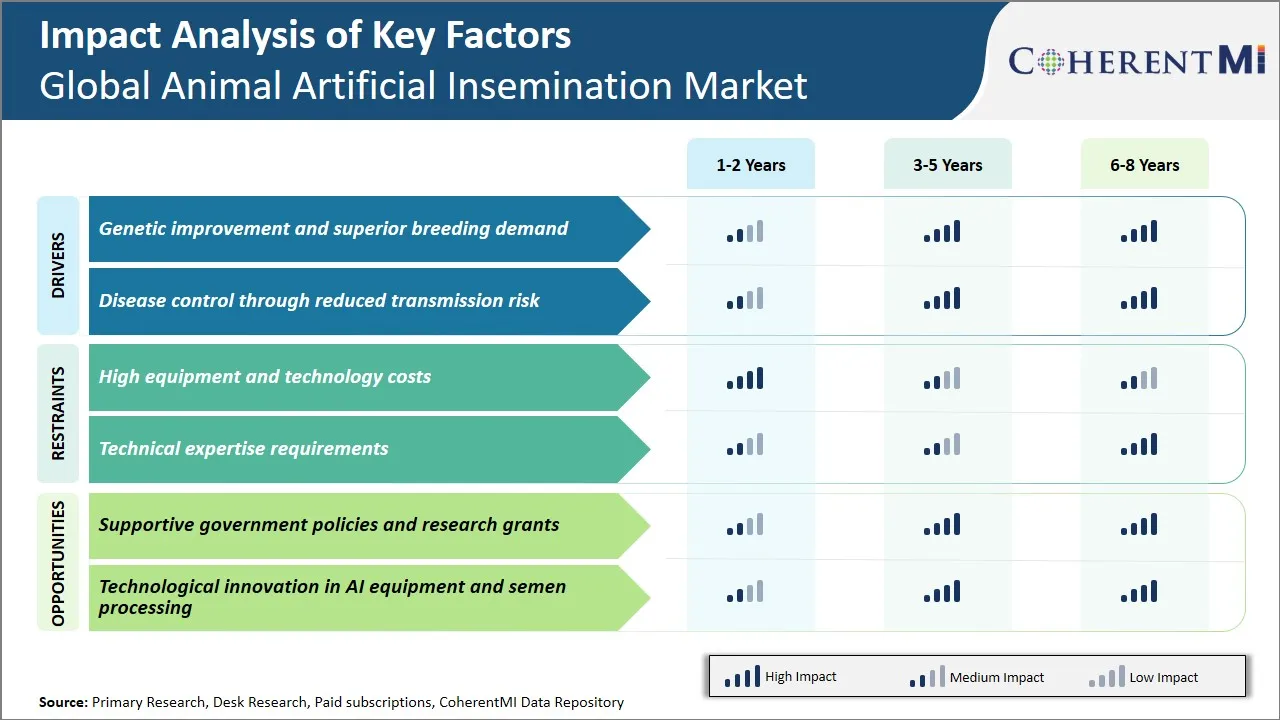
Market Driver - Genetic Improvement and Superior Breeding Demand
The unstoppable quest after genetic perfection in the breeding of livestock has become a basic trigger that propels the entire animal artificial insemination market that has essentially changed the way farmers worldwide deal with animal reproduction and herd management. The motivation behind this driver is that the nature of the agricultural industry is that it must maximize productivity, improve animal welfare, and provide high quality animal proteins to an ever-growing global demand at the same time considering the issue of sustainability that has taken center stage in the current farming practices. The genetic improvement paradigm is a complex breeding technology that goes well beyond the classic breeding selection technique, and incorporates the more recent reproductive technology that allows producers to tap the genetic potential of better animals over wide geographic boundaries and varied breeding stocks.
For instance, opening of Rajasthan’s first sex‑sorted semen laboratory for cattle at Bassi in August 2025 in India, supported by the National Dairy Development Board (NDDB), aims to produce USD 1million semen doses annually to improve livestock quality and enhance breed characteristics by providing access to genetically superior semen for farmers.
(Source- https://www.theweek.in/wire-updates/national/2025/08/11/des61-rj-semen-lab.html)
Market Driver - Disease Control Through Reduced Transmission Risk
The necessity to reduce the risk of disease transmission to animal stocks has become an urgent mechanism in the global animal artificial insemination market due to the increasing awareness of the biosecurity issues in the industry and the catastrophic economic effects of the disease outbreak in livestock stocks. This driver includes a holistic view on animal health care whereby artificial insemination is identified as an important device towards reversing disease transmission cycles which hitherto take place when animals come into direct contact with one another during the natural action of mating.
 To learn more about this report, Request Free Sample Copy
Market Challenge - High Equipment and Technology Costs
The global animal artificial insemination market has massive headwinds that are represented by the accumulative capital to buy sophisticated equipment and innovative technologies. Farming small and medium size operations especially in the emerging markets find it difficult to justify such initial cost even though the long-term gain will be the better quality of genetic and more efficient breeding. This problem is also complicated by the fact that continuous upgrades of technology are required as the reproductive technologies are growing fast with advancements in cryopreservation methods, sex-sorted semen, and genomic selection instruments.
There are also the hidden expenses of maintenance of advanced equipment such as frequent calibration, consumable replacement, and special technical support which pose financial immediate financial liabilities over time which may amount to 15-20 percent of the capital expenditure annually. This is a very high barricade in the developing world where they have fewer financing alternatives through agriculture and farmers tend to work with slim profit margins.
Market Opportunity - Supportive Government Policies and Research Grants
The global animal artificial insemination market is experiencing unprecedented growth opportunities due to the government efforts across the world to create policies that favor growth and adequate funding of research. Considering the importance of the AI technology in delivering food security and agricultural sustainability objectives, governments in both developed and developing economies are also enforcing facilitated policies such as subsidies on AI equipment acquisition, tax-deductible incentives on uptake of agricultural technologies, and research and development grants. These are reinforced by the public-private collaborations where farmers are attracted by cutting their financial barriers and also by transferring technology between the research and commercial use. Grants from the government to fund research in sexed semen technology, better cryopreservation techniques, and creation of portable AI devices that can be used in isolated locations are hastening innovation.
For instance, the animal artificial insemination market is India’s Rashtriya Gokul Mission and Nationwide AI Programme, where the government has backed artificial insemination services to enhance breeding coverage with high‑genetic‑merit semen, training thousands of AI technicians, and subsidizing sex‑sorted semen technology to increase productivity and farmer income as of 2025, over USD 95 million animals have been covered and nearly USD 150 million AI procedures performed under this programme.
(Source- https://sansad.in/getFile/annex/268/AU1181_cZK9ZJ.pdf?source=pqars)
Segmental Analysis of Animal Artificial Insemination Market
 To learn more about this report, Request Free Sample Copy
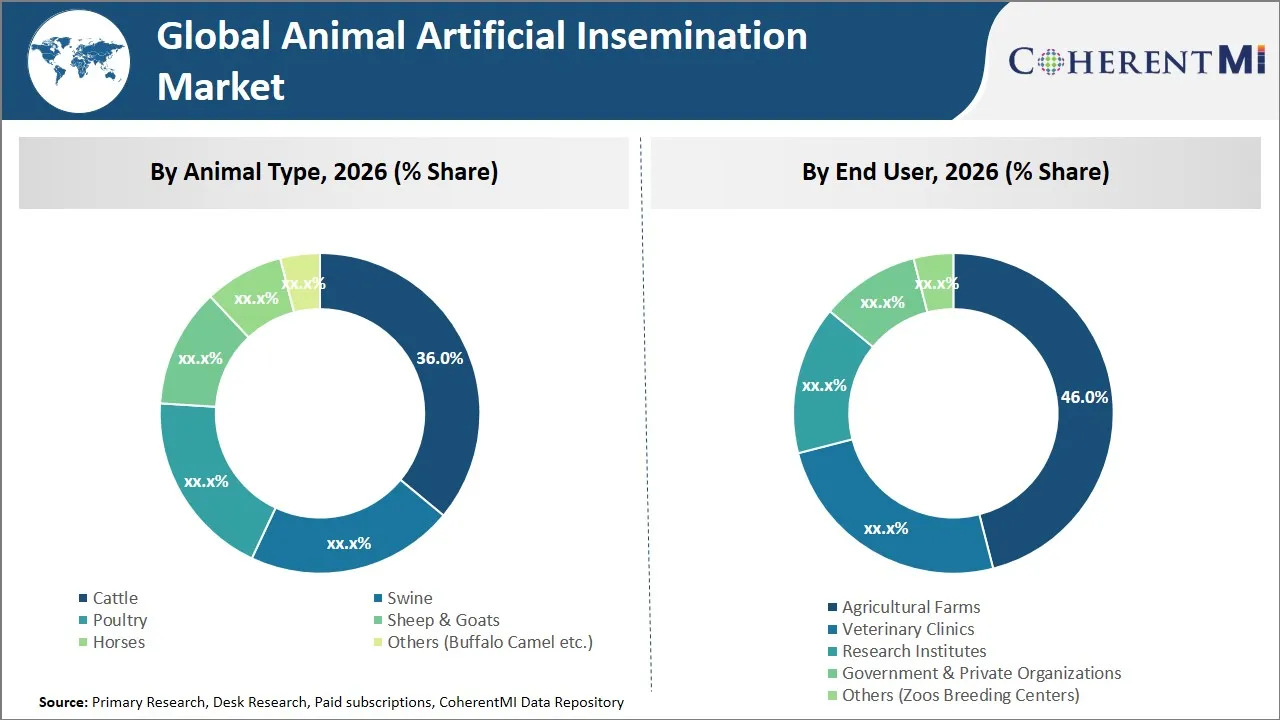
Insights, By Animal Type: Cattle’s Dominance is Driven by Economic Efficiency and Global Dairy Demand
By animal type, cattle is expected to contribute the highest share of 36% in 2026, owing to the substantial economic benefits and widespread adoption of artificial insemination practices in dairy and beef production systems worldwide. The dominance of the cattle segment in the market is due to a number of interrelated factors that render artificial insemination not only advantageous but also requisite to the economies of the contemporary cattle farms.
The main factor that has led to cattle segment’s dominance in the market is the high genetic improvement potential that artificial insemination offers to cattle breeders. Cattle, in contrast to the other species of livestock, have a rather long generation period, and genetic advancement by the power of natural breeding is very slow and ineffective.
For instance, more than 60% of dairy cows in the U.S. are bred using artificial insemination, demonstrating high adoption in dairy cattle reproductive practices.
Insights, By End User: Agricultural Farms Lead Through Scale Economics and Production Efficiency Demands
By end user, agricultural farms take the largest portion of the market with an estimated share of 46% in 2026, due to the fundamental economics of large-scale livestock production and the imperative for operational efficiency in competitive agricultural markets. The largest users of artificial insemination technologies are commercial agricultural farms, since their scale enables a significant payoff of the benefits of breeding programs that are controlled.
The prevalence of agricultural farms in adopting artificial insemination has to do with the fact that they have to maximize the reproductive efficiency of a large number of animals. Commercial farms, as opposed to smaller operations or research facilities, need to maximize conception rates, decrease calving times and synchronize breeding cycles, in order to maintain stable production flows. Artificial insemination offers the accuracy and control that is required to attain these functional goals and minimizes the intensity of labor involved in the management of natural breeding.
Impact of Government Subsidies and Programs on the Animal Artificial Insemination Market
- Government subsidies and programs significantly support the animal artificial insemination market, particularly in regions with large agricultural economies. In countries like India, China, and Brazil, governments offer financial assistance for establishing AI centers, providing subsidies for semen processing, and offering training programs for AI technicians to improve livestock productivity. These programs aim to enhance genetic improvement and disease control, driving the widespread adoption of AI technology in cattle breeding.
- Additionally, government support often extends to subsidized semen technology, such as sexed semen and frozen semen production, which further reduce the cost of livestock breeding. Policy incentives also focus on improving food security, sustainability, and animal welfare, ensuring long-term growth in the animal artificial insemination market. These government-backed initiatives not only make AI more accessible to farmers but also foster broader market adoption, benefiting both small and large-scale producers.
The Role of Digital Livestock Monitoring in Enhancing Animal Artificial Insemination
- Digital livestock monitoring integration is the next revolution in the sphere of livestock management and breeding, where farmers monitor and control their livestock using the Internet of Things (IoT) devices, sensors, and sophisticated data analytics. Such technologies can be used to track and monitor real-time of different parameters like health indicators, fertility, behavior, and even the environmental conditions of the animals. With the help of its means of gathering and evaluating data (body temperature, rumination patterns, movement patterns, etc.), farmers will be able to comprehend the well-being of the animals overall and the readiness to breed more closely. This is enabled through digital integration of the decision-making process of optimized animal feeding, health management, and breeding practices.
- The monitoring of digital livestock in the framework of animal artificial insemination allows a more accurate determination of the moment of insemination, i.e. when animals are in heat or at the time that they are most fertile. As an illustration, AI can be discussed during the point when sensors are able to notice the slightest variations in activity or body temperature. Moreover, AI and genetic selection tools which operate on the basis of digital monitoring can become more effective in breeding where more precise semen usage can be obtained, particularly with sexed semen or with the target of a particular genetic characteristic. The outcome is increased success of insemination, better genetic compositions, low costs of labor and increased productivity of livestock. The digital monitoring systems are hence becoming very important in ensuring that livestock management is efficient, sustainable and profitable.
Additional Insights of Animal Artificial Insemination Market
- The animal artificial insemination market is primarily driven by increased demand for dairy and beef production, with AI offering improved genetic potential for better yields and disease resistance.
- Technological advancements such as sexed semen, which offers higher precision in breeding female calves, are driving further growth and adoption in cattle AI practices.
- The market is supported by government subsidies and initiatives, especially in developing regions like India, where AI programs improve cattle productivity and farmer incomes.
- The market faces challenges such as high initial setup costs, technical expertise requirements, and regulatory concerns, but opportunities for genetic improvement and enhanced livestock management continue to push growth in the sector.
Competitive overview of Animal Artificial Insemination Market
The major players operating in the global animal artificial insemination market include IMV Technologies, Genus, Shipley Swine Genetics, Stallion AI Services Ltd, Select Sires Inc., URUS Group LP, CRV, SEMEX, Swine Genetics International, STgenetics, AgTech Inc., Kruuse Ltd., Premier Select Sires Inc., Bovine Elite LLC, and Santa Cruz Biotechnology.
Animal Artificial Insemination Market Leaders
- IMV Technologies
- Genus
- Shipley Swine Genetics
- Stallion AI Services Ltd
- Select Sires Inc.
Recent Developments in Animal Artificial Insemination Market
- On February 7, 2026, The Bill & Melinda Gates Foundation announced plans to set up more than 200 artificial insemination centers across Vidarbha and Marathwada regions in India to enhance cattle productivity and dairy income through improved breeding and allied veterinary services.
- In April 2025, the government of India announced the launch of an indigenously developed sex‑sorted semen production technology, aimed at producing female calves with up to 90% accuracy and reducing the cost per dose from around 0.8 million to approx. 0.25 million, supported by incentives to farmers.
- In October 2025, ABS Global launched an advanced semen collection and processing system in the U.S. that incorporates enhanced storage technology and AI‑driven fertility tracking to help improve herd reproductive efficiency.
- In February 2023, Select Sires and Zoetis US teamed up to integrate advanced genomic, data, and reproductive technologies for cattle producers. This collaboration combines Select Sires’ high-fertility genetics—including gender-selected semen—with Zoetis’s digital, genomic, and health management tools, such as Performance Livestock Analytics and CowManager.
Animal Artificial Insemination Market Segmentation
- By Animal Type
- Cattle
- Swine
- Poultry
- Sheep & Goats
- Horses
- Others (Buffalo Camel etc.)
- By End User
- Agricultural Farms
- Veterinary Clinics
- Research Institutes
- Government & Private Organizations
- Others (Zoos Breeding Centers)
- By Product Type
- Semen Collection & Processing
- Insemination Equipment
- Guns
- Straws
- Pipettes
- Others (Canisters Liquid Nitrogen Tanks)
- By Technology
- Conventional Artificial Insemination
- Sexed Semen Artificial Insemination
- Gene Editing Technologies
- Others (Cryopreservation In Vitro Fertilization)
- By Application
- Livestock Breeding
- Animal Conservation
- Genetic Improvement
- Research & Development
- Others (Disease Control Population Management)
- By Source
- Fresh Semen
- Frozen Semen
- Sexed Semen

Would you like to explore the option of buying individual sections of this report?
Ghanshyam Shrivastava - With over 20 years of experience in the management consulting and research, Ghanshyam Shrivastava serves as a Principal Consultant, bringing extensive expertise in biologics and biosimilars. His primary expertise lies in areas such as market entry and expansion strategy, competitive intelligence, and strategic transformation across diversified portfolio of various drugs used for different therapeutic category and APIs. He excels at identifying key challenges faced by clients and providing robust solutions to enhance their strategic decision-making capabilities. His comprehensive understanding of the market ensures valuable contributions to research reports and business decisions.
Ghanshyam is a sought-after speaker at industry conferences and contributes to various publications on pharma industry.