Computer Peripherals Market SIZE AND SHARE ANALYSIS - GROWTH TRENDS AND FORECASTS (2026 - 2033)
Computer Peripherals Market is segmented By Product (Input Devices, Output Devices, Storage Devices)...
Computer Peripherals Market Size - Analysis
The global computer peripherals market is estimated to be valued at USD 545 Bn in 2026 and is expected to reach USD 1,380 Bn by 2033, exhibiting a compound annual growth rate (CAGR) of 10% from 2026 to 2033. This ongoing rise stems from persistent need for computer add-ons, fueled by a growing worldwide labor force alongside deeper integration of digital tools in business operations. That strong market value highlights how vital these devices are, serving daily tasks through improved efficiency and better interaction with technology whether at home or within large organizations.
Market Size in USD Bn
CAGR10%
| Study Period | 2026 - 2033 |
| Base Year of Estimation | 2025 |
| CAGR | 10% |
| Market Concentration | Medium |
| Major Players | Logitech International S.A, Corsair Gaming, Razer Inc, HP Inc, Dell Technologies and Among Others |

please let us know !
Computer Peripherals Market Trends
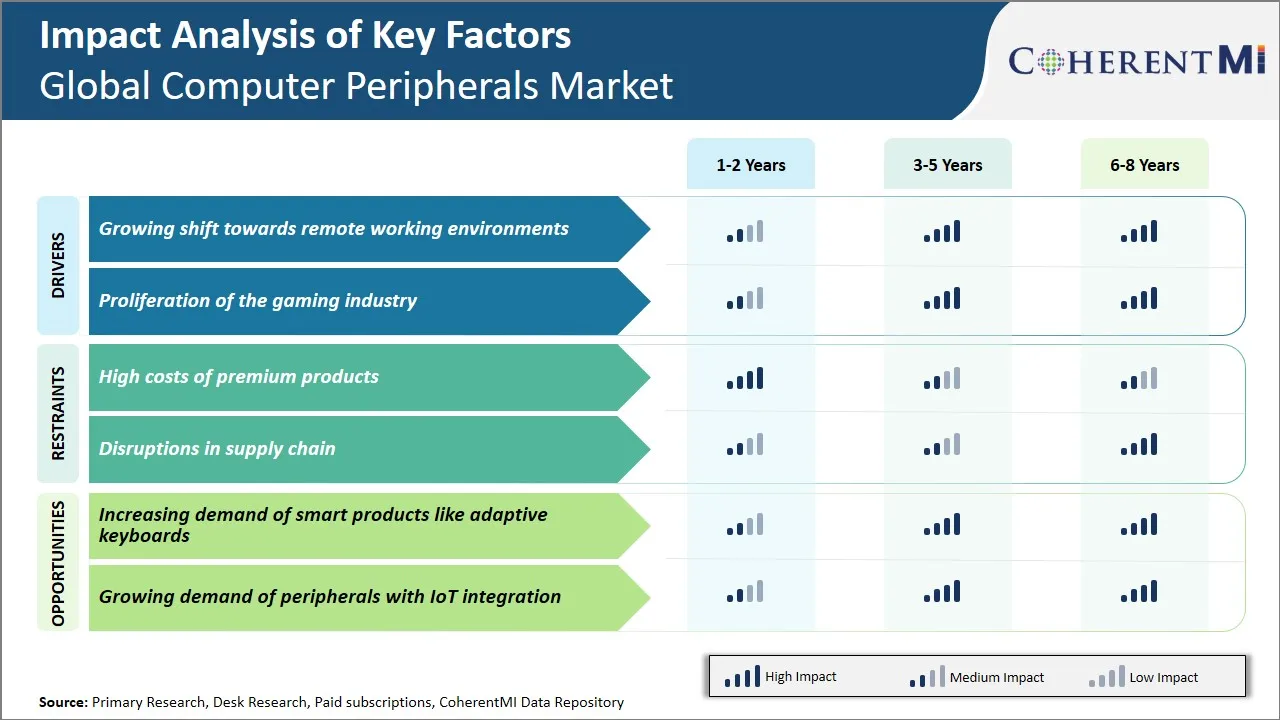
Market Driver - Growing Shift Towards Remote Working Environments
A shift toward remote collaboration means clear visuals matter more than before. Instead of basic built-in cameras, people choose dedicated models offering sharper detail. Lighting control grows in importance where natural light falls short. Performance must remain steady through hours of virtual meetings. Image clarity affects how messages are received. Equipment choices today reflect expectations set by professional settings.
Modern starting point includes sharp visuals, automatic clarity adjustments, steady protection of private data. Alongside, audio capabilities evolve similarly, shaped by dependence on clean speech in virtual gatherings. Seamless delivery gains importance across remote collaborations. Equipment that silences surrounding noise, moves without wires, operates fully during extended use sets the present benchmark.
For instance, on September 23, 2025, Logitech introduced Zone Wireless 2 ES and Zone Wired 2 headsets, designed for noisy work environments.
(Source: ir.logitech.com)
Market Driver - Proliferation of the Gaming Industry
As preferences shifted, tools evolved beyond simple beginnings toward greater usefulness. Over years of adjustment, responsive elements merged with software built for specific tasks. Little by little, shapes changed to support long periods of interaction, favoring ease over showy appeal. Behavior shapes innovation, never the reverse of fleeting trends. Beneath interactions, quiet responses emerge within tools. Patterns run deep, guiding function without announcement.
For instance, on January 5, 2026, Acer announced the new Predator Galea 570 gaming headset and the Predator Cestus gaming mouse for premium gaming experience.
(Source: news.acer.com)
 To learn more about this report, Request Free Sample Copy
Market Challenge - High Costs of Premium Products
Despite growing demand, expensive parts restrict access to high-performance computers. Priced three to five times higher than average models, premium machines favor those with deep pockets. Wealthy users or well-funded institutions usually make up the buyer pool. Common alternatives stay within reach of many people, unlike specialized equipment. Access shrinks when expenses exceed normal spending limits.
Fast changes in technology force producers to raise prices, covering high research costs - slowing broader industrial gains. Features like colored lights, sensitive controls, exact detectors, or connection without wires increase build expenses, price shifts directly onto buyers.
Market Opportunity - Rising Demand for Smart Adaptive Peripherals
Now growth takes shape through changing assumptions, even as progress continues. These tools respond not only to touch but also to routine, adapting as people engage repeatedly. Advancement stems less from newness and instead from everyday adjustments, illumination shifts automatically and button layouts shift depending on active programs. Such a change aligns closely with daily patterns of human tool usage. Instead of reacting, systems now adjust before requests arrive.
Instead of rigid structures, fluid solutions take priority. This move comes alongside advances in home technology. Devices connect without effort through web-based services. One gadget links to the next, forming a chain across digital spaces. Businesses take notice when efficiency improves without added effort. Customizable hardware lowers learning curves while cutting physical stress over long hours at screens. Comfort gains translate into steadier focus and fewer complaints among staff members day after day.
For instance, on January 6, 2025, Wearable Devices Ltd. announced the launch of its Mudra Link, the first neural wristband compatible with Android, macOS, and Windows devices.
(Source: nasdaq.com)
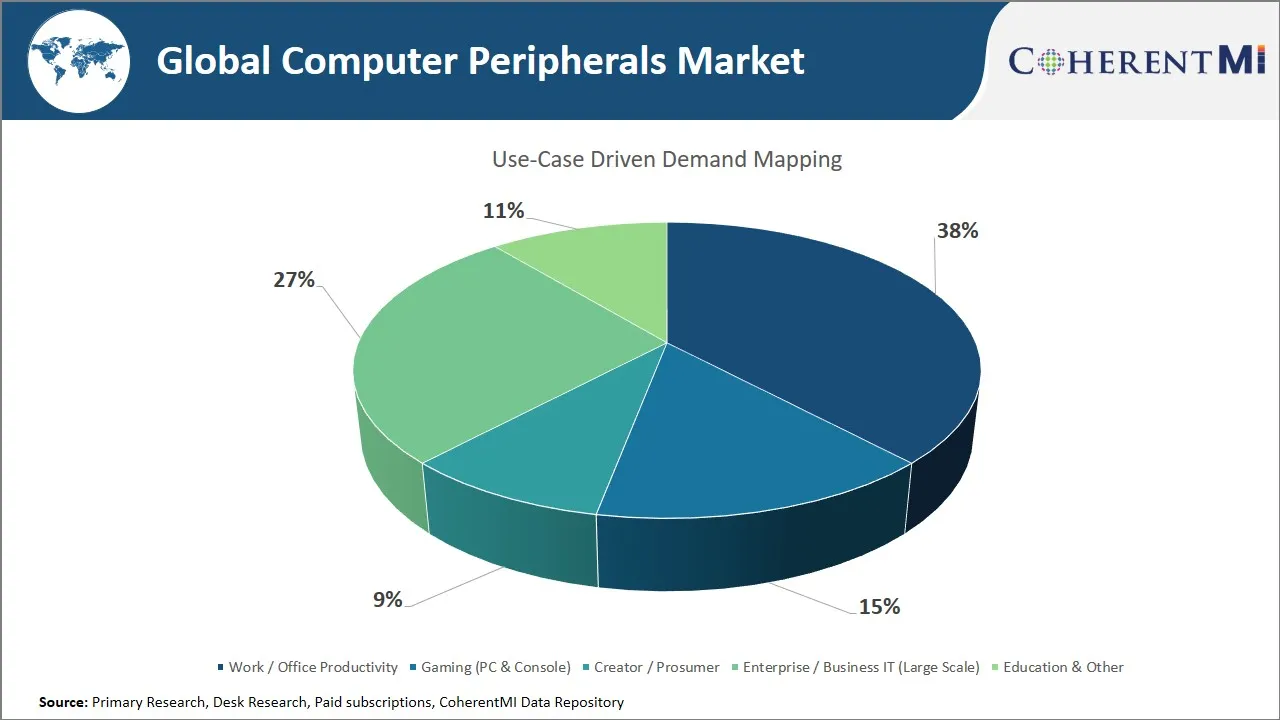
Use-Case Driven Demand Mapping:
 To learn more about this report, Request Free Sample Copy
Key winning strategies adopted by key players of Computer Peripherals Market
Product Innovation and R&D Investment Strategy: Logitech International has invested 8-10% of its annual revenue in R&D for the last 5 years. It also launched MX Master 3 series with electromagnetic scrolling technology, introduced Logi Bolt wireless technology for enterprise security and developed Blue Yeti X microphone with real-time LED meter.
Strategic Acquisitions and Vertical Integration: HP Inc. acquired HyperX gaming division from Kingston Technology for USD 425 million. It integrated HyperX's gaming headset and keyboard expertise and leveraged HP's global distribution network for HyperX products.
Segmental Analysis of Computer Peripherals Market
 To learn more about this report, Request Free Sample Copy
Insights, By Product: Digital Transformation and User Interface Evolution Drive Input Devices’ Dominance
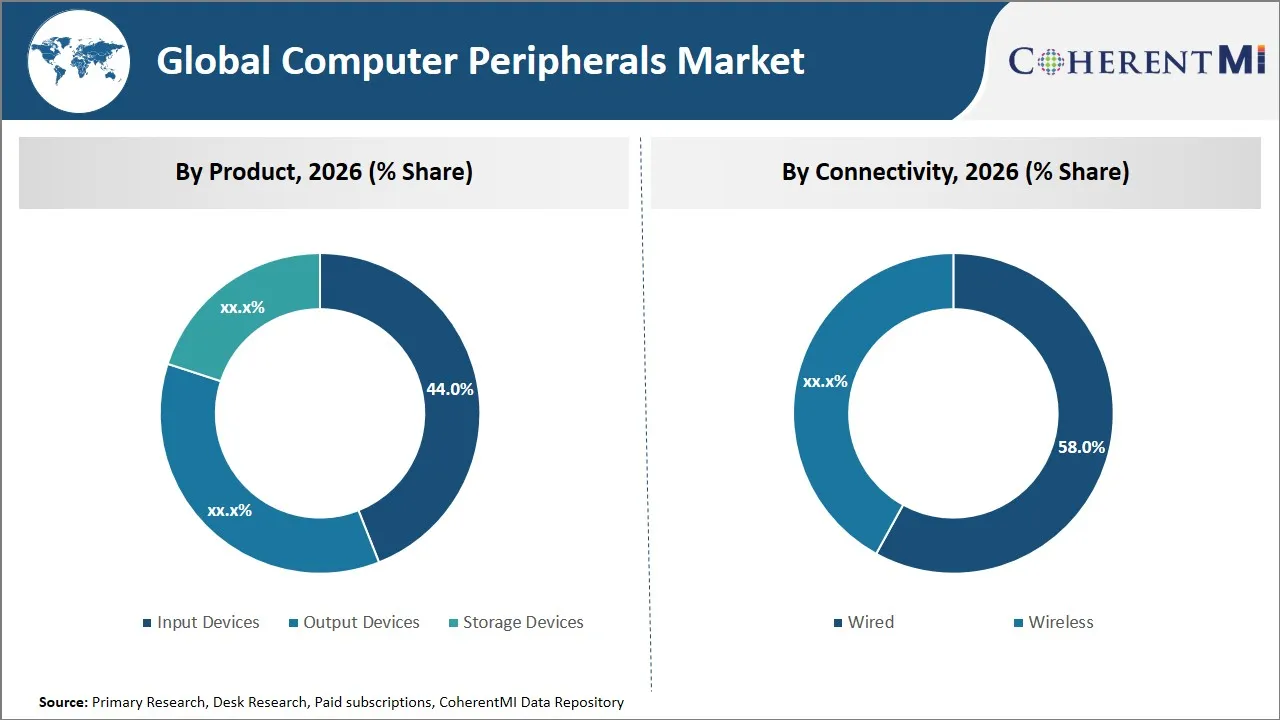
In terms of product, the input devices segment is expected to account for 44% of the market share in 2026. A major reason for expansion lies in how crucial these tools are for communication between people and machines, along with shifts in today's tech settings. Leading position comes not by chance but due to being at the core of user-system contact, present without exception in every form of computer use.
From homes turned into offices, a shift toward remote setups drives interest in advanced tools for typing and navigation. With longer days spent at makeshift desks, comfort-focused keyboards gain attention alongside highly accurate pointing devices. Equipment designed for specific tasks now sees greater consideration among those adapting to new routines.
Furthermore, a surge in gaming's reach plays a central role. As esports rise, alongside everyday play and competitive scenes, needs shift toward tailored gear. Demand grows where precision matters most.
For instance, on January 6, 2026, CORSAIR unveiled the GALLEON 100 SD at CES 2026. A full-sized mechanical keyboard with Stream Deck integration, Galleon fuses CORSAIR and Elgato engineering into one groundbreaking device.
(Source: corsair.com)
Insights, By Connectivity: Reliability and Performance Stability Sustain Wired Connectivity Leadership
In terms of connectivity, wired is expected to acquire 58% of the market share in 2026. This expansion exists because physical links hold natural benefits - benefits that often surpass wireless ease when tasks demand precision. Though convenience tempts, stability still leans on cables where failure is not an option. Performance stays steady through wires, shaped by needs no signal can guarantee. Where operations must endure without pause, metal conducts what air cannot carry.
Corporate offices tend toward cabled devices because they offer stable performance plus fewer access risks. Rather than relying on signals through air, these setups depend on physical links that do not degrade under network load. One benefit lies in consistent function without sudden power loss or signal overlap from nearby electronics. Security teams appreciate the reduced exposure since data does not broadcast beyond fixed pathways.
For instance, on October 16, 2025, ASUS Republic of Gamers (ROG) announced the Azoth 96 HE, the latest addition to the ROG Azoth gaming keyboard series. The Azoth 96 HE boasts a load of upgrades over other series offerings, including ROG HFX V2 magnetic switches, a new 96% layout for versatility, and up to 8000Hz polling rate.
(Source: press.asus.com)
Additional Insights of Computer Peripherals Market
- Output devices are expected to hold a dominant position after input devices owing to the increasing demand for high quality displays.
- Wireless is expected to follow the wired segment in terms of connectivity, owing to the increasing use of TWS earbuds and headphones.
- Asia Pacific led the computer peripherals market with a 49% revenue share in 2026, driven by increasing expenditure in R&D.
- North America is expected to witness the fastest growth in the global computer peripherals market due to a booming gaming industry in the region.
Competitive overview of Computer Peripherals Market
The major players operating in the global computer peripherals market include Logitech International S.A, HP Inc, Dell Technologies, Apple Inc, Canon Inc, Samsung Electronics, Corsair Gaming, Razer Inc, Kingston Technology, BenQ, A4Tech, Trust International B.V, Epson, Toshiba, and Microsoft Corporation.
Computer Peripherals Market Leaders
- Logitech International S.A
- Corsair Gaming
- Razer Inc
- HP Inc
- Dell Technologies
Recent Developments in Computer Peripherals Market
- On January 6, 2025, CORSAIR announced its upcoming lineup of products that are designed to help professional and aspiring professional gamers take their skills to the next level. This lineup is currently being shown at CES 2026 and includes new carbon-fiber and magnesium alloy models of CORSAIR’s award-winning SABRE v2 PRO Ultralight Wireless Gaming Mouse, the new MM PRO Control Esports-Tuned Cloth Mouse Pad, and the MAKR PRO 75 Hall Effect DIY Keyboard.
- On February 4, 2025, Epson announced the launch of 12 new 3-chip 3LCD PowerLite L-Series laser projectors. The new PowerLite L-Series was displayed at ISE in Barcelona.
Computer Peripherals Market Segmentation
- By Product
- Input Devices
- Output Devices
- Storage Devices
- By Connectivity
- Wired
- Wireless
- By End User
- Residential
- Commercial

Would you like to explore the option of buying individual sections of this report?
As an accomplished Senior Consultant with 7+ years of experience, Pooja Tayade has a proven track record in devising and implementing data and strategy consulting across various industries. She specializes in market research, competitive analysis, primary insights, and market estimation. She excels in strategic advisory, delivering data-driven insights to help clients navigate market complexities, optimize entry strategies, and achieve sustainable growth.