Broadcast Equipment Market SIZE AND SHARE ANALYSIS - GROWTH TRENDS AND FORECASTS (2026 -2033)
Broadcast Equipment Market is segmented By Product Type (Dish Antennas, Switches, Video Servers, Tra...
Broadcast Equipment Market Size - Analysis
The Global Broadcast Equipment Market is estimated to be valued at USD 6 Bn in 2026 and is expected to reach USD 9.50 Bn by 2033, exhibiting a compound annual growth rate (CAGR) of 7% from 2026 to 2033. This steady rise comes from growing need for improved broadcast tools, not just on TV and radio but also across new online channels. Boosted by major spending to upgrade networks, alongside shifts from older analog formats toward digital setups, progress continues as more people use internet-based streaming that depends on complex hardware. Equipment demands grow stronger when delivery methods evolve beyond conventional models into connected environments.
Market Size in USD Bn
CAGR7%
| Study Period | 2026 -2033 |
| Base Year of Estimation | 2025 |
| CAGR | 7% |
| Market Concentration | High |
| Major Players | Cisco Systems Inc, Telefonaktiebolaget LM Ericsson, CommScope, Evertz Microsystems Ltd, Harmonic Inc. and Among Others |

please let us know !
Broadcast Equipment Market Trends
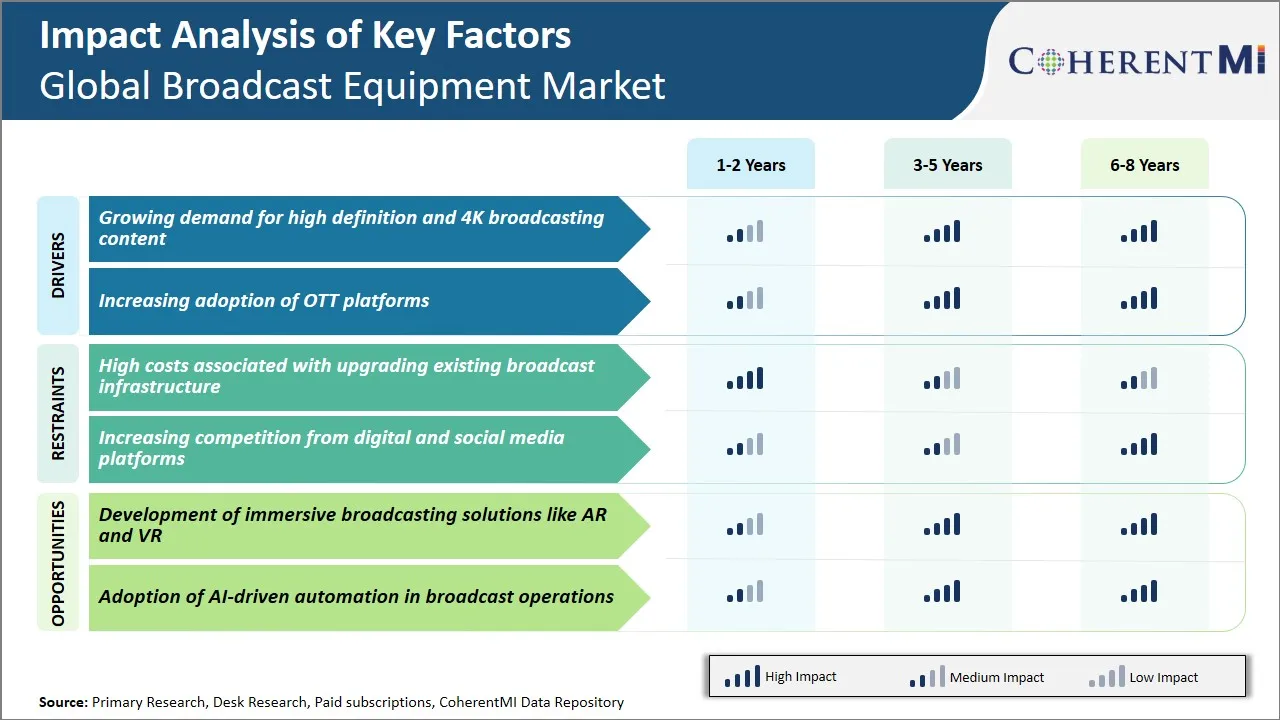
Market Driver - Growing Demand for High Definition and 4K Broadcasting Content
Nowhere is change more evident than in how broadcasts are delivered, shaped by rising demands for sharper images. High definition plus 4K have shifted from extras to basics across platforms. Driven less by choice than necessity, firms now update tools to keep pace. Clarity matters more today, pulling entire production chains toward higher standards. Progress here does not pause; it pushes steadily ahead.
It is clear how TV makers helped drive interest, lowering prices so more people could own 4K screens. As high-resolution sets spread into homes across continents, networks began facing quiet but firm expectations to deliver matching quality programming.
For instance, on January 28, 2026, Comcast’s Xfinity announced the launch of RealTime4K, a new ultra-low latency technology that gives customers the fastest, most lifelike experience for viewing live sports in 4K. This innovative format will deliver the Super Bowl to Xfinity TV customers just seconds behind the on-field action, and up to 30 seconds faster than other 4K providers.
(Source: corporate.comcast.com)
Market Driver - Increasing Adoption of OTT Platforms
Unexpected shifts began with over-the-top platforms surging beyond conventional limits, altering long-standing broadcast frameworks while sparking fresh needs in hardware across international markets. Instead of relying on legacy systems, these services bypass centralized control, using web-based networks to deliver material straight to viewers, transforming who controls access and how signals move globally.
Streaming services around the world set standards in technology and content quality, raising what viewers expect regardless of platform. As these companies poured resources into high-end AI in networks, their influence pushes older broadcast models toward similar upgrades. Advanced streaming methods adjust automatically to user conditions, a feature now seen as essential.
For instance, on October 2, 2025, Hulu announced that it became a global general entertainment brand on Disney+. With this change, and in preparation for a fully integrated unified app experience, users will begin to see further integrations of Hulu across the Disney+ app as part of an ongoing and iterative slate of product updates on the homepage and beyond.
(Source: thewaltdisneycompany.com)
 To learn more about this report, Request Free Sample Copy
Market Challenge - High Costs Associated with Upgrading Existing Broadcast Infrastructure
The need for costly upgrades poses a major hurdle across the international broadcast equipment sector. Facing aging setups, many stations find it difficult to afford shifts toward advanced methods like 4K/8K Ultra HD. Instead of gradual updates, full-scale transformations demand heavy investment.
Still, swift changes in technology mean systems grow outdated faster, making frequent updates necessary despite their expense. On top of this, rules differ by location, which leads to tailored setups that add layers to both planning and spending.
Market Opportunity - Development of Immersive Broadcasting Solutions like AR and VR
Immersive tech like AR and VR is shifting how broadcast gear evolves worldwide, altering both production methods and audience interaction. Driven forward through increased demand for deeper engagement, momentum builds as remote lifestyles push digital media into sharper focus. Moreover, growth of interactive streaming is also a major bonus for the growth of broadcast equipment.
With 5G expanding, transmission of augmented reality and virtual reality material to handhelds and head-mounted displays grows faster due to reduced delays and increased data flow. Immersive broadcasts gain traction as pioneers show profit potential, virtual shows, athletic competitions, and reporting draw strong audiences, leading to higher ad value.
For instance, on September 5, 2025, Emergent announced a series of high-profile partnerships and collaborations to be featured at IBC2025. The company will highlight its ability to merge cutting-edge data integration with creative visualization, demonstrating how its technology empowers broadcasters, event producers, and enterprises to deliver dynamic real-time content.
(Source: tvtechnology.com)
Global Broadcast Equipment Market - Regional Spectrum & 5G Broadcast Deployment Impact
|
Region |
5G Broadcast/LTE-5G Broadcast Deployments |
|
Asia Pacific |
600+ broadcast initiatives launched |
|
Japan: 22 5G broadcast nodes deployed | |
|
India: LTE broadcast in 14 metropolitan areas | |
|
China: >80 broadcast pilot programs | |
|
Europe |
400+ mobile towers upgraded for broadcast support |
|
65%+ broadcaster participation in hybrid broadcast-broadband pilots | |
|
Middle East & Africa |
40+ cities hosting broadcast pilots |
|
28 active broadcast projects in UAE & Saudi Arabia | |
|
7 municipalities with 5G broadcast systems in South Africa |
Key winning strategies adopted by key players of Broadcast Equipment Market
- Strategic Technology Innovation and R&D Investment: Sony invested USD 2.3 billion in broadcast technology R&D over five years, developing the FX9 camera system and complete IP workflow solutions. Sony launched HDC-5500 4K/HD camera system and developed PWS-110SC1 SxS memory card station. These initiatives resulted in 23% increase in professional broadcast equipment revenue and market share growth from 18% to 22% in professional cameras segment. Sony successfully supplied equipment for Tokyo Olympics, generating USD 450 million in additional revenue.
- Strategic Acquisitions and Vertical Integration: Blackmagic acquired Fairlight Audio for USD 20 million and Fusion Visual Effects for USD 15 million. These acquisitions resulted in revenue growth from USD 180 million to USD 520 million and market share increase in post-production equipment from 12% to 28%. The company also achieved 65% gross margins through integrated product offerings.
Segmental Analysis of Broadcast Equipment Market
 To learn more about this report, Request Free Sample Copy
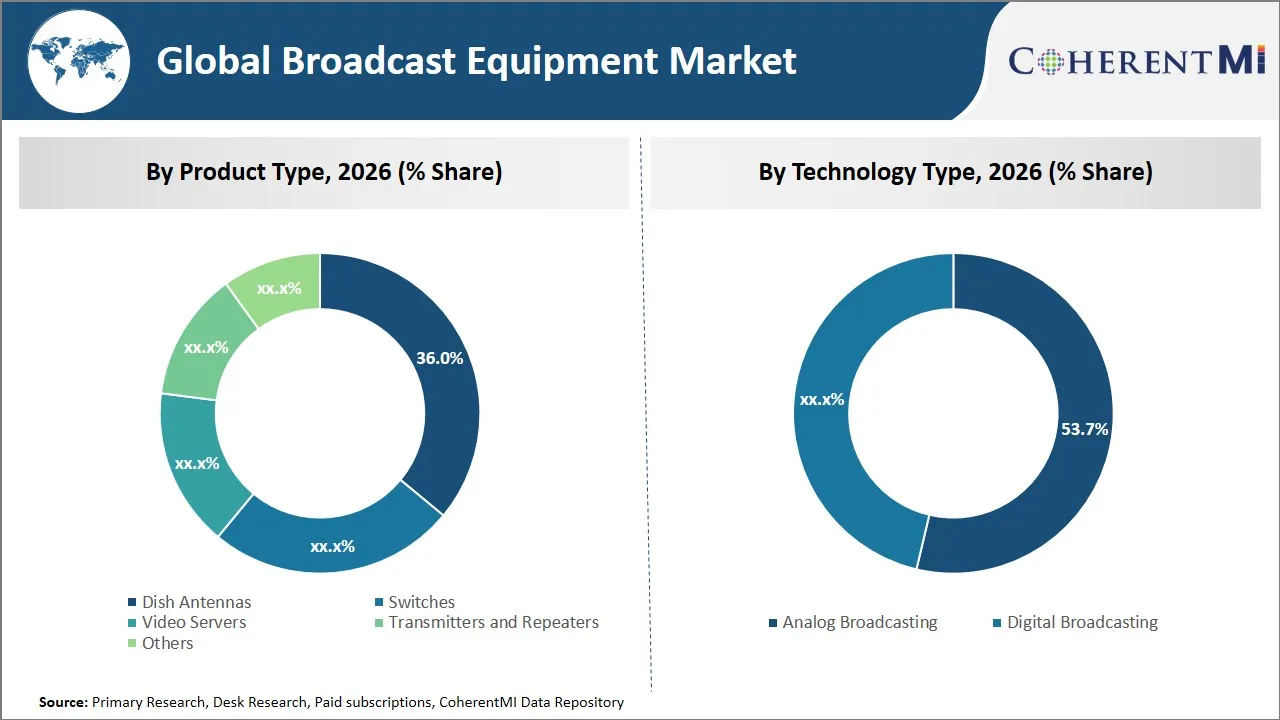
Insights, By Product Type: Dish Antennas Dominate Product Segment Owing to Superior Signal Reception and Technological Versatility
In terms of product type, the dish antennas segment is expected to account for 36% of the market share in 2026. A major reason behind the rise lies in how these structures serve as core components for receiving signals across global transmission systems. Because they efficiently collect and direct radio waves from orbiting sources, parabolic reflectors maintain a leading position. Their widespread use continues due to consistent performance in ground-based and space-linked communication setups.
One reason dish antennas see broad use lies in how well they handle signal clarity. Because they focus radio waves at a single spot, reception improves sharply while background noise drops. Owing to this design, transmissions stay sharp even under challenging conditions. For broadcasters aiming to meet high output benchmarks, such reliability proves essential. Despite alternatives existing, few match the consistency offered here.
For instance, on May 16, 2024, DISH Network and Hughes Network Systems announced a new bundled service offering that brings the power of DISH satellite TV together with Hughesnet satellite internet to create a superior solution in TV and internet. In the modern, ultra-connected world, quality entertainment and reliable connectivity are crucial to the modern rural home, making this collaboration between DISH and Hughesnet a critical step toward enhanced accessibility.
(Source: ir.echostar.com)
Insights, By Technology Type: Analog Broadcasting Maintains Market Leadership Despite Digital Transition Through Established Infrastructure and Cost Advantages
In terms of technology type, analog broadcasting segment is expected to account for 53.7% of the market share in 2026. Although older systems remain in place, expansion is driven by long-standing networks alongside high costs tied to full digital shifts. What keeps analog transmission alive lies in operational practicality - legacy setups still produce income, even as updates proceed step by step.
Despite massive financial commitments, dismantling existing analog broadcast setups proves impractical within short timeframes. Worldwide, radio and television rely heavily on long-established transmission methods, making transitions costly and complex. Equipment once considered standard now anchors entire operational frameworks - studios, processors, distribution - all shaped by analog requirements. Shifting away demands more than new hardware; it requires rethinking entrenched workflows rooted in legacy design.
Additional Insights of Broadcast Equipment Market
- Broadcasters increasingly use REMI workflows for major live events and sports to reduce on-site costs and centralize production controls.
- European broadcasters (U.K., Germany, France) increasingly use REMI for sports and live entertainment due to regulatory support and telecom upgrades.
- Rapid digital and 5G rollouts in China, Japan, South Korea and India are boosting the adoption of remote production workflows.
- REMI adoption in Latin America is improving but remains at a smaller scale.
- Adoption rates in the Middle East & Africa remain relatively modest compared to other regions.
Competitive overview of Broadcast Equipment Market
The major players operating in the Global Broadcast Equipment Market include Cisco Systems Inc, Telefonaktiebolaget LM Ericsson, CommScope, Evertz Microsystems Ltd, Harmonic Inc., EVS Broadcast Equipment, Grass Valley, Sony Corporation, Panasonic Corporation, Avid Technology, Wellav Technologies Ltd, Clyde Broadcast, Belden Inc., AVL Technologies, and NEP Group.
Broadcast Equipment Market Leaders
- Cisco Systems Inc
- Telefonaktiebolaget LM Ericsson
- CommScope
- Evertz Microsystems Ltd
- Harmonic Inc.
Recent Developments in Broadcast Equipment Market
- On May 22, 2024, Hollyland Technology announced the launch of the Pyro series, a new wireless video transmission system. The Pyro range, comprising Pyro H, Pyro S, and Pyro 7, brings innovative multi-person mobile wireless image transmission and monitoring solutions to small or medium commercial and television shooting teams.
- On February 29, 2024, VMware, recently acquired by Broadcom Inc, announced that DISH Wireless has deployed VMware Telco Cloud Service Assurance across the Boost Wireless Network in a pilot production environment to deliver real-time network monitoring, assurance and automation, providing a superior 5G network and subscriber experience.
Broadcast Equipment Market Segmentation
- By Product Type
- Dish Antennas
- Switches
- Video Servers
- Transmitters and Repeaters
- Others
- By Technology Type
- Analog Broadcasting
- Digital Broadcasting
- By Application
- Television
- Radio

Would you like to explore the option of buying individual sections of this report?
Ramprasad Bhute is a Senior Research Consultant with over 6 years of experience in market research and business consulting. He manages consulting and market research projects centered on go-to-market strategy, opportunity analysis, competitive landscape, and market size estimation and forecasting. He also advises clients on identifying and targeting absolute opportunities to penetrate untapped markets.