Robotic Vacuum Cleaners Market SIZE AND SHARE ANALYSIS - GROWTH TRENDS AND FORECASTS (2026 - 2033)
Robotic Vacuum Cleaners Market is segmented By Product (Floor Vacuum Cleaner, Pool Vacuum Cleaner), ...
Robotic Vacuum Cleaners Market Size - Analysis
The global robotic vacuum cleaners market is estimated to be valued at USD 7 Bn in 2026 and is expected to reach USD 15 Bn by 2033, growing at a compound annual growth rate (CAGR) of 13% from 2026 to 2033. This steady rise shows how more people are using smart home devices while interest grows in automatic cleaning tools at homes and workplaces alike. What fuels this shift is progress in artificial intelligence, longer-lasting batteries, better movement control in machines, yet also lower prices that allow average earners around the world to afford robot vacuums easier now.
Market Size in USD Bn
CAGR13%
| Study Period | 2026 - 2033 |
| Base Year of Estimation | 2025 |
| CAGR | 13% |
| Market Concentration | Medium |
| Major Players | iRobot Corporation, Ecovacs Robotics, Xiaomi Corporation, Samsung Electronics Co Ltd, Haier Group Corporation and Among Others |

please let us know !
Robotic Vacuum Cleaners Market Trends
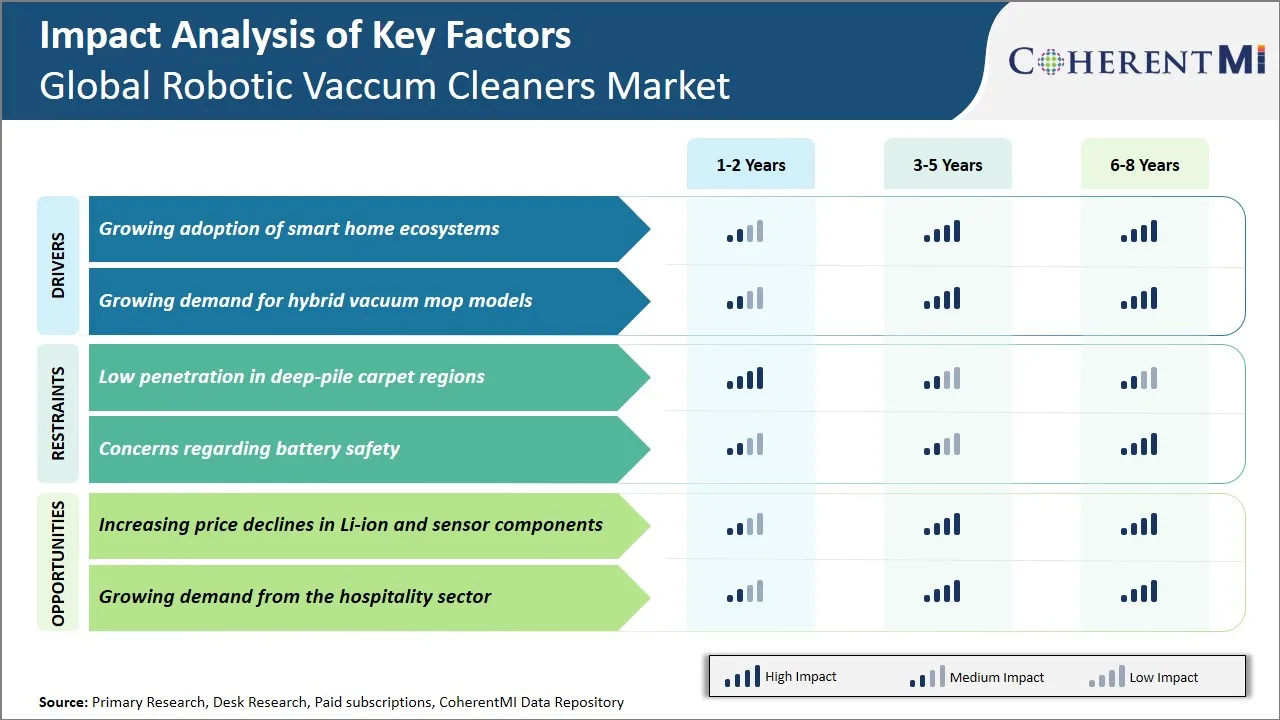
Market Driver - Growing Adoption of Smart Home Ecosystems
A shift has taken place in how households adopt technology, with devices increasingly linked through shared command platforms. What marks many modern residences is a collection of appliances that exchange information effortlessly, overseen by centralized hubs. Because these elements work together, decisions about purchases, like choosing self-guided vacuum models, are shaped differently than before. Interaction among machines follows predefined patterns, reducing the need for ongoing oversight.
What once seemed optional now feels routine: robotic vacuums occupy central roles in modern living spaces shaped by digital advancement. Through links to widely used household systems and dedicated mobile interfaces, today's models shift how people engage with upkeep tools. Commands spoken aloud initiate tasks.
For instance, on January 4, 2026, Samsung Electronics Co., Ltd. unveiled its Companion to AI Living vision at The First Look, its CES 2026 event held Las Vegas. The focus of the event was on AI as Samsung’s philosophy, a foundation that connects the company’s R&D product development, operations, and user experience.
(Source: news.samsung.com)
Market Driver - Growing Demand for Hybrid Vacuum Mop Models
With hybrid vacuum-mop units now available, a notable shift has occurred in automated floor cleaning. These machines respond directly to user dissatisfaction with limited one-task robots. Instead of focusing solely on dust pickup, they combine functions that cover more ground - literally. Where older models struggled on mixed surfaces, newer versions adapt. Performance once restricted to bare floors or carpets alone now extends across varied materials. This broader utility supports wider adoption in homes where different floor types coexist. Over time, such flexibility influences purchasing patterns.
Nowhere else have vacuum designs adapted so fully to real home conditions. Where floors change type room by room, these units shift tasks without user input. Instead of relying on multiple machines, one device handles both dust removal and wet wiping. Performance stays consistent whether moving over smooth tiles or sensitive wood finishes. With precision fluid release paired with strong airflow, results meet practical expectations. Not every model manages this balance equally well.
For instance, on January 6, 2026, ECOVACS ROBOTICS showcased its latest next-generation, multi-scenario robotic solutions at CES 2026 in Las Vegas, including the all-new DEEBOT T90 PRO OMNI, the DEEBOT X12 Family, together with new robotic window cleaner WINBOT, robotic lawn mower GOAT.
(Source: ecovacs.com)
 To learn more about this report, Request Free Sample Copy
Market Challenge - Low Penetration in Deep-Pile Carpet Regions
In certain areas like the Middle East and select European locales, dense textiles underfoot limit device mobility. Thick rugs define cleaning expectations across some North American households too. Cultural attachment to soft flooring complicates automation uptake. Performance issues arise when bristles meet lofty fibers. Preferences shaped by comfort slow technological integration.
Despite advances, most robot vacuums fail to pull dirt effectively from thick carpet piles, needing several rounds where conventional models complete the task in one. Moving across carpets of varying thickness remains a challenge for their sensors, sometimes causing halts mid-route. Efficiency drops when wheels lose traction on uneven surfaces. Some units restart incorrectly after such stops, wasting time.
Market Opportunity - Declining Costs of Li-Ion Batteries and Sensor Components
A sharp drop in prices for lithium-ion batteries, alongside lower expenses for high-precision sensors, opens new pathways for growth in robot vacuum markets worldwide. About seventy percent less is now paid for these power cells compared to five years ago, thanks largely to mass-scale output linked to electric cars and refinements in how they are made. With cheaper energy storage available, companies can offer models that run longer without charging while also lowering retail prices. These shifts reshape what consumers expect from automated cleaning devices.
As these expenses align, production of once-exclusive functions becomes feasible at lower price points. Because of shifting financial patterns, premium functionalities now reach mass-market devices. With adjusted pricing strategies, companies maintain solid returns even when cutting costs significantly. Where affordability matters most, such as parts of Latin America or Southeast Asia, demand begins to shift. Lowered retail values, possibly by nearly a third, invite broader consumer entry. Advanced cleaning robots increasingly appear within reach of average earners worldwide.
For instance, on June 18, 2024, Coulomb Solutions Inc. (CSI), announced even greater price reductions on its highly dependable CATL battery packs effective for customers placing large volume orders.
(Source: prnewswire.com)
AI Navigation & Sensor Tier Economics:
|
Technology Tier |
Approx. Adoption |
Typical Price Tier |
|
LiDAR Navigation |
~60%+ of new models |
USD 300–USD 500+ |
|
AI Mapping & Obstacle Recognition |
~48% adoption increase |
Premium tier (USD 500+) |
|
vSLAM (Visual SLAM) |
Lower than LiDAR at scale |
USD 250–USD 400 |
|
Basic/Random Navigation (IR/Wall sensors) |
Budget entry |
<USD 150–USD 250 |
|
Sensor Cost (LiDAR chips) |
~USD 12–USD 15 per unit |
Drives price down |
Subscription Model & Post-Purchase Revenue Forecasts:
|
Revenue Source |
2026 Estimated |
2033 Forecast |
|
Consumable Sales (Filters, Brushes, Bags, Mops, Liquids) |
USD 1.5 Bn |
USD 6.0 Bn |
|
Software/Cloud Service Subscriptions |
USD 0.5 Bn |
USD 2.8 Bn |
|
Premium Service Plans (Protection, Support) |
USD 0.4 Bn |
USD 1.8 Bn |
|
Device Subscription (Robot-as-a-Service / Financing) |
USD 0.3 Bn |
USD 2.5 Bn |
Key winning strategies adopted by key players of Robotic Vacuum Cleaners Market
- Technology Innovation and R&D Investment Strategy: iRobot invested USD 180 million annually in R&D (15-20% of revenue) from 2015-2023. iRobot revolutionized the market with the launch of Imprint Smart Mapping technology introduced in the Roomba i7 series.
- Strategic Ecosystem Development: Xiaomi introduced the Mi Home ecosystem integration in 2022. Xiaomi leveraged its broader smart home ecosystem including integration with 300+ Mi Home devices and unified mobile app controlling entire smart home.
Segmental Analysis of Robotic Vacuum Cleaners Market
 To learn more about this report, Request Free Sample Copy
Insights, By Product: Advanced Navigation Technology and Multi-Surface Adaptability Drive Floor Vacuum Cleaner Dominance
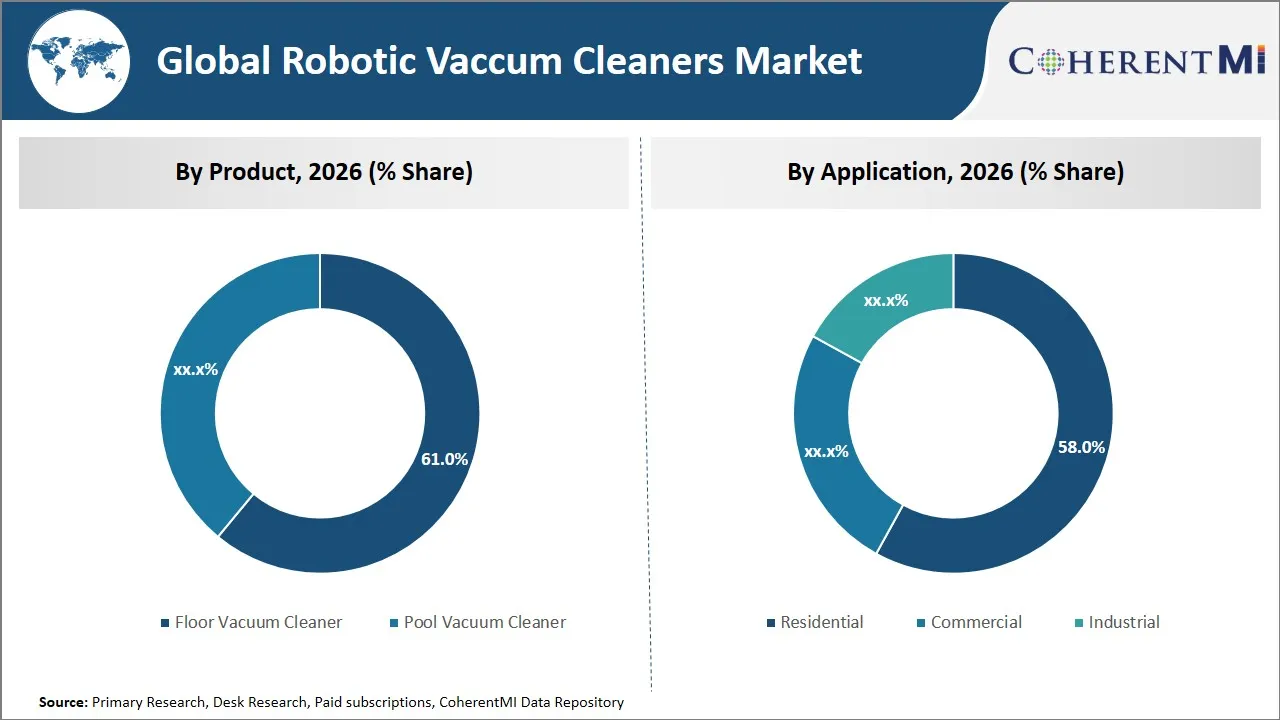
In terms of product, floor vacuum cleaner is expected to account for 61% of the market share in 2026. Growth comes from advanced technology combined with broad cleaning functions meeting varied floor demands in homes and workplaces. Floor vacuum cleaners lead because they move easily across different surfaces such as hardwood, tile, carpet, laminate, or vinyl.
The growing use of smart technology and sensors pushes floor vacuum cleaners forward. Instead of bumping around, many now rely on LiDAR combined with infrared systems to build accurate layouts of rooms. Their internal logic adjusts movement based on real-time data so paths stay organized. Because of this, units steer clear of edges like stairways while still covering every reachable spot. Movement flows logically due to background calculations that prevent repeats or stuck positions.
For instance, on January 5, 2026, Bosch announced the launch of its first ever cordless stick vacuum in the U.S., the Bosch Unlimited 10 and 9.
(Source: businesswire.com)
Insights, By Application: Lifestyle Evolution Shaping Housing Trends to Fuel Residential Segment Leadership
In terms of application, the residential segment is expected to capture 58% share in 2026. Change in daily routines has influenced expansion, as city living spreads together with evolving family structures focused on saving time. Homes lead the market because more owners choose automatic cleaning tools to manage busy jobs alongside upkeep duties.
As city lifestyles continue to shape housing trends, demand rises in residential zones where people live in apartments or tight quarters and look for practical ways to keep homes tidy. Because many newer homes blend living areas into one another and mix floor types needing frequent care, machines that clean floors by themselves fit well into daily routines. Where space is limited, small units that navigate narrow spots become useful, fitting easily into corners after finishing tasks.
Additional Insights of Robotic Vacuum Cleaners Market
- Pool vacuum cleaner is expected to hold a dominant position after floor vacuum cleaner owing to increasing demands for efficient lawn and pool cleaning.
- Commercial is expected to follow the residential segment in terms of application, owing to the increasing use of robotic vacuum cleaners in public facilities like shopping malls and multiplexes.
- Asia Pacific led the robotic vacuum cleaners market with a 41% revenue share in 2026, driven by increasing expenditure on R&D.
- North America is expected to witness the fastest growth in the global vacuum cleaners market due to increasing adoption of smart home systems in the region.
Competitive overview of Robotic Vacuum Cleaners Market
The major players operating in the global robotic vacuum cleaners market include iRobot Corporation, Ecovacs Robotics, Xiaomi Corporation, Beijing Roborock Technology Co Ltd, SharkNinja Operating LLC, Neato Robotics Inc, Cecotec Innovaciones S.L, Panasonic Corporation, Samsung Electronics Co Ltd, Dyson Ltd, Electrolux AB6, Haier Group Corporation, ILIFE Innovation Ltd, Anker Innovations, and Vorwerk SE and Co.
Robotic Vacuum Cleaners Market Leaders
- iRobot Corporation
- Ecovacs Robotics
- Xiaomi Corporation
- Samsung Electronics Co Ltd
- Haier Group Corporation
Recent Developments in Robotic Vacuum Cleaners Market
- On January 6, 2026, Roborock announced the debut of its new product line-up for the first half of the year at the Consumer Electronics Show 2026 (CES 2026) taking place in Las Vegas. The product line included the Saros Rover, the world's first robotic vacuum with AI-powered wheel-leg architecture that can both navigate stairs and slopes with human-like agility while cleaning them. Announcements also included the Roborock Saros 20, Roborock Saros 20 Sonic, Roborock F25 ACE Pro, and Roborock Qrevo Curv 2 Flow.
- On September 3, 2025, BSH Home Appliances Group and ECOVACS ROBOTICS announced a global strategic partnership. The two companies are combining their expertise and focusing on joint development to bring innovative and intelligent floor cleaning solutions to market.
Robotic Vacuum Cleaners Market Segmentation
- By Product
- Floor Vacuum Cleaner
- Pool Vacuum Cleaner
- By Application
- Residential
- Commercial
- Industrial
- By Distribution Channel
- Offline
- Online

Would you like to explore the option of buying individual sections of this report?
Vipul Patil is a dynamic management consultant with 6 years of dedicated experience in the pharmaceutical industry. Known for his analytical acumen and strategic insight, Vipul has successfully partnered with pharmaceutical companies to enhance operational efficiency, cross broader expansion, and navigate the complexities of distribution in markets with high revenue potential.