Interactive Whiteboard Market SIZE AND SHARE ANALYSIS - GROWTH TRENDS AND FORECASTS (2026 - 2033)
Interactive Whiteboard Market is segmented By Form Factor (Fixed, Portable), By Projection Type (Fro...
Interactive Whiteboard Market Size - Analysis
The global interactive whiteboard market is estimated to be valued at USD 5.10 Bn in 2026 and is expected to reach USD 9.80 Bn by 2033, growing at a compound annual growth rate (CAGR) of 7.5% from 2026 to 2033. A steady upward trend emerges as schools and workplaces embrace digital tools, fueled by needs for better group work and display systems. Backing arrives through public policies encouraging tech-equipped classrooms, distance education demands, not only in advanced nations but also developing ones. Emphasis shifts toward active instruction methods, shaping how spaces adapt globally.
Market Size in USD Bn
CAGR7.5%
| Study Period | 2026 - 2033 |
| Base Year of Estimation | 2025 |
| CAGR | 7.5% |
| Market Concentration | Medium |
| Major Players | BenQ, Boxlight, Cisco Systems Inc, Panasonic Corporation, Sharp Corporation and Among Others |

please let us know !
Interactive Whiteboard Market Trends
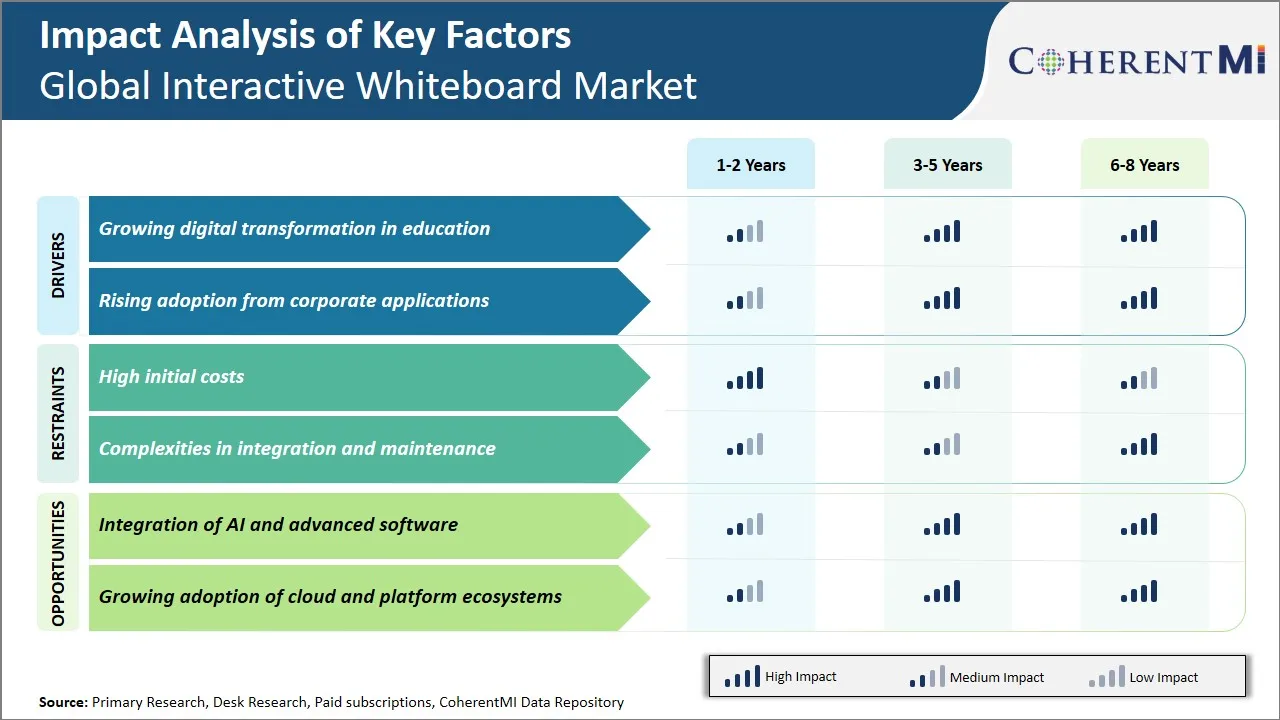
Market Driver - Growing Digital Transformation in Education
Change moves fast across education systems everywhere, as schools adopt digital tools to support teaching and meet new classroom needs. Not long ago seen as optional, interactive whiteboards now sit at the center of daily instruction, altering both lesson delivery and student response. Nowadays, learning spaces at every level are moving away from chalk dust and one-way talks. Instead of sitting still, students engage through motion, images, fitting responses. These changes do not discard order or meaning. They aim for real connection - lessons felt more than heard. Attention stays present when activity replaces silence. Structure remains, though it bends toward life.
Even though older teaching styles remain common, instruction now moves differently because of interactive whiteboards - lessons unfold in layers, blending videos, motion graphics, live simulations, while inviting group work on screen. Not standing apart, these screens gather resources smoothly: online syllabi, electronic books, cloud-held media, shaping classes that reach further yet connect more directly.
For instance, on January 21, 2025, Samsung Electronics unveiled its new AI-powered Interactive Display (WAFX-P model) at Bett 2025, Europe’s largest education technology exhibition. Through Samsung AI Assistant, the education-focused display combines advanced hardware and cutting-edge AI capabilities to create smarter learning environments that are more engaging and collaborative.
(Source: news.samsung.com)
Market Driver - Rising Adoption from Corporate Applications
Despite common trends, many firms now rely on interactive whiteboards to reshape how teams exchange ideas, work together, because these tools adapt easily within different departments. As market pressures grow, companies focus on streamlining workflows by adopting methods that encourage joint problem-solving - this shift places digital boards at the center of daily operations. Instead of traditional setups, organizations choose dynamic displays where inputs from multiple participants merge smoothly during sessions due to real-time responsiveness. Where once outdated methods decline, this kind of tool adapts quietly to how teams now gather, particularly in discussions demanding precision. When choices depend on mutual awareness within groups, clear communication becomes essential through its function.
Fixed forms once shaped meetings. Now, motion defines them. Not limited to static layouts, exchange flows without strict order. Rather than a lone voice leading, contributions build together. In place of stacked reports, screens respond to fingers. Input arrives through taps, swipes, adjustments by many hands. Direction comes not from the front, yet grows among participants. Marks appear, shift, link - thoughts in real time.
For instance, on May 20, 2025, ViewSonic Corp. presented its latest integrated visual innovations at its annual Visual Solution Forum. Through real-world demonstrations, ViewSonic showcased how its user-centric ecosystem drives more efficient, collaborative, and productive ways of working across a wide range of business applications.
(Source: viewsonic.com)
 To learn more about this report, Request Free Sample Copy
Market Challenge - High Initial Costs
Despite growing interest, high initial costs limit how quickly interactive whiteboards spread worldwide. Where budgets are tight, schools find it hard to shift from old methods to these digital tools. In emerging regions, education systems face pressure keeping up without enough funds available. Businesses of smaller scale weigh many needs before choosing such equipment. Limited money means companies must decide carefully where to spend, often delaying upgrades. Other priorities tend to take precedence over new display solutions in daily operations.
One more aspect demands attention, preparing users through instruction so they can operate dynamic tools, which increases total deployment spending. In different regions, reactions to cost differ sharply, some developing areas hesitate to embrace high-cost options even when advantages in learning and teamwork are clear.
Market Opportunity - Integration of AI and Advanced Software Solutions
Despite rising complexity in learning spaces, artificial intelligence shifts how interactive whiteboards function - transforming handwritten notes, improving rough drawings into clear visuals, while quietly advancing multilingual translation during live sessions. Driven by internal logic systems, such tools adapt without effort, supporting comprehension for varied individuals independent of digital familiarity. Growth follows quietly, driven by subtle shifts rather than sudden breakthroughs.
Through advanced software links, connection to cloud platforms becomes smooth, so access to large online collections is possible alongside remote teamwork, while material stays updated instantly on various gadgets. Learning environments shift when educational companies use artificial intelligence. By observing student interactions, systems adjust responses to fit individual needs. Instruction evolves through personalized patterns instead of fixed formats. These changes allow broader access while improving effectiveness across varied classroom settings.
For instance, on September 13, 2025, ZTE Corporation, a global leading provider of integrated information and communication technology solutions, demonstrated its innovative AI-Powered Video Conference Board at the IBC2025 exhibition.
(Source: zte.com.cn)
Hybrid Work & Remote Collaboration Use Cases
|
Use Case Category |
Key Metrics / Numbers |
|
Hybrid Corporate Meetings |
~320,000 IWB units deployed in business |
|
Remote Team Collaboration |
78% of Fortune 500 companies reported using collaborative tools including IWBs/projected displays |
|
Hybrid Educational Instruction |
>62% of K-12 and higher-ed classrooms in North America/Europe use IWBs |
|
Project Planning & Strategy Workshops |
Europe workforce example: ~41% remote, ~28% hybrid |
|
Training & Onboarding for Hybrid Staff |
~45% of industrial businesses in Germany had IWBs in training as of 2025 survey context. |
Key winning strategies adopted by key players of Interactive Whiteboard Market
- Product Innovation and Technology Leadership: SMART Technologies invested in multi-touch technology integration and software ecosystem development. SMART Technologies pioneered the integration of multi-touch capabilities in their SMART Board series, allowing multiple users to interact simultaneously. This innovation came at a critical time when collaborative learning was gaining prominence. The company invested USD 45 million annually in R&D and launched SMART Board 800 series with dual-touch technology.
- Strategic Partnerships and Channel Development: Promethean Partnered with major educational publishers like Pearson and McGraw-Hill and established relationships with 40+ regional distributors globally. It Created Activ Inspire software with integrated curriculum content and launched Promethean Planet, a community platform with 1.8 million educators.
Segmental Analysis of Interactive Whiteboard Market
 To learn more about this report, Request Free Sample Copy
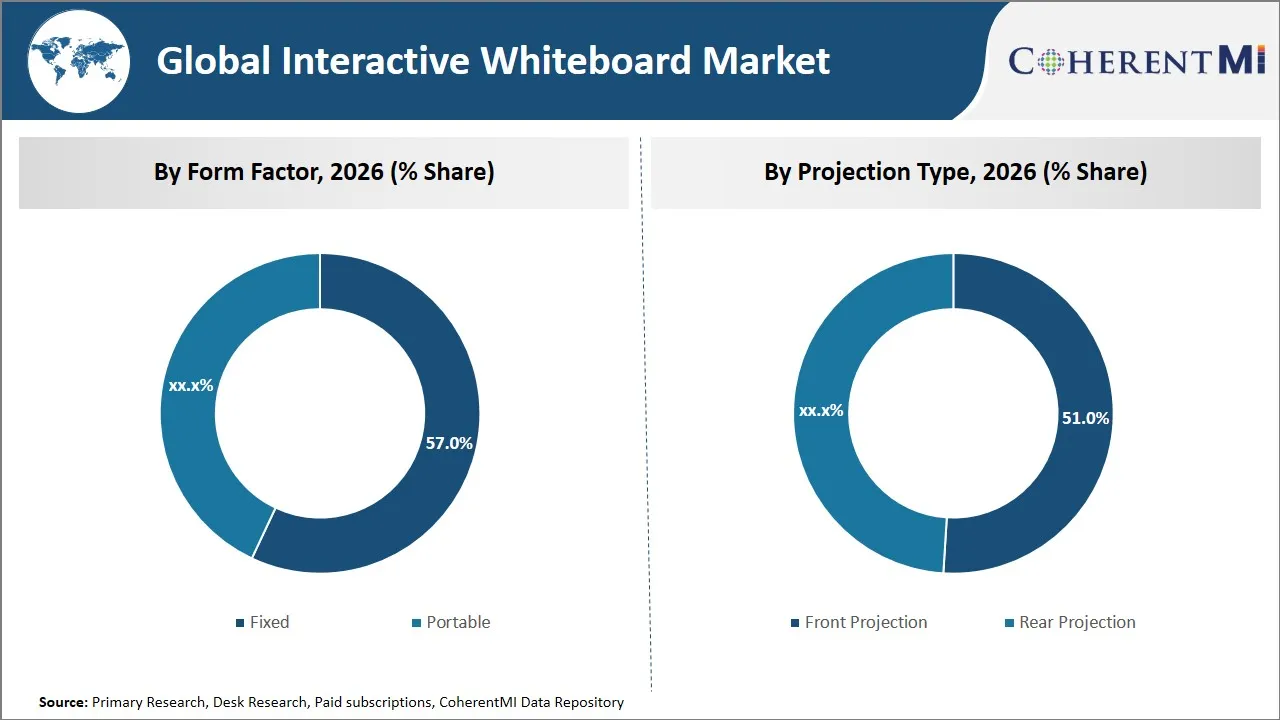
Insights, By Form Factor: Institutional Permanence and Infrastructure Integration Drive Market Leadership for Fixed Interactive Whiteboards
In terms of form factor, fixed is expected to account for 57% of the market share in 2026. The rise stems not just from broader acceptance but also from how widely schools and companies now embed fixed systems into daily operations. Long-term use guides the design of these areas, where permanence takes priority rather than short-lived arrangements. Built to match existing structures, cables, supports, programs, they settle into place because they do not force change. Not driven by newness, but shaped by steady function, their value grows through repeated use. This quiet reliability becomes the reason so many institutions continue relying on them.
Mounted screens find strong preference within learning environments. Whether classrooms, training halls, or lecture spaces, fixed installations suit ongoing daily use. When equipment faces continuous interaction, stability becomes a deciding factor. Unlike portable versions, which degrade quicker through relocation, built-in units withstand persistent operation. Long-term reliability often outweighs flexibility in these settings. Endurance shapes selection where usage is steady and intense. When lessons move swiftly - new groups, shifting times, the equipment stays steady across intervals.
For instance, on November 27, 2024, RICOH launched the IWB A series of fixed interactive whiteboards. The RICOH Interactive Whiteboard A series offers three versatile models designed to meet the diverse needs of modern organizations, IWB A6510, IWB A7510 and IWB A8610. These models differ in their touchscreen sizes, offering 65-inch, 75-inch and 86-inch options, adapted for conference rooms, classrooms or large collaboration spaces.
Insights, By Projection Type: Cost-Effectiveness and Installation Flexibility Fuel Market Supremacy for Front Projection Technology
In terms of projection type, front projection is expected to account for 51% of the market share in 2026. Owing to affordable setup costs, adoption rates rise where financial limits shape decisions. Because minimal changes suit existing spaces, schools and midsize firms find value without overhaul demands. What draws interest is how accessible tools grow more appealing when powerful functions cost little. When schedules press hard, simple setup matters most during busy work periods. Where clarity meets purpose, projection techniques rise in preference without fuss. Even weak systems adapt well once broad compatibility removes old barriers. Entry barriers lower significantly if prior systems do not block integration paths.
Cost efficiency defines why front projection systems lead in market preference. With smaller upfront expenses than rear projection models, they appeal strongly to schools managing limited financial resources. Because their design is less intricate, dedicated enclosures become unnecessary along with extra csooling mechanisms and elaborate reflective components found in rear setups. Over time, these factors combine to diminish total ownership expenses through simpler setup procedures and fewer servicing demands.
Additional Insights of Interactive Whiteboard Market
- Mid-range boards (75”) typically cost USD 1,800–3,200 per unit (excluding software, installation, and training).
- Premium large models (85″+) can exceed USD 7,000 per unit before ancillary installation and support costs are added.
- Education remains dominant, accounting for ~60–65% of total deployments globally, with universities and K-12 schools the primary users.
- Around 60%+ of teachers in developing regions cite limited training/tech proficiency as a significant barrier to effective use.
- ~30–40% of smaller schools and institutions delay adoption due to high upfront costs and lack of support infrastructure.
Competitive overview of Interactive Whiteboard Market
The major players operating in the global interactive whiteboard market include BenQ, Boxlight, Cisco Systems Inc, Epson, Google LLC, Hitachi, Ltd, Microsoft Corporation, Newline Interactive, Panasonic Corporation, Promethean Limited, Ricoh, SAMSUNG, Sharp Corporation, SMART Technologies ULC and ViewSonic Corporation.
Interactive Whiteboard Market Leaders
- BenQ
- Boxlight
- Cisco Systems Inc
- Panasonic Corporation
- Sharp Corporation
Recent Developments in Interactive Whiteboard Market
- On May 7, 2025, Promethean announced a partnership with Google to develop and launch a new Chromebox OPS compute device that pairs effortlessly with Promethean’s interactive flat panel displays (IFPDs).
- On February 3, 2025, SMART Technologies announced the launch of three groundbreaking products at Integrated Systems Europe (ISE) 2025: the SMART Board Mini interactive podium, the SMART Board M Pro High Secure Series TAA Interactive Display, and the SMART OneLaunch meeting tool.
- On August 30, 2024, BenQ announced the launch of its newest interactive displays, the BenQ Board Essential RE04 series, which has the lowest power consumption of any ENERGY STAR certified smart board on the market.
Interactive Whiteboard Market Segmentation
- By Form Factor
- Fixed
- Portable
- By Projection Type
- Front Projection
- Rear Projection
- By Technology Type
- Infrared
- Resistive Touch
- Electromagnetic Pen
- Capacitive
- Others
- By Application
- Education
- Corporate
- Commercial
- Others

Would you like to explore the option of buying individual sections of this report?
Gautam Mahajan is a Research Consultant with 5+ years of experience in market research and consulting. He excels in analyzing market engineering, market trends, competitive landscapes, and technological developments. He specializes in both primary and secondary research, as well as strategic consulting across diverse sectors.