Solar Microinverter Market SIZE AND SHARE ANALYSIS - GROWTH TRENDS AND FORECASTS (2026 -2033)
Solar Microinverter Market is segmented By Type (Single Phase, Three Phase), By Power Rating (Below ...
Solar Microinverter Market Size - Analysis
The Global Solar Microinverter Market is estimated to be valued at USD 3.50 Bn in 2026 and is expected to reach USD 11 Bn by 2033, exhibiting a compound annual growth rate (CAGR) of 18% from 2026 to 2033. A clear upward trend emerges as market dimensions widen, shaped by broader integration of decentralized solar setups along with progress in how effectively power is converted. Growth continues steadily under these influences. The market demonstrates strong momentum as residential and commercial sectors increasingly prioritize modular solar solutions that offer enhanced monitoring capabilities and improved energy harvest optimization.
Market Size in USD Bn
CAGR18%
| Study Period | 2026 -2033 |
| Base Year of Estimation | 2025 |
| CAGR | 18% |
| Market Concentration | Medium |
| Major Players | SMA Solar Technology AG, Canadian Solar, SolarEdge Technologies Inc., Complete Solaria, Delta Electronics, Inc. and Among Others |

please let us know !
Solar Microinverter Market Trends
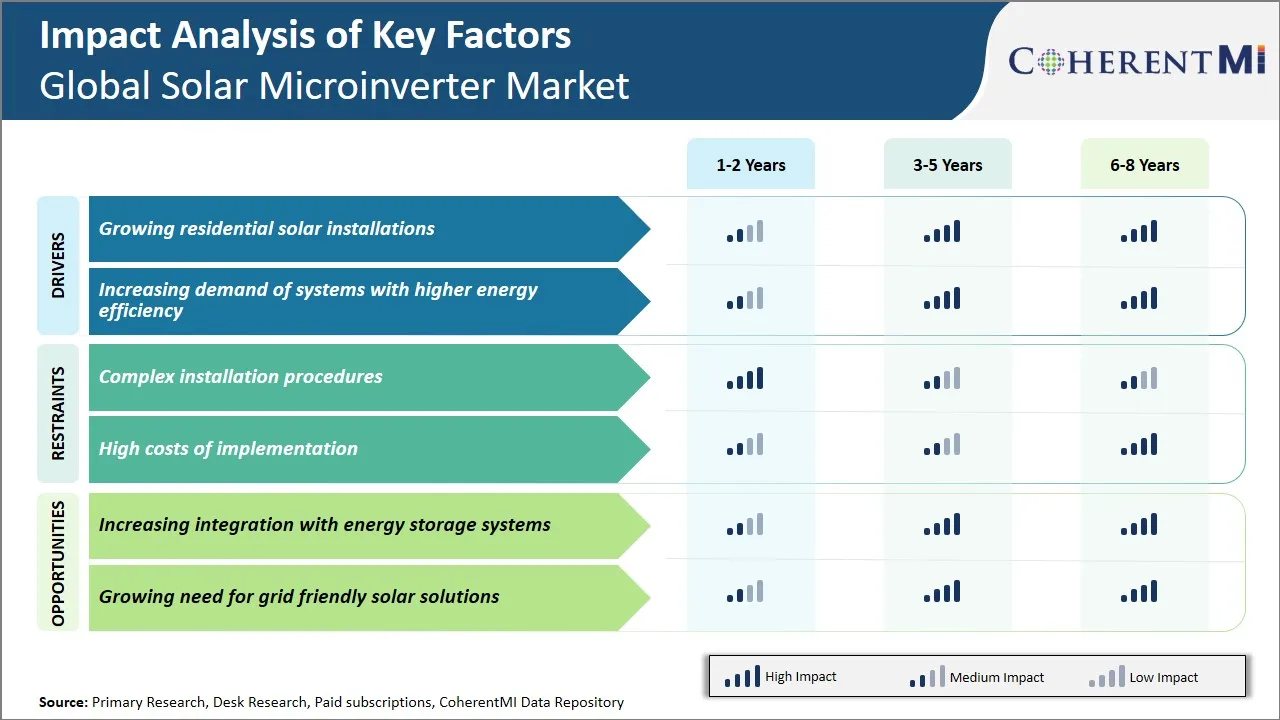
Market Driver - Growing Residential Solar Installations
Across the world, homes equipped with solar panels have become more common, altering how widely microinverters are used in everyday energy setups. Growth in rooftop installations now plays a central role in advancing demand for microinverter solutions, since property owners observe performance improvements compared to older string-based models. Momentum arises less from isolated triggers than from layered forces, shifting economies, adjusted regulations, together with rising demands for performance, that gradually support placing microinverters into compact energy systems.
Across the globe, support from public authorities has shaped how quickly homes adopt solar power. Where rules encourage change, outcomes often follow. Financial benefits like rebates or billing adjustments influence homeowner decisions more than expected. In places using these tools, households show consistent interest in rooftop setups. One small device stands out under each panel: it adjusts output individually. That detail improves total yield over time.
For instance, on January 5, 2026, Tata Power Solaroof, a subsidiary of Tata Power Company Limited achieved a significant milestone of 1 GWp installed rooftop solar capacity. The Tata Power Solaroof added more than 1.7 lakh installations, registering a remarkable 345% YoY growth compared to 38,494 installations in the corresponding period of Financial Year 2025.
(Source: tatapower.com)
Market Driver - Increasing Demand for Systems with Higher Energy Efficiency
A growing focus on using less electricity shapes solar market trends, leading to more frequent adoption of microinverters across different areas and applications. As a result, individuals responsible for solar systems whether through ownership, installation, or oversight now prioritize higher performance, driven by both economic considerations alongside decreased dependence on grid-supplied energy.
Each microinverter works on its own, adjusting output per panel so weak sunlight affects only one unit. Instead of linking panels together, these devices prevent underperforming units from dragging down overall system yield. Where older setups rely on a single central converter, flaws in any part reduce total production. Performance stays higher because faults stay isolated, not spread across the circuit.
For instance, on May 1, 2025, Enphase Energy, Inc, a global energy technology company and the world's leading supplier of microinverter-based solar and battery systems, announced that it had shipped more than 6.5 million IQ Microinverters and 50 MWh of IQ Batteries from U.S. contract manufacturing facilities.
(Source: investor.enphase.com)
 To learn more about this report, Request Free Sample Copy
Market Challenge - Complex Installation Procedures
Despite growing interest, global demand for solar microinverters encounters obstacles linked to intricate setup methods. Installation complexity slows uptake in homes and businesses alike. Where string inverters allow simple connections, these systems need separate fitting per panel. Each unit must be fixed and connected on its own. This raises duration and workforce expenses markedly. Progress remains limited as a result.
Qualified installers require deep understanding of power networks along with targeted education, limiting their numbers. In developing regions, fitting microinverters demands complex skills that rise sharply due to gaps in both trained workers and supporting frameworks.
Market Opportunity - Increasing Integration with Energy Storage Systems
Power stability becomes more achievable when solar microinverters combine with battery storage, altering market dynamics worldwide within ten years. Where sunlight varies, such pairings smooth supply without losing efficiency unique to small-scale inverters. Homes and businesses gain reliable output, reducing grid reliance through smarter setups. Benefits grow quietly where consistency meets innovation, shifting how power needs are met.
Now found in advanced microinverters, smart power handling aligns smoothly with batteries. Coordination happens without disruption, shaping how energy flows through a home. Real-time usage data guides when to store, draw, or redirect power. Performance shifts quietly in response to grid signals and household demand. Where electricity rates change by hour, these systems adapt automatically. Areas limited in net metering benefit from delayed exports.
For instance, on March 24, 2025, Sunrun announced a new innovative partnership with Pacific Gas and Electric Company (PG&E). The collaboration will utilize hundreds of Sunrun solar-plus-storage customer homes to deliver targeted load relief to neighborhoods identified with highly constrained electric grids.
(Source: investors.sunrun.com)
Global Solar Microinverter Market - Installer Economics & Labor Time Savings
|
Metric |
Microinverter System |
|
Upfront Cost per Watt |
~USD 0.55 – USD 0.65/W |
|
Installation Time (Residential) |
3.5 hours saved (plug‑and‑play) |
|
Installer Labor Efficiency Gain |
~10–15% faster in complex layouts |
|
Reduced Callbacks / Troubleshooting |
30–40% less time |
|
Additional System Cost (5 kW) |
~USD 1,000 – USD 2,000 more |
|
Impact on Labor in Shaded/Multi‑Orientation Roofs |
~50% reduction vs string |
|
Lifetime Service Labor Reduction |
~30–40% fewer site visits |
Global Solar Microinverter Market - Failure Rates & Lifetime Reliability Metrics
|
Metric |
Microinverters |
String Inverters |
|
Typical Warranty Duration |
20–25 years |
10–15 years |
|
Early Failure Rate (1st 2 yrs) |
<0.125% (~1 in 800) |
~0.89% (~1 in 112) |
|
Claims / Failure Rate (per 1,000 units) |
~0.55 per 1,000 (0.055%) |
~10.3 per 1,000 (1.03%) |
|
Target Manufacturer Failure Rate |
~0.05% (~1 in 2,000) |
~0.5% |
|
Mean Time Between Failures (MTBF) |
~20–25 years equivalent |
~10–15 years equivalent |
|
Predicted Operational Lifetime |
~24–48 years (74% reliability) |
Not commonly quantified |
|
Failure Impact on System Output |
~3–4% loss per failed micro in typical 30‑panel system |
~100% loss if string inverter fails |
|
Field Survey 15‑yr Failure Likelihood (general inverters) |
~34.3% for residential inverters (all types) |
~34.3% |
Key winning strategies adopted by key players of Solar Microinverter Market
- Technology Innovation and R&D Leadership: Enphase Energy launched the first-generation microinverters with 95% efficiency and introduced IQ series with 97.5% peak efficiency. Furthermore, it released IQ 7 series with 97.5% weighted efficiency and advanced grid-tie capabilities and launched IQ8 series with "sunlight backup" capability, enabling solar-only operation during outages.
- Strategic Partnerships and Channel Development: Enphase Energy launched "Enphase Installer Network" with over 3,000 certified installers and provided comprehensive training programs and technical support. It developed installer-friendly tools and mobile applications and implemented tiered partnership programs with volume incentives.
Segmental Analysis of Solar Microinverter Market
 To learn more about this report, Request Free Sample Copy
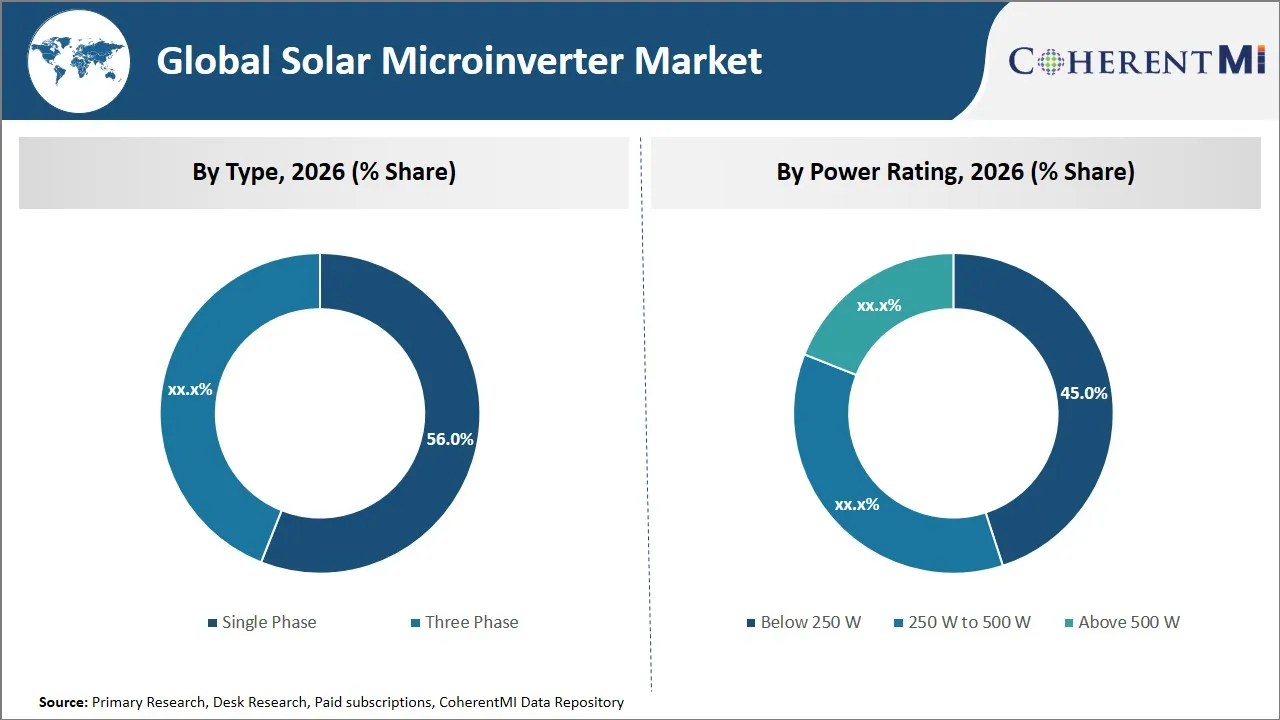
Insights, By Type: Cost-Effectiveness and Residential Installation Simplicity Drive Single Phase Leadership
In terms of type, single phase is expected to account for 56% of the market share in 2026. The growth ties closely to natural alignment with home wiring setups. Cost benefits stand out clearly when applied to modest photovoltaic arrays. Preference has built up around these units given how easily they connect to typical dwelling circuits. Most regions run domestic power on single phase setups - this reality shapes adoption patterns steadily over time.
One reason single phase microinverters lead the market lies in how well they match home energy use. As homes typically run on single-phase power, these devices integrate smoothly without requiring major wiring changes or extra setup costs.
For instance, on February 26, 2025, Hoymiles launched its highly anticipated MiS series microinverters at Intersolar North America 2025, underscoring its commitment to driving innovation in the solar industry.
(Source: hoymiles.com)
Insights, By Power Rating: Perfect Match for Standard Residential Solar Panels and Distributed Generation Drive Below 250 W Segment Leadership
In terms of power rating, below 250 W is expected to account for 45% of the market share in 2026. A major reason for the growth lies in how well it matches common household solar panel outputs, alongside a shift toward localized power setups. Because this level fits typical home system needs - where single panels often operate at or under these levels - it has moved ahead of competitors. Market dominance emerged through focus on practical fit, not broad claims. Its position stems from answering real installation demands, quietly aligning with existing hardware limits.
Despite varying sizes, many home solar setups favor lower output units due to common panel ratings. Where rooftops limit area, systems under 250W match well with existing equipment. Since numerous household arrays fall beneath 300W, especially older ones, smaller microinverters fit seamlessly. Efficiency improves when components are closely matched in capacity. Cost stays low because oversized parts are unnecessary. Compatibility defines success here more than peak performance.
Additional Insights of Solar Microinverter Market
- Three phase segment is emerging as an important segment owing to increasing demands of systems with higher energy efficiency.
- 250 W to 500 W is expected to follow the below 250 W segment in terms of power rating, owing to the growing need for grid friendly solar solutions.
- Asia Pacific is projected to lead the solar microinverter market with a 42% revenue share in 2026, driven by increasing expenditure on R&D.
- North America is expected to witness the fastest growth in the global solar microinverter market due to increasing adoption of smart and energy-efficient home systems in the region.
Competitive overview of Solar Microinverter Market
The major players operating in the global solar microinverter market include SMA Solar Technology AG, Canadian Solar, SolarEdge Technologies Inc., Complete Solaria, Delta Electronics, Inc., Yaskawa Solectria Solar, Sineng Electric Co. Ltd., Hitachi Hi-Rel Power Electronics Private Limited, Sungrow, and Sensata Technologies Inc.
Solar Microinverter Market Leaders
- SMA Solar Technology AG
- Canadian Solar
- SolarEdge Technologies Inc.
- Complete Solaria
- Delta Electronics, Inc.
Recent Developments in Solar Microinverter Market
- On June 14, 2024, Hoymiles launched what it claims to be the largest and most efficient three-phase microinverter on the solar market to date, the new MIT-5000-8T microinverter, at the SNEC tradeshow in Shanghai, China.
- On March 6, 2024, Altenergy Power System Inc. signed a partnership agreement to collaborate with Solarclarity BV at the Solarsolutions Amsterdam trade fair.
Solar Microinverter Market Segmentation
- By Type
- Single Phase
- Three Phase
- By Power Rating
- Below 250 W
- 250 W to 500 W
- Above 500 W
- By Application
- Residential
- Commercial
- Industrial

Would you like to explore the option of buying individual sections of this report?
Pankaj Poddar is a seasoned market research consultant with over 12 years of extensive experience in the fast-moving consumer goods (FMCG) and plastics material industries. He holds a Master’s degree in Business Administration with specialization in Marketing from Nirma University, one of India’s reputed institutions, which has equipped him with a solid foundation in strategic marketing and consumer behavior.
As a Senior Consultant at CMI for the past three years, he has been instrumental in harnessing his comprehensive understanding of market dynamics to provide our clients with actionable insights and strategic guidance. Throughout his career, He has developed a robust expertise in several key areas, including market estimation, competitive analysis, and the identification of emerging industry trends. His approach is grounded in a commitment to understanding client needs thoroughly and fostering collaborative relationships. His dedication to excellence and innovation solidifies his role as a trusted advisor in the ever-evolving landscape of not only FMCG but also chemicals and materials markets.