Synchronous Condenser Market SIZE AND SHARE ANALYSIS - GROWTH TRENDS AND FORECASTS (2026 - 2033)
Synchronous Condenser Market is segmented By Cooling (Hydrogen Cooled, Air Cooled, Water Cooled), By...
Synchronous Condenser Market Size - Analysis
The Global Synchronous Condenser Market is estimated to be valued at USD 1.50 Bn in 2026 and is expected to reach USD 2.25 Bn by 2033, exhibiting a compound annual growth rate (CAGR) of 3% from 2026 to 2033. This consistent upward trend shows how industrial sectors increasingly require stable grids along with effective reactive power management. Because renewable energy connects more often to existing networks, older infrastructure faces upgrades at a faster pace. Voltage control within long-distance lines becomes essential under such conditions. Worldwide shifts toward sustainable generation methods push these developments forward.
Market Size in USD Bn
CAGR3%
| Study Period | 2026 - 2033 |
| Base Year of Estimation | 2025 |
| CAGR | 3% |
| Market Concentration | High |
| Major Players | Siemens Energy, Hitachi Energy Ltd., General Electric, ABB, Eaton and Among Others |

please let us know !
Synchronous Condenser Market Trends
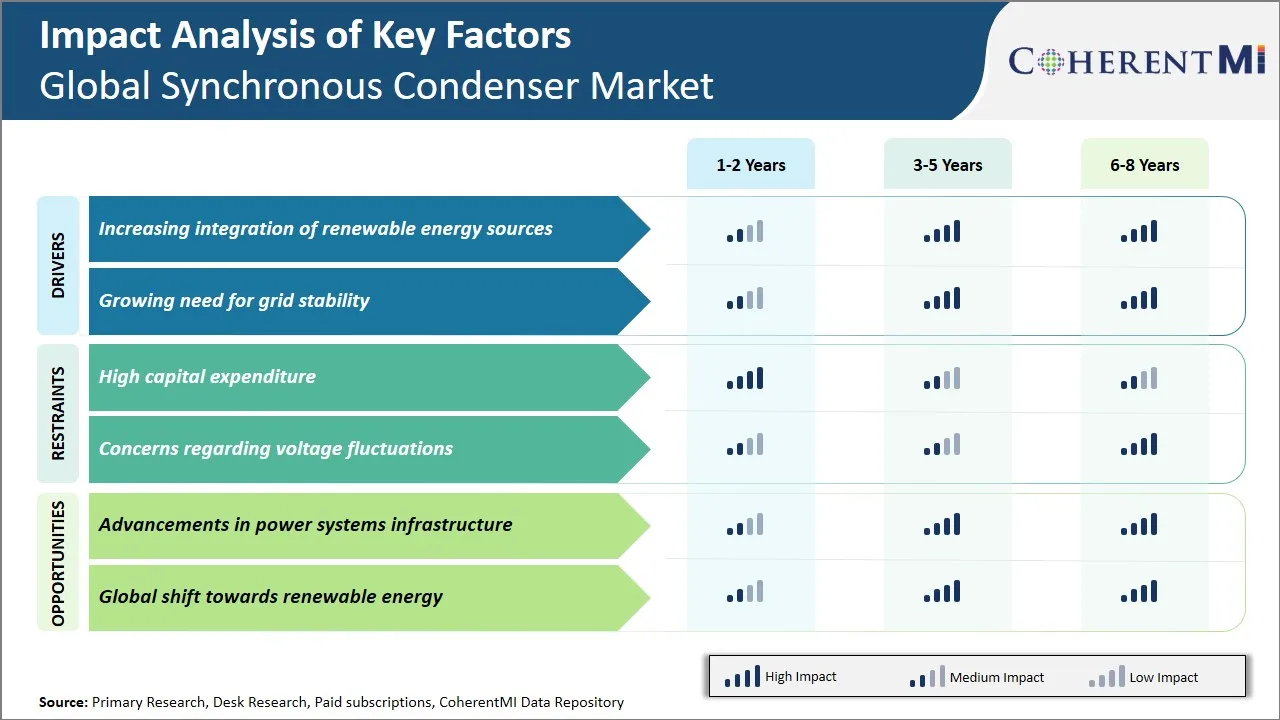
Market Driver - Increasing Integration of Renewable Energy Sources
Around the world, energy systems now change at deeper levels as countries move faster toward cleaner forms of smart energy and power. Instead of relying on coal or oil, many regions adopt wind, sunlight, water flow, and underground heat to generate electricity. These shifts reshape how electric networks behave, introducing new demands on performance. With supply patterns becoming less predictable, coordination within grids grows more complex. New tools emerge not by choice but necessity, helping balance fluctuating inputs across vast lines. Stability can no longer depend on past methods alone. As behaviors evolve beneath the surface, engineering responses follow different logics than before.
For instance, on January 13, 2026, ANDRITZ and AXIA Energia signed a major contract for the supply of six 300-MVAr synchronous condensers and auxiliary systems to four substations within Brazil’s National Interconnected System: Assu III, João Câmara III e, Paracatu IV, and Nova Ponte III.
(Source: andritz.com)
Market Driver - Growing Need for Grid Stability
Though grids grow more intricate, their core task stays unchanged - holding steady under pressure from fresh tech, shifting demands, among varied power generation methods. What keeps a network balanced rests on several linked factors: how fast electrons cycle, how high the push behind them stands, along with brief surges after disruptions. Within tight margins these elements require constant oversight so lights stay on without blackouts or total breakdowns unfolding. As older control strategies falter, newer responses take shape where timing, coordination, alongside precision define success or failure across vast networks.
Frequency stability matters greatly for keeping power grids steady, since production and usage of electricity need constant alignment. Should imbalance arise - caused by abrupt shifts in either supply or demand - the grid's frequency may drift from standard levels. Such deviation risks activating safeguards that isolate parts of the network, possibly setting off wider disruptions across the system.
For instance, on July 22, 2025, ABB announced it has been awarded a large order as the operator of the Sangachal terminal in Azerbaijan, to support the electrification and power grid stability of one of the world’s largest oil and gas terminals. Connection to the country’s national grid will enable the electrification of the site, which covers more than 688 hectares or an area equivalent to more than 800 football pitches.
(Source: swisscham.com)
 To learn more about this report, Request Free Sample Copy
Market Challenge - High Capital Expenditure
Despite their role in grid stability, widespread adoption of synchronous condensers encounters obstacles tied to financial scale. Because they involve massive rotating assemblies paired with intricate support infrastructure, costs rise quickly. Each installation may require anywhere from a few million up to many millions of dollars - exact figures shaped by output needs and design details. High initial outlays deter deployment even when technical benefits are evident.
Longer repayment times, typically lasting between fifteen and twenty years, complicate investment decisions even when future gains exist. For small utility providers and standalone energy suppliers, the burden grows heavier due to limited funds needed for several installations that support balanced electrical networks.
Market Opportunity - Advancements in Power Systems Infrastructure
The worldwide shift toward updated electricity networks opens new paths for synchronous condensers, shaped less by choice than by necessity. As older grids strain under evolving demands, their renewal brings quiet momentum to certain technologies. Renewables grow faster now, especially wind and solar, spreading across regions without uniform patterns. Because supply fluctuates with weather, steady voltage becomes harder to maintain.
Still, focus on stronger grids grows, especially in advanced economies, pushing major spending on systems where synchronous condensers deliver key functions like fault current supply, recovery after outages, and stability during disturbances. As high-voltage lines extend to link renewables and enable cross-border electricity exchange, need rises for voltage control at critical junctions across the network.
For instance, on January 26, 2026, Waaree Renewable Technologies Limited (WRTL) announced that its Board of Directors has approved entering into a binding term sheet for the acquisition of approximately 55% stake in Associated Power Structures Limited (ASPL) through a mix of primary and secondary investment, subject to completion of due diligence and customary closing conditions.
(Source: waaree.com)
Renewable Penetration Thresholds of Synchronous Condensers
|
Grid Stability Impact/Threshold Concern |
Renewable Penetration (% of annual generation/inverter share) |
|
Minimal impact on inertia; synchronous generators still dominant |
~0–20% |
|
Noticeable reduction in rotational inertia; voltage/reactive support begins to decline |
20–40% |
|
System inertia significantly reduced; high RoCoF and deeper frequency nadirs during contingencies |
~40–60% |
|
Low inertia becomes a dominant system risk factor; poor fault current contribution |
60–80% |
|
Conventional generation largely displaced; very low inherent inertia |
>80–90% |
|
No inherent physical inertia; full reliance on control systems |
100% IBR |
Key winning strategies adopted by key players of Synchronous Condenser Market
- Technology Innovation and R&D Investment Strategy: Siemens Energy invested USD 200 million in R&D for next-generation synchronous condensers and developed AI-powered grid stabilization algorithms with integrated IoT sensors for predictive maintenance. By these actions, Siemens secured USD 400 million in new orders within 18 months of launch and increased market share from 18% to 24%, by achieving 30% reduction in maintenance costs for customers.
- Strategic Partnerships and Joint Ventures: ABB and Hitachi Energy collaborated for a joint technology development agreement. The partnership announcement with USD 200 million joint investment commitment established joint manufacturing facility in India and launched co-developed synchronous condenser for renewable energy applications. The players further expanded partnership to include grid modernization solutions.
Segmental Analysis of Synchronous Condenser Market
 To learn more about this report, Request Free Sample Copy
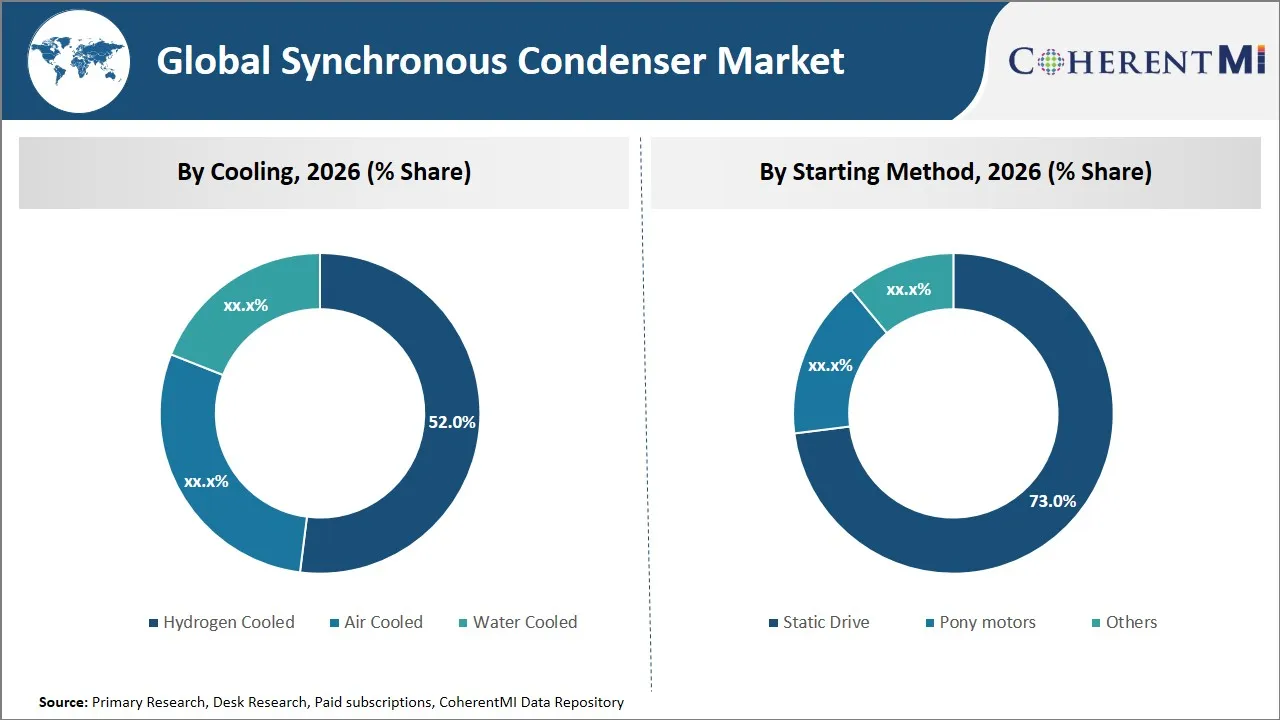
Insights, By Cooling: Superior Heat Dissipation and Operational Efficiency Drive Hydrogen Cooled Segment’s Dominance
In terms of cooling, hydrogen cooled is expected to account for 52% of the market share in 2026. This expansion results mainly from outstanding heat transfer abilities, along with better performance when set beside other cooling techniques. What sets hydrogen apart in synchronous condensers lies in specific physical traits - traits well suited to managing large-scale electrical systems under intense loads. Despite alternatives existing, few match the balance achieved through gaseous properties found only in hydrogen under these circumstances. Efficiency gains emerge not just from speed of heat removal but also stability during continuous operation at elevated outputs.
Despite common assumptions, it is the superior ability of hydrogen to move heat that sets it apart in cooling applications. When contrasted with air, hydrogen conducts thermal energy far more effectively, pulling warmth away from spinning parts and electrical coils inside synchronous condensers. Because heat removal improves under such conditions, equipment builders find room to shrink overall size without sacrificing temperature control. Smaller designs follow naturally, delivering stronger output per unit volume alongside a smaller physical presence on site.
For instance, on May 27, 2025, the GE Vernov and ANDRITZ HYDRO Corp. consortium announced a recognition for engineering, procurement, and construction (EPC) contract for the addition of two synchronous condensers to the LCRA Transmission Services Corporation (LCRA TSC) project at the 345 kV Bakersfield substation in West Texas.
(Source: andritz.com)
Insights, By Starting Method: Advanced Control Capabilities and Grid Integration Efficiency Propel Static Drive’s Leadership
In terms of starting method, static drive is expected to account for 73% of the market share in 2026. Growth stems from advanced control functions along with smooth connection traits fitting modern power systems. Static drives lead in starting synchronous condensers, showing a shift toward precision, faster response, and compatibility within intricate grids. Equipment now adapts better to network demands through refined engineering choices shaped by operational needs rather than legacy designs.
Precision timing and steady operation push the demand for static drives. Through modern electronic components, these systems allow a gradual speed increase in synchronous condensers, beginning at zero up to full rotational match. Such regulation removes strain on machinery while avoiding sudden current shifts typical of older techniques. As a result, repeated activation becomes possible without weakening system durability.
Additional Insights of Synchronous Condenser Market
- Repurposing an existing 100 MVAr generator into a synchronous condenser can cost around USD 15 million, compared to USD 23 million for a comparable new synchronous condenser build.
- Full repurposing of a retired thermal generator (mechanical, electrical and civil modifications) typically requires 15 to 18 months from start to commissioning.
- Many major capital components (stator, rotor, cooling systems, grid connection infrastructure) of a retired generator can be reused, reducing new equipment investment by a significant share (often >50% of the equipment cost).
- Grids in regions like South Australia, Texas, and Ireland already experience 50-60% inverter generation and require significant support.
Competitive overview of Synchronous Condenser Market
The major players operating in the Global Synchronous Condenser Market include Siemens Energy, Hitachi Energy Ltd., General Electric, ABB, Eaton, Mitsubishi Electric Power Products, Inc, Doosan, Alstom SA, ANDRITZ, Ansaldo Energia, Baker Hughes, Bharat Heavy Electricals Limited, Ingeteam, NIDEC Corporation, and Power Systems & Controls, Inc.
Synchronous Condenser Market Leaders
- Siemens Energy
- Hitachi Energy Ltd.
- General Electric
- ABB
- Eaton
Recent Developments in Synchronous Condenser Market
- On November 6, 2025, GE Vernova Inc. announced that it has signed a contract with Transgrid for the supply of synchronous condensers, highly-sought-after equipment that will assist in stabilizing the New South Wales (NSW) grid as it transitions from coal to renewables.
- On May 20, 2025, Siemens Energy announced a partnership with ACEREZ to supply and install synchronous condensers for the Central-West Orana Renewable Energy Zone (REZ) in New South Wales, supporting one of Australia’s most significant renewable energy infrastructure programs.
Synchronous Condenser Market Segmentation
- By Cooling
- Hydrogen Cooled
- Air Cooled
- Water Cooled
- By Starting Method
- Static Drive
- Pony motors
- Others
- By End User
- Utilities
- Industrial

Would you like to explore the option of buying individual sections of this report?
Pankaj Poddar is a seasoned market research consultant with over 12 years of extensive experience in the fast-moving consumer goods (FMCG) and plastics material industries. He holds a Master’s degree in Business Administration with specialization in Marketing from Nirma University, one of India’s reputed institutions, which has equipped him with a solid foundation in strategic marketing and consumer behavior.
As a Senior Consultant at CMI for the past three years, he has been instrumental in harnessing his comprehensive understanding of market dynamics to provide our clients with actionable insights and strategic guidance. Throughout his career, He has developed a robust expertise in several key areas, including market estimation, competitive analysis, and the identification of emerging industry trends. His approach is grounded in a commitment to understanding client needs thoroughly and fostering collaborative relationships. His dedication to excellence and innovation solidifies his role as a trusted advisor in the ever-evolving landscape of not only FMCG but also chemicals and materials markets.