Lightning Arrester Market SIZE AND SHARE ANALYSIS - GROWTH TRENDS AND FORECASTS (2026 - 2033)
Lightning Arrester Market is segmented By Type (Horn Gap, Rod Gap, Sphere, Electrolyte, Metal Oxide ...
Lightning Arrester Market Size - Analysis
The global lightning arrester market is estimated to be valued at USD 924.5 Mn in 2026 and is expected to reach USD 1,465.2 Mn by 2033, exhibiting a compound annual growth rate (CAGR) of 6.8% from 2026 to 2033. This robust growth trajectory reflects the increasing global emphasis on electrical infrastructure protection and the rising frequency of extreme weather events worldwide. The market expansion is primarily driven by escalating investments in power generation, transmission, and distribution infrastructure across emerging economies, coupled with the modernization of aging electrical grids in developed nations.
Market Size in USD Mn
CAGR6.8%
| Study Period | 2026 - 2033 |
| Base Year of Estimation | 2025 |
| CAGR | 6.8% |
| Market Concentration | Medium |
| Major Players | Schneider Electric, Siemens AG, General Electric, ABB Ltd., Eaton Corporation and Among Others |

please let us know !
Lightning Arrester Market Trends
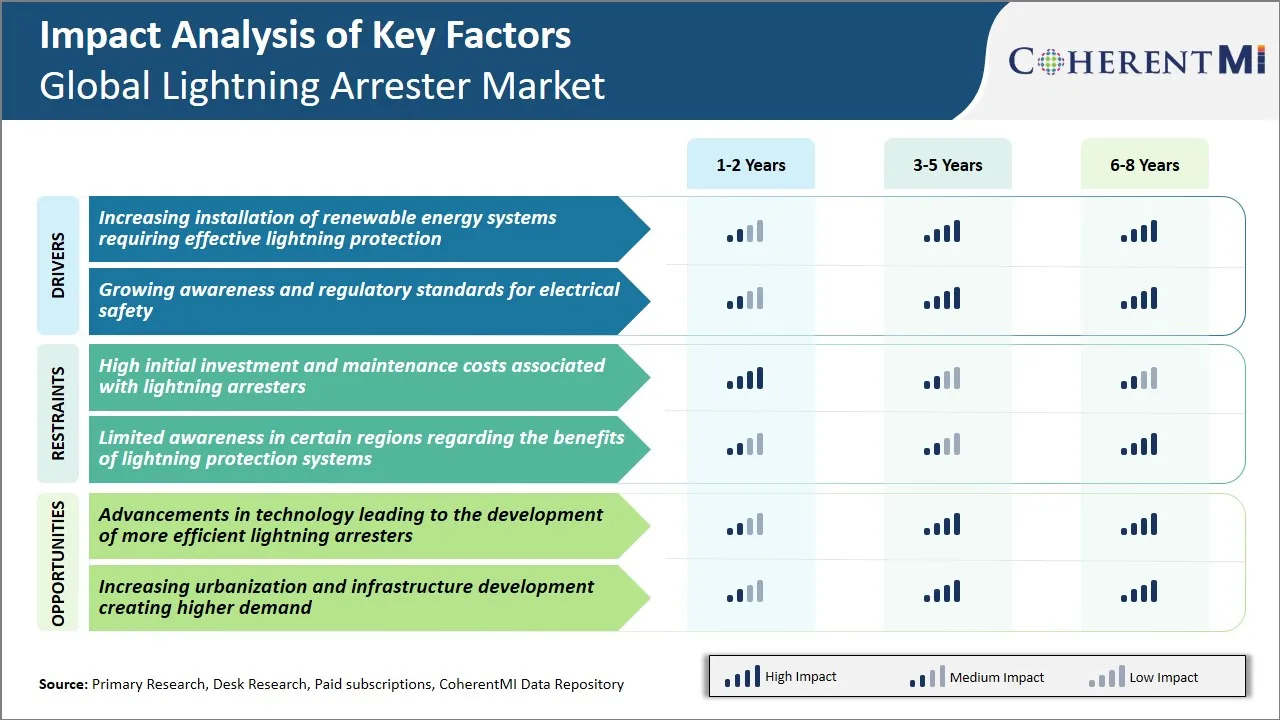
Market Driver - Increasing Installation of Renewable Energy Systems Requiring Effective Lightning Protection
The global energy landscape is experiencing a profound transformation as countries worldwide accelerate their transition toward renewable energy sources, fundamentally reshaping the demand dynamics for lightning protection systems. The solar photovoltaic installations and wind farms among other renewable energy infrastructures are some of the most vulnerable to lightning strike since most of them are highly placed, huge metallic materials with strategic location at the most open and exposed areas where the natural resources are most abundant. The solar power farms in specific pose a distinct problem in lightning protection due to the large-scale arrays of panels mounted on metal structures in large geographical locations and often incorporate areas with high solar energy activity which often overlap site areas with high thunderstorm activity.
Market Driver - Growing Awareness and Regulatory Standards for Electrical Safety
The development of the electrical safety awareness in the industrial, commercial, and residential sphere has produced more advanced perception of the dangers related to lightning and the significant role of the complex protection in keeping the human life and the significant electrical infrastructure safe. This increased awareness is a result of a complex of forces such as better meteorological studies that recorded patterns and intensities of lightning strikes, better lightning related incident reporting systems, and a heightened comprehension of the great financial losses that follow inadequate lightning protection control systems.
The electrical safety regulations have evolved significantly due to recorded lightning-related events, innovation of protection system technologies and increased knowledge of lightning physics and its relationship with the contemporary electrical systems. With a special focus on the critical infrastructure, healthcare facility, educational facility, and high-occupancy buildings, the national and international standards organizations have established more demanding lightning protection systems requirements, where considerations of human safety are the highest priority.
 To learn more about this report, Request Free Sample Copy
Market Challenge - High Initial Investment and Maintenance Costs Associated with Lightning Arresters
The international lightning arrester market is experiencing huge head winds because of high cost of initial capital and cost of maintenance of these protecting systems. Initial costs of installation of a complete infrastructure of lightning protection may be prohibitive, especially in the case of small and medium-sized businesses in the telecommunications sector, the renewable energy sector, and the industrial production sector. Surge arresters of premium grade particularly of high-voltage transmission lines and important infrastructure may cost thousands of dollars apiece with full installation incurring further costs of special mounting apparatus, grounding systems, and professional installation service.
Market Opportunity - Technological Advancements Driving Market Efficiency
The market of lightning arrester is undergoing unparalleled expansion opportunities due to accelerated technological advances which are completely changing product performance, dependability and affordability. Newer generation of metal oxide surge arresters that use advanced ceramic formulations and nanotechnology based varistor are also providing better energy absorbency alongside much smaller footprints. These technological advancements are facilitating the creation of small high-performance arresters with better voltage current features and longer lifespan which is running over the old industry fears of frequent replacement and maintaining expenses.
Smart lightning protection systems can be viewed as a novel paradigm in the marketplace, as they combine Internet of Things (IoT) sensors, real-time monitoring features, and predictive analytics to transform the approach to the management of assets. These smart arresters allow continuous health checks, fault detection before it gets too late and automatic reports so that maintenance can be planned and the occurrence of unforeseen outage can be minimized.
Key winning strategies adopted by key players of Lightning Arrester Market
- Product Innovation: Organizations are launching better lightning protecting systems that have superior durability and performance. In 2022, ABB launched a new series of composite-based lightning arresters that are more resistant to adverse weather conditions.
- Market Growth: Major actors are after the growing markets especially in Asia Pacific, in order to spur expansion. Siemens entered the Indian market through distribution by partnering with Indian distributors to satisfy the ever-increasing demand of the Indian market with regards to electrical infrastructure.
- Sustainability Focus: The companies are giving focus to materials that are friendly to the environment and manufacturing processes that are sustainable. Schneider Electric introduced a new series of lightning arresters with a high degree of eco-efficiency that are made of recyclable materials which minimize the carbon footprint of the products.
Segmental Analysis of Lightning Arrester Market
 To learn more about this report, Request Free Sample Copy
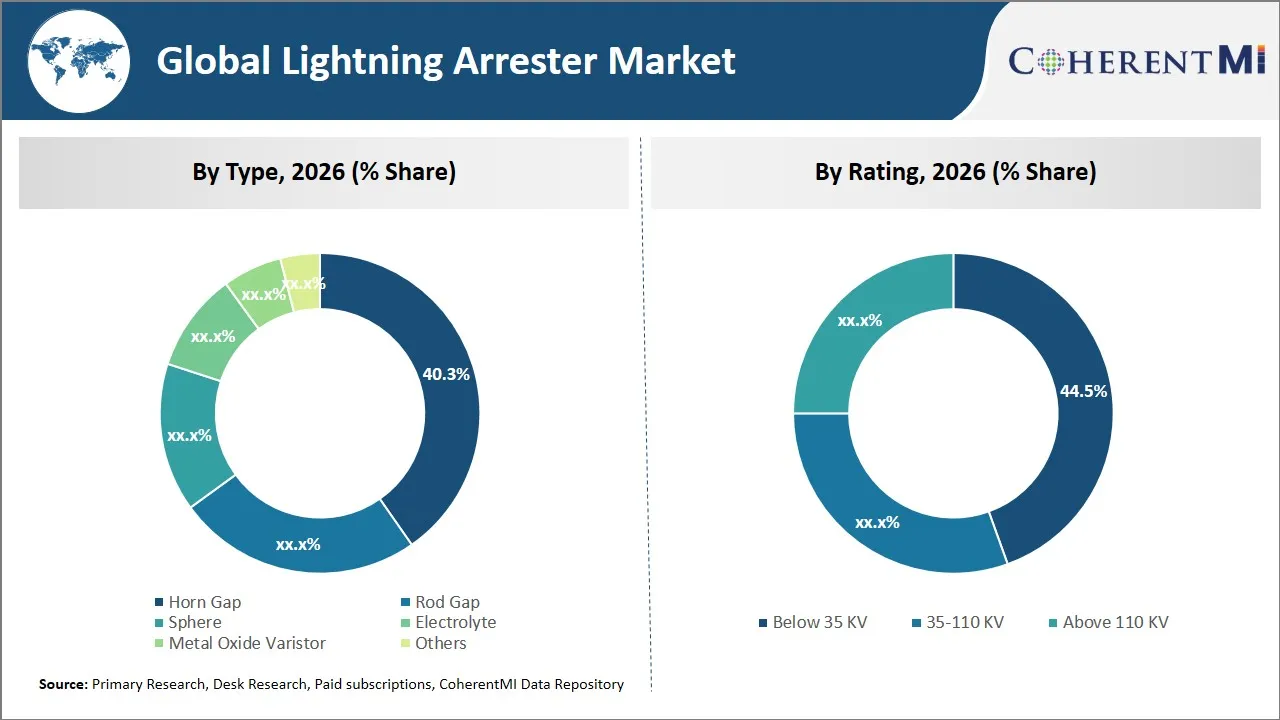
Insights, By Type: Horn Gap is Leading Through Proven Reliability and Cost-Effectiveness
In terms of type, the horn gap segment is expected to contribute 40.3% of the market share in 2026, because of their strong design and the success they have had in shielding electrical systems against the lightning induced surge.
The main aspect that has made horn gap lead the market is its outstanding durability and lack of maintenance. Contrary to other more complicated designs of arresters, horn gap arresters have a simple air gap structure which works under the basic electrical principle. As electrical lightning or voltage surges are captured, then the electric arc will be formed between the horn-shaped electrodes, channeling the excess current in a safe manner to ground. This mechanism is uncomplicated and yet efficient to provide consistent performance over the extended time, which is why it is especially appealing to the utilities and industrial operators who want to have guaranteed protection with less operational overhead.
Insights, By Rating: Below 35 KV Segment Driven by Distribution Network Expansion and Rural Electrification
The below 35 KV segment is projected to contribute 44.5% of the market share in 2026, owing to the extensive proliferation of distribution networks worldwide and the critical need for protecting low to medium voltage electrical infrastructure that serves residential, commercial, and light industrial consumers.
The preeminent role of the below 35 KV rating segment can be explained mainly by the sheer number of distribution facilities that are working in this voltage range. The largest part of electrical grid infrastructure is the distribution networks, which consist of Mns of transformers, switchgear, and protection devices of lower voltages than 35 KV. All residential areas, business districts and industrial sites need these levels of protection and this results in a huge addressable market that easily surpasses the needs of higher-voltage transmission systems.
Additional Insights of Lightning Arrester Market
- Asia Pacific Dominance: Asia Pacific has the largest market of lightning arrestors in the world that has been fueled by the high rate of industrialization, urbanization, and development of power infrastructure in such countries as China, India and Japan. The fact that thunderstorms are becoming more common in the area is another reason why there is a high demand to have high quality lightning protection.
- The market of lightning arresters is experiencing a growing tendency towards innovation with the aim to ensure more safety and prolonged life. Manufacturers are developing arresters that can withstand extreme weather conditions and provide better protection for sensitive electrical systems, driven by the rising demand for more resilient and efficient products.
- Lightning Arrester’s Role in Infrastructure Resilience: The growing emphasis on improving infrastructure resilience is boosting the demand for advanced lightning arresters. Their role in protecting critical infrastructure such as data centers, telecommunications networks, and power grids is being increasingly highlighted, as they ensure uninterrupted service and prevent significant damage from electrical surges.
Competitive overview of Lightning Arrester Market
The major players operating in the global lightning arrester market include Schneider Electric, Siemens AG, General Electric, ABB Ltd., Eaton Corporation, Mersen SA, Hubbell Incorporated, Citel Group, Raychem (TE Connectivity), Protec Systems, Phoenix Contact GmbH & Co. KG, Emerson Electric Co., Littelfuse, Inc., S&C Electric Company, and Sisilion Technology Co., Ltd.
Lightning Arrester Market Leaders
- Schneider Electric
- Siemens AG
- General Electric
- ABB Ltd.
- Eaton Corporation
Recent Developments in Lightning Arrester Market
Lightning Arrester Market Segmentation
- By Type
- Horn Gap
- Rod Gap
- Sphere
- Electrolyte
- Metal Oxide Varistor
- Others
- By Rating
- Below 35 KV
- 35-110 KV
- Above 110 KV
- By Application
- Transmission Line
- Distribution Line
- Substation

Would you like to explore the option of buying individual sections of this report?
Yash Doshi is a Senior Management Consultant. He has 12+ years of experience in conducting research and handling consulting projects across verticals in APAC, EMEA, and the Americas.
He brings strong acumen in helping chemical companies navigate complex challenges and identify growth opportunities. He has deep expertise across the chemicals value chain, including commodity, specialty and fine chemicals, plastics and polymers, and petrochemicals. Yash is a sought-after speaker at industry conferences and contributes to various publications on topics related commodity, specialty and fine chemicals, plastics and polymers, and petrochemicals.