Tinplate Market SIZE AND SHARE ANALYSIS - GROWTH TRENDS AND FORECASTS (2026 - 2033)
Tinplate Market is segmented By Type (Prime Grade, Secondary Grade), By Base Metal (Steel, Aluminum,...
Tinplate Market Size - Analysis
The global tinplate market is estimated to be valued at USD 32.45 Bn in 2026 and is expected to reach USD 44.15 Bn by 2033, exhibiting a compound annual growth rate (CAGR) of 4.5% from 2026 to 2033. This steady growth trajectory reflects the sustained demand from key end-use industries, particularly food and beverage packaging, which continues to dominate market consumption.
Market Size in USD Bn
CAGR4.5%
| Study Period | 2026 - 2033 |
| Base Year of Estimation | 2025 |
| CAGR | 4.5% |
| Market Concentration | Medium |
| Major Players | ArcelorMittal S.A., Tata Steel Limited, U.S. Steel Corporation, Nippon Steel Corporation, JFE Holdings, Inc. and Among Others |

please let us know !
Tinplate Market Trends
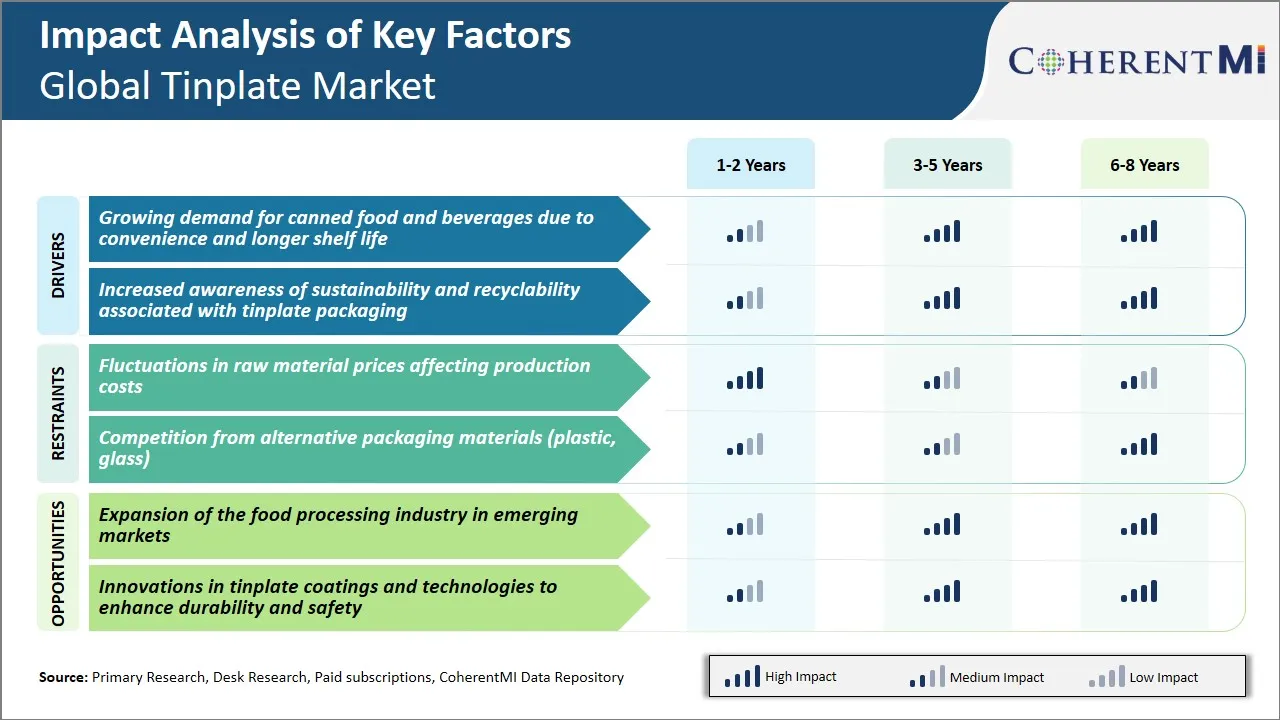
Tinplate Market Driver - Growing Demand for Canned Food and Beverages Due to Convenience and Longer Shelf Life
The modern consumer environment has been characterized by the radical changes in the modern convenience-driven consumption patterns of food and beverages, which is a key factor in stimulating the market to demand tinplate packaging solutions in the global market. The contemporary work-related schedules, two-earner families, and urbanization trends have given rise to a consumerism culture that has seen people put an even greater demand on ready-to-consume foods which provide them with nutritional benefit and a longer shelf life. It comes to light that Tinplate packaging will be the best option available to manufacturers who will want to satisfy these new consumers tastes without compromising on the integrity and safety standards of products.
Market Driver - Increased Awareness of Sustainability and Recyclability Associated with Tinplate Packaging
Environmental awareness has become a new powerful trend to influence packaging choice in industries with tinplate packaging being a viable alternative to most conventional packaging materials with its outstanding recyclability properties and its ability to become a circular economy. The increasing interest of consumers, producers and regulation agencies on environmental effects has generated an unprecedented pressure on the food service packaging solutions that reduce ecological footprints without compromising the performance standards.
Tinplate packaging is one solution to these issues of sustainability with its combine application of both infinite recyclability and no loss in quality and a relatively low environmental impact in the entire lifecycle. In comparison with lots of other packaging materials, which will lose their structural integrity or performance properties during the recycling process, tinplate can be recycled several times without losing its fundamental characteristics and properties, which makes it an appealing choice to environmental conscious brands and customers who want to minimize their environmental footprint.
 To learn more about this report, Request Free Sample Copy
Market Challenge - Fluctuations in Raw Material Prices Affecting Production Costs
The global tinplate market is being affected by major antagonists of incessant instability in the cost of raw materials, especially steel and tin which cumulatively comprise 70-80 percent of the overall production cost. The market forces of iron ore and coking coal have made the steel prices to be more volatile than ever seen in the last three years where they moved between the price of USD 600 and 1200/metric ton. At the same time, the prices of tin have been excessively volatile, spanning between 15 000 and 45 000 per metric ton depending on supply chain disruptions in leading producing nations such as Indonesia and Myanmar, geopolitical conflicts and speculative investors. The combination of these two commodities exposes the cost structure of the tinplate manufacturers to a compounding effect and it is hard to sustain the stable pricing strategies and profit margins.
Market Opportunity - Expansion of the Food Processing Industry in Emerging Markets
The fast-growing food processing sector in the emerging economies is a revolutionary growth prospect to the world tinplate market, where emerging economies in the Asia Pacific, Latin America and Africa have demonstrated strong, two-digit rates of growth in consumed processed food. The basic change in consumer behavior, which is being witnessed in such countries as India, Vietnam, Brazil, and Nigeria, is due to the rate of urbanization of more than 3-4% per year, increasing levels of disposable incomes, and lifestyle changes where convenience foods are growing in popularity.
It is projected that the organized food processing business in these markets will increase the compound annual growth rate at 12-15% by 2028 as compared to the relatively low growth rates of developed markets of 2-3 years. This growth directly corresponds to the growth in the needs of tinplate packaging where food processors are seeking cost-effective packaging solutions that would guarantee the safety and longevity of their products and the changing regulatory requirements.
Packaging Format Dependency Ratio (2-Piece vs 3-Piece Cans)
|
Aspect |
2-Piece Cans |
3-Piece Cans |
|
Production Complexity |
Lower (single metal sheet) |
Higher (three components) |
|
Cost per Unit |
Lower (simpler manufacturing process) |
Higher (additional welding and sealing processes) |
|
Material Cost (per ton) |
Lower (efficient material usage) |
Higher (due to multi-component production) |
Key winning strategies adopted by key players of Tinplate Market
- Product Innovation: Tinplate Industry players are concentrating on innovation by developing better functionality and design of its products in a bid to meet the needs of various consumers. As an illustration, Tata steel has come up with a new generation of tinplate which has enhanced resistance to corrosion and enhanced barrier properties which is perfect in packaging delicate food and beverage products.
- Market Expansion: The major players are increasing their market share in the developing economies such as India and the Southeast. As an example, ArcelorMittal has also put more capital in the Asia Pacific by doing upgrades in its India and China production facilities to meet the rising demand of tinplate in the packaging, automobile, and consumer goods industries.
- Sustainability Focus: The concept of sustainability has become an important strategy to the tinplate manufacturers. Most of the companies are embracing environmentally friendly methods including recycled tinplate and better production efficiency to lower carbon footprint. Tata steel has engaged in lowering its environmental impact by using recycled steel in producing its tinplate products and U.S. steel is engaged in plans to make its products highly recyclable and ensure reduction of the total waste generated in the supply chain.
Segmental Analysis of Tinplate Market
 To learn more about this report, Request Free Sample Copy
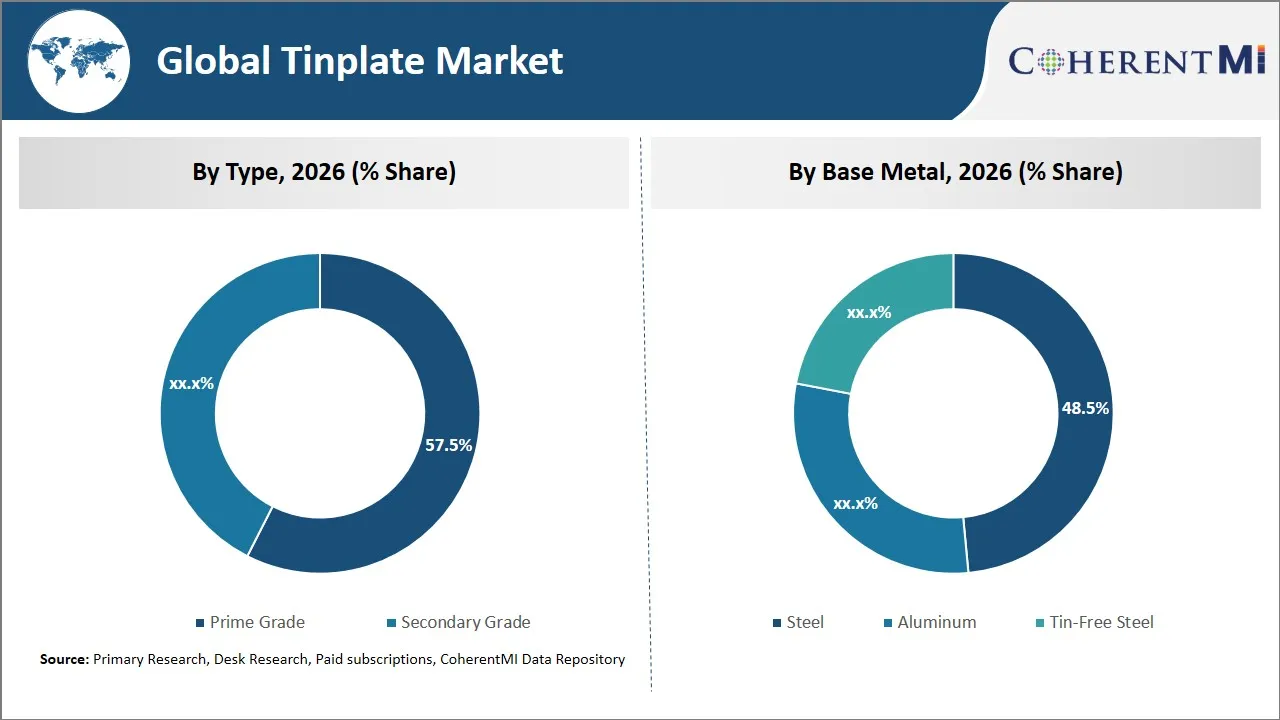
Insights, By Type - Prime Grade Dominates Due to Superior Quality Standards Drive Market Leadership
Prime grade segment is expected to capture 57.5% of the market share in 2026, due to the outstanding qualities of grade as well superior performance features that will fulfill the demanding features of a high-end application in a variety of industries. Prime grade tinplate dominates due to its corrosion resistance properties that are of essential use in packaging of foodstuffs that contain acids or are very reactive to corrosion. The food and beverage industry is the major contributor of this segmentation of market leadership due to increased focus on product safety, shelf-life increase, and preservation of product integrity along the supply chain.
Prime grade tinplate is a better choice because it can be formed under stress, and has high-quality surface and coating thickness without much defects, hence it is the choice when it comes to superior packaging. The increased demand of high-quality components by the automotive industry has also played an important role in the development of this segment since Prime Grade tinplate offers a good deep-drawing performance and the ability to offer the consistency of mechanical properties that are critical to the production of precise automotive components. The segment also enjoys the advantages of quality control at production level which also creates less rejection and more customer satisfaction levels.
Insights, By Base Metal – Steel Segment Dominates Due to Cost-Effectiveness and Versatility
Steel segment is expected to contribute 48.5% of the market share in 2026, due to its outstanding cost-effectiveness, better mechanical qualities, and wide application opportunities in various industrial fields. Steel-based tinplate segments market control is mainly determined by the fact that it has optimum balance between the performance qualities and economic feasibility and thus, it is chosen in preference in large-scale industrial use. The strength and durability exhibited by steels offer great structural integrity in packaging usage especially in the food and beverage sector which has significant needs in container reliability and protection of products.
Additional Insights of Tinplate Market
- The global tinplate market recognizes Asia Pacific as its foremost region because rapid industrial growth and strong packaging industry demand and extensive manufacturing facilities of China and India drive market expansion. The region experiences growth through its rising usage of tinplate packaging materials for food products and beverage items and consumer goods, with China emerging as a top producer and consumer of tinplate items.
- Health-conscious consumers together with environmentally sustainable packaging guide tinplate industry research and development efforts. Consumers are increasingly demanding packaging materials that are not only functional but also sustainable. The tinplate industry works to improve its products which preserve food quality and prevent contamination while maintaining their ability to be recycled throughout their shelf life.
- The growing environmental advantages of tinplate lead to its increased use because it can be recycled 100 percent. The worldwide sustainability movement which grows stronger every day has brought focus on tinplate because it helps reduce plastic waste while improving circular economy systems. Its recyclability and lower environmental impact compared to other materials make it a key player in the packaging industry especially in food and beverage sectors where environmental regulations are becoming stricter.
Competitive overview of Tinplate Market
The major players operating in the global tinplate market include ArcelorMittal S.A., Tata Steel Limited, U.S. Steel Corporation, Nippon Steel Corporation, JFE Holdings, Inc., China Steel Corporation, thyssenkrupp AG, K MEMSOL, Toyobo Co., Ltd., Mitsubishi Materials Corporation, Anhui Steel Group Co., Ltd., POSCO, and Salzgitter AG.
Tinplate Market Leaders
- ArcelorMittal S.A.
- Tata Steel Limited
- U.S. Steel Corporation
- Nippon Steel Corporation
- JFE Holdings, Inc.
Recent Developments in Tinplate Market
- In May 2025, Saudi Arabia announced that it is set to localize tinplate and tin-free steel production through a partnership with China, establishing the region’s first facility of its kind with an annual capacity of 400,000 tons.
- In April 2023, Tinplate Company of India (TCIL), a subsidiary of Tata Steel, expanded its production capacity at Jamshedpur. The expansion project is expected to help the company retain its market dominance, expand its product portfolio, and increase its export markets. The first phase of the expansion will raise TCIL's capacity to 715,000 tons per annum (TPA) from the current 415,000 TPA at Jamshedpur.
- In July 2022, JFE Steel acquired EcoLeaf, the Japan Environmental Product Declaration (EPD) program for tinplate products, by SuMPO (Sustainable Management Partners Organization). The acquisition of EcoLeaf was in line with JFE Steel's commitment to sustainability and its efforts to reduce the environmental impact of its products.
- In September 2022, Tosyalı-Toyo, a joint venture of Tosyalı Holding and Toyo Kohan, invested USD 200 million to double its tin production capacity from 325,000 mt to 650,000 mt. The project was expected to be completed by the end of 2023.
Tinplate Market Segmentation
- By Type
- Prime Grade
- Secondary Grade
- By Base Metal
- Steel
- Aluminum
- Tin-Free Steel
- By Coating
- Electrolytic Tinplate
- Hot-Dipped Tinplate
- Chromium-Coated Tinplate
- By Application
- Food and Beverage Cans
- Chemical Cans
- General Metal Containers
- Others (e.g., aerosol cans, closures)

Would you like to explore the option of buying individual sections of this report?
As an accomplished Senior Consultant with 7+ years of experience, Pooja Tayade has a proven track record in devising and implementing data and strategy consulting across various industries. She specializes in market research, competitive analysis, primary insights, and market estimation. She excels in strategic advisory, delivering data-driven insights to help clients navigate market complexities, optimize entry strategies, and achieve sustainable growth.