Automated Test Equipment Market SIZE AND SHARE ANALYSIS - GROWTH TRENDS AND FORECASTS (2026 -2033)
Automated Test Equipment Market is segmented By Product(Non-Memory ATE, Memory ATE, Discrete ATE, Ot...
Automated Test Equipment Market Size - Analysis
The Global Automated Test Equipment Market is estimated to be valued at USD 8.50 Bn in 2026 and is expected to reach USD 12 Bn by 2033, exhibiting a compound annual growth rate (CAGR) of 5% from 2026 to 2033. This robust growth trajectory reflects the increasing demand for sophisticated testing solutions across the semiconductor, telecommunications, automotive, and aerospace industries. The market expansion is primarily driven by the proliferation of complex electronic devices, rising quality assurance requirements, and the need for faster time-to-market strategies in highly competitive technology sectors.
Market Size in USD Bn
CAGR5%
| Study Period | 2026 -2033 |
| Base Year of Estimation | 2025 |
| CAGR | 5% |
| Market Concentration | Medium |
| Major Players | Teradyne Inc, Danaher, Aemulus Corporation, Chroma ATE Inc, VIAVI Solutions Inc and Among Others |

please let us know !
Automated Test Equipment Market Trends
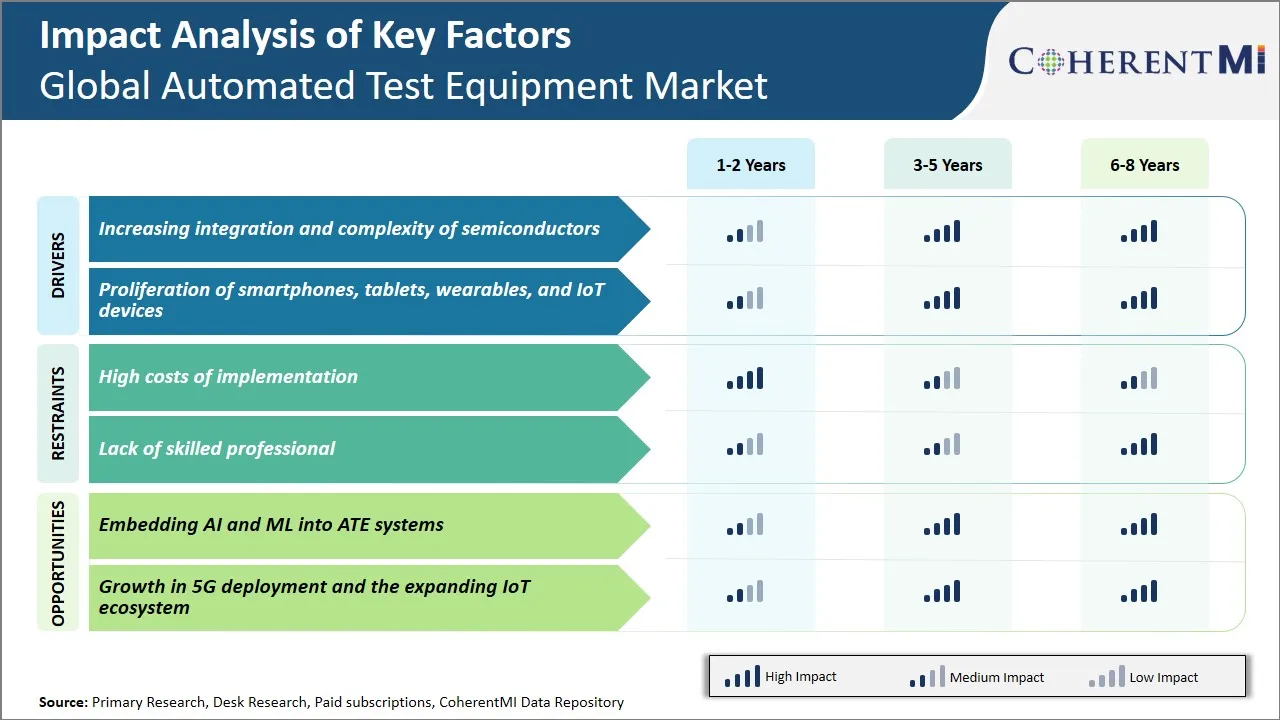
Market Driver - Increasing Integration and Complexity of Semiconductors
Semiconductors have evolved significantly over time. Inside compact footprints exist vast arrays of switching elements, arranged with intent, needing thorough inspection processes merely to ensure consistent operation. Functionality unfolds within narrow margins where exactness holds priority, influenced by developments once unforeseen yet widely relied upon today. Assessment procedures evolve steadily, adjusting behind the scenes, systematically, leaving no space for mistakes or pauses.
Within today's chip architectures, numerous elements - such as computing cores, data storage managers, visual rendering units, connectivity modules, alongside dedicated performance boosters - are combined on one semiconductor base. This consolidation demands evaluation methods capable of assessing standalone operations together with intricate cross-module coordination and overall operational coherence across the entire unit.
With the shift to mixed-component systems, standard test techniques struggle more noticeably. Where older strategies fall short, identifying minor flaws becomes less certain. System behavior under actual conditions may differ when such oversights occur. Reliability risks grow if these inconsistencies remain unchecked.
 To learn more about this report, Request Free Sample Copy
Market Challenge - High Costs of Implementation
A steep financial threshold marks entry into the world of automated test equipment, limiting its reach despite broad industrial interest. As accuracy becomes critical, spending increases, often exceeding one million dollars for complete setups designed for complex operations.
Smaller firms often feel pressure from costs, since reserves for sophisticated testing are hard to reach. Following initial payments, ongoing duties appear, contracts for support, regular calibrations, software revisions, alterations triggered by evolving standards. These demands shift gradually, demanding attention well after installation.
Market Opportunity – Embedding AI and ML into ATE Systems
With artificial intelligence shaping machine learning applications, automated test equipment evolves beyond earlier limits. Because prediction becomes part of diagnostics, test routines adjust without manual input. Efficiency rises when systems detect faults using pattern recognition instead of fixed rules. As global demand shifts, older models give way to smarter alternatives. Where once static procedures dominated, dynamic responses now take precedence.
Examining extensive historical test records allows machine learning to identify repeated behaviors without depending on static guidelines. Because outcomes reveal underlying structures, forecasts about potential failures become possible, redirecting attention to regions with greater likelihood of error. As testing proceeds, adjustments happen continuously, shaped by real-time demands rather than decisions made earlier in planning stages.
Efficiency gains often cut total duration between forty and sixty percent compared to older methods. Detection accuracy improves because models adjust based on fresh inputs over time. Unlike static frameworks, these systems evolve through exposure to varied conditions. Adaptation happens without manual reconfiguration due to built-in feedback loops.
Test Time vs. Product Revenue Impact:
|
Metric |
Parameter |
|
Test Time Reduction via AI/ML-Driven ATE (typical) |
15–30% reduction |
|
Parallel Multi-Site Testing Impact |
0–97% fewer measurements |
|
Manufacturing Speed Difference Impact |
15% difference in revenue per wafer (from semiconductor throughput modeling) |
|
Hybrid Test Time Reduction |
40% faster test cycle |
|
Defect Detection Increase on Faster Test |
28.6% higher defect detection (model) |
|
Test Coverage Gain |
95% vs 60% |
Key winning strategies adopted by key players of Automated Test Equipment Market
Strategic Partnerships and Business Collaborations: Market leaders have recognized that ATE’s success requires comprehensive ecosystem partnerships spanning semiconductor manufacturers, software providers, and end-use industries. Teradyne established strategic partnerships with major semiconductor companies including TSMC, Samsung, and Qualcomm. These partnerships created dedicated customer engineering teams and co-development programs
Significant Investments in R&D: For example, the Keysight Technologies' 5G and IoT Testing Revolution. The company invested USD 400 million over 4 years dedicated to 5G testing, IoT device validation, and automotive electronics.
Segmental Analysis of Automated Test Equipment Market
 To learn more about this report, Request Free Sample Copy
Insights, By Product: Non-Memory ATE’s Dominance is Driven by Complex System-on-Chip Testing Requirements
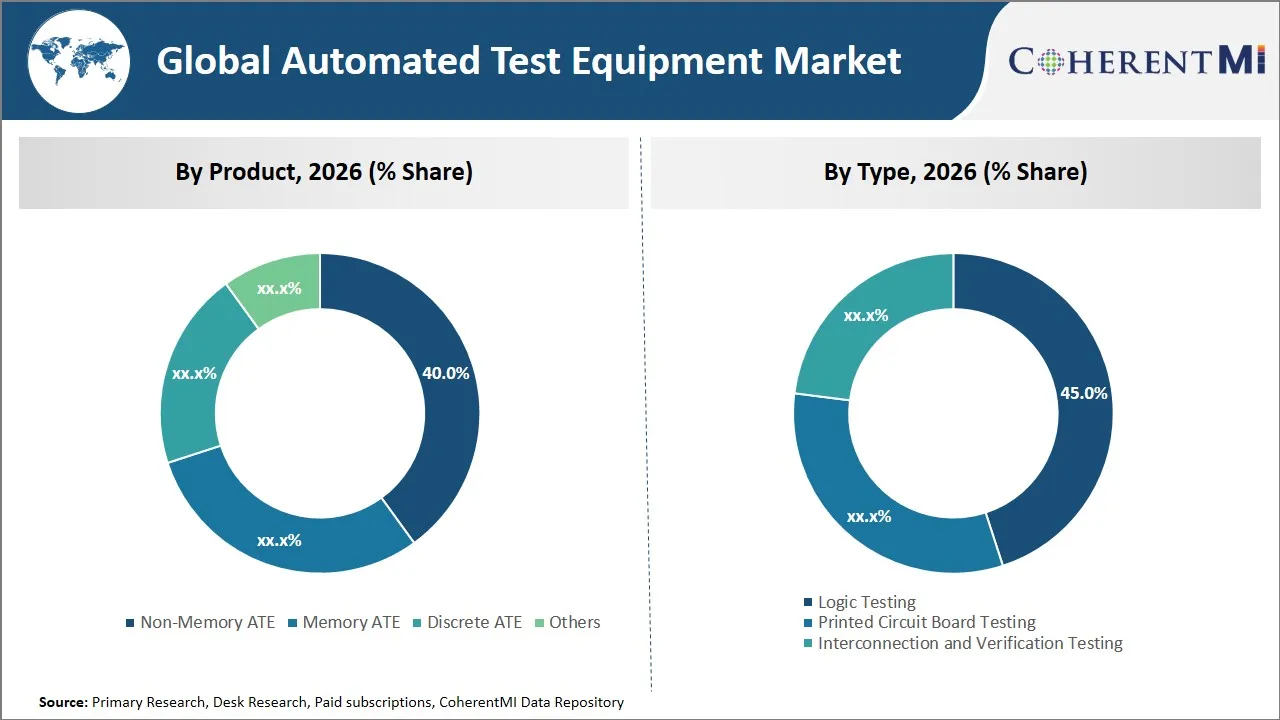
In terms of product, Non-Memory ATE is expected to account for 40% of the market share in 2026. One reason behind the rise lies in increasingly intricate chip architectures, coupled with a broader need for advanced evaluation methods throughout different sectors. What sets Non-Memory ATE apart is its focus on verifying logic-based parts, hybrid signal modules, radio frequency elements, and integrated single-chip platforms - each demanding thorough checks of functionality during diverse operational scenarios.
Non-Memory ATE chips are denser, multifunctional, and tightly woven into single units. As processors, controllers, and custom circuits pack greater complexity, older test methods fall short. Verification must now track logical accuracy alongside precise timing and energy use - all at once. This demand shapes the tools used today.
Insights, By Type: Logic Testing's Leadership is Fueled by Digital Transformation and Processor Complexity
In terms of type, Logic Testing is expected to acquire 45% of the global market in 2026. Built on rising intricacies within digital hardware, thorough function checks have become unavoidable throughout chip development. As digital components underpin most contemporary electronics, confirming correct behavior matters fundamentally. Verification spans circuits, computing units, and full-scale embedded architectures - each requiring precise examination before production moves forward. Without such scrutiny, reliability in operation cannot be assumed across real-world uses.
Starting fast, changes in chip design reshape logic testing across modern setups. Within every unit reside several processors working together through tight links. Across new models runs a web of tiny gates placed so precisely that synchronization hold under shifting voltages, temperatures, while clocks pulse at varied rates. Some faults stay unseen until specific patterns trigger them behind normal operation. Verification relies on accurate delays along with complex inputs aligning to predicted results. Through each system flows specific input, designed according to individual circuit layout, serving as verification of actual results against intended design. This alignment, when examined, reveals consistency between expected function and observed behavior across operational sequences. Precision in structure supports accuracy in outcome evaluation under defined conditions. Deviations appear only where configuration differs from original framework specifications.
For instance, in January 2024, Rohde and Schwarz and Analog Devices, Inc. (ADI) announced their latest automated test solution for wireless battery management systems (wBMS). It is specifically designed for wireless device test verification and mass production tests based on existing activities for wBMS RF robustness testing.
(Source: rohde-schwarz.com)
Additional Insights of Automated Test Equipment Market
- Printed Circuit Board Testing is expected to hold a dominant position owing to an increase in integration of AI and ML.
- Memory ATE is expected to follow the Non-Memory ATE segment in terms of Product, owing to the increasing deployment of Memory ATE in connectivity development.
- Asia Pacific led the automated test equipment market with a 49% revenue share in 2026, driven by increasing development of semiconductors.
- North America is expected to witness the fastest growth in the global automated test equipment market due to increasing penetration of smartphones and wearable gadgets.
Competitive overview of Automated Test Equipment Market
The major players operating in the global automated test equipment market include Aemulus Corporation, Chroma ATE Inc, VIAVI Solutions Inc, Astronics Corporation, Advantest Corportion, Cohu Inc, Teradyne Inc, STAr Technologies Inc, TESEC Corporation, Roos Instruments, National Instruments, Xcerra Corporation, Marvin Test Solutions Inc, Danaher, and Beijing Huafeng Test.
Automated Test Equipment Market Leaders
- Teradyne Inc
- Danaher
- Aemulus Corporation
- Chroma ATE Inc
- VIAVI Solutions Inc
Recent Developments in Automated Test Equipment Market
- On January 31, 2025, Teradyne, Inc., a leading supplier of automated test solutions, and Infineon Technologies AG, a global semiconductor leader in power systems and IoT, announced that they have entered into a strategic partnership to advance power semiconductor test.
- On February 12, 2025, Advantest Corporation launched the T5801 Ultra-High-Speed DRAM Test System. This state-of-the art platform is designed to accommodate the most recent developments in high-speed memory technologies such as GDDR7, LPDDR6, and DDR6.
Automated Test Equipment Market Segmentation
- By Product
- Non-Memory ATE
- Memory ATE
- Discrete ATE
- Others
- By Type
- Logic Testing
- Printed Circuit Board Testing
- Interconnection and Verification Testing

Would you like to explore the option of buying individual sections of this report?
Gautam Mahajan is a Research Consultant with 5+ years of experience in market research and consulting. He excels in analyzing market engineering, market trends, competitive landscapes, and technological developments. He specializes in both primary and secondary research, as well as strategic consulting across diverse sectors.