Cherry Picker Forklift Market SIZE AND SHARE ANALYSIS - GROWTH TRENDS AND FORECASTS (2026 -2033)
Cherry Picker Forklift Market is segmented By Type (Internal Combustion Engine, Electric Motor, Dies...
Cherry Picker Forklift Market Size - Analysis
The Global Cherry Picker Forklift Market is estimated to be valued at USD 58.19 Bn in 2026 and is expected to reach USD 101.02 Bn by 2033, exhibiting a compound annual growth rate (CAGR) of 8.2% from 2026 to 2033. This substantial market expansion reflects the increasing demand for versatile material handling equipment across various industrial sectors, driven by rapid infrastructure development, expanding e-commerce operations, and growing warehouse automation needs. The robust growth trajectory indicates strong market fundamentals supported by technological advancements and increasing adoption across emerging markets.
Market Size in USD Bn
CAGR8.2%
| Study Period | 2026 -2033 |
| Base Year of Estimation | 2025 |
| CAGR | 8.2% |
| Market Concentration | Medium |
| Major Players | JLG Industries, Inc., Genie (Terex Corporation), Haulotte Group, Aichi Corporation, Manitou BF and Among Others |

please let us know !
Cherry Picker Forklift Market Trends
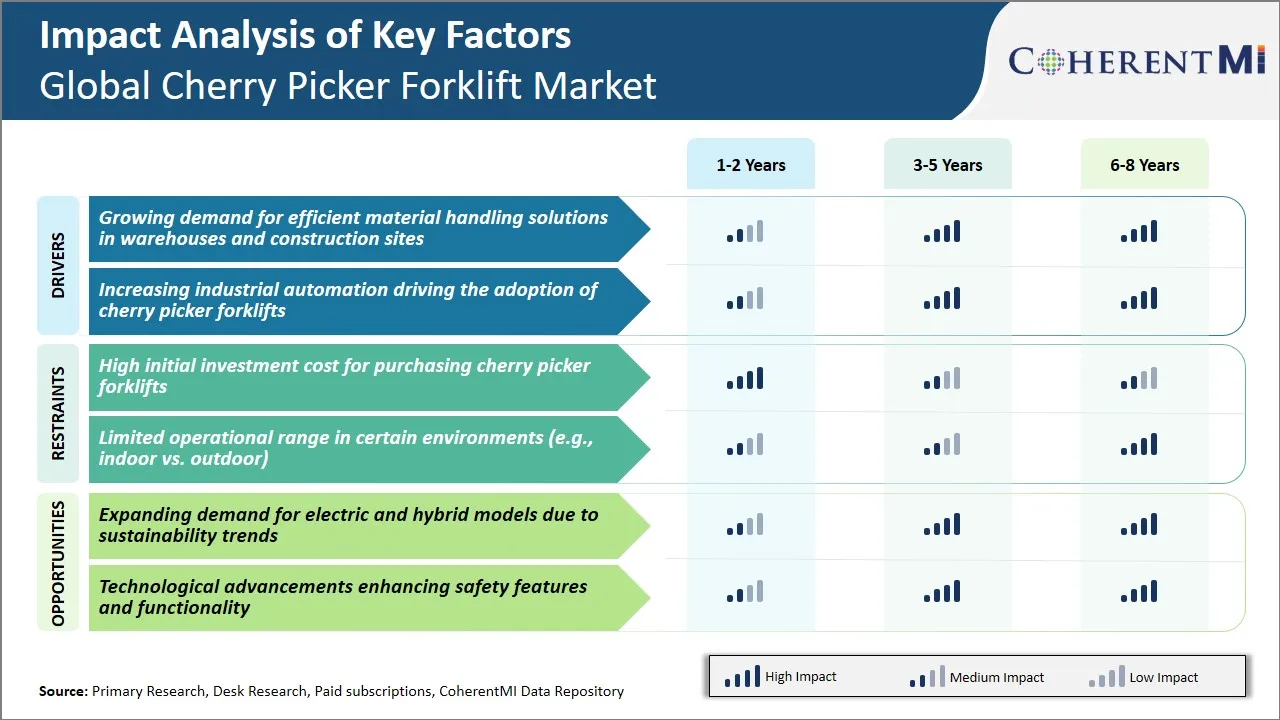
Market Driver - Growing Demand for Efficient Material Handling Solutions in Warehouses and Construction Sites
The contemporary business landscape is witnessing an unprecedented transformation in material handling requirements across warehouses and construction sites, fundamentally driving the adoption of cherry picker forklifts as essential operational equipment. The latest warehouses have become advanced distribution facilities which require maximum effectiveness in the vertical space usage which is becoming increasingly important given the fact that real estate prices are getting higher in strategic industrial areas.
The use of cherry picker forklifts has become an essential part of overcoming these problems since they allow drivers to use the limited space of aisles and reach the elevated storage levels as accurately and safely as possible.
Market Driver - Increasing Industrial Automation Driving the Adoption of Cherry Picker Forklifts
The growing rate of automation of industries in the manufacturing and logistics industries is generating high demand in cherry picker forklifts which have advanced technological features that can easily fit the automated operations of the facility. The contemporary industrial plants are progressively implementing all-inclusive automation plans that have necessitated material transporting machineries to act as parts and parcels of bigger automated systems instead of single machines.
Cherry picker forklifts are developing to suit such demands incorporating into the warehouse management systems, inventory tracking technologies and automated guidance systems that help in operating with minimal human supervision yet still ensuring high standards of accuracy and efficiency. Such high-tech forklifts have sensors and communication systems that constantly control the working parameters, the well-being of the equipment and the environmental state and send the data to the central control systems, modular data center to analyze and optimize it.
 To learn more about this report, Request Free Sample Copy
Market Challenge - High Initial Investment Cost for Purchasing Cherry Picker Forklifts
The limitation of the cherry picker forklift market in the world is a substantial initial capital outlay that is a huge obstacle to entry into the market, especially in the case of small and medium (SME) organizations. Given the specialized engineering and high-level features of safety, cherry picker forklifts usually are priced on a premium scale of between USD 40,000 and USD 200,000 depending on specifications, lifting capacity and level of technology. Such a high threshold of investment poses a strong affordability barrier particularly to those in the construction industry, warehousing business as well as to the maintenance service providers that may have limited budgets or access to desirable financing services.
The issue is further compounded by the total cost of ownership factors that are in the form of future purchase price costs. Organizations should include total insurance premiums, special operator training programs, regular maintenance costs, and possible cost of downtime of repair.
The large initial investment will make the rental of equipment to potential buyers appealing (especially in emerging markets where credit facilities are still scarce) and the manufacturers of equipment are limited in the number of potential buyers who can make direct sales. Also, the customization of cherry picker forklifts causes the unpredictability of resale values and makes it hard to buy them to rationalize the investment on its basis as a result of subsequent asset appreciation or the possibility to recover it. This financial hurdle is especially strong in markets that are price-sensitive where decision-makers need to have shown evident payback on investment in reduced payback periods resulting in the delay in purchasing decisions or using less advanced alternatives that might undermine operational efficiency and safety levels.
Market Opportunity - Expanding Demand for Electric and Hybrid Models Due to Sustainability Trends
The cherry picker forklift market in the world is also enjoying unprecedented growth prospects due to the increasing propulsion system transition to electric and hybrid propulsion impetrated by the growing environmental awareness and strict regulatory environments of relevant markets. Businesses across the globe are giving more importance to sustainability programs as a corporate social responsibility requirement, and this puts strong pressure on the need for environmentally sound material handling system which will go a long way in minimizing carbon footprints without impeding business performance. Electric cherry picker forklifts have strong strengths such as zero direct emission, much lower noise levels, lower operating costs due to reduced fuel consumption and maintenance needs, especially in the indoor setting, urban construction sites, and sensitive work areas.
Electric vs Diesel Total Cost of Ownership (TCO) & Compliance Impact
|
Compliance Impact |
Electric Cherry Picker Forklift |
Diesel Cherry Picker Forklift |
|
Environmental Regulations |
Low or zero emissions, meets emissions standards |
Higher emissions, compliance with regional standards |
|
Noise Compliance |
Lower noise levels, compliant with noise regulations |
Higher noise emissions, may need mitigation in some areas |
|
Regulatory Certifications |
CE, UL, EN Compliance |
CE, EPA Certification |
Key winning strategies adopted by key players of Cherry Picker Forklift Market
- Product Innovation: The firms are working on the creation of superior and more productive cherry picker forklifts, incorporating innovations such as telematics, automation, and energy-efficient electric ones. Firms such as Toyota Material Handling and JLG Industries have unveiled the use of electric powered cherry picker or forklifts that have improved safety operations and efficiency.
- Market Expansion: The major competitors are also entering new markets like Asia Pacific where infrastructure development and e-commerce is fueling the demand for material handling equipment. KION Group gained access in China, by providing domestic solutions and tailored forklifts that were to be used in the expanding warehouse and construction industries.
- Sustainability Focus: The idea of sustainability is turning into a key strategic concern, and businesses are moving to electric and hybrid models to lower emissions and improve their performance. Businesses such as Liebherr and Doosan Industrial Vehicles have also developed greener, low-emission cherry picker forklifts to be able to comply with the green regulations in the market and appeal to the customers who are concerned about the environment.
Segmental Analysis of Cherry Picker Forklift Market
 To learn more about this report, Request Free Sample Copy
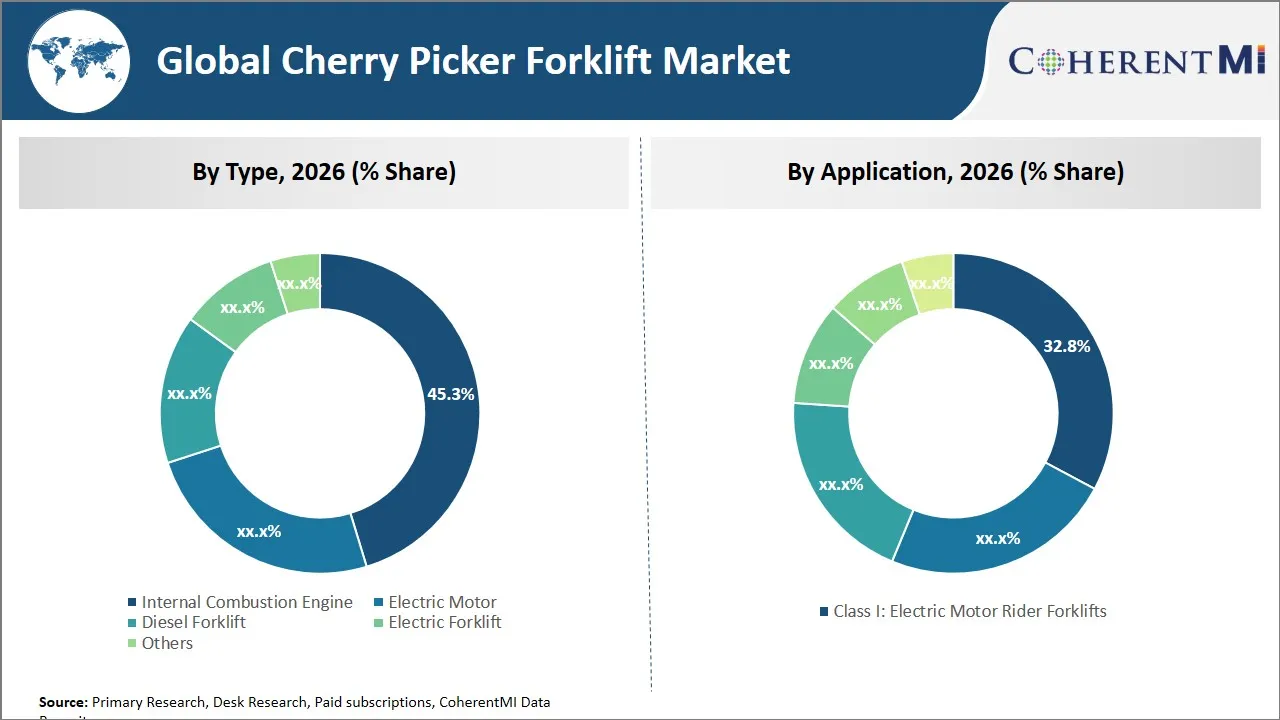
Insights, By Type: Internal Combustion Engine Dominance is Driven by Superior Power Output and Operational Versatility
In terms of type, the internal combustion engine segment is projected to contribute 45.3% share of the market in 2026, owing to its exceptional power-to-weight ratio and unmatched performance capabilities in demanding industrial environments. The cherry picker forklifts with internal combustion engines have proven to have better lifting capacity and efficiency in operation and thus are invaluable in the heavy-duty material movement of the varying industrial fields.
The main force behind this market leadership is due to the high torque nature of internal combustion engines. These powertrains offer a stable performance with respect to change in load conditions, and cherry pickers forked forklifts can perform under heavy weights with significant heights without failure in stability and operational safety. The internal combustion engine variants have been favored in manufacturing plants, construction sites, and warehouses especially since they continue to achieve the best performance stages in prolonged operation cycles, even when they are exposed to a continuous heavy-duty usage pattern.
For example, the Toyota 8FGU25 model is a 5,000-pound capacity forklift equipped with an internal combustion engine. It is widely used in construction and heavy-duty warehouse operations due to its superior power-to-weight ratio, which allows it to handle substantial loads at significant heights.
Industrial Segment Dominates Cherry Picker Forklift Market in 2026 Due to Intensive Material Handling and Safety Requirements
Industrial segment contributes the 42.5% share of the market in 2026, owing to the sector's intensive material handling requirements and complex operational environments that demand specialized lifting equipment. Industrial facilities encompass manufacturing plants, automotive assembly lines, steel mills, chemical processing facilities, and heavy machinery production centers, all requiring precise vertical access solutions for maintenance, installation, and quality control processes. The intricate nature of industrial operations necessitates cherry picker forklifts capable of maneuvering in confined spaces while providing stable platforms for workers to access elevated machinery, production lines, and structural components.
The critical safety requirements inherent in industrial environments drive substantial demand for cherry picker forklifts equipped with advanced safety features and certifications. Industrial facilities must comply with stringent occupational safety regulations, requiring equipment that meets specific safety standards for working at height in potentially hazardous environments. Cherry picker forklifts serve as essential tools for conducting routine maintenance on overhead conveyor systems, installing heavy machinery components, and performing quality inspections on elevated production equipment while maintaining worker safety protocols.
Additional Insights of Cherry Picker Forklift Market
- Asia Pacific Dominance: Asia Pacific has a great portion in the cherry picker forklift market which has been caused by the high rates of industrialization, growth of manufacturing processes, and development of infrastructure in countries such as China and India. The strong development of logistics, warehousing, and building industries in the region is one more stimulator of the material handling equipment demand.
- Technological Advancements Driving Growth: The growing need to have more efficient and safe material handling apparatus has brought innovation in cherry picker forklifts. Characteristics such as increased energy efficiency, automation, or telematics integration are now considered a standard and are becoming increasingly appealing to business organizations concerned with operational optimization.
- Emphasis on Safety and Compliance: With the growing focus on workplace safety, there is an increased demand for cherry picker forklifts that meet safety standards, including enhanced load controls, stable base structures, and ergonomic lifts. This is in line with the increasing safety standards in all industries, and makes compliance one of the major market growth decisions.
- Sustainability Trends: Electric and hybrid cherry picker forklift are becoming more popular as the industries strive towards greener solutions. Such models have lower emissions, low noise levels, and low operational costs, and would be attractive to businesses that are concerned with sustainability and minimizing their carbon footprint.
Company Insights:
- The global cherry picker forklift market is dominated by JLG Industries and offers electric, diesel, and hybrid cherry pickers. They are known for innovative safety features, such as advanced stability controls, expanded platform capacities, and telematics-based fleet management systems. Through its ongoing investments in autonomous and semi-autonomous lifting solutions, the company is positioning itself as a leader in the space.
- Haulotte Group focuses on compact and eco-friendly cherry picker forklifts with enhanced maneuverability
Competitive overview of Cherry Picker Forklift Market
The major players operating in the Global Cherry Picker Forklift Market include JLG Industries, Inc., Genie (Terex Corporation), Haulotte Group, Aichi Corporation, Manitou BF, Niftylift Ltd., Skyjack Inc., Toyota Industries Corporation, Crown Equipment Corporation, Linde Material Handling, Caterpillar Inc., Hyster-Yale Materials Handling, Inc., Doosan Corporation, and Komatsu Ltd.
Cherry Picker Forklift Market Leaders
- JLG Industries, Inc.
- Genie (Terex Corporation)
- Haulotte Group
- Aichi Corporation
- Manitou BF
Cherry Picker Forklift Market Segmentation
- By Type
- Internal Combustion Engine
- Electric Motor
- Diesel Forklift
- Electric Forklift
- Others
- By Application
- Class I: Electric Motor Rider Forklifts
- Class II: Electric Motor Narrow Aisle Forklifts (Reach Trucks, Order Pickers)
- Class III: Electric Pallet Jacks, Stackers, and Tow Tractors
- Class IV: Internal Combustion Cushion Tire Forklifts
- Class V: Internal Combustion Pneumatic Tire Forklifts
- Class VI: Electric/IC Engine Tow Tractors
- By End-use Industry
- Industrial
- E-Commerce and Logistics
- Others

Would you like to explore the option of buying individual sections of this report?
Gautam Mahajan is a Research Consultant with 5+ years of experience in market research and consulting. He excels in analyzing market engineering, market trends, competitive landscapes, and technological developments. He specializes in both primary and secondary research, as well as strategic consulting across diverse sectors.