Busbar Market SIZE AND SHARE ANALYSIS - GROWTH TRENDS AND FORECASTS (2026 - 2033)
Busbar Market is segmented Product Type (Copper, Aluminum), By End User (Commercial, Industrial, Res...
Busbar Market Size - Analysis
The global busbar market is estimated to be valued at USD 17 Bn in 2026 and is expected to reach USD 24 Bn by 2033, exhibiting a compound annual growth rate (CAGR) of 5.5% from 2026 to 2033. Steady movement upward stems from rising need for effective electricity delivery in multiple sectors, especially due to fast-paced industrial growth, city expansion, along with infrastructure upgrades in developing regions. Expansion continues as more funding flows into clean energy initiatives, computing hubs, also networks for powering electric transport - each demanding strong, dependable grid performance.
Market Size in USD Bn
CAGR5.5%
| Study Period | 2026 - 2033 |
| Base Year of Estimation | 2025 |
| CAGR | 5.5% |
| Market Concentration | High |
| Major Players | Siemens AG, ABB Ltd, Schneider Electric SE, Eaton Corporation plc, TE Connectivity Ltd and Among Others |

please let us know !
Busbar Market Trends
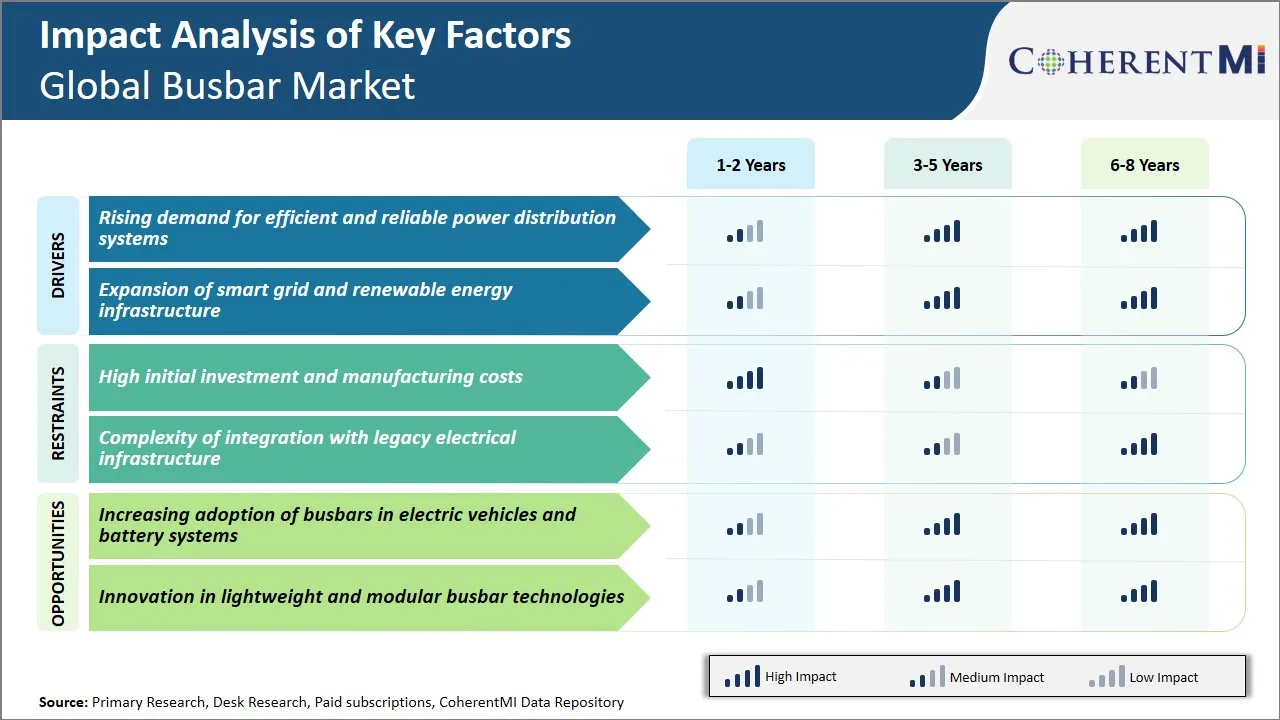
Market Driver - Rising Demand for Efficient and Reliable Power Distribution Systems
Notably reshaping operations, energy delivery systems face mounting pressure to perform without disruption. Where heavy machinery runs continuously, stability in supply becomes a central concern. Power needs rise sharply within digital storage hubs, prompting design shifts in how electricity moves through circuits. Offices and retail spaces adapt wiring layouts to match fluctuating demands throughout the day. Homes now integrate more equipment requiring steady voltage levels, altering traditional network expectations.
Growing intricacy in today's wiring systems demands ways to spread electricity capable of managing greater flow intensity, yet reducing wasted energy along with excessive warmth. Because they manage temperature more effectively, busbars perform well under heavy usage, maintaining stable voltage levels over time. Despite sudden shifts in demand, sectors like car building, chip fabrication, and medicine making depend on steady electric feed, allowing almost no room for glitches or outages.
For instance, on December 2, 2025, ABB announced the completion of its acquisition of Gamesa Electric’s power electronics business. The acquired portfolio includes power conversion products such as wind converters for doubly-fed induction generator (DFIG), industrial battery energy storage systems (BESS), and utility-scale solar inverters.
(Source: new.abb.com)
Market Driver - Expansion of Smart Grid and Renewable Energy Infrastructure
Moving globally toward cleaner energy and smarter electricity networks opens new roles for busbars in modern infrastructure. Because smart grids are changing the way power is produced, delivered, and used, advanced parts must now handle two-way currents, instant data tracking, and shifting demand patterns. These updated systems depend on reliable conductive elements capable of adapting quickly to fluctuating conditions across regions embracing digitalized electric frameworks.
What sets apart solar panels and wind turbines is how they feed electricity unevenly into the grid, creating pressure on existing networks. Despite such fluctuations, a stable flow becomes possible when conductive rails manage incoming power more smoothly than conventional setups. From rooftops to open fields, these rigid conductors simplify connections while capturing energy with less loss during transfer phases.
For instance, on February 9, 2026, Adani Energy Solutions Ltd announced that it has secured long-term financing from a consortium of Japanese banks for its flagship high-voltage direct current (HVDC) transmission project, a green evacuation corridor designed to strengthen the flow of renewable power across northern India.
(Source: adani.com)
 To learn more about this report, Request Free Sample Copy
Market Challenge - High Initial Investment and Manufacturing Costs
Heavy initial costs and steep production prices create ongoing barriers for the busbar industry, limiting its reach in multiple sectors. Though essential, building reliable units involves complex setups - machining tools exacting in tolerance, surface treatment systems tailored to specifications, and inspection gear capable of rigorous validation - all demanding seven-figure commitments. Such outlays often stretch budgets thin, especially for newer firms entering the space.
Beyond standard setups, varied industrial needs for busbars call for adaptable production methods along with sustained R&D efforts to align with differing technical demands and compliance rules. Especially in niches like power transmission networks or solar infrastructure, expenses grow due to strict operational limits that require top-grade components combined with precision engineering processes.
Market Opportunity - Increasing Adoption of Busbars in Electric Vehicles and Battery Systems
Growth in the busbar industry ties closely to worldwide shifts in electrified transport, a trend gaining momentum alongside rising demand from electric vehicles and widespread adoption of modern battery setups. As electric vehicles depend on precise handling of strong electric currents, reliable internal power pathways become essential - this is where busbars play a central role. Instead of traditional wiring, these rigid conductors link key parts like batteries, inverters, and motors, ensuring stable flow with reduced waste heat and improved efficiency.
Moreover, as governments push clean energy through rules and rewards, more people buy it. Battery prices fall at the same time performance rises, so electric cars now match regular models on price more often. Together, these changes feed one another, lifting need steadily. Experts expect that during coming years, power bars will grow quickest where used for storing electricity or moving electrons inside electric transport.
For instance, on May 7, 2025, ENNOVI introduced patent‑pending busbar sealing technology (ENNOVI‑SealTech) designed specifically for electric and hybrid vehicle powertrains to prevent coolant leaks and improve reliability and manufacturability of busbar assemblies in EV battery/inverter systems.
(Source: ennovi.com)
Global Busbar Market- Busbar Capacity & Delivery Lead Time Index
|
Region |
Delivery Lead Time Index |
Typical Lead Time |
|
Asia Pacific |
High Capacity, Shorter Lead Times |
12-20 weeks |
|
North America |
Moderate Capacity & Lead Times |
16-24 weeks |
|
Europe |
Moderate Capacity, Moderate Lead Times |
16-26 weeks |
|
Middle East & Africa |
Lower Capacity, Longer Lead Times |
20-30 weeks |
|
Latin America |
Lower Capacity, Longer Lead Times |
18-28 weeks |
Key winning strategies adopted by key players of Busbar Market
- Product Innovation and Technology Advancement: Schneider Electric invested USD 1.5 billion annually in R&D to develop IoT-enabled busbar systems integrated with their EcoStruxure platform. Schneider Electric launched smart busbar trunking systems with integrated sensors, developed predictive maintenance capabilities using AI algorithms and introduced modular designs reducing installation time by 30%. These resulted in market share of Schneider Electric in in European busbar market increase from 18% to 23% and revenue from digital-enabled power solutions grew 12% annually.
- Strategic Mergers and Acquisitions: Eaton corporation executed a USD 2.8 billion acquisition spree targeting complementary technologies and emerging markets. Eaton acquired Power Distribution Inc. for USD 1.1 billion, Ulusoy Elektrik for USD 215 million and Tripp Lite for USD 1.65 billion. After the successful completion of more such acquisitions, Eaton’s global busbar market share increased from 12% to 16%, reduced dependency on North American market from 65% to 48% and EBITDA margin improved from 15.2% to 17.8% through operational synergies.
Segmental Analysis of Busbar Market
 To learn more about this report, Request Free Sample Copy
Insights, Product Type: Superior Electrical Properties Drive Copper’s Market Dominance
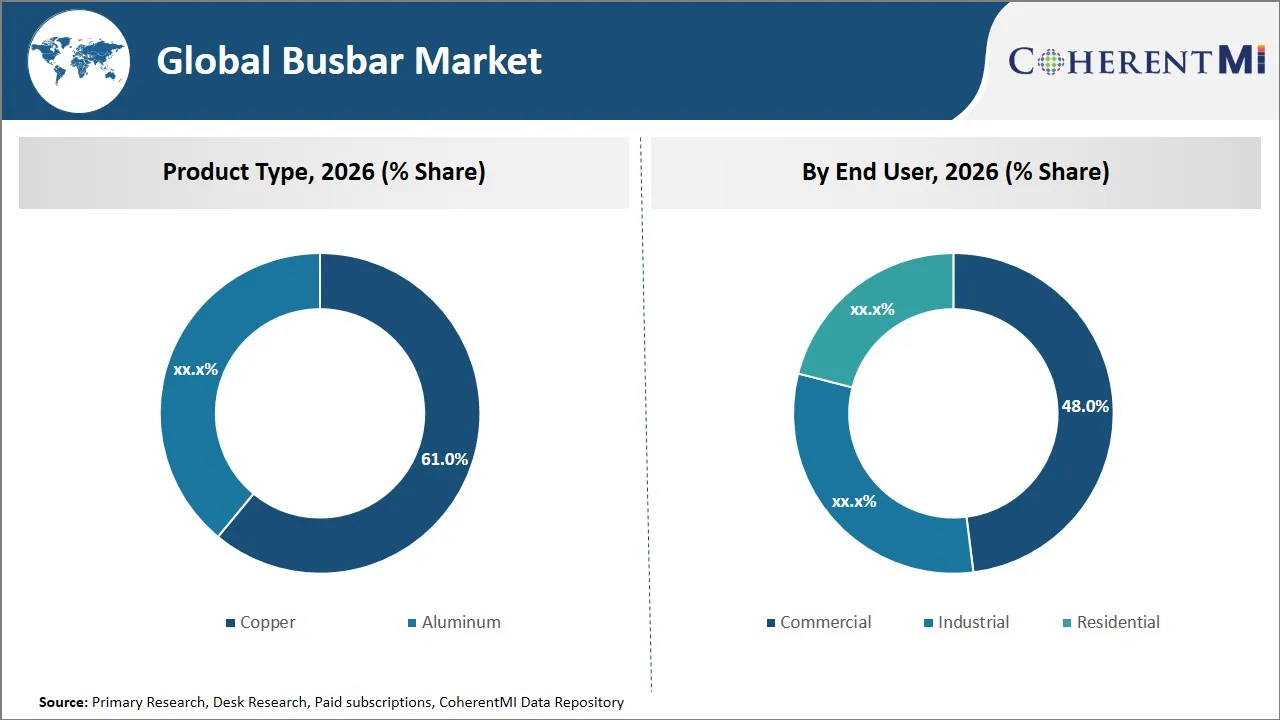
In terms of product type, the copper segment is expected to account for 61% of the market share in 2026. Despite common alternatives, copper remains dominant due to unmatched electrical performance under demanding conditions. Owing to stable behavior in high-load environments, selection trends favor it for busbar construction in varied industries. Its widespread adoption stems not solely from efficiency but also long-term operational consistency. Material superiority becomes evident when durability and minimal resistance are required simultaneously.
What pushes copper ahead in markets is its strong ability to conduct electricity, surpassed just by silver across metallic elements. Owing to this trait, busbars made from copper move electric current effectively while wasting little energy. Such performance ensures their role remains critical within advanced electrical networks. Facilities producing power, along with substations and factories using heavy machinery, depend on these components to keep energy use steady and lower expenses tied to lost transmission capacity.
Insights, End User: Commercial Sector’s Leadership is Driven by Infrastructure Modernization and Energy Efficiency Demands
By end user, the commercial segment is expected to account for 48% of the market share in 2026. Growth stems from faster infrastructure expansion along with strict energy rules in commercial construction. What counts as commercial includes offices, stores, hospitals, schools, hotels - each needing strong power networks for current needs.
Rules about using less power push businesses to adopt modern electrical setups, since nations enforce tighter construction rules tied to environmental goals. Pressure grows on managers of office buildings to lower electricity use and emissions, which increases interest in advanced ways to deliver power. Instead of older wire methods, flat conductive strips move electricity more effectively, helping companies follow laws without raising costs.
For instance, on September 25, 2025, Anbusway launched a new Compact Busbar Trunking System series tailored for commercial complexes and renovation projects with limited space, offering high current‑carrying capacity and modular installation to suit modern commercial building layouts.
(Source: anbusway.com)
Additional Insights of Busbar Market
- Smart busbar systems equipped with IoT/AI sensors enable real-time monitoring of voltage, current, and temperature, supporting predictive maintenance and fault detection. Such systems can reduce unplanned downtime by around 25% in data centers and critical infrastructure.
- Advanced busbar solutions with embedded digital monitoring are integrated into smart grids to enable adaptive load balancing, real-time load tracking, and dynamic response to grid conditions. Over 40% of new installations in 2024 featured these smart capabilities.
- Integration with grid EMS (Energy Management Systems) and SCADA platforms allows busbar systems to feed real-time data (e.g., load and fault metrics) which can cut maintenance costs by up to approximately 20% by enabling condition-based servicing rather than fixed schedules.
- Control strategies based on busbar voltage enable fast adaptation to fluctuating generation in microgrids (especially PV + storage systems), stabilizing busbar voltage within specified ranges and improving system flexibility.
Competitive overview of Busbar Market
The major players operating in the global busbar market include Siemens AG, ABB Ltd, Schneider Electric SE, Eaton Corporation plc, TE Connectivity Ltd, Legrand, Mersen, CHINT Group Co Ltd, C&S Electric Limited, Rogers Corporation, Friedhelm Loh Group, Cubic Module System, Hager Vertriebsgesellschaft GmbH, Starline Holdings LLC, and Sedotec GmbH.
Busbar Market Leaders
- Siemens AG
- ABB Ltd
- Schneider Electric SE
- Eaton Corporation plc
- TE Connectivity Ltd
Recent Developments in Busbar Market
- On March 11, 2024, Rockwell Automation, Inc announced the regional availability of its CUBIC product line. CUBIC specializes in IEC-61439 compliant modular enclosure systems for the construction of power and electrical panels.
- On March 3, 2024, ABB launched its new range of modular protection devices, FlexLine to provide an easier, faster, and more flexible installation in residential and small commercial buildings. The FlexLine series covers Miniature Circuit Breakers (MCBs), Residual Current Devices (RCDs) and Arc Fault Detection Devices (AFDDs), all designed with push-in technology so they can be flexibly combined on one single busbar type.
Busbar Market Segmentation
- Product Type
- Copper
- Aluminum
- By End User
- Commercial
- Industrial
- Residential

Would you like to explore the option of buying individual sections of this report?
Vidyesh Swar is a seasoned Consultant with a diverse background in market research and business consulting. With over 6 years of experience, Vidyesh has established a strong reputation for his proficiency in market estimations, supplier landscape analysis, and market share assessments for tailored research solution. Using his deep industry knowledge and analytical skills, he provides valuable insights and strategic recommendations, enabling clients to make informed decisions and navigate complex business landscapes.