Palletizer Market SIZE AND SHARE ANALYSIS - GROWTH TRENDS AND FORECASTS (2026 - 2033)
Palletizer Market is segmented By Machine Type (Conventional Palletizers, Robotic), By Product Type ...
Palletizer Market Size - Analysis
The global palletizer market is estimated to be valued at USD 3.55 Bn in 2026 and is expected to reach USD 6.90 Bn by 2033, exhibiting a compound annual growth rate (CAGR) of 5.6% from 2026 to 2033. Despite steady expansion, shifts in automation uptake stem partly from higher workforce expenses. As industries prioritize precision, machine-driven systems now feature more widely in factories. Where output volume demands uniformity, reliance on such technology grows. With supply chains under pressure, these tools support steadier workflows.
Market Size in USD Bn
CAGR5.6%
| Study Period | 2026 - 2033 |
| Base Year of Estimation | 2025 |
| CAGR | 5.6% |
| Market Concentration | High |
| Major Players | ABB Ltd, FANUC Corporation, KUKA AG, Honeywell International Inc, KION Group AG and Among Others |

please let us know !
Palletizer Market Trends
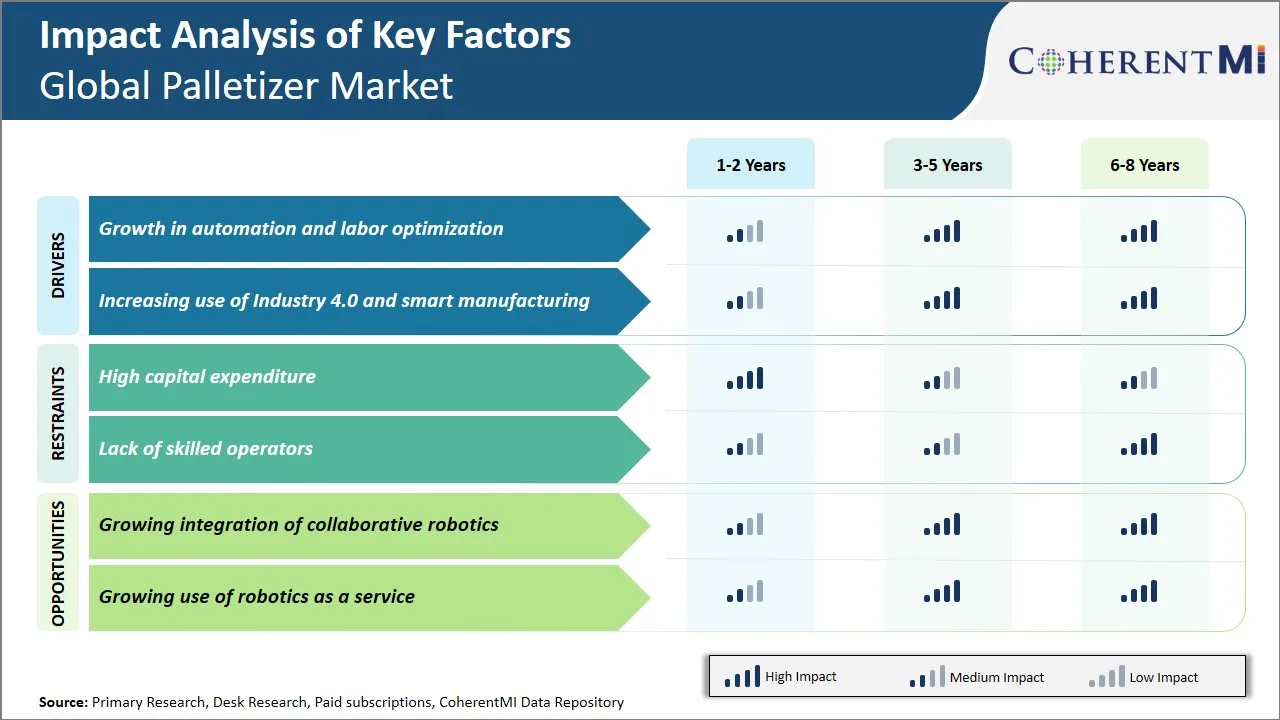
Market Driver - Growth in Automation and Labor Optimization
Unexpected growth marks the worldwide palletizer sector, fueled by rising automation use along with pressure to reduce workforce demands in production and logistics. It becomes clear across industries that hand-loaded stacking methods fail under modern requirements, where performance, reliability, and spending control shape outcomes.
Workforce efficiency now ranks high among priorities for companies facing ongoing staffing issues - shortages, growing pay expenses, awkward shifts, and tough physical work tied to stacking goods by hand. Handling these loads without machines often means using many people, placing strain on bodies through constant lifting, positioning, and piling of heavy items onto skids.
For instance, on January 12, 2026, Legion Technologies, a leader in AI-powered workforce management, announced the release of more than 90 new innovations that extend the capabilities of Legion AI and redefine how labor decisions are made and executed at scale.
(Source: HRTech Series)
Market Driver - Increasing Use of Industry 4.0 and Smart Manufacturing
With Industry 4.0 taking hold, traditional approaches to palletizing now shift toward smarter systems. As digital integration matters more, equipment must operate within broader production networks. As a result, standalone machines lose relevance. Connectivity becomes essential, not optional. Equipment choices reflect changes far beyond the factory floor.
Throughout Industry 4.0, sensors of greater precision operate together with localized processing systems, continuously monitoring performance metrics, production norms, and equipment actions second by second. From such setups emerge wide streams of live data, revealing how layers perform. Efficiency patterns become visible through these signals. Resource use unfolds over time, shaped by subtle shifts within workflows.
For instance, on June 30, 2025, Amazon announced the deployment of its 1 millionth industrial robot across global facilities and launched a new AI foundation model, DeepFleet, to optimize its robotic fleet movement and warehouse operations.
(Source: aboutamazon.com)
 To learn more about this report, Request Free Sample Copy
Market Challenge - High Capital Expenditure
Even with rising need, automated palletizing stays beyond reach for numerous small businesses because startup expenses are too high. Where budgets tighten, minor operations tend to postpone implementation despite expected improvements in output. Lacking adaptable funding options, financial hesitation shapes most choices. While benefits exist, payback periods raise doubts among budget-conscious operators.
Despite swift tech progress, worries emerge over gear becoming obsolete too soon. Firms hesitate as high-cost assets risk losing worth prematurely. In developing regions, these issues grow sharper due to scarce funding avenues. Limited financial pathways tighten pressure on decisions around automation tools.
Market Opportunity - Growing Integration of Collaborative Robotics
Working together with robotic platforms opens new paths in how machines stack goods worldwide, shifting old methods by focusing on adaptability, protection, and lower expenses. Rather than needing walled-off zones like standard factory robots, these shared systems operate near people without danger, allowing setups that save room while doing more tasks.
Another benefit lies in how straightforward these service robotic systems are to program and operate, which shortens setup periods while lowering the need for extensive staff instruction and this opens automation options to firms once held back by complicated setups or high expenses. Beginning with just one unit becomes possible because cobot installations support growth over time; expansion follows actual workflow needs alongside available funding levels.
For instance, on January 6, 2026, Universal Robots and Robotiq unveiled a groundbreaking robotic palletizing solution at CES 2026 in collaboration with Siemens. The joint demonstration highlights how advanced robotics and digital twin technology can accelerate industrial transformation for manufacturers worldwide.
(Source: universal-robots.com)
Global Palletizer Market - Safety & Compliance Requirements
|
Regulation |
Standard |
Applicability |
|
ISO Machinery Safety |
ISO 12100:2010 - Risk Assessment & Risk Reduction |
All machinery; foundational global safety standard |
|
ISO Functional Safety |
ISO 13849-1:2023 - Safety-related parts of control systems (SRP/CS) |
Palletizer safety control systems |
|
ISO Machinery Safety Hierarchy |
ISO 13849-2: Validation of Safety Functions |
Machinery safety system validation |
|
EU CE Compliance |
Machinery Directive 2006/42/EC & EN 415-4:2025 (Palletizers) |
Europe / machines marketed with CE |
|
CE Documentation Requirements |
CE Technical File |
Machinery placed in EU markets |
Key winning strategies adopted by key players of Palletizer Market
- Strategic Product Innovation and Technology Leadership: ABB invested heavily in developing AI-powered robotic palletizers with advanced vision systems and collaborative robotics capabilities. It Launched the IRB 460 palletizing robot with 240kg payload capacity and introduced FlexPalletizer software with intuitive. ABB's robotics division revenue increased by 23% and market share in robotic palletizing grew from 15% to 22%. ABB deployed over 10,000 ABB palletizing robots installed globally by 2023.
- Strategic Acquisitions and Market Consolidation: Honeywell International executed a series of strategic acquisitions to strengthen its warehouse automation portfolio. Honeywell acquired Intelligrated for USD 1.5 billion and warehouse automation assets from various smaller companies for USD 800 million in total. These moves created comprehensive end-to-end automation solutions and enhanced market presence in e-commerce fulfillment centers. Honeywell's warehouse automation revenue grew from USD 1.2 billion to USD 2.1 billion and market share in integrated palletizing solutions increased from 8% to 15%.
Segmental Analysis of Palletizer Market
 To learn more about this report, Request Free Sample Copy
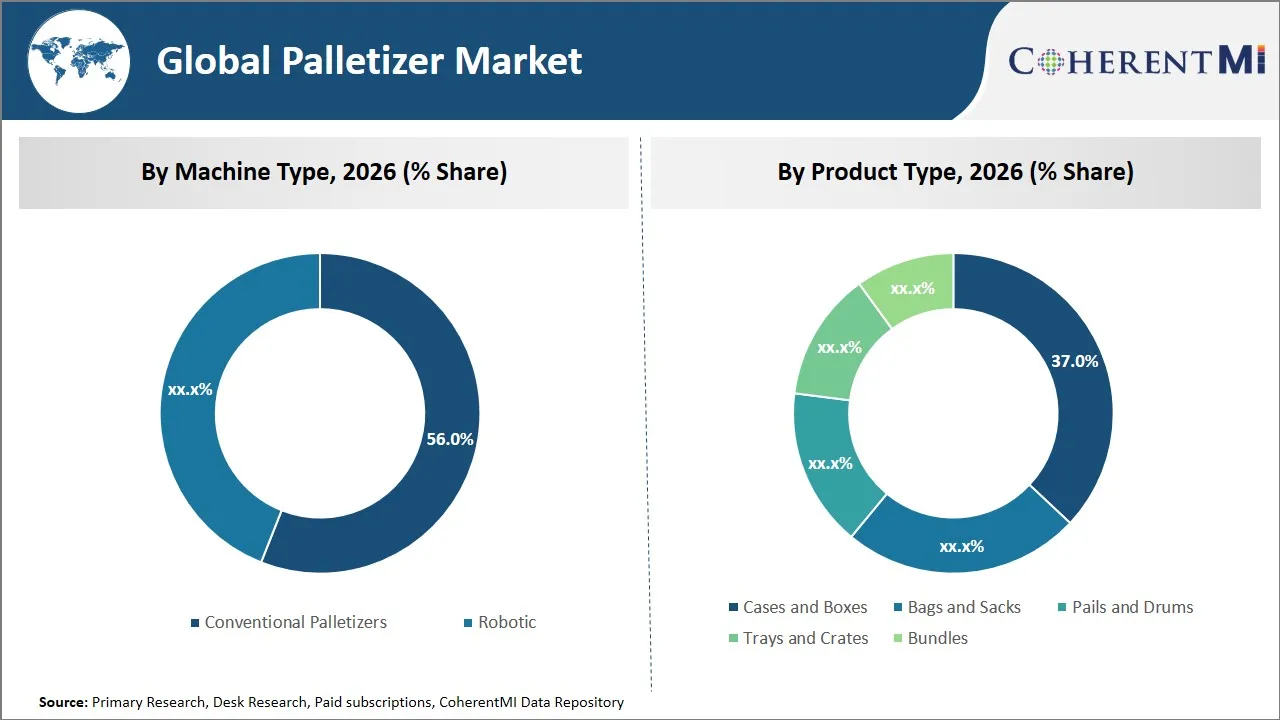
Insights, By Machine Type: Established Infrastructure and Cost-Effectiveness Drive Dominance of Conventional Palletizers
In terms of machine type, conventional palletizers are expected to account for 56% of the market share in 2026. The growth can be attributed to consistent performance, minimal startup costs, followed by broad adoption in varied production settings. Decades-long improvements, together with fine-tuning, made these mechanisms central to automated packing tasks.
Durability defines why traditional palletizing systems lead the market. Because they rely on simple mechanics, worker familiarity grows quickly. Their design uses proven methods instead of complex electronics. Training needs shrink when technology stays basic. Maintenance crews adapt without extensive instruction. Simplicity ensures fewer breakdowns over time. Longevity emerges naturally from uncomplicated construction. Experience matters more than innovation here.
For instance, on July 14, 2025, Vention announced the launch of its next-generation Rapid Series Palletizer, the industry's most versatile palletizing solution engineered for unmatched deployment speed.
(Source: Robotics Tomorrow)
Insights, By Product Type: Standardization and Handling Efficiency Drive the Dominance of Cases and Boxes
In terms of product type, cases and boxes is expected to account for 37% of the market share in 2026. Owing to uniform sizes, strong stacking ability, because of broad use in various sectors as the go-to form for machine-based handling. Shape itself supports effective loading on pallets, yet ensures minimal unused room during transport and storage.
Despite differing shapes, cases and boxes follow uniform dimensions, which simplifies automation processes across distribution networks. Because they align with predefined size criteria, these containers move efficiently through existing palletizing systems without frequent recalibration. Their predictable form allows stacking sequences to shift as needed, maintaining balance while reducing empty gaps within loads.
Additional Insights of Palletizer Market
- Robotic systems now represent a majority segment (~55–58%) of new palletizer installations in many markets, reflecting accelerated automation demand.
- Cobots (collaborative robots) are increasing share rapidly (~12–22% adoption), especially among SMEs that previously avoided full automation.
- AI/vision‐guided robotics adoption rising (~32–38%).
- Still significant in regions and industries with lower automation maturity, with conventional palletizers representing ~30–46% of current installed base in some markets.
- Conventional palletizers remain relevant where CAPEX sensitivity and simpler stacking needs prevail.
Competitive overview of Palletizer Market
The major players operating in the global palletizer market include ABB Ltd, FANUC Corporation, KUKA AG, Honeywell International Inc, KION Group AG, Columbia Machine, Inc, Premier Tech, Fuji Yuosoki Kogyo Co Ltd, CONCETTI S.p.A, Beumer Group GmbH, Krones AG, Daifuku Co Ltd, SSI Schaefer Group, ABC Packaging Machine Corporation, and BW Integrated Systems.
Palletizer Market Leaders
- ABB Ltd
- FANUC Corporation
- KUKA AG
- Honeywell International Inc
- KION Group AG
Recent Developments in Palletizer Market
- On September 25, 2025, Verbruggen Palletizing Solutions inaugurated a new facility in Emmeloord, the Netherlands, to broaden its product portfolio from pure palletizers to comprehensive end‑of‑line solutions, suggesting investment in capacity and market reach beyond basic equipment supply.
- On November 21, 2024, FlexLink announced the launch of the new palletizer RC12, the latest addition to its range of collaborative palletizers. As a third-generation model, the RC12 is designed to enhance production efficiency while ensuring operator safety and simplifying the palletizing process.
Palletizer Market Segmentation
- By Machine Type
- Conventional Palletizers
- Robotic
- By Product Type
- Cases and Boxes
- Bags and Sacks
- Pails and Drums
- Trays and Crates
- Bundles
- By End User
- Food and Beverages
- Healthcare and Pharmaceuticals
- Cosmetics
- Chemicals and Materials
- Others

Would you like to explore the option of buying individual sections of this report?
Gautam Mahajan is a Research Consultant with 5+ years of experience in market research and consulting. He excels in analyzing market engineering, market trends, competitive landscapes, and technological developments. He specializes in both primary and secondary research, as well as strategic consulting across diverse sectors.