Blockchain Identity Management Market SIZE AND SHARE ANALYSIS - GROWTH TRENDS AND FORECASTS (2026 -2033)
Blockchain Identity Management Market is segmented By Component (Software, Services), By Network Typ...
Blockchain Identity Management Market Size - Analysis
The Global Blockchain Identity Management Market is estimated to be valued at USD 3.10 Bn in 2026 and is expected to reach USD 210 Bn by 2033, exhibiting a compound annual growth rate (CAGR) of 83.3% from 2026 to 2033. This rapid rise traces how markets shift from early trials toward broad use in various sectors. Expansion on such scale signals trust among businesses placing bets on blockchain for managing identities, as digital transformation pressures grow alongside worldwide rules tightening around data control.
Market Size in USD Bn
CAGR83.3%
| Study Period | 2026 -2033 |
| Base Year of Estimation | 2025 |
| CAGR | 83.3% |
| Market Concentration | Medium |
| Major Players | IBM Corporation, Amazon Web Services Inc, Oracle Corporation, Microsoft Corporation, Dock Labs AG and Among Others |

please let us know !
Blockchain Identity Management Market Trends
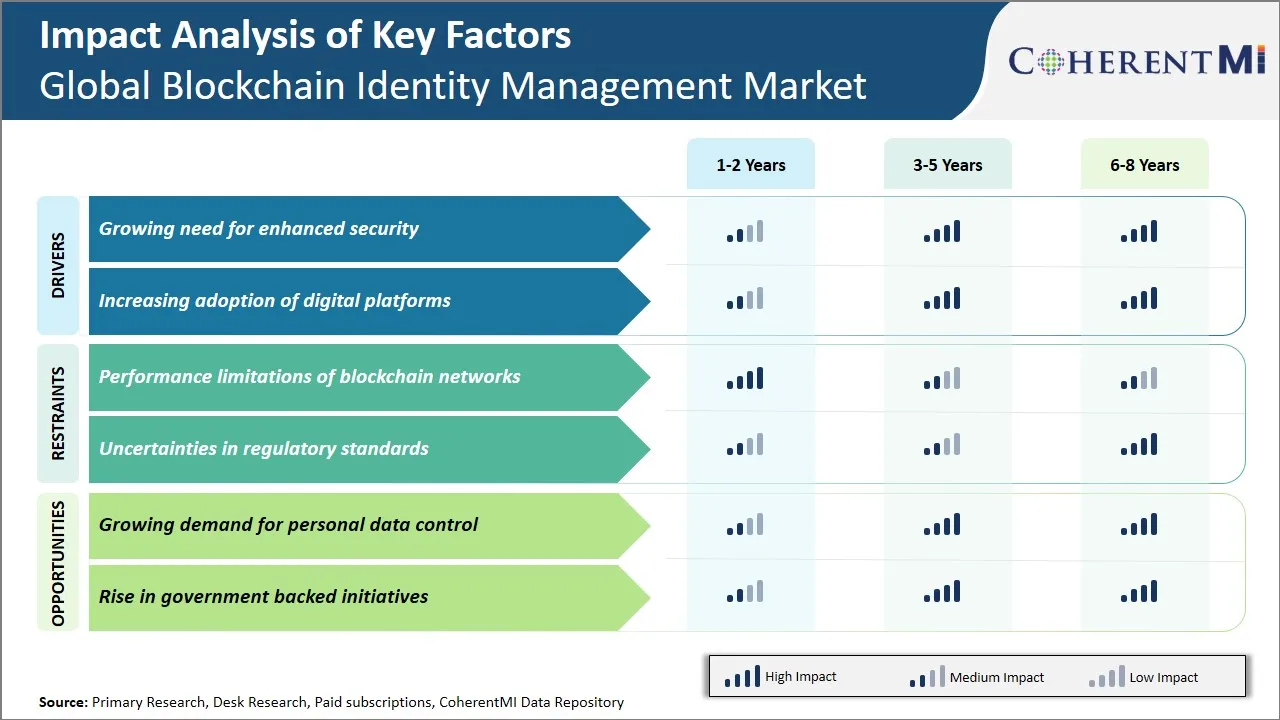
Market Driver - Growing Need for Enhanced Security
Growing complexity in digital dangers now shapes corporate methods for handling user identities, pushing need for stronger safeguards that resist manipulation. Because past centralized models often fail under assault, well-known cases have revealed vast amounts of private information, leading to serious monetary loss and weakened public trust among businesses in multiple sectors.
What sets blockchain apart is its resistance to changes after data entry, reshaping approaches to managing identity information. A single update becomes part of a chain that resists tampering, visible only if consistency across prior points holds. Any attempt to alter past details disrupts the sequence, making interference evident immediately. Integrity gains strength under such conditions, since trust shifts from central oversight to structural design.
For instance, on May 15, 2025, Airtel unveiled a new cutting-edge solution that will detect and block malicious websites across all communication Over- The-Top (OTT) apps and platforms including emails, browsers, OTTs like WhatsApp, Telegram, Facebook and Instagram in real time.
(Source: airtel.in)
Market Driver - Increasing Adoption of Digital Platforms
Every industry sees digital shifts altering how companies operate, interact with customers, and manage tasks, prompting reliance on smarter identity solutions across varied web platforms. As expectations evolve, firms move operations into cloud setups, use software through ongoing access models, then roll out mobile apps as routine steps. Despite steady progress, complexity grows where trust, speed, and consistency must align without disruption.
Modern offices host numerous interactions daily with workers, clients, outside collaborators, all engaging through multiple linked tools. As device networks expand rapidly, so does the number of entry locations requiring identity oversight. Equipment ranging from handhelds to automated environmental monitors now routinely exchange data. Complex arrangements form naturally when diverse technologies communicate continuously instead of simply linking up. Each new connection adds structure where simple links once stood.
For instance, on February 9, 2026, AuthBridge and Vibrium AI announced a strategic technology collaboration and co-innovation partnership. Through this alliance, the companies aim to jointly develop next-generation, AI-driven verification and conversational intelligence solutions that will redefine digital trust, strengthen operational intelligence, and enhance innovation across the verification ecosystem.
(Source: prnewswire.com)
 To learn more about this report, Request Free Sample Copy
Market Challenge - Performance Limitations of Blockchain Networks
Despite growing interest, global adoption of blockchain for identity management encounters obstacles rooted in system design flaws. Performance bottlenecks emerge prominently in networks relying on proof-of-work methods, such as Bitcoin or Ethereum. These frameworks struggle under increasing load, limiting their usefulness for managing identities at scale.
For instance, on September 2, 2025, a recent European pilot of a Hyperledger Fabric-based immigration identity system pointed out that many blockchain identity proposals suffer from a security-throughput tradeoff and scalability gaps in real usage.
(Source: nature.com)
Market Opportunity - Growing Demand for Personal Data Control
With more people seeking authority over personal details, momentum builds behind blockchain technology solutions for digital identification. Rising concerns about privacy, sparked by major leaks and misuse incidents, shapes new expectations. Pressure grows on companies to clarify methods used when gathering individual records. Noticed more often are the parties gaining advantage through these methods of data handling. Under growing observation, how organizations keep personal information now stands questioned. Changes in oversight tend to emerge shortly after attitudes across communities begin shifting.
Where laws such as GDPR in Europe or CCPA in California exist, tighter handling of personal data becomes necessary; organizations are expected to enable access, deletion, and movement of user information. With identity systems built on blockchain, people hold their own secure credentials, alteration is blocked, control remains local.
For instance, on February 5, 2026, ExpressVPN announced the launch of ExpressMailGuard, a new email aliasing and inbox protection service designed to help users take control of one of their most exposed digital identifiers: their email address.
(Source: expressvpn.com)
Global Blockchain Identity Management Market - Compliance-Driven Adoption Mapping
|
Compliance Framework |
Regulatory Scope |
Enforcement Metric |
|
GDPR (EU General Data Protection Regulation) |
Applies across all EU member states for personal data protection. |
GDPR enacted 2018; fines up to USD 20 Mn or 4 % of global turnover for breaches. |
|
eIDAS 2.0 (EU Digital Identity Framework) |
EU-wide digital ID regulation requiring digital identity wallets for all EU citizens by ~2026. |
Target: 100 % EU citizens offered Digital Identity Wallets by 2026 under eIDAS 2.0 mandate. |
|
HIPAA (U.S. Health Insurance Portability and Accountability Act) |
U.S. healthcare data privacy/security standard. |
No universal blockchain adoption percentage available; research shows blockchain can reduce HIPAA compliance verification time by ~87 % and improve audit accuracy to ~99.8 % in pilot contexts. |
Global Blockchain Identity Management Market - Identity Fraud Cost vs Blockchain Mitigation Impact
|
Impact Category |
Traditional Identity Fraud Cost |
Blockchain Identity Mitigation Impact |
|
Enterprise Data Breach Cost (Identity-linked) |
~USD 4.45 million per breach on average. |
68 % reduction in breach costs |
|
Fraud Reduction in Blockchain Enabled Identity Verification |
Baseline traditional fraud incidents (no blockchain) |
0–65 % reduction in fraud incidents |
|
Identity Verification Cost Savings |
Traditional identity verification (KYC/AML) high cost |
40–70 % reduction in identity verification costs |
|
KYC Cost Impact in Financial Sector |
~USD 50 M+ annual traditional KYC spend per institution. |
~47 % KYC cost reduction |
|
Identity Verification Processing Speed |
Traditional speeds variable |
71 % faster transaction / verification processing |
Key winning strategies adopted by key players of Blockchain Identity Management Market
- Strategic Partnerships and Ecosystem Building: Microsoft partnered with organizations like Accenture, Avanade, and government entities to create a comprehensive identity verification ecosystem. Microsoft launched Azure AD Verifiable Credentials and partnered with 50+ organizations including universities and healthcare providers. Integrated with existing Microsoft 365 ecosystem (used by 345 million users globally). Microsoft captured 23% market share in enterprise blockchain identity solutions by 2023 and generated USD 180 million in revenue from blockchain identity services in FY2023.
- Government and Regulatory Alignment: Hyperledger Indy and Sovrin Foundation collaborated with the Government of British Columbia on digital credentials and partnered with European governments for GDPR-compliant identity solutions. The Sovrin Network processed over 2.3 million credential transactions by 2023, secured USD 45 million in government contracts across North America and Europe and achieved 40% market share in government blockchain identity projects.
Segmental Analysis of Blockchain Identity Management Market
 To learn more about this report, Request Free Sample Copy
Insights, By Component: Software Segment’s Dominance is Driven by Comprehensive Identity Solution Requirements
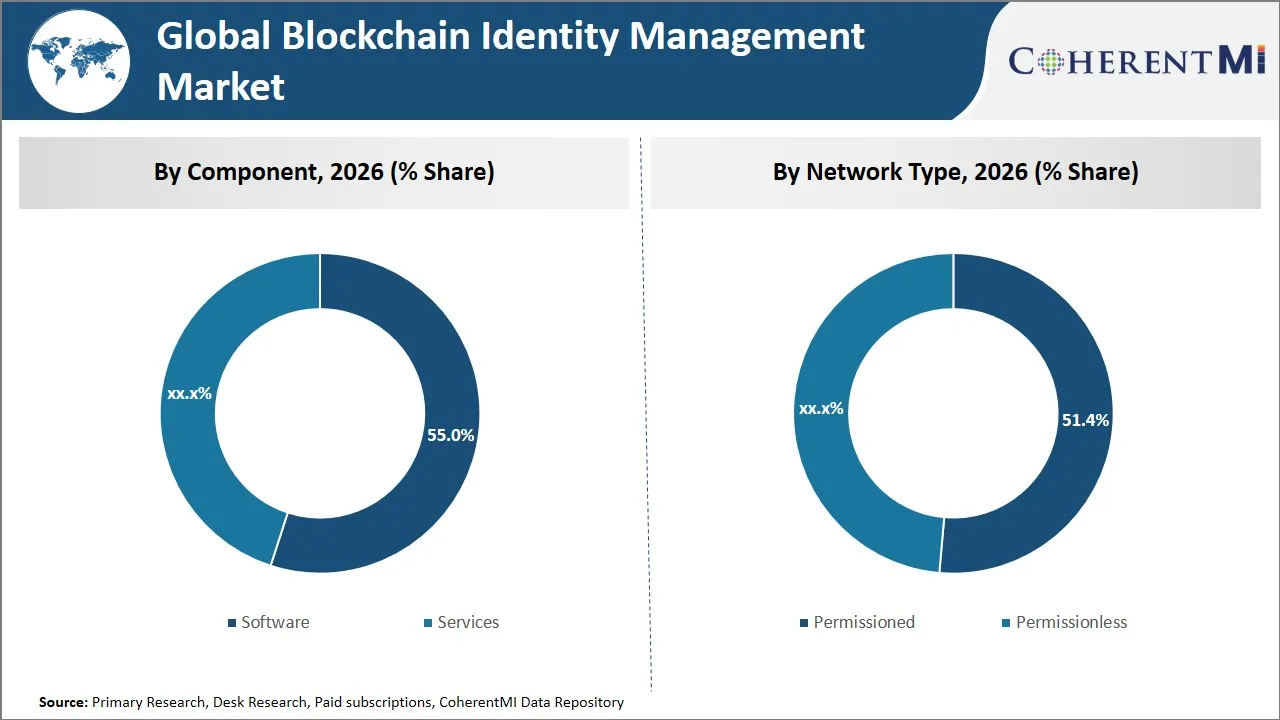
In terms of component, the software segment is expected to account for 55% of the market share in 2026. The rise follows growing need for complete blockchain-based identity systems that work immediately within current setups. Fueled by complete-cycle validation, entry oversight, and activity logging, progress emerges where dependence on advanced technical knowledge fades. Despite minimal expertise demands, consistent operation thrives through structured digital checks, regulated permissions, and monitored interactions across platforms.
As demands spread through sectors, progress in software follows where consistent identification methods take hold. Not preference but requirement pushes shared systems to manage client entry, employee access, or verification of outside entities. Instead of building from scratch, organizations turn to ready-made components alongside connection tools - reducing delays without compromising compliance. Security stays intact, effort remains low; improvements proceed with little coding needed.
For instance, on October 20, 2025, Proof announced the launch of digital credential solutions that enable digital asset wallets, service providers, and users to prove their identity and KYC characteristics in a privacy-protecting, repeatable, and secure way.
(Source: proof.com)
Insights, By Network Type: Permissioned Networks Leading Through Enterprise Security and Control Requirements
In terms of network type, the permissioned segment is expected to account for 51.4% of the market share in 2026. A change appears as businesses seek clear governance for handling digital identities within blockchain systems. Authority in controlled environments arises through emphasis on control paired with protected transparency, beyond mere market pressure.
As identity data demands protection, entry must be restricted to verified members. Only after review may a participant join, with approval granted solely by network managers. Trust becomes enforceable when access to personal records remains under oversight. Operations stay stable since unauthorized interference drops sharply within regulated setups.
Additional Insights of Blockchain Identity Management Market
- Blockchain-anchored identity wallets increased from ~50 million in 2023 to ~210 million in 2024 and are predicted to exceed ~1.5 billion users by 2032.
- SSI-based credentials (verifiable digital identity credentials) accounted for ~6% of 5 billion global credentials issued in 2024, expected to grow to >35% by 2032.
- Estimated savings for enterprises (not strictly regional but relevant) from SSI adoption in financial services could exceed USD 4.2 billion per year by 2030 due to streamlined KYC and identity verification.
Competitive overview of Blockchain Identity Management Market
The major players operating in the Global Blockchain Identity Management Market include IBM Corporation, Amazon Web Services Inc, Oracle Corporation, Microsoft Corporation, Dock Labs AG, NEC Corporation, Bitfury Group Limited, Antiersolutions, Wipro, NuID Inc, Evernym, Blockstack PBC, Blockpass IDN Ltd, SelfKey Foundation, and Jolocom GmbH.
Blockchain Identity Management Market Leaders
- IBM Corporation
- Amazon Web Services Inc
- Oracle Corporation
- Microsoft Corporation
- Dock Labs AG
Recent Developments in Blockchain Identity Management Market
- On October 27, 2025, IBM announced the launch of IBM Digital Asset Haven, a comprehensive platform for financial institutions, governments, and corporations to securely manage and scale their digital asset operations.
- On September 19, 2024, Privado ID announced a merger with Disco, a pioneer in multichain verifiable data and reputation management. The merger will accelerate the creation and adoption of a unified, chain-agnostic digital identity infrastructure that bridges both Web2 and Web3 ecosystems.
Blockchain Identity Management Market Segmentation
- By Component
- Software
- Services
- By Network Type
- Permissioned
- Permissionless
- By Provider Type
- Application Provider
- Middleware Provider
- Infrastructure Provider
- By End User
- BFSI
- IT and Telecom
- Government
- Healthcare
- Others

Would you like to explore the option of buying individual sections of this report?
Gautam Mahajan is a Research Consultant with 5+ years of experience in market research and consulting. He excels in analyzing market engineering, market trends, competitive landscapes, and technological developments. He specializes in both primary and secondary research, as well as strategic consulting across diverse sectors.