Microsoft Dynamics Market SIZE AND SHARE ANALYSIS - GROWTH TRENDS AND FORECASTS (2026 - 2033)
Microsoft Dynamics Market is segmented By Solution (365 Platform, Services), By Access Type (System-...
Microsoft Dynamics Market Size - Analysis
The global Microsoft dynamics market is estimated to be valued at USD 14 Bn in 2026 and is expected to reach USD 40 Bn by 2033, exhibiting a compound annual growth rate (CAGR) of 12% from 2026 to 2033. Steady upward movement shows more companies now using cloud-hosted ERP and CRM systems, a shift prompted by wide-ranging efforts to modernize operations through technology. Expansion on this scale comes not just from demand but also from businesses seeking unified software tools - these help simplify workflows while deepening interactions with customers and delivering timely data to support strategic choices.
Market Size in USD Bn
CAGR12.00%
| Study Period | 2026 - 2033 |
| Base Year of Estimation | 2025 |
| CAGR | 12.00% |
| Market Concentration | Medium |
| Major Players | Microsoft Corporation, Accenture Plc, Tata Consultancy Services, Infosys Ltd., Capgemini SE and Among Others |

please let us know !
Microsoft Dynamics Market Trends
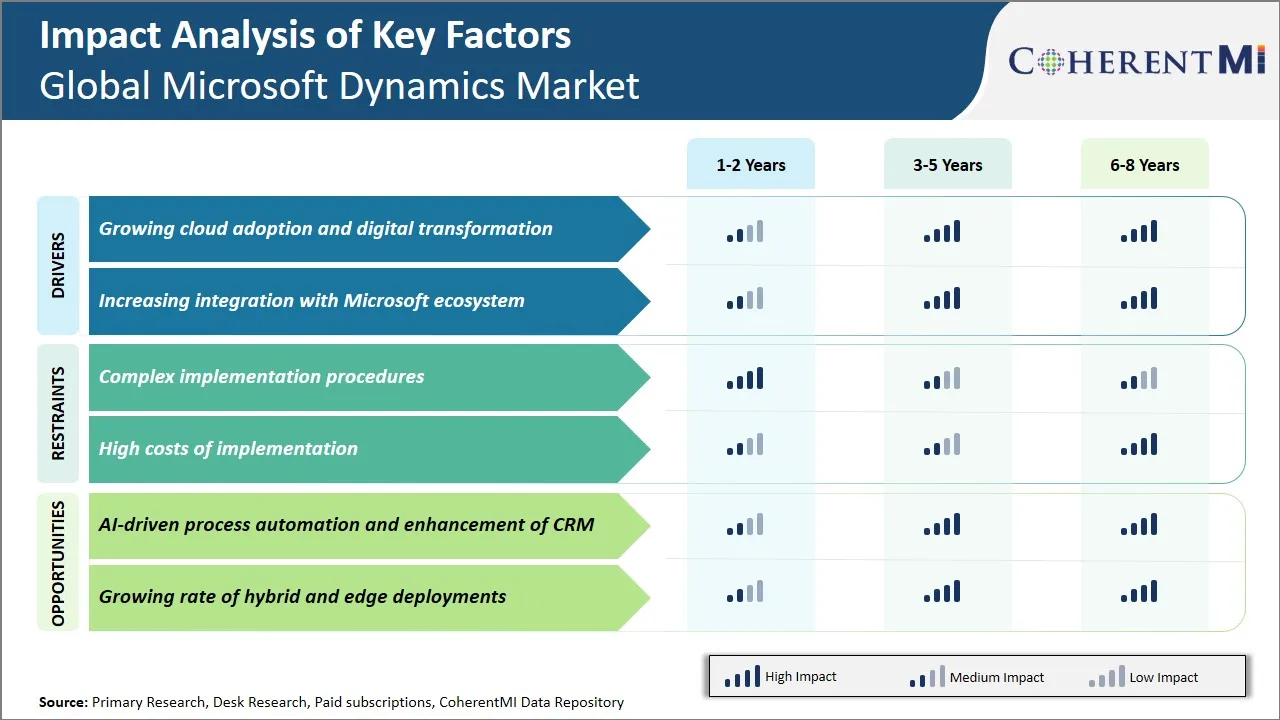
Market Driver - Growing Cloud Adoption and Digital Transformation
Change happens fast now, driven by movement into cloud setups alongside broad efforts to update digitally - this pushes the worldwide Microsoft dynamics field ahead. Across many fields, groups see necessity in refreshing how they work, leaving old local systems for flexible, expandable, and cheaper options online. Such change goes beyond tools; it reshapes deeply how companies function, stand out, bring worth to those involved.
At the core of this shift stands Microsoft dynamics, built on a strong foundation in the cloud. Its wide range of business tools supports companies aiming to use scalable technology. Flexibility remains intact, even as operations grow more complex. Custom needs are met without sacrificing integration. Modern workflows adapt smoothly within this environment. What emerges is a system aligned with evolving demands, shaped by structure yet responsive to change.
For instance, on January 14, 2026, Amazon Web Services (AWS) announced the general availability of the AWS European Sovereign Cloud, a new, independent cloud for Europe entirely located within the EU, and physically and logically separate from other AWS Regions.
(Source: aws.amazon.com)
Market Driver - Increasing Integration with Microsoft Ecosystem
With connections growing stronger between Microsoft dynamics and other tools within the Microsoft suite, more businesses see benefit in staying within this environment. As information moves smoothly across systems, using these linked platforms simplifies operations. User interactions remain uniform, which reduces confusion over time. Administration becomes less complex when one framework supports multiple functions. This cohesion influences decisions to adopt - and keep - these integrated solutions.
A vast network of tools - spanning software for daily tasks, online storage systems, environments for building programs, and data analytics solutions forms Microsoft’s offering. This structure supports companies aiming to get more utility from existing tech budgets without tangled setups or excessive management demands. Efficiency emerges through cohesion across components designed to interact smoothly. Decisions around deployment become less burdened when compatibility is built in from the start.
For instance, on July 16, 2025, Microsoft released Wave 2 for Microsoft dynamics 365, Microsoft Power Platform, and Copilot offerings that introduce new and improved capabilities which help organizations to harness the full potential of this new era.
(Source: Microsoft)
 To learn more about this report, Request Free Sample Copy
Market Challenge - Complex Implementation Procedures
Despite growing demand, expansion of the global Microsoft dynamics market encounters obstacles rooted in complicated setup processes. These hurdles discourage new users while pushing rollout periods further than expected. Across different sectors, companies struggle to shift from outdated systems to dynamics environments. Reasons for delays include difficulties moving historical data, adapting features to specific needs, together with connecting to current business tools.
Complicated systems call for deep training routines, fine-tuning setups, also continuous upkeep handled by experts. When work methods differ wildly between teams, reshaping procedures becomes unavoidable - leading firms to restructure habits in quiet but lasting ways.
Market Opportunity - AI-Driven Process Automation and CRM Enhancement
With artificial intelligence now part of Microsoft dynamics, shifts in worldwide market dynamics appear increasingly likely. Owing to smarter automation and AI in networks, how organizations manage customer relationship management is changing at a fundamental level. Predictive insights emerge more reliably when systems learn from interaction patterns over time. Lead prioritization improves once algorithms interpret behavioral signals accurately. Customer pathways unfold with less manual input where adaptive models guide next steps.
Significant gains in sales outcomes emerge when firms adopt recent advances in artificial intelligence. Efficiency rises notably through decreased reliance on human-driven paperwork. Beyond standard client management tools, new capabilities appear - chat systems that respond intelligently, self-updating records, foresight into equipment servicing needs - all shaping smoother workflows. Within these frameworks, pattern-finding software adjusts engagements instantly, tailors price structures fluidly, directs assets wisely.
How Power Platform and Copilot are Expanding the Dynamics Ecosystem?
|
Category |
Metric |
Value |
|
Dynamics & Power Platform Usage |
Organizations using Dynamics 365 or Power Platform |
>500,000 |
|
Fortune 500 adoption |
97% | |
|
Customers using Copilot features (Dynamics/Power Platform) |
>40,000 | |
|
Organizations experienced Copilot in Dynamics/Power Platform |
>130,000 | |
|
Copilot Growth & Adoption |
Azure AI customers using Power Platform AI features |
>480,000 organizations |
|
Copilot features in Dynamics monthly active user growth |
>60% QoQ increase | |
|
Power Platform Base |
Monthly active users (Power Platform) |
48 M |
|
Dynamics 365 Business Central |
Business Central organizational users |
>40,000 |
Key winning strategies adopted by key players of Microsoft Dynamics Market
- Cloud-First Strategy and Digital Transformation Leadership: Microsoft launched dynamics CRM Online with aggressive pricing at USD 65/user/month. Microsoft also introduced dynamics 365 as unified cloud platform and integration with Microsoft 365 and Azure ecosystem. This strategy helped Microsoft capture 4.8% of the global CRM market and 2.1% of the ERP market by 2023, making it the fastest-growing enterprise software provider.
- Industry-Specific Solution Development: HSO International launched specialized solutions for manufacturing, retail, and professional services. It also developed industry-specific accelerators reducing implementation time by 40% and created pre-configured templates for 15+ industries. These strategies resulted in revenue growth of 68% in targeted verticals and implementation time reduced from average 18 months to 11 months.
Segmental Analysis of Microsoft Dynamics Market
 To learn more about this report, Request Free Sample Copy
Insights, By Solution: Cloud-First Strategy and Comprehensive Integration Drive 365 Platform Dominance
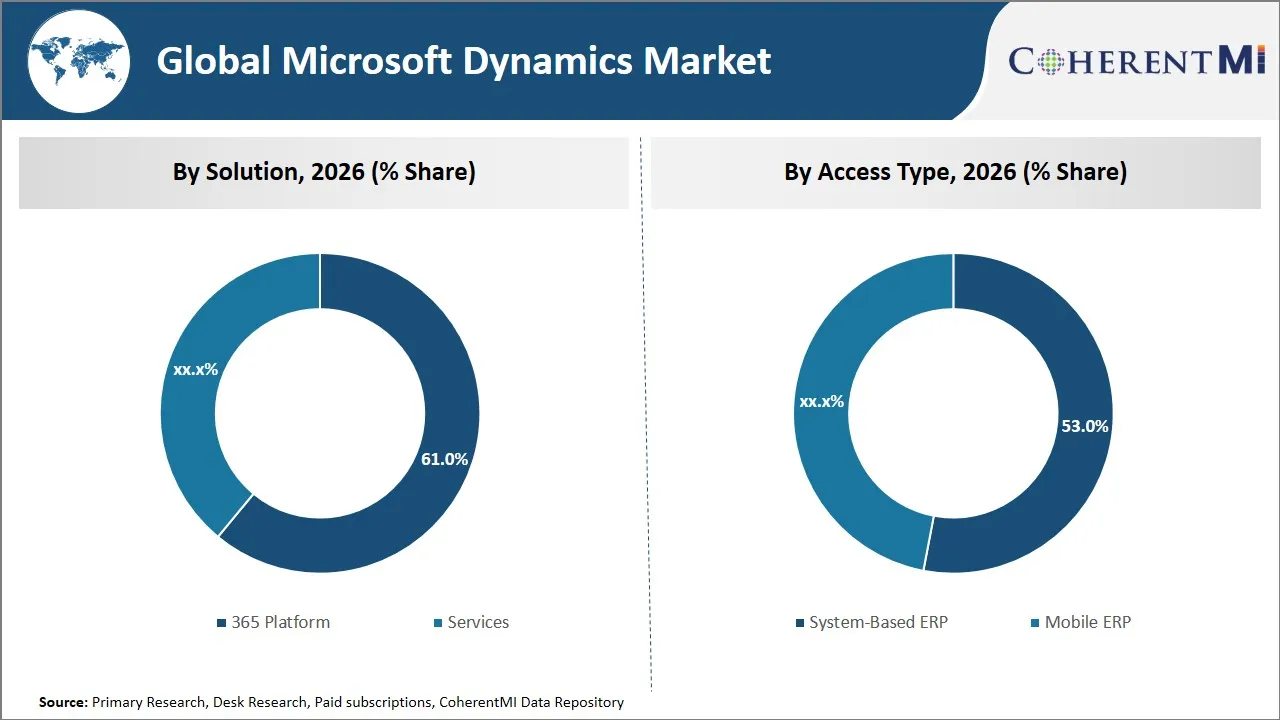
In terms of solution, 365 platform is expected to account for 61% of the market share in 2026. This expansion follows a core transition to cloud systems for businesses, together with Microsoft’s role as an integrated digital workspace supplier. Leading position in the 365 Platform comes not only from linking work apps smoothly but also combining teamwork features and operational functions across one connected environment meeting current company demands.
What sets 365 platform apart stems from a design built directly for the cloud, avoiding constraints typical of locally installed systems. Because modern companies favor tools that scale quickly, lower hardware demands, and allow access from varied locations, this approach gains relevance. Instead of large initial spending, firms see steady recurring charges under the subscription structure - this supports budget planning. Ongoing improvements arrive automatically, alongside reinforced safeguards, which helps maintain performance over time. For enterprises aiming to refine IT strategies without heavy early investment, such traits become central.
Insights, By Access Type: Legacy System Integration and Robust Infrastructure Requirements Fuel System-Based ERP Dominance
In terms of access type, system-based ERP is expected to account for 53% of the market share in 2026. The growth is primarily due to the complex integration requirements of large enterprises and the need for robust, on-premises infrastructure control. System-Based ERP solutions maintain their market leadership position because they offer organizations complete control over their data, processes, and system customizations, which remains critical for many industries with specific operational requirements.
The dominance of system-based ERP is fundamentally driven by enterprise-level organizations' need for comprehensive integration with existing legacy systems and specialized industry equipment. Many manufacturing, healthcare, and financial services organizations have invested significantly in proprietary systems and specialized hardware that require direct system integration capabilities.
For instance, on May 20, 2025, SAP unveiled new Business Suite application packages and AI-enhanced updates to supply chain applications. SAP repackaged its cloud ERP applications to make it easier for new customers to buy into its ecosystem, and adding AI-based product enhancements for its existing customers.
(Source: cio.com)
Additional Insights of Microsoft Dynamics Market
- Services segment is expected to hold a dominant position after 365 platform owing to increasing adoption of cloud services.
- Mobile ERP is expected to follow the system-based ERP segment in terms of access type, owing to the growing need for hybrid and edge deployments.
- North America is expected to lead the Microsoft dynamics market with a 42% revenue share in 2026, driven by increasing expenditure on R&D.
- Asia Pacific is expected to witness the fastest growth in the Microsoft dynamics market due to an increase in AI-driven process automation.
Competitive overview of Microsoft Dynamics Market
The major players operating in the global Microsoft dynamics market include Microsoft Corporation, Accenture Plc, Tata Consultancy Services, Infosys Ltd., Capgemini SE, DXC Technology, Cognizant, Wipro Ltd., HCL Technologies, Avanade, Hitachi Solutions, RSM International, Velosio, Merit Solutions, and ArcherPoint.
Microsoft Dynamics Market Leaders
- Microsoft Corporation
- Accenture Plc
- Tata Consultancy Services
- Infosys Ltd.
- Capgemini SE
Recent Developments in Microsoft Dynamics Market
- On December 11, 2025, Avanade, the world’s leading Microsoft expert and 20-time Microsoft Global System Integrator Partner of the Year, announced its expansion into India, marking a significant milestone in the company’s Asia Pacific growth strategy. The move reflects the growing demand across the region for AI-enabled transformation, cloud modernization, and secure, enterprise-grade digital solutions built on the Microsoft ecosystem for mid-market organizations.
- On November 18, 2025, Microsoft announced the expansion of dynamics 365 agentic AI applications, enhancing sales qualification benchmarks and real‑time ERP insights for faster decision making.
Microsoft Dynamics Market Segmentation
- By Solution
- 365 Platform
- Services
- By Access Type
- System-Based ERP
- Mobile ERP
- By Module
- Finance and Accounting
- Human Capital Management
- Supply Chain Management
- Customer Relationship Management
- Sales and Marketing
- Procurement
- Inventory Management
- Others
- By End User
- Finance
- Manufacturing and Resources
- Distribution Service
- Services
- Public Sector
- Infrastructure

Would you like to explore the option of buying individual sections of this report?
Gautam Mahajan is a Research Consultant with 5+ years of experience in market research and consulting. He excels in analyzing market engineering, market trends, competitive landscapes, and technological developments. He specializes in both primary and secondary research, as well as strategic consulting across diverse sectors.