Quantum Computing Software Market SIZE AND SHARE ANALYSIS - GROWTH TRENDS AND FORECASTS (2026 - 2033)
Quantum Computing Software Market is segmented By Component (Solution, Services), By Technology (Sup...
Quantum Computing Software Market Size - Analysis
The global quantum computing software market is estimated to be valued at USD 1.25 Bn in 2026 and is expected to reach USD 4.75 Bn by 2033, exhibiting a compound annual growth rate (CAGR) of 16.3% from 2026 to 2033. Despite steady momentum, progress stems largely from wider use of quantum systems in multiple sectors alongside rising funding for related software initiatives from corporate and state sources. Expansion occurs because more organizations acknowledge quantum methods can address intricate calculations impossible for traditional machines - especially within encryption, logistics planning, molecular research, and economic simulations.
Market Size in USD Bn
CAGR16.3%
| Study Period | 2026 - 2033 |
| Base Year of Estimation | 2025 |
| CAGR | 16.3% |
| Market Concentration | High |
| Major Players | IBM, Microsoft Corporation, Google LLC, Amazon Web Services, NVIDIA Corporation and Among Others |

please let us know !
Quantum Computing Software Market Trends
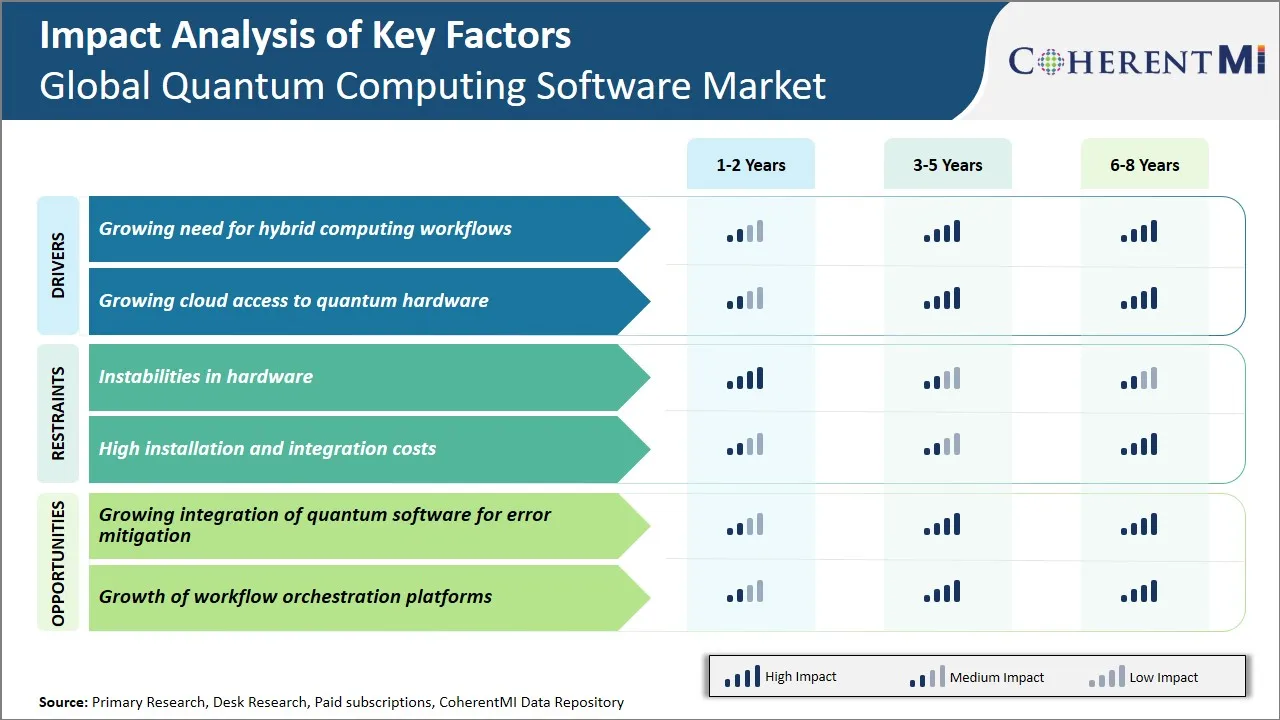
Market Driver - Growing Need for Hybrid Computing Workflows
The modern computing world shifts when firms see fixed boundaries in traditional systems during tough tasks. Such awareness sparks new patterns. mixed-method computing rises, where quantum programs link old-style machines with next-generation processors in subtle ways.
Despite differences in industry focus, from drug development to shipping, large institutions face challenges whose nature shifts how useful traditional computers appear. Where step-by-step logic, information handling, or predictable methods matter most, standard systems perform reliably. Problems involving massive combinations, security protocols, or modeling intricate interactions often push beyond those limits. Such tasks, though difficult to manage conventionally, show where newer computation models might offer advantage instead.
For instance, on November 6, 2025, Alice & Bob announced the software integration of its future QPUs with high-performance computing (HPC) environments through SLURM, the world’s most widely used workload management system, present in 60% of the world’s top supercomputers.
(Source: alice-bob.com)
Market Driver - Growing Cloud Access to Quantum Hardware
The availability of quantum computing via cloud platforms changes how institutions interact with the technology. As access widens, reliance on specialized infrastructure declines. Because entry hurdles shrink, interest grows in software suited for remote quantum systems. With distribution shifts come new expectations for tools managing dispersed hardware. This transition reshapes priorities across development environments. Demand rises quietly, driven by reach rather than readiness.
Access to varied quantum systems now comes via cloud platforms, where intricate backend details fade behind streamlined tools. These environments support full-cycle work in quantum computation without exposing users to operational intricacies. Availability shifts how researchers engage with hardware, opening doors once limited by physical access. Behind simple entry points lies a network of advanced processors ready for remote utilization.
For instance, on February 26, 2025, IBM upgraded the IBM Quantum Platform to offer enterprise-grade cloud access and previewed access to additional QPUs, improving hardware availability and performance for cloud users.
(Source: ibm.com)
 To learn more about this report, Request Free Sample Copy
Market Challenge - Instabilities in Hardware
Despite progress, instability remains central to quantum computing’s limited real-world application. Because quantum states decay quickly under outside influence, machines struggle with consistency. Environmental factors, temperature shifts, electromagnetic fields, vibration, disrupt operations easily. These disruptions stem from a core weakness: coherence cannot last long enough. Equipment today lacks the resilience needed for steady performance. Without stable conditions, results often fail to repeat.
Despite progress, differences among quantum devices, such as those using superconductors, ion traps, or light-based setups prevent uniform software design, so programs often need custom versions for each system. Because of these constraints, tools built today tend to stay isolated within labs; they rarely move beyond testing phases, which slows adoption in real-world settings while also restricting how widely the field can expand.
Market Opportunity - Growing Integration of Quantum Software for Error Mitigation
Growth in the field of quantum computing software unfolds at a notable pace, driven by progress in advanced tools designed to reduce errors. With latest quantum systems still functioning within the limits of the NISQ phase, need rises steadily for adaptive programs able to detect, forecast, correct faults during operation. Though hardware remains imperfect, focus shifts toward smarter computational layers that respond dynamically under unstable conditions.
A shift toward embedding artificial intelligence within quantum error mitigation tools opens new pathways, where machine learning methods adjust corrections by observing device-specific trends while refining responses in real time. Such progress favors firms focused on quantum control platforms, compilation efficiency, or intermediary frameworks designed to align unstable quantum processors with usable outcomes - progress unfolding quietly yet reshaping vendor potential.
For instance, on June 24, 2025, Q-CTRL announced the availability of its software integration with Rigetti. As part of this integration, Q-CTRL’s flagship quantum performance management software, Fire Opal, is now available on Ankaa-3, Rigetti’s latest 84-qubit quantum computer through the Rigetti Quantum Cloud Services platform (QCS).
(Source: q-ctrl.com)
Global Quantum Computing Software Market - Open-Source vs Proprietary Quantum Software Spend Trends
|
Indicator |
Open-Source Quantum Software |
Proprietary Quantum Software |
|
Developer Adoption Growth |
High growth, open-source libraries & SDK usage ↑ 30–70% |
Moderate growth- proprietary tools usually bundled with enterprise stacks |
|
Contribution / Community Increase |
>60% of OSS ecosystem share in major repos / frameworks |
<40% of overall proprietary software participation |
|
Cloud Integration Trend |
Usage rising by ~70% year-over-year |
Enterprise integrations rising by ~40–50% |
|
Ecosystem Developer Growth |
OSS dev participation growing ~40–50% YoY |
Proprietary tooling adoption growing ~15–30% YoY |
|
Hybrid System Spend Focus |
Strong ↑ (e.g., hybrid development tooling use ↑ ~45%) |
Strong ↑ (enterprise contracts often include hybrid modules) |
Key winning strategies adopted by key players of Quantum Computing Software Market
- Ecosystem Development and Open-Source Strategy: IBM released Qiskit as an open-source quantum computing framework, established IBM Quantum Network with 200+ members including Fortune 500 companies and created quantum education initiatives reaching 400,000+ students globally. Qiskit has been downloaded over 500,000 times with 450,000+ registered users (as of 2023). GitHub Engagement has 2,400+ contributors, 19,000+ stars, demonstrating strong community involvement IBM captured approximately 25% of the quantum software market share by 2023. IBM's quantum computing division generated USD 1.9 billion in revenue in 2022, with 15% attributed directly to software solutions and services.
- Strategic Partnership and Hybrid Cloud Integration: Microsoft formed partnerships with IonQ, Honeywell (now Quantinuum), Rigetti Computing while integrating with classical Azure cloud services. Azure Quantum services showed 130% year-over-year growth in 2022. Microsoft registered 85+ enterprise customers within 18 months of launch. Combined hardware-software partnerships generated estimated USD 200 Mn in committed contracts.
Segmental Analysis of Quantum Computing Software Market
 To learn more about this report, Request Free Sample Copy
Insights, By Component: Solution Dominates Owing to Enterprise Integration Needs and Platform Maturity
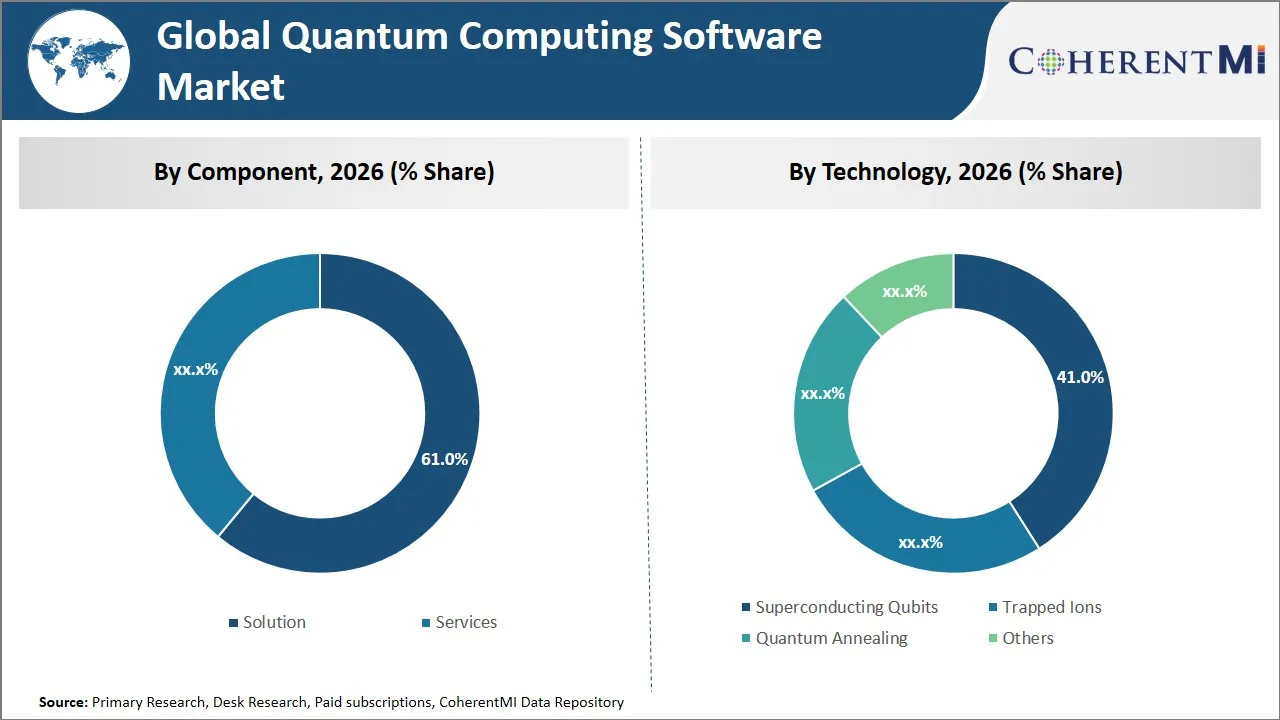
In terms of component, the solution segment is expected to account for 61% of the market share in 2026. Growth appears linked to rising interest in full-scale quantum computing systems capable of supporting entire workflows for quantum software creation. What stands behind this includes tools such as coding interfaces, specialized languages, simulation engines, and unified cloud-based platforms - each contributing to a cohesive environment where companies build and launch quantum applications.
What keeps the solution segment ahead is how enterprises need ready-to-use quantum systems fitting smoothly into current computing setups. Driven by diverse sectors, demand grows for quantum tools featuring simple controls, strong programming support, together with clear guidance materials easing access to quantum technology.
Insights, By Technology: Superconducting Qubits Dominate Owing to Commercial Scalability and Industry Investment
In terms of technology, the superconducting qubits segment is expected to account for 41% of the market share in 2026. Growth stems from greater room to expand, methods already set in production, also support drawn from top-tier tech firms alongside academic hubs. What places superconducting qubits ahead lies in how well they align with current chip-making workflows, paired with proven results in executing precise quantum tasks across larger systems.
One key strength of superconducting qubits lies in their compatibility with mass-production methods unlike many competing platforms. Owing to reliance on standard chip-making procedures, building these qubits allows steady growth in quantity without steep price increases. As hardware scales efficiently, demand rises for tailored software capable of handling calibration across hundreds of interconnected units. Instead of custom solutions, developers focus on tools that adjust performance drifts automatically under real operating conditions.
For instance, on November 5, 2025, Quantinuum announced the launch of Helios, the world’s most accurate general-purpose commercial quantum computer, designed to accelerate quantum computing adoption by enterprises. With the highest fidelity† of any commercial system and a first-of-its-kind real-time control engine, Helios enables developers to program a quantum computer in much the same way they program heterogeneous classical computers.
(Source: quantinuum.com)
Additional Insights of Quantum Computing Software Market
- 65% of quantum software access uses cloud-hosted platforms, giving most users remote access to hardware/software resources without owning quantum machines.
- 35% prefer on-premises deployments, especially where data control and security are critical
- Cloud-hosted quantum tools continue to attract higher adoption, due to broader accessibility and reduced upfront costs.
- On-premises adoption is moderate and stable, motivated by organizations needing tight control over sensitive workloads.
Competitive overview of Quantum Computing Software Market
The major players operating in the global quantum computing software market include IBM, Microsoft Corporation, Google LLC, Amazon Web Services, NVIDIA Corporation, Quantinuum, Xanadu, D-Wave Systems, Rigetti Computing, IonQ, Pasqal, Classiq, QC Ware, Zapata AI, and Q-CTRL.
Quantum Computing Software Market Leaders
- IBM
- Microsoft Corporation
- Google LLC
- Amazon Web Services
- NVIDIA Corporation
Recent Developments in Quantum Computing Software Market
- On November 12, 2025, Microsoft announced the expansion of its Quantum facility in Lyngby, Denmark, marking a significant milestone in the company’s mission to develop general‑purpose, fault‑tolerant quantum computing technology. Building on two decades of investments by Microsoft in Denmark, the new state-of-the-art facility will advance the development of quantum technology, including the development of topological qubits that form the heart of Microsoft’s Majorana 1 chip.
- On July 21, 2025, Amazon announced that Amazon Braket, the quantum computing service by Amazon Web Services, now offers access to Emerald, the latest quantum processing unit (QPU) by IQM. Emerald is a 54-qubit superconducting QPU providing customers higher fidelity gates and full square lattice connectivity.
Quantum Computing Software Market Segmentation
- By Component
- Solution
- Services
- By Technology
- Superconducting Qubits
- Trapped Ions
- Quantum Annealing
- Others
- By Application
- Optimization
- Machine Learning
- Simulation
- Others
- By End User
- Aerospace and Defense
- BFSI
- Healthcare
- Automotive
- Energy and Power
- Chemical
- Government
- Others

Would you like to explore the option of buying individual sections of this report?
Kalpesh Gharte is a senior consultant with approximately 5 years of experience in the consulting industry. Kalpesh holds an MBA in Operations and Marketing Management, providing him with a strong foundation in market strategy and analysis. He has contributed to various consulting and syndicated reports, delivering valuable insights that support informed business decisions