System Integrator Market SIZE AND SHARE ANALYSIS - GROWTH TRENDS AND FORECASTS (2026 - 2033)
System Integrator Market is segmented By Services (Infrastructure Integration, Application Integrati...
System Integrator Market Size - Analysis
The global system integrator market is estimated to be valued at USD 595 Bn in 2026 and is expected to reach USD 1,900 Bn by 2033, exhibiting a compound annual growth rate (CAGR) of 14% from 2026 to 2033. Big shifts in the market show companies pushing harder into digital changes, while also dealing with more tangled tech setups inside their operations. Across the globe, businesses pour resources into connecting systems, aiming to update old software, run smoother, and stay ahead where everything runs on digital momentum.
Cloud shifts, AI use, along with more connected gadgets push changes across industries. Instead of one setup, companies now mix private and public clouds - this complexity needs smarter connections between systems. Processing data closer to where it's created has grown common; security worries plus rules around data add pressure too. Firms that were once hesitant, particularly smaller ones, now join larger players using these tools, broadening who benefits overall.
Market Size in USD Bn
CAGR14%
| Study Period | 2026 - 2033 |
| Base Year of Estimation | 2025 |
| CAGR | 14% |
| Market Concentration | Medium |
| Major Players | Accenture, Capgemini, IBM Global Services, Tata Consultancy Services, PwC and Among Others |

please let us know !
System Integrator Market Trends
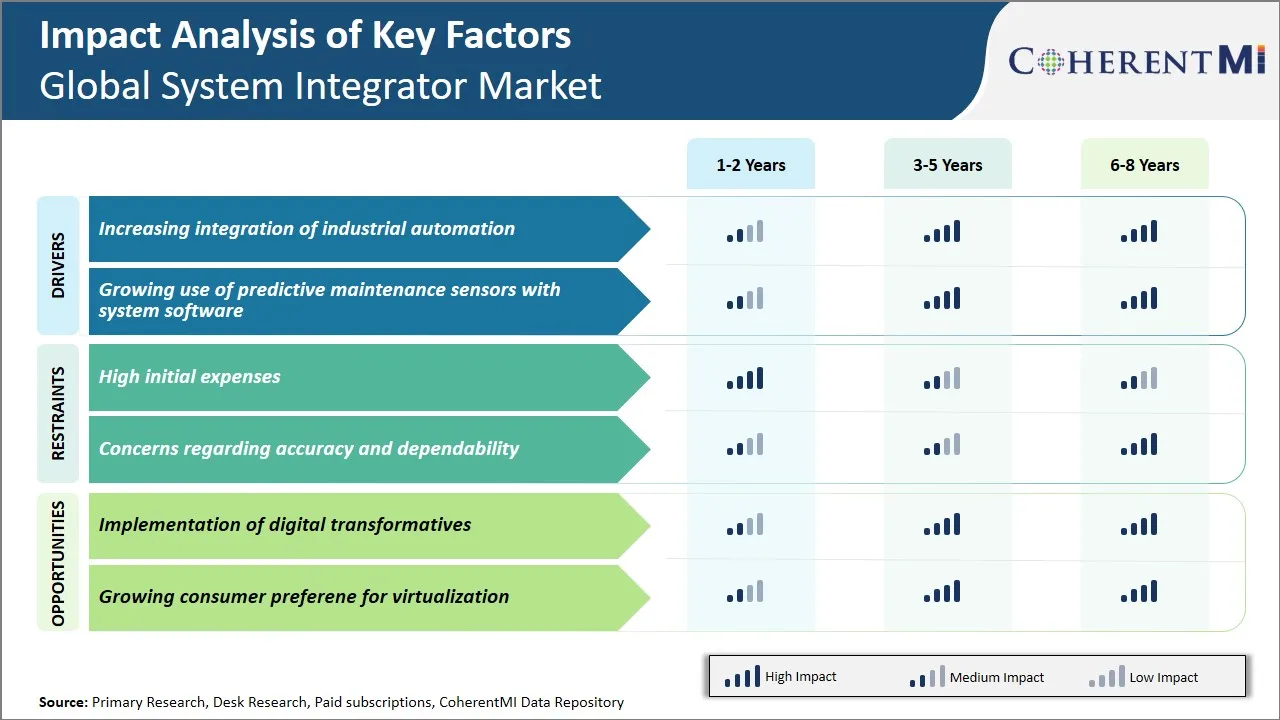
Market Driver - Increasing Integration of Industrial Automation
Driven by shifts in demand, production sites rely increasingly on automated systems to stay competitive. Yet these devices exchange data solely because trained professionals create pathways among them; absent such ties, advancement halts. A single flawed integration drags the full operation behind. Smooth function does not emerge by chance - it is built deliberately, segment after precise segment. Mastery proves essential precisely at the point where legacy mechanisms encounter modern programming.
Latest equipment performs beyond simple operations. Rather than isolated devices, such setups integrate across multiple networked layers. Starting at machine-mounted sensors up to platforms handling enterprise details, seamless links are essential. One device exchanges information with a peer via structured channels designed for ongoing interaction. Where machinery operates, signals move beyond local function. Though equipment runs correctly standalone, isolation risks data misalignment. Because systems link, physical output aligns with digital logs. When adjustments occur onsite, reporting layers register shifts immediately. Through structured pathways, operational movement informs enterprise-level summaries. Only when devices communicate do records remain consistent across functions.
For instance, on January 6, 2026, Siemens and NVIDIA announced a significant expansion of their strategic partnership to bring artificial intelligence into the real world. Together, the companies aim to develop industrial and physical AI solutions that will bring AI-driven innovation to every industry and industrial workflow.
(Source: nvidianews.nvidia.com)
Market Driver - Growing Use of Predictive Maintenance Sensors with System Software
Now emerging across factories, continuous equipment tracking replaces fixed schedules. Instead of waiting for failures, measurements flow from smart detectors mounted directly on machinery. These signals travel through local processors before reaching central analysis tools. With patterns detected early, interventions align precisely with actual wear. Not every firm adapts at once, yet those adopting real-time insights reduce downtime significantly. Expert teams now assemble networks that link physical assets to decision dashboards. Gradually, older methods fade where data-driven oversight takes root.
Sensors inside current machinery record vast data such as motion, temperature, noise, oil state and additional devices monitor performance continuously. Not the amount of information counts, but transforming continuous inputs into straightforward direction enables faster maintenance decisions plus smoother function. Even though acquisition runs nonstop, meaningful conclusions do not appear by default. Meaning forms slowly once recurring structures buried in data expose changes ahead of breakdowns.
For instance, on December 16, 2025, Treon announced that Treon Flow solution for Material Handling, a cloud-native, AI-first predictive maintenance solution, is now available on Amazon Marketplace. Built to deliver zero downtime operations, Treon Flow helps enterprises detect faults early, reduce maintenance costs, and scale from pilot to thousands of assets, with installation measured in days.
(Source: treon.fi)
 To learn more about this report, Request Free Sample Copy
Market Challenge - High Initial Expenses
Facing strong resistance globally, the system integrator market struggles under heavy initial funding needs. Because of costs tied to advanced tools and technology, many providers hesitate before entering. Large financial commitments mark most integration efforts, stretching resources thin. Specialized software purchases come alongside demands for modern equipment setups. Recruitment of qualified staff adds another layer of expense. Training initiatives follow closely, requiring time and structured planning. These elements together shape a landscape where entry proves difficult.
Under pressure to deliver more, system integrators now channel funds into inventive projects - often coordinating multiple technology vendors rather than aligning with just one provider. As relevance requires quicker adaptation, skill enhancement ceases being optional; it simply occurs. Yearly, these companies dedicate between 16% and 20% of revenue to modernizing equipment as well as securing qualified staff, altering financial priorities. This spending impacts balance sheets sharply - particularly for mid-sized firms attempting to remain visible alongside top-tier competitors.
Market Opportunity - Digital Transformation Acceleration Driving Market Expansion
With digital change moving faster than before, new chances arise for system integration providers around the world. As businesses shift, staying ahead depends less on choice and more on adapting quickly. What once seemed gradual now demands response - resilience forms through updated operations, not just strategy. Essential upgrades emerge where efficiency meets long-term stability.
For instance, on January 23, 2026, Infosys inaugurated its new office in Zurich, Switzerland. Relocating the Swiss headquarters to The Circle at Zurich Airport marks a major milestone in Infosys’ 25-year presence in the country, reinforcing its commitment to guiding clients through their digital and AI-led transformation journey.
(Source: infosys.com)
Hybrid & Multi-Cloud Integration Spend:
|
Category |
Value |
|
Hybrid Cloud Integration |
~51% of total cloud budget |
|
Legacy Systems Modernization & Integration |
~13% of IT spend |
|
Multi-Cloud & Cross-Cloud Orchestration Spend |
~68% of organizations operate multi-cloud |
|
Data Fabric/Data Integration Focus |
Enterprises allocate 2–3% of annual revenue to integration/ERP systems |
|
Integration Spend Growth vs. Overall IT |
Integration spending grows 15–20% faster than overall IT budgets |
Key winning strategies adopted by key players of System Integrator Market
- Strategic Digital Transformation and Cloud-First Approach: Accenture invested over USD 3 billion in acquisitions of digital agencies and cloud specialists. Accenture acquired 40+ digital companies including Fjord, Karmarama and Droga5 and Established dedicated cloud practices for major platforms (AWS, Microsoft Azure, Google Cloud). Owing to these initiatives and acquisitions, digital services revenue grew from 25% in 2013 to 70% in 2022 and annual revenue increased from USD 28.6 billion (2013) to USD 61.6 billion (2022).
- Vertical Industry Specialization: TCS developed industry-specific platforms and solutions across Banking, Retail, Manufacturing, and Healthcare. TCS created BaNCS (Banking platform) serving 150+ banks globally and developed TCS OmniStore for retail transformation. These resulted in TCS attaining banking and financial services revenue to 31.1%.
Segmental Analysis of System Integrator Market
 To learn more about this report, Request Free Sample Copy
Insights, By Services: Digital Transformation Demands Drive Market Leadership for Infrastructure Integration
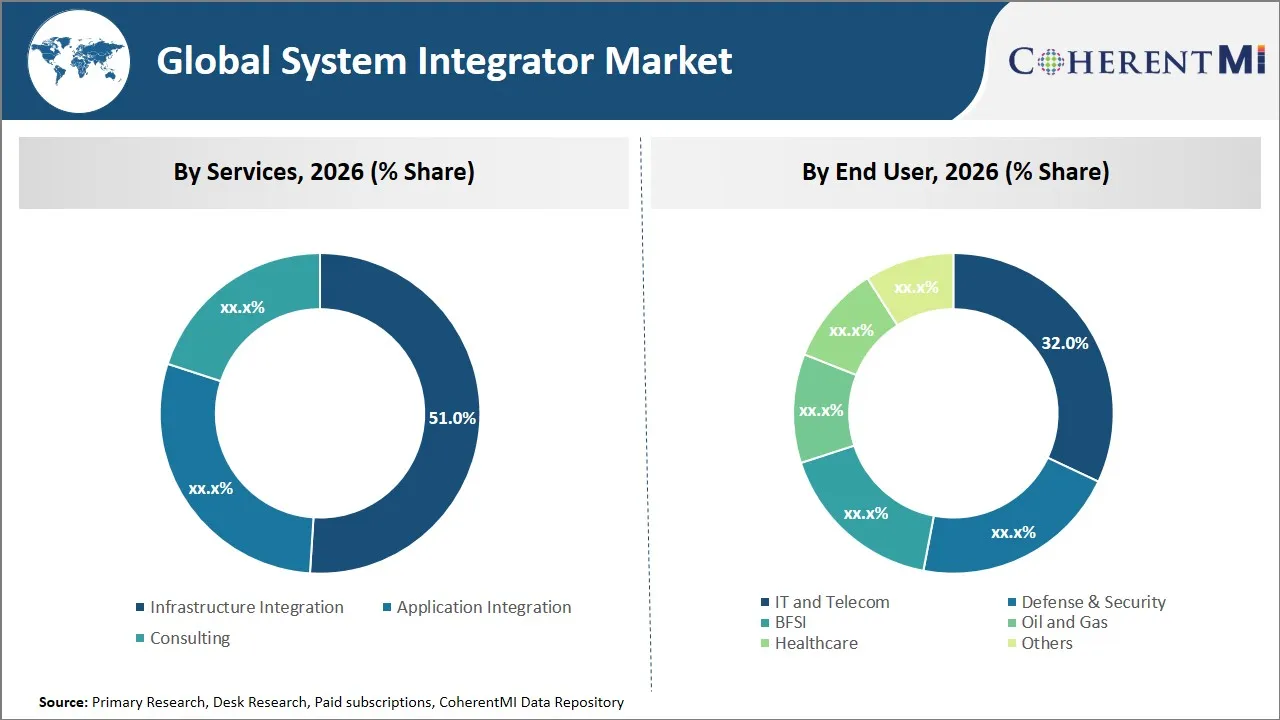
In terms of services, infrastructure integration is expected to account for 51% of the market share in 2026. Growth stems from rising demand for complete upgrades to digital systems in sectors worldwide. As strong connections between technologies and AI in networks support effective change, companies now see integration as essential. This shift places infrastructure at the core of what matters most in system-wide solutions. What drives progress today often begins where networks meet operations. Critical needs emerge not from isolated tools, but from how well components work together across borders.
Dominance in infrastructure integration begins with how widely hybrid and multi-cloud setups have spread. Instead of older on-site models, companies now favor adaptable structures linking public clouds, private ones, along with established internal systems. Such layered technology landscapes demand strong connection tools so information moves smoothly between different platforms while maintaining performance. Complexity grows when multiple environments interact; coordination becomes essential just to keep functions aligned without disruption.
For instance, on October 28, 2025, NVIDIA announced that it is working with the U.S. Department of Energy’s national labs and the nation’s leading companies to build America’s AI infrastructure to support scientific discovery, economic growth and power the next industrial revolution.
(Source: nvidianews.nvidia.com)
Insights, By End User: Technology Evolution Spurs Integration Demands in IT and Telecom
In terms of end user, IT and telecom is expected to account for 32% of the market share in 2026. Despite its intricate nature, progress emerges mainly because change happens quickly here. As technology shifts without pause, complex connections become necessary more often. This field leads where others eventually follow, simply due to how fast new tools appear. Firms adjust not by choice but as a response to what comes next. Adaptation is built into daily operations, quietly shaping demand. What results is steady need for alignment across systems. Expectations shift; responses form around cohesion.
Current telecom operations rely more on code-based structures than just traditional mobile device management. Previously, isolated machines directed flows; today, automated systems perform functions via configurable rules. Rather than rigid configurations, flexible setups appear by linking virtual pieces over distances. Ahead lies the challenge of aligning outdated parts with newer solutions. Poor planning leads older sections to clash with evolving substitutes. Step by step, small shifts create space for steady function amid changing frameworks. Precision becomes necessary - not after, but within each stage, when separate systems begin to join. While movement happens slowly, exactness holds everything together during transitions across functions.
For instance, on December 18, 2025, HCLTech, a leading global technology company, signed an agreement to purchase HPE’s Telco Solutions business, further strengthening its market-leading position in the telecom industry.
(Source: hcltech.com)
Additional Insights of System Integrator Market
- A large majority of enterprises are prioritizing digital transformation, with surveys showing roughly 70–72% of organizations placing it at the top of their strategic development.
- As of 2025, around 63% of large enterprises adopted the use of system integrators.
- Cloud-based integration services represent about 54% of system integration projects globally.
- 60% of SI client portfolios focus on one or two hyperscaler environments, reflecting major revenue streams tied to cloud integration and deployment.
- Across ecosystems like Salesforce, SIs lead 70% of integrations, indicating strong dependency on ISV platforms for services revenue.
Competitive overview of System Integrator Market
The major players operating in the global system integrator market include Accenture, Capgemini, IBM Global Services, Tata Consultancy Services, PwC, Johnson Controls, Cognizant, Infosys, NTT Data, DXC Technology, HCL Technologies, Wipro, Atos, Hewlett Packard Enterprise, and Oracle.
System Integrator Market Leaders
- Accenture
- Capgemini
- IBM Global Services
- Tata Consultancy Services
- PwC
Recent Developments in System Integrator Market
- On January 19, 2026, IBM announced IBM Enterprise Advantage, a first-of-its-kind asset-based consulting service that combines proven AI-tools and expertise to help clients quickly build, govern, and operate their own tailored internal AI platform at scale.
- On January 6, 2026, Accenture announced plans to acquire Faculty, a leading U.K.-based AI native services and products business built on highly technical applied AI skills and a unique decision intelligence product that features advanced simulation and optimization capabilities.
System Integrator Market Segmentation
- By Services
- Infrastructure Integration
- Application Integration
- Consulting
- By End User
- IT and Telecom
- Defense & Security
- BFSI
- Oil and Gas
- Healthcare
- Others

Would you like to explore the option of buying individual sections of this report?
Gautam Mahajan is a Research Consultant with 5+ years of experience in market research and consulting. He excels in analyzing market engineering, market trends, competitive landscapes, and technological developments. He specializes in both primary and secondary research, as well as strategic consulting across diverse sectors.