Carbon Accounting Software Market SIZE AND SHARE ANALYSIS - GROWTH TRENDS AND FORECASTS (2026 - 2033)
Carbon Accounting Software Market By Deployment Mode (Cloud, On Premises), By Organization Size (Lar...
Carbon Accounting Software Market Size - Analysis
The global carbon accounting software market is estimated to be valued at USD 13 Bn in 2026 and is expected to reach USD 68 Bn by 2033, exhibiting a compound annual growth rate (CAGR) of 22% from 2026 to 2033. Growth of notable scale emerges as companies face stronger pressure to track emissions, responding to tighter rules and rising expectations around environmental responsibility. Expansion unfolds because policies grow stricter, businesses pledge deeper sustainability efforts, while precision in measuring carbon output becomes essential - seen clearly within sectors like transport, production, power generation, and banking alike.
Market Size in USD Bn
CAGR22%
| Study Period | 2026 - 2033 |
| Base Year of Estimation | 2025 |
| CAGR | 22% |
| Market Concentration | Medium |
| Major Players | Persefoni, Watershed, Sweep, Normative, Plan A and Among Others |

please let us know !
Carbon Accounting Software Market Trends
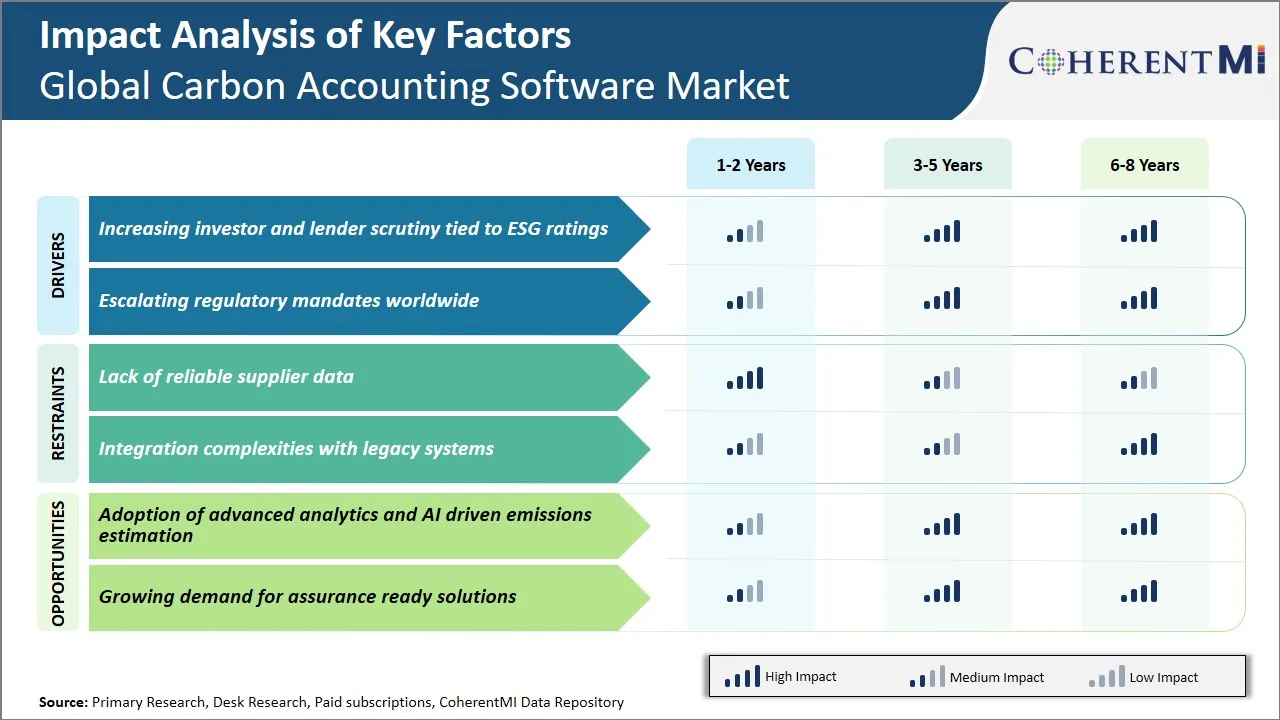
Market Driver - Increasing Investor and Lender Scrutiny Tied to ESG Ratings
Nowhere is change more evident than in finance, where sustainable, social, and governance factors shape how money moves. Instead of fading, these priorities have embedded themselves into core practices around investing and borrowing. Funding availability, alongside pricing and worth, ties increasingly to sustainable outcomes. What once seemed peripheral now drives assessments across institutions.
Not only has ESG-driven investing grown, but it also pressures firms to disclose detailed records on emissions, power usage, while showing ecological consequences linked to every stage of operations. Beyond balance sheets, what counts now includes live access to eco-related indicators, investors see these as essential when assessing durability and exposure over time.
For instance, on February 10, 2026, a shareholder in Texas sued asset manager at BlackRock Inc, alleging its leadership pressured coal companies to reduce production and misled investors by promoting funds as free from political ESG influence, highlighting how ESG-related investor expectations can lead to legal action against executives for strategy and disclosure practices.
(Source: reuters.com)
Market Driver - Escalating Regulatory Mandates Worldwide
Across regions, rules on carbon reporting have grown more detailed and widespread than ever before. Because of this shift, businesses now face layered obligations simply to operate and reach markets. Governments increasingly see climate impacts as threats to financial systems. Such awareness drives the need for enforced corporate disclosures. These measures aim to support better decisions by policymakers and participants in commerce.
Starting with broad regulatory frameworks, European Union measures now shape how carbon data gets reported worldwide. Instead of stopping at basic environmental rules, they include full product life-cycle assessments. Supply networks must track emissions thoroughly because oversight reaches deep into vendor operations. Future climate projections also require structured modeling approaches.
For instance, on September 25, 2025, the California Air Resources Board (CARB) published its preliminary list of companies that may be subject to California’s climate disclosure laws SB 253 (the Climate Corporate Data Accountability Act, which requires U.S.‑based entities doing business in California with over USD 1 billion in annual revenue to publicly disclose their Scope 1, 2 and 3 greenhouse gas (GHG) emissions) and SB 261 (the Climate‑Related Financial Risk Act, which requires U.S.‑based entities doing business in California with over USD 500 million in annual revenue to prepare biennial reports describing their climate‑related financial risks and the measures taken to mitigate them, in line with global reporting frameworks).
(Source: ww2.arb.ca.gov)
 To learn more about this report, Request Free Sample Copy
Market Challenge - Lack of Reliable Supplier Data
A major hurdle facing the worldwide carbon accounting software sector lies in inconsistent supplier information, especially regarding Scope 3 emission measurement. Driven by new regulations like the EU’s CSRD and the SEC’s draft climate reporting standards, firms must now disclose full carbon impacts. Yet accuracy falters when supply chain partners fail to deliver consistent, prompt, structured emissions figures. Despite growing demand, data gaps remain widespread across vast vendor ecosystems.
What makes it difficult lies in how data gathering differs widely between sectors and locations. As suppliers submit information in mismatched structures, apply divergent methods for calculations, or depend on obsolete emissions data, obstacles arise when firms work to assemble reliable climate impact summaries.
Market Opportunity - Adoption of Advanced Analytics and AI Driven Emissions Estimation
With precision modeling emerging, complex emission patterns gain clarity across international tracking systems. Where traditional methods fall short, intelligent analysis fills voids using dynamic prediction layers. Through algorithmic refinement, measurement accuracy improves notably within environmental reporting platforms. As datasets evolve, automated interpretation supports consistency in climate-related documentation worldwide.
When companies face gaps in supplier information, artificial intelligence begins offering ways to improve reliability. From satellite images to power usage logs, machine learning processes diverse inputs to fill missing details. Where original measurements lack, models infer emissions with precision using patterns found across transport routes, output levels, and climate conditions. These systems adapt continuously, drawing conclusions from layers of indirect evidence rather than waiting for direct reporting.
For instance, on July 2, 2025, carbon intelligence solutions provider, Climatiq announced that it has raised million USD 11.7 million in a Series A funding round, with proceeds aimed at accelerating its AI-powered solutions to help companies integrate carbon data into their business decisions.
(Source: climatiq.io)
Global Carbon Accounting Software Market - Regulatory Compliance Index
|
Software |
SEC Climate |
SBTi Support |
CSRD / ESRS |
|
Persefoni |
Built-in SEC-ready reporting and XBRL-tagging workflows (audit trails) |
Supports science-based target metrics & scenario planning |
Automated CSRD/ESRS report generation |
|
Watershed |
Fast disclosure workflows; policy intelligence for climate rules |
Not core, but supports target modelling |
CSRD reporting and Scope 3 |
|
SpheraCloud |
Regulatory automation present but not SEC-tagging |
Strong Scope 1-3 tracking & decarbonization planning |
CSRD/ESRS aligned with audit-grade data |
|
Emitwise |
General emissions reporting |
Supports SBTi inputs via Scope 3 data |
Automated CSRD/ESRS reporting & supplier tools |
|
Workiva (Carbon + ESG) |
Designed for combined ESG & SEC disclosures |
Can support target tracking through linked data |
CSRD, ESRS, TCFD, GRI |
|
Microsoft Sustainability Manager |
Reports data but no specific SEC tagging workflows |
Target dashboards via Azure integration |
CSRD/ESRS reporting |
|
Salesforce Net Zero Cloud |
Basic carbon reporting |
Supports SBTi relevant metrics |
CSRD/ESRS enabled reporting |
Key winning strategies adopted by key players of Carbon Accounting Software Market
- Strategic Acquisitions and Market Consolidation: Market leaders have pursued aggressive acquisition strategies to rapidly expand capabilities, customer bases, and geographic reach while eliminating competition. Microsoft launched Microsoft Cloud for sustainability and integrated carbon accounting capabilities into existing Azure ecosystem. It achieved 40% year-over-year growth in sustainability solutions revenue by Q3 2023. Microsoft reported over 1,000 enterprise customers adopted their sustainability platform within 18 months. Salesforce launched Net Zero Cloud and acquired multiple smaller carbon tracking startups and integrated into core CRM. These resulted in 300+ enterprise customers by end of 2022 for Salesforce and USD 500 Mn+ in sustainability-related revenue in FY2023.
- Platform Integration and Ecosystem Development: Leading companies have focused on creating comprehensive ecosystems that integrate carbon accounting with existing enterprise software infrastructure. SAP SE embedded carbon accounting across SAP S/4HANA, SuccessFactors, and Ariba. SAP gained 2,000+ customers using integrated sustainability features by 2023 and 45% of existing SAP customers adopted at least one sustainability module. Average contract value increased 25% for customers using sustainability features.
Segmental Analysis of Carbon Accounting Software Market
 To learn more about this report, Request Free Sample Copy
Insights, By Deployment Mode: Cloud Deployment Dominates Owing to Scalability and Cost-Efficiency
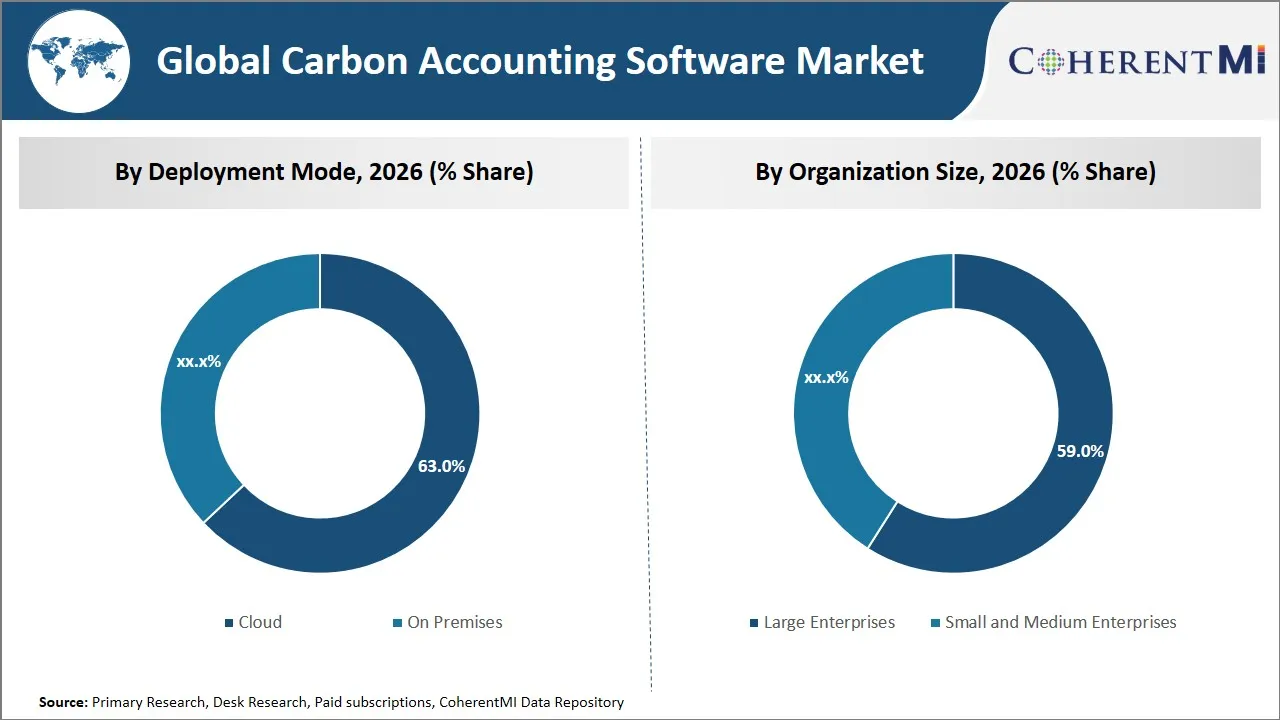
In terms of deployment mode, the cloud segment is expected to account for 63% of the market share in 2026. A major reason behind the rise lies in how easily it can be reached, expanded, and run - features fitting well with shifting demands in measuring carbon output. A major force driving adoption is a way of delivering services online, now favored by groups wanting full systems to monitor and document emissions, avoiding burdens tied to older technology setups.
What drives cloud deployment to lead the market is how easily it connects distant operations to carbon tracking systems right away. As teams spread across countries or regions can share one system, companies with several sites tend to prefer this approach. Instead of setting up separate programs everywhere, information flows into a single point through online access. That centralization happens smoothly when updates occur automatically across all points.
For instance, on June 18, 2024, Workiva Inc. announced the launch of Workiva Carbon. The new offering advances its ESG and Sustainability Platform for organizations to support the requirements of global climate regulations, including the Corporate Sustainability Reporting Directive (CSRD), SEC’s climate disclosure rules, and California’s Climate Corporate Data Accountability Act (SB 253) and Climate-Related Financial Risk Act (SB 261).
(Source: investor.workiva.com)
Insights, By Organization Size: Large Enterprises Segment Dominates as Complex Operations and Regulatory Compliance Drive Adoption
In terms of organization size, the large enterprises segment is expected to account for 59% of the market share in 2026. Despite having intricate systems, major firms must track emissions across many locations under strict rules. As compliance demands precision, these organizations rely on advanced tools to manage diverse environmental data. Where regulations differ widely, integrated platforms become essential for consistency. With multiple sites comes the burden of aligning disparate processes into unified reports. Since oversight is non-negotiable, accuracy shapes technology choices.
Large companies lead in using carbon accounting tools due to complex operations. As they run many sites in varied locations, uniform tracking becomes difficult. Each facility uses different energy sources, follows unique production methods, shows separate emissions patterns. As a result, software must adapt to regional rules, differing data inputs, local regulations. Despite variation, consistent measurement remains essential across all units. Where conditions differ widely, systems still need reliable integration.
Additional Insights of Carbon Accounting Software Market
- North America: Enterprise is expected to account for ~60–68 %, SMB is expected to account for ~30–40 %, driven by SEC compliance and ESG reporting.
- Europe: Enterprise is expected to account for ~55–60 %, SMB is expected to account for ~30–45 %, driven by CSRD/ESRS mandates and supply chain transparency.
- Asia Pacific: Enterprise is expected to account for ~45–55 %, SMB is expected to account for ~25–35 %, driven by industrial adoption and digitalization pressures.
- Middle East & Africa: Enterprise is expected to account for ~30–40 %, SMB is expected to account for ~15–25 %, driven by energy sector adoption and carbon incentives.
Competitive overview of Carbon Accounting Software Market
The major players operating in the global carbon accounting software market include Persefoni, Watershed, Sweep, Normative, Plan A, Sphera, IBM Envizi, Microsoft, Salesforce Net Zero Cloud, SAP Sustainability Footprint Management, Diligent ESG, FigBytes, Sinai Technologies, Terrascope, and Workiva.
Carbon Accounting Software Market Leaders
- Persefoni
- Watershed
- Sweep
- Normative
- Plan A
Recent Developments in Carbon Accounting Software Market
- On December 2, 2025, Diginex Limited announced the signing of a non-binding MOU for the acquisition of PlanA.earth GmbH, one of Europe’s leading AI-powered carbon accounting and decarbonization platforms. This strategic all-share transaction will create a powerful, integrated end-to-end ESG and carbon management solution, enabling enterprises worldwide to measure, manage, and meaningfully reduce their environmental impact while meeting rising stakeholder expectations.
- On March 31, 2024, Workiva Inc and Persefoni, Inc announced a strategic partnership to provide transparent, investor-grade carbon disclosures seamlessly to joint customers.
Carbon Accounting Software Market Segmentation
- By Deployment Mode
- Cloud
- On Premises
- By Organization Size
- Large Enterprises
- Small and Medium Enterprises
- By End User
- Energy and Utilities
- IT and Telecom
- Healthcare
- Transportation and Logistics
- Retail
- Construction and Infrastructure
- Food and Beverages
- Chemicals
- Others

Would you like to explore the option of buying individual sections of this report?
Gautam Mahajan is a Research Consultant with 5+ years of experience in market research and consulting. He excels in analyzing market engineering, market trends, competitive landscapes, and technological developments. He specializes in both primary and secondary research, as well as strategic consulting across diverse sectors.