Healthcare Quality Management Market SIZE AND SHARE ANALYSIS - GROWTH TRENDS AND FORECASTS (2026 - 2033)
Healthcare Quality Management Market is segmented By Component (Software, Services), By Technology T...
Healthcare Quality Management Market Size - Analysis
The Global Healthcare Quality Management Market is estimated to be valued at USD 1.39 Bn in 2026 and is expected to reach USD 3.17 Bn by 2033, exhibiting a compound annual growth rate (CAGR) of 12.5% from 2026 to 2033. This substantial growth trajectory reflects the increasing emphasis on patient safety, regulatory compliance, and operational efficiency across healthcare organizations worldwide. The market expansion is driven by rising healthcare expenditures, growing adoption of digital health technologies, and stringent quality standards imposed by regulatory bodies, positioning healthcare quality management as a critical investment priority for healthcare providers seeking to enhance care delivery outcomes.
Market Size in USD Bn
CAGR12.5%
| Study Period | 2026 - 2033 |
| Base Year of Estimation | 2025 |
| CAGR | 12.5% |
| Market Concentration | Medium |
| Major Players | Veeva Systems, Sparta Systems, HealthStream, Ideagen, Cerner and Among Others |

please let us know !
Healthcare Quality Management Market Trends
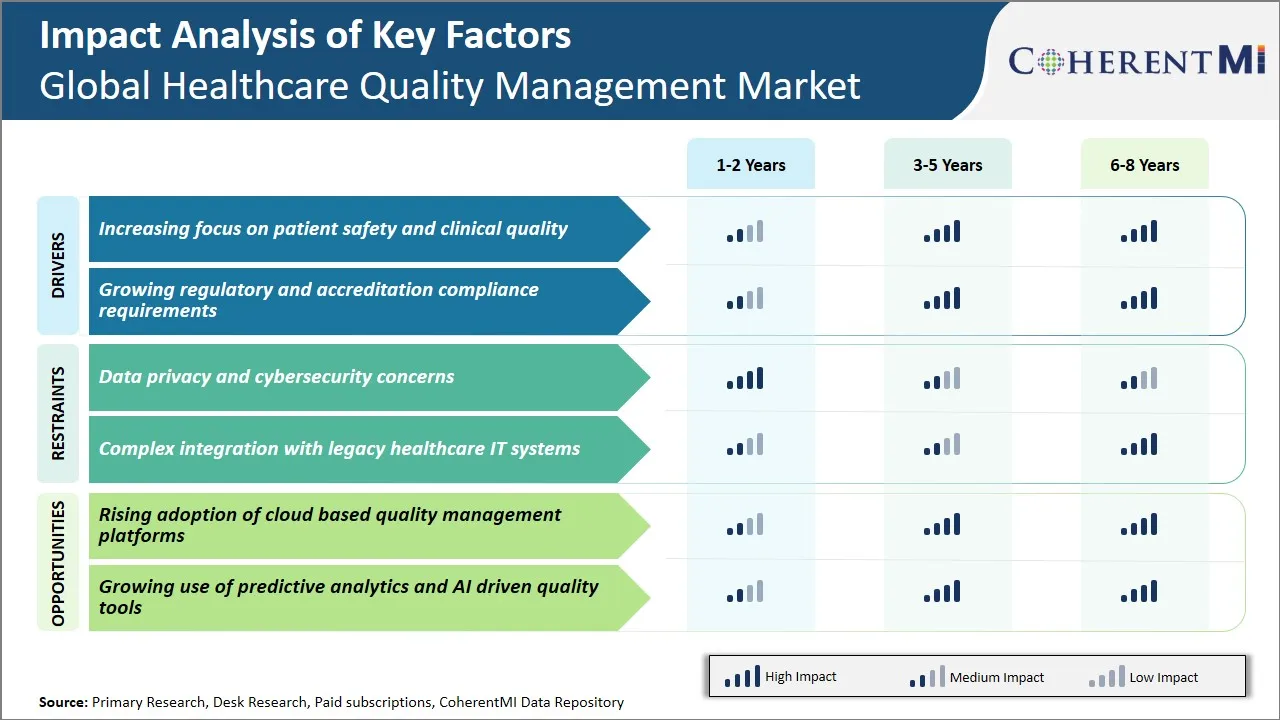
Healthcare Quality Management Market Driver - Increasing Focus on Patient Safety and Clinical Quality
The focus on patient safety and clinical quality issues in the healthcare industry is one of the largest drivers in the global healthcare quality management market. This change is a paradigm shift in healthcare philosophy since it is not a reactive approach to medical errors and adverse events but a proactive, systematic approach in which the prevention of the problems addressed and continuous improvement as well as patient-centered care delivery are prioritized. Healthcare organizations all over the world are becoming aware of the fact that patient safety is not a regulatory decision or an ethical imperative, but a strategic necessity, which directly affects the image of an institution, its financial sustainability, and its performance excellence.
In October 2025, West Tennessee Healthcare launched a Centralized Monitoring Unit (CMU) and eICU powered by Philips in Tennessee, U.S. This progressive system is constantly monitoring patient vital signs and this allows real-time communication between telemetry technicians and bedside caregivers. The CMU enhances safety, response time, and staff alarm fatigue. It will grow to incorporate an eICU virtual command center by early 2026, whereby more care will be provided to patients through remote monitoring.
Healthcare Quality Management Market Driver - Growing Regulatory and Accreditation Compliance Requirements
The steady growth of regulatory systems and accreditation guidelines in healthcare systems worldwide has introduced a more complex compliance environment that is fundamentally transforming the way healthcare organizations are working on quality management. This regulatory evolution reflects governments' and international bodies' recognition that standardized quality measures, transparent reporting mechanisms, and accountable healthcare delivery systems are essential for protecting public health, ensuring equitable access to care, and maintaining public trust in healthcare institutions. The proliferation of these requirements spans multiple dimensions of healthcare delivery, including clinical protocols, patient safety measures, data security standards, provider credentialing processes, and organizational governance structures.
Healthcare organizations are finding themselves navigating an intricate web of overlapping and sometimes conflicting regulatory requirements that demand sophisticated quality management capabilities to ensure comprehensive compliance while maintaining operational efficiency and clinical effectiveness Medical institutions are increasingly struggling with a complex network of overlapping and even contradicting regulatory demands that require highly sophisticated quality management skills to guarantee holistic compliance without compromising operational efficiency and clinical effectiveness.
 To learn more about this report, Request Free Sample Copy
Healthcare Quality Management Market Challenge - Data Privacy and Cybersecurity Concerns
The problem of growing data privacy and cybersecurity issues has become a major headwind impacting the quality management market in healthcare globally and has become the primary reason to prevent the widespread use of technology. Healthcare organizations process huge stores of confidential patient data, such as personal health records, treatment history, and diagnostic data, which serve as ripe targets by cybercriminals.
The stringent compliance requirements in regulatory frameworks like HIPAA in the U.S., GDPR in Europe, and other data protection regulations worldwide make the quality management system implementation in the field of quality management a very complex task. The quality management practices adopted by healthcare providers have to be conducted within the complex regulatory environments in ways that guarantee the strong data encryption, access controls, and audit trails.
Moreover, most healthcare institutions have sensitive IT infrastructure that is not properly secured to provide a loophole when implementing newer quality management systems. Such security issues tend to lead to delays in implementation, higher compliance costs, and unwillingness of healthcare administrators to make the entire quality management processes digital. This is also complicated by the lack of cybersecurity experts in the medical field where healthcare organizations are unable to ensure proper security management of its quality management systems.
Healthcare Quality Management Market Opportunity - Rising Adoption of Cloud-Based Quality Management Platforms
The fast-growing trend of moving to the cloud-based quality management systems is a disruptive prospect regarding market expansion in the world of healthcare quality management. Healthcare organizations are increasingly becoming aware of the fact that cloud-based quality management systems do not require the significant initial investments in IT infrastructure and can offer access to enterprise-level security services which in most cases go beyond on-premise offerings.
For instance, in August 2025, Oracle announced its third generation Electronic Health Record (EHR), which used AI to improve the provision of healthcare. Oracle Health EHR is a cloud-built product with contextual and conversational AI, which enables clinicians to get the most important information about a patient with voice commands. This solution makes administrative work less complex so that workflow is simplified to enable clinicians concentrate on patient care.
(Source- https://www.oracle.com/news/announcement/oracle-unveils-next-generation-ehr-2024-10-29/)
Segmental Analysis of Healthcare Quality Management Market
 To learn more about this report, Request Free Sample Copy
Insights, By Software - Accelerating Digital Transformation Across Healthcare Organizations Worldwide Drives Market Leadership
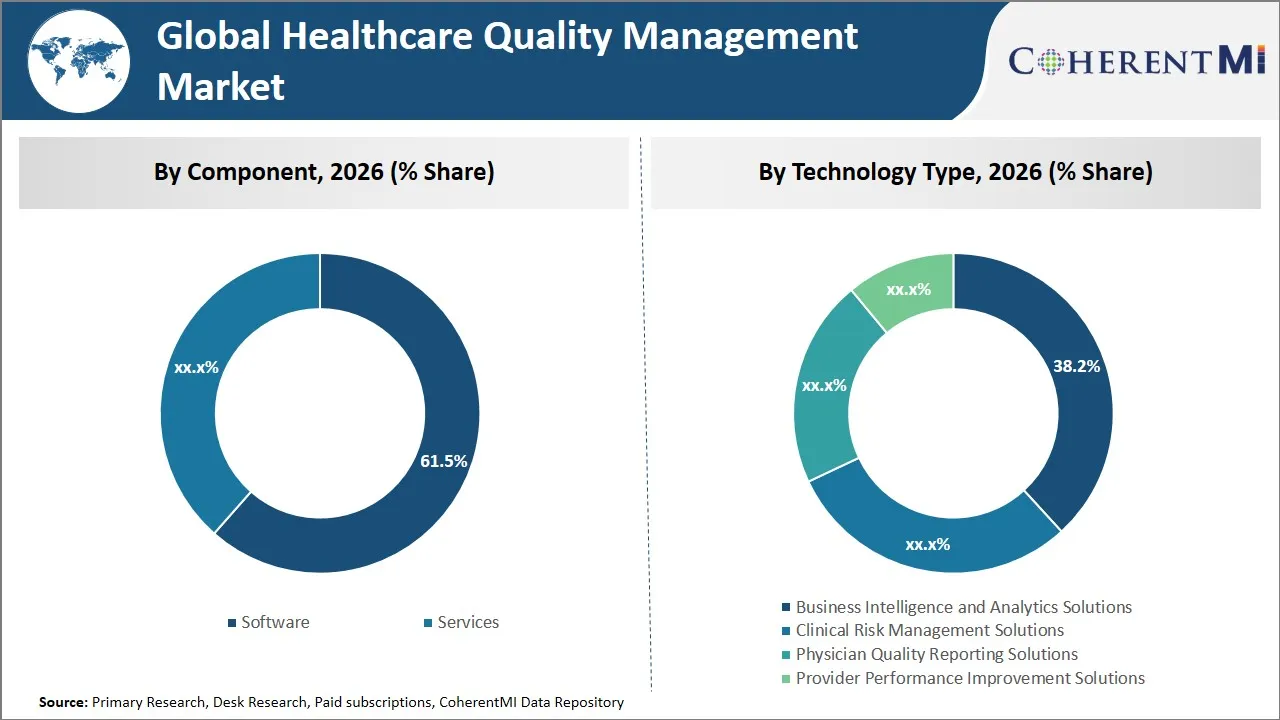
By component, software is expected to contribute the highest share of 61.50% in 2026 owing to the accelerating digital transformation across healthcare organizations worldwide. Healthcare providers are appreciating the fact that quality management systems in paper format are inadequate in satisfying the intricate needs of contemporary patient care and regulatory compliance. The software solutions provide detailed platforms, which can easily blend with the already existing healthcare information systems and can be used to monitor in real time and analyze data and quality improvement initiatives within entire healthcare networks.
The increased complexity in healthcare quality metrics and reporting requirements is the main force behind the growth in software segments. Healthcare organizations are also required to monitor many quality indicators at the same time such as patient safety measures, clinical outcomes, infection rates, medication errors, and the scores of patient satisfaction. The automated data collection features available through software platforms remove the process of data collection that is not automated, minimizes human error, and provides uniform quality measurements across various departments and facilities.
For instance, in July 2025, Telecom Egypt collaborated with KareXpert and introduced a digital healthcare platform in Egypt. The platform combines the hospital management systems with the electronic records and revenue solutions which are hosted on the nationwide secure cloud platform. This partnership helps achieve the goals of the Vision 2030 of Egypt, as it will contribute to better efficiency of healthcare, guaranteeing the privacy of the data and providing the opportunity to scale AI and IoT in the future.
(Source- https://www.karexpert.com/)
Insights, By Technology Type - Healthcare Organizations' Growing Recognition that Data-driven Decision Making is Essential for Effective Quality Management
By technology type, business intelligence and analytics solutions take the largest portion of the market with an estimated share of 38.20% in 2026 as healthcare providers generate vast amounts of data daily through electronic health records, monitoring systems, laboratory results, and patient interactions. Business intelligence and analytics software transforms this uncooked data into actionable response that can assist quality managers to recognize patterns, forecast possible troubles and put in place specific betterment plans.
The growing interest in value-based care models is a major contributor to the demand for business intelligence and analytics solutions in healthcare quality management. To be successful when healthcare organizations operate within value-based reimbursement systems, they need to show patient outcomes improvement that are measurable and cost control.
Cost of Poor Quality (COPQ) in Healthcare and its Impact on Operational Efficiency and Patient Outcomes in Healthcare Quality Management Market:
- Cost of poor quality (COPQ) is a vital problem in the healthcare sector, as it affects patient results and financial performance. Medical devices and healthcare management system are usually cited by end users, including hospitals, clinics, and long-term care facilities, as having inconsistent quality. As an example, when a hospital used to work with untrustworthy reporting tools regarding patient safety, critical issues became identified wrong, which led to longer recovery periods of patients and unnecessary complications. On the other hand, the healthcare organizations that have established effective quality management systems with sophisticated data analytics have been able to detect the areas of improvement and minimize the medical errors and patient satisfaction levels have been elevated with minimal costs. These are the positive examples of the advantages of the correct, up-to-date information to improve the decision-making and quality control.
- Still, a number of healthcare providers continue to face unmet market needs, including a lack of integration between different software systems, high costs of implementation, and a lack of specificity to the healthcare environment. One of the main questions posed by end users concerns the difficulty of the adoption of overall quality management tools in a variety of departments having different needs. The solution to these gaps would require the creation of affordable, tailored, and interoperable solutions that would not only diminish COPQ but also generate long-term customer retention and innovation in the field of healthcare. The end goal of decreasing the price of low quality is better patient care outcome, and efficient running of the hospital business as well as the efficiency of the healthcare system overall.
Regulatory & Accreditation-Driven Demand Mapping in Healthcare Quality Management Market
- Regulatory and accreditation agencies are very important in influencing demand in the healthcare quality management market. Healthcare professionals have to adhere to high standards and requirements provided by international, regional, and local agencies, including the Joint Commission (U.S.), ISO 9001, and National Accreditation Board of Hospitals and Healthcare Providers (NABH, India). These standards are not only capable of assuring patient safety, operational excellence, and clinical quality, but also the need to move the demand towards high-quality management systems (QMS) capable of sustaining continuous compliance.
- As an example, to obtain reimbursements under Medicare and Medicaid, hospitals in North America are forced to implement quality management systems that adhere to Healthcare Effectiveness Data and Information Set (HEDIS) and Merit-based Incentive Payment System (MIPS). This has also triggered the need to seek better-looking data analytics and performance management tools that can ensure that institutions are able to streamline operations without compromising on compliance. Nonetheless, complications are encountered because of the expense of compliance, integration with the existing hospital systems, and training.
Additional Insights of Healthcare Quality Management Market
- By component type, software is expected to hold the largest market share at 61.5% in 2026.
- In terms of technology type, business intelligence and analytics solutions are expected to account for the highest share at 38.20% in 2026.
- Cloud based deployment mode leads the market with an estimated share of 58% in 2026.
- North America is expected to lead the market, holding a share of 39.9% in 2026. Asia Pacific is anticipated to be the fastest-growing region, with 25.5% share in 2026.
Competitive overview of Healthcare Quality Management Market
The major players operating in the Global Healthcare Quality Management Market include Veeva Systems, Sparta Systems, HealthStream, Ideagen, Cerner, Oracle Cerner, McKesson, Premier, Wolters Kluwer Health, Symplr, Medisolv, Quantros, Intelex Technologies, Nuance Communications, and IBM Watson Health.
Healthcare Quality Management Market Leaders
- Veeva Systems
- Sparta Systems
- HealthStream
- Ideagen
- Cerner
Recent Developments in Healthcare Quality Management Market
- In December 2025, GE HealthCare supplied more than 300 computed tomography (CT) scanners under Indonesia’s Strengthening Indonesia’s Health Referral Network (SIHREN) programme to deliver equitable, high-quality care to more than 280 million Indonesians. Collaboration supports Indonesian Government’s agenda to enhance diagnostic access and build national healthcare resilience.
- In February 2025, Yokogawa released OpreX Quality Management System to accelerate DX in quality assurance processes for the manufacturing of pharmaceuticals and food & beverages.
- On January6, 2026, Title21 Health Solutions, a leading provider of enterprise quality management systems and cell and gene therapy orchestration platforms, announced the acquisition of MyCellHub and its advanced manufacturing execution system (MES) platform, expanding its ability to connect the advanced therapies ecosystem through cutting-edge digital solutions.
Healthcare Quality Management Market Segmentation
- By Component
- Software
- Services
- By Technology Type
- Business Intelligence and Analytics Solutions
- Clinical Risk Management Solutions
- Physician Quality Reporting Solutions
- Provider Performance Improvement Solutions
- By Deployment Mode
- Cloud Based
- On Premise
- By Application
- Data Management
- Risk Management
- Performance and Quality Reporting
- Regulatory Compliance and Audit Management
- By End User
- Healthcare Providers
- Hospitals
- Ambulatory Care Centers
- Physician Groups
- Healthcare Payers
- Insurance Companies
- Government Payers
- Other Entities (e.g., Accountable Care Organizations, Pharmacies)

Would you like to explore the option of buying individual sections of this report?
Nikhilesh Ravindra Patel is a Senior Consultant with over 8 years of consulting experience. He excels in market estimations, market insights, and identifying trends and opportunities. His deep understanding of the market dynamics and ability to pinpoint growth areas make him an invaluable asset in guiding clients toward informed business decisions. He plays a instrumental role in providing market intelligence, business intelligence, and competitive intelligence services through the reports.