Patient Safety and Risk Management Software Market SIZE AND SHARE ANALYSIS - GROWTH TRENDS AND FORECASTS (2026 - 2033)
Patient Safety and Risk Management Software Market is segmented By Software Type (Incident Reporting...
Patient Safety and Risk Management Software Market Size - Analysis
The global patient safety and risk management software market is estimated to be valued at USD 2.53 Bn in 2026 and is expected to reach USD 5.73 Bn by 2033, growing at a compound annual growth rate (CAGR) of 12.4% from 2026 to 2033. Such a strong growth curve is indicative of the fact that the healthcare sector has been placing a higher emphasis on patient safety standards and regulatory compliance needs. The market growth is influenced by the increased spending on healthcare, increased awareness about medical error, and rigid government policies that require full risk management systems throughout the healthcare facilities around the world.
Market Size in USD Bn
CAGR12.4%
| Study Period | 2026 - 2033 |
| Base Year of Estimation | 2025 |
| CAGR | 12.4% |
| Market Concentration | High |
| Major Players | RLDatix, Origami Risk, Riskonnect, Ventiv Technology, symplr and Among Others |

please let us know !
Patient Safety and Risk Management Software Market Trends
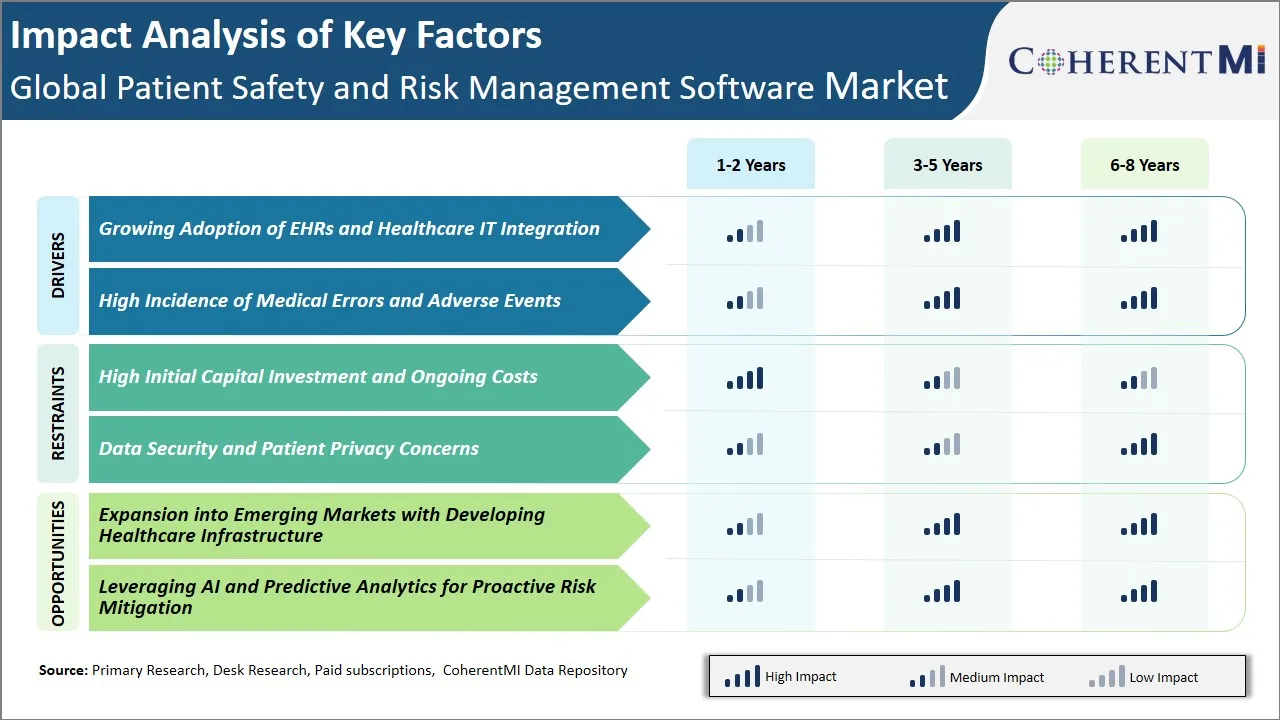
Market Driver - Growing Adoption of EHRs and Healthcare IT Integration
The widespread implementation of Electronic Health Records (EHRs) across healthcare institutions globally has emerged as a fundamental catalyst driving the expansion of patient safety and risk management software markets. It is becoming more and more apparent in healthcare organizations that standalone EHR systems, though groundbreaking in terms of patient information digitization, can be complemented with more elaborate technologies to achieve the full potential of these systems in terms of improving patient safety outcomes. This has resulted in an irresistible need to have concerted patient safety and risk management solutions that can be fully integrated with existing EHR infrastructures to form wholesome ecosystems to support clinical decision-making, risk recognition, and preventive care programs.
For instance, in August 2025, Oracle Health launched an AI-backed electronic health record for U.S. ambulatory providers. The system strengthens patient safety and risk management software by reducing documentation burden using voice-driven workflows. AI-generated summaries help clinicians identify care gaps, medication risks, and readmission concerns faster.
Market Driver - High Incidence of Medical Errors and Adverse Events
The unending problem of medical errors and adverse events within healthcare delivery system across the world have been one of the most influential forces behind the use of patient safety and risk management software programs. Medical errors are the multidimensional reality with which healthcare organizations in all the care settings grapple with even in the light of the recent medical knowledge, technology, and clinical protocol advancement.
This cold fact has led to a sense of dire need to deploy extensive software-based solutions to the healthcare institutions that can effectively monitor the identification, analysis and prevention of probable safety events before they lead to patient harm. The complexity of medical errors, which can be caused by mistakes in administration of medications to diagnostic errors and complications during the implementation of the procedure, demands complex technological strategies that can be implemented to deal with the multiple risk factors and contributing situations that cause an adverse event.
 To learn more about this report, Request Free Sample Copy
Market Challenge - High Initial Capital Investment and Ongoing Costs
Global patient safety and risk management software market is highly courageous with high capital outlay of initial capital investments and recurring operational expenses that the healthcare organizations are required to put in order to adopt and sustain these advanced systems. The relatively high cost of acquiring full-fledged patient safety software programs can be a significant challenge to healthcare institutions, especially to smaller organizations, as it can cost hundreds of thousands and sometimes millions of dollars based on the size of the facility and the complexity of options.
In addition to the initial costs of software licenses, organizations should also consider the massive upgrade of hardware infrastructure, system integration with the current Electronic Health Records (EHR) and Hospital Information Systems (HIS), as well as the extensive staff training process that can take several months.
Market Opportunity - Expansion into Emerging Markets with Developing Healthcare Infrastructure
Emerging markets offer a significant growth potential to the patient safety and risk management software vendors as the developing countries are starting to emphasize the modernization of healthcare infrastructure and digital transformation projects. There is an acceleration of the economies, growing middle classes, and the impetus of government-led healthcare reforms in countries of Asia-Pacific, Latin America, Africa, and Eastern Europe, squarely focused on quality care delivery and patient safety standards. Such markets provide a moderately unexploited customer base in which the digitization of healthcare is still in the infancy phase and thus there is a great potential of software vendors to gain market share and develop long-term relationships with healthcare facilities, government bodies, and individual health care networks.
For instance, in December 2025, Trivitron Healthcare, a global medical technology company, launched Trivitron Digital.AI to boost clinical interoperability and digital hospital workflows. The platform enhances Patient Safety and Risk Management Software by unifying lab, imaging, and patient record systems for smarter care. It connects diagnostic, clinical, and administrative data to improve efficiency and reduce errors. Trivitron Digital.AI aims to expand digital healthcare access from metros to underserved regions globally.
Segmental Analysis of Patient Safety and Risk Management Software Market
 To learn more about this report, Request Free Sample Copy
Insights, By Software Type - Regulatory Compliance and Immediate Response Capabilities Drive Incident Reporting Software Dominance
By software type, incident reporting software is the largest shareholder of the market with an estimated 26.8% share in 2026, due to the strict regulatory requirements and the urgent requirement to have adverse events recorded in real time in all healthcare corporations globally. Healthcare organizations have become aware that the core of any program of patient safety lies in the presence of a well-developed incident reporting system, which is why significant funding has been directed towards such solutions.
The preeminence of Incident Reporting Software is mostly due to the changing regulatory frameworks, which necessitate the healthcare facilities to ensure the presence of comprehensive records on patient safety incidents. Different regions have introduced mandatory reporting policies of adverse events, near-misses and safety incidents, forcing healthcare facilities to install advanced digital reporting systems.
For instance, in October 2025, Coram AI was recognized as a leading emergency incident platform. The company was highlighted for advancing patient safety and risk management software through AI-driven automation and real-time visibility. Coram integrates emergency management, access control, and video intelligence into one unified system. The platform enables faster threat detection, coordinated responses, and improved safety outcomes across complex organizations.
Insights, By Safety Domain – Medication Complexity and High-Risk Profile Establish Medication Safety as Market Leader
Regarding safety domain, the medication safety segment is expected to hold the largest market share of 29.1% in 2026, due to the complexity of medication management processes and the high rate of medication-related adverse events in healthcare facilities. The complexity of the medication safety issues, which cover the period between prescribing and delivering the medication, poses a wide range of needs in the specialized software solutions, which can be used to mitigate many different points of failure in the medication use process.
The commonest occurrence of medication errors is a primary reason behind the market leadership of this segment. Medication-related incidents are a challenge confronting healthcare organization globally which are experienced throughout the medication management process, such as the prescribing, transcribing, dispensing, administering, and monitoring phases. All of these phases have their own safety risks that need the complex software interventions to avoid the mistakes and negative drug events.
Regulatory Compliance Avoidance Risk Model and Penalty Cost Mitigation Framework
- Regulatory Compliance Avoidance Risk Model quantifies the financial exposure avoided by preventing non-compliance incidents in healthcare organizations. Patient Safety and Risk Management Software help hospitals avoid penalties from CMS reimbursement reductions, JCAHO citations, and state-level sanctions by ensuring continuous compliance tracking, incident documentation, and audit readiness.
- By automating reporting, standardizing workflows, and providing real-time compliance alerts, these platforms reduce the risk of missed events and delayed corrective actions. The avoided costs include denied claims, accreditation loss, legal settlements, and reputational damage, making compliance-driven ROI a core buying driver for providers.
- For example, hospitals use Wolters Kluwer to maintain CMS and Joint Commission readiness through embedded regulatory guidance. Press Ganey links safety events to accreditation standards to strengthen compliance performance. Conduent Midas helps providers avoid CMS penalties through automated incident tracking and audit reporting.
Additional Insights of Patient Safety and Risk Management Software Market
- In 2026, by software type, incident reporting software is expected to hold the largest share at 26.8%
- By safety domain, medication safety is projected to lead the market with a 29.1% share in 2026.
- By deployment model, on-premise solutions dominate with a 58.8% of the market share in 2026.
- North America is expected to lead the market, holding a share of 39.5% in 2026. Asia Pacific is anticipated to be the fastest-growing region, with 24.5% share in 2026.
Competitive overview of Patient Safety and Risk Management Software Market
The major players operating in the global patient safety and risk management software market include RLDatix, Origami Risk, Riskonnect, Ventiv Technology, symplr, Premier Inc Stanson Health, Oracle Cerner, Epic Systems, MEDITECH, Veradigm, Wolters Kluwer, Conduent Midas, Health Catalyst, Press Ganey, and The Patient Safety Company.
Patient Safety and Risk Management Software Market Leaders
- RLDatix
- Origami Risk
- Riskonnect
- Ventiv Technology
- symplr
Recent Developments in Patient Safety and Risk Management Software Market
- In August 2025, RLDatix, a global provider of patient safety and risk management software serving over 10,000 healthcare organizations, launched AI Smart Entry to improve incident reporting. The new feature reduces harm event reporting time by up to 70% while improving data accuracy and completeness. Smart Entry enables frontline staff to narrate incidents, which the system converts into structured safety reports.
- In March 2025, Riskonnect launched new AI capabilities for patient safety and risk management software. The update introduced predictive category classification and adverse event severity prediction for healthcare providers. These features automate event categorization, reduce nurse workload, and prioritize investigations faster. The launch strengthens Riskonnect’s Intelligent Risk platform and accelerates safer, data-driven clinical risk decisions.
- In January 2024, Origami Risk LLC launched Origami Mobile to enhance field-based risk workflows. The app strengthens Patient Safety and Risk Management Software by enabling audits, inspections, and incident reporting remotely. It allows safety professionals to capture data offline using mobile phones or tablets. This improves reporting speed, accuracy, and usability across EHS and risk management operations.
- In September 2024, CluePoints launched Medical and Safety Review software for clinical trials. The solution strengthens Patient Safety and Risk Management Software by simplifying medical data review and oversight. MSR automates dashboards, checks, and trend detection to reduce errors and improve safety decisions. The launch enhances regulatory compliance, collaboration, and patient safety visibility across clinical studies.
Patient Safety and Risk Management Software Market Segmentation
- By Software Type
- Incident Reporting Software
- Risk Assessment and Analysis Software
- Patient Safety Event Management Software
- Root Cause Analysis (RCA) Software
- Compliance and Audit Management Software
- Clinical Risk Management Software
- By Safety Domain
- Medication Safety
- Patient Fall Prevention
- Infection Control and Surveillance
- Surgical Safety
- Diagnostic Safety
- Transfusion Safety
- By Deployment Model
- On-premise
- Cloud-based
- By End User
- Hospitals
- Ambulatory Surgical Centers (ASCs)
- Long-Term Care and Nursing Facilities
- Specialty Clinics
- Diagnostic and Imaging Centers
- By Organization Size
- Large Healthcare Systems
- Mid-Size Healthcare Providers
- Small Clinics and Specialty Centers

Would you like to explore the option of buying individual sections of this report?
Ghanshyam Shrivastava - With over 20 years of experience in the management consulting and research, Ghanshyam Shrivastava serves as a Principal Consultant, bringing extensive expertise in biologics and biosimilars. His primary expertise lies in areas such as market entry and expansion strategy, competitive intelligence, and strategic transformation across diversified portfolio of various drugs used for different therapeutic category and APIs. He excels at identifying key challenges faced by clients and providing robust solutions to enhance their strategic decision-making capabilities. His comprehensive understanding of the market ensures valuable contributions to research reports and business decisions.
Ghanshyam is a sought-after speaker at industry conferences and contributes to various publications on pharma industry.