Clinical Information System Market SIZE AND SHARE ANALYSIS - GROWTH TRENDS AND FORECASTS (2026 - 2033)
Clinical Information System Market, By Deployment Mode (Cloud-Based, On-Premises), By Component (Sof...
Clinical Information System Market Size - Analysis
The Global Clinical Information System Market is estimated to be valued at USD 1.31 Bn in 2026 and is expected to reach USD 2.32 Bn by 2033, exhibiting a compound annual growth rate (CAGR) of 8.5% from 2026 to 2033. This massive market growth is because of the increasing digitalization of the healthcare sector and the urgent necessity to implement holistic clinical data management tools.
The high growth profile can be attributed to the fact that, the extent of healthcare spending continues to increase, rising demand for effective management of patient data, and the current trend of penetrating electronic health records in healthcare facilities worldwide. The clinical information system market is trending toward the integration of artificial intelligence and machine learning, enabling predictive analytics and advanced decision support. Models of cloud-based deployment are becoming popular as they offer scalability, affordability, and increased accessibility to healthcare providers.
Market Size in USD Bn
CAGR8.5%
| Study Period | 2026 - 2033 |
| Base Year of Estimation | 2025 |
| CAGR | 8.5% |
| Fastest Growing Market | Medium |
| Major Players | Cerner Corporation, Epic Systems Corporation, Allscripts Healthcare Solutions, Inc, eClinicalWorks, GE Healthcare, McKesson Corporation, Siemens Healthineers, Philips Healthcare, Meditech, IBM Watson Health, NextGen Healthcare, Athenahealth, Inc, Medical Information Technology, Inc, iMDsoft, Practice Fusion, Inc and Among Others |

please let us know !
Clinical Information System Market Trends
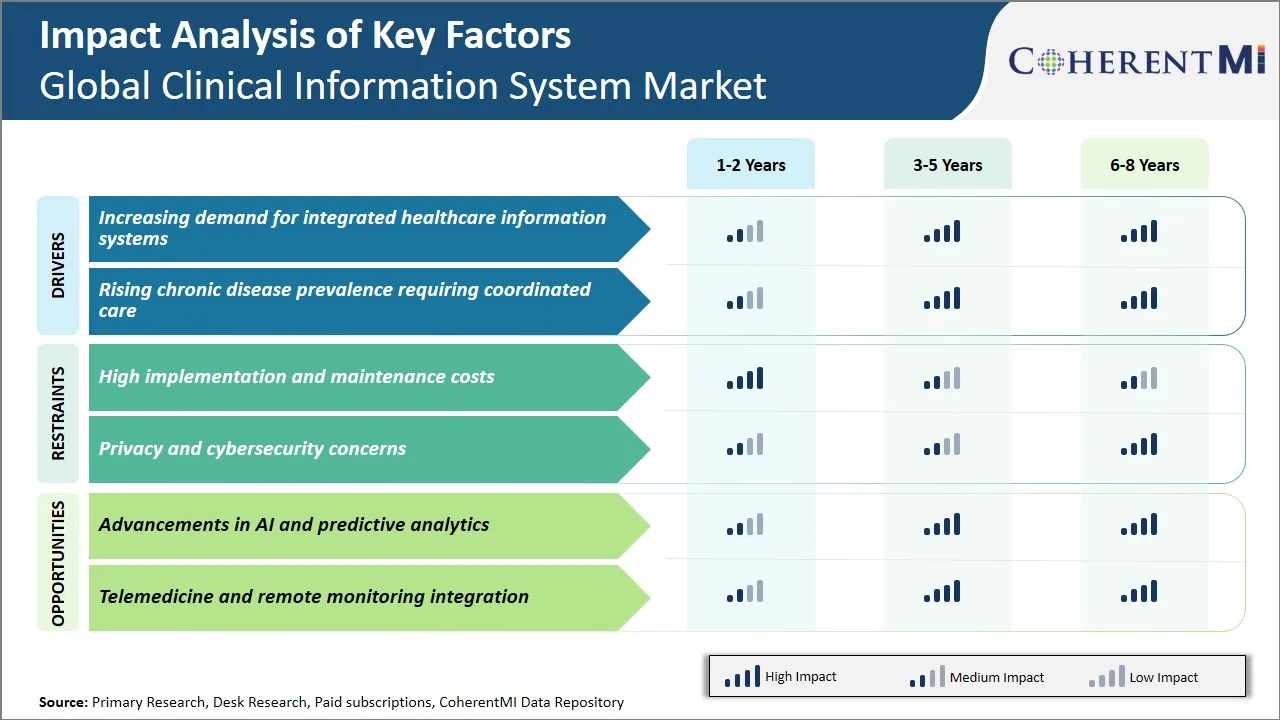
Market Driver - Increasing Demand for Integrated Healthcare Information Systems
A fundamental shift has taken place in the healthcare industry, with organizations appreciating the serious role of effective information flow throughout all care delivery points. There is a trend among healthcare providers to change the disjointed, siloed system into a fully integrated system capable of connecting patient data, workflows, and supporting coordinated healthcare delivery. The transition is one of the biggest driving forces in the development of the clinical information systems, as healthcare organizations aim to dissolve the traditional boundaries standing between one’s departments, specialties, and care environment. The need to integrate is due to the increasing complexity of the contemporary healthcare provision where patients have a tendency to deal with numerous providers, professionals, and medical institutions during a treatment process.
For instance, in October 2024, Oracle Health launched an enhanced Clinical Digital Assistant integrated with its EHR platform, designed to unify clinical workflows by combining voice-enabled documentation, patient data access, and decision support into a single system, addressing the growing demand for integrated healthcare information systems.
(Source: Oracle Health)
Market Driver - Rising Chronic Disease Prevalence Requiring Coordinated Care
The global healthcare environment is increasingly challenged by a rising prevalence of chronic illnesses, creating significant demand for advanced clinical information systems capable of supporting long-term, complex care management. Chronic conditions such as diabetes, cardiovascular disease, chronic kidney disease, respiratory disorders, and autoimmune diseases have become the leading causes of morbidity and mortality, fundamentally changing how healthcare systems must organize and deliver care.
Unlike acute medical conditions that require short-term intensive treatment, chronic diseases demand prolonged management and coordinated care among multiple healthcare professionals over years or even decades. This shift is driving healthcare organizations to invest heavily in clinical information systems that enable comprehensive chronic disease management, including longitudinal patient tracking, coordinated care planning, medication management, and outcome monitoring across diverse care settings and provider networks.
 To learn more about this report, Request Free Sample Copy
Market Challenge - High Implementation and Maintenance Costs
The high monetary cost involved in implementing the clinical information system and its maintenance are some of the major challenges for the global clinical information system market. Small healthcare institutions especially mid-sized hospitals are fading away due to the initial requirements in the capital investment necessary to fully implement CIS that vary between several hundreds of thousands and millions of dollars based on the size and complexity of the system. Such expenses include software licensing, infrastructure changes aimed at updating hardware, data transfer costs out of the old systems, and massive employee training courses. Even in the implementation phase, implementation may take 12-24 months where organizations will be required to support and sustain operations at the same time moving to new systems and adding to the strain and costs of operation.
Market Opportunity - Advancements in AI and Predictive Analytics
The concept of artificial intelligence and predictive analytics integration is a paradigmatic shift in the global clinical information system market, which makes the technologies one of the major differentiators that can result in a significant increment of the market and value generation. Healthcare organizations are actively acknowledging how patient care and treatment can be revolutionized by AI-powered CIS solutions to gain better results in terms of accuracy in diagnostics, customized treatment regimens, and proactive health management.
Machine learning and neural network applications within a clinical information system can analyze vast amounts of electronic medical records, radiology images, laboratory results, and real-time patient monitoring data to identify patterns and predict adverse events before they occur. This is possible due to the resulting ability of the clinicians to make more informed decisions, minimize medical errors, and improve patient outcomes and at the same time optimize resource allocation and operational efficiency.
For instance, in March 2022, GE HealthCare announced the launch of its Edison Digital Health Platform, an AI-enabled system integrating predictive analytics, data aggregation, and clinical applications to support improved decision-making and workflow efficiency across healthcare systems.
(Source: GE HealthCare)
Cloud vs On-Premise Adoption in Clinical Information Systems
- Cloud-based clinical information systems are strongly being adopted because of their scalability, reduced upfront investment as well as the capability to avail remote access to patient information. They also facilitate real-time data sharing, smooth updates, and integration with telehealth and analytics tools and are therefore a good option to healthcare providers that want flexibility and cost efficiency.
- On-premise systems are still carried out by organizations who still need greater control over the security of data, customization, and regulatory compliance. This model is more likely to be appreciated by large hospitals having developed IT infrastructure where the cost of installation and maintenance is significantly higher than cloud-based solutions, yet, they have more control and less flexibility.
Key winning strategies adopted by key players of Clinical Information System Market
- Product Innovation and Digital Transformation- Some of the major participants are concerned with the ongoing product innovation, especially with the implementation of AI, cloud computing, and advanced analytics in clinical information systems to make decisions and workflows more efficient. Firms are developing integrated systems combining Electronic Health Records (EHR), Radiology Information Systems (RIS), and Laboratory Information Systems (LIS) to provide cohesive access to patient data and improve overall clinical performance. Investments in heavy R&D and digital-first solutions enable vendors to be technologically ahead of the curve and address new needs in healthcare.
- Strategic Partnerships, M&A, and Expansion- Leading companies utilize a merger, acquisition, and strategic partnerships as a means to grow the capabilities, enhance the portfolios, and move into new markets. Collaboration with hospitals, research facilities, and technology owners will make made-to-order solutions and quicker adoption possible. Moreover, companies are venturing out to new territories and are using cloud-based subscriptions to achieve higher scalability, retention of customers, and recurring earnings.
Segmental Analysis of Clinical Information System Market
 To learn more about this report, Request Free Sample Copy
Insights, By Deployment Mode - Cloud-Based Segment is Driven Through Superior Scalability and Cost Optimization
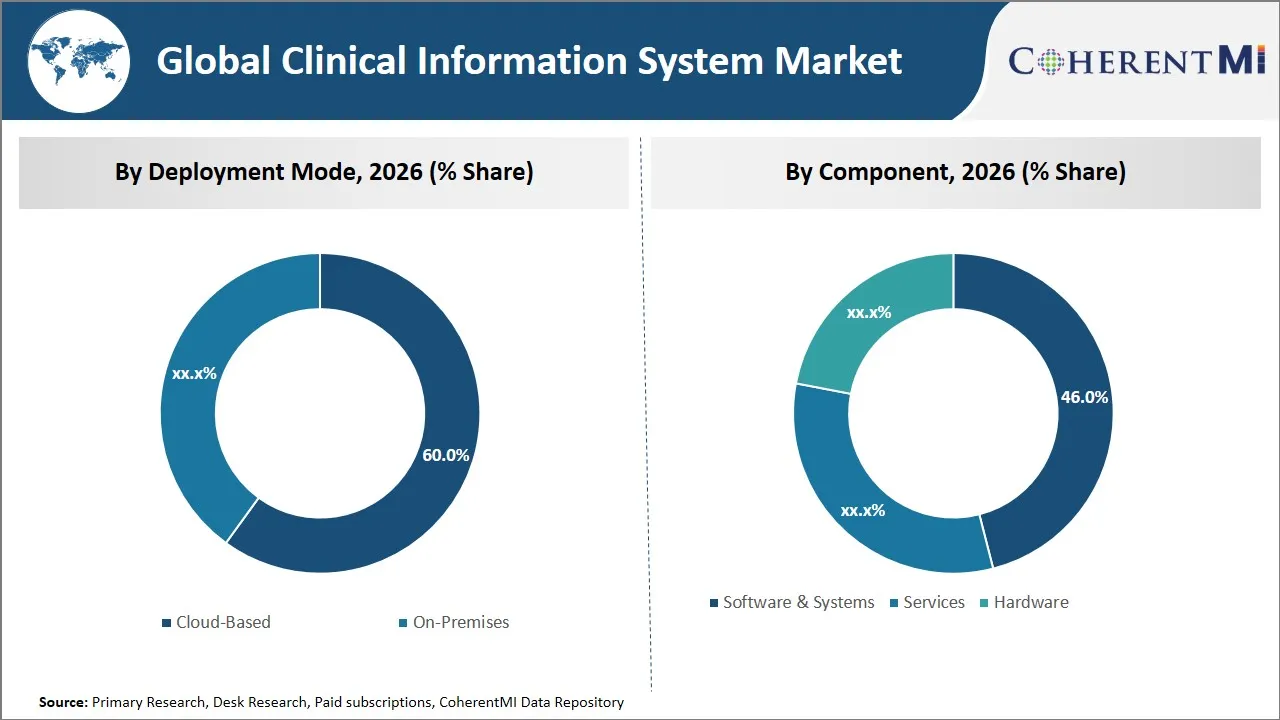
By deployment mode, cloud-based takes the largest portion of the market with an estimated share of 60% in 2026, owing to the transformative advantages it offers healthcare organizations seeking enhanced operational efficiency and technological advancement. The cloud-based deployment model has also become the preference of the healthcare institutions mainly because of the fact that it offers scalable infrastructure that can be newly adjusted in response to changes in patient volumes and organizational requirements without incurring the big capital investments.
The main motivation to the dominance of clouds-based segment is the fact that it is more cost-effective than old on-premise solutions. Healthcare institutions can also save a great deal of their total cost of ownership by avoiding the necessity to purchase a large amount of hardware equipment, maintain it, and manage specific IT infrastructure. The model enables hospitals and medical facilities to adjust the capital expenditure into the operating cost that also enables them to better manage and control cash flows and allocate their funds to the main healthcare provision as opposed to support of technology.
For instance, in February, 2025, Edifecs launched its Healthcare Interoperability Cloud, a cloud-based clinical information platform designed to enable seamless exchange of clinical and administrative data across healthcare systems, supporting interoperability, scalability, and real-time care coordination.
(Source: Edifecs)
Insights, By Component - Software & Systems Drive Through Advanced Integration Capabilities and Workflow Optimization
By component type, software & systems takes the largest portion of the market with an estimated share of 46% in 2026, owing to the critical role these solutions play in digitalizing and streamlining healthcare operations across all organizational levels. The software and systems segment dominates the market primarily because it forms the foundational layer that enables healthcare institutions to manage, process, and utilize clinical data effectively while improving patient care quality and operational efficiency.
The core driving force behind software and systems dominance stems from their ability to integrate disparate healthcare processes into cohesive workflows. Modern clinical information systems software provides comprehensive functionality that encompasses patient data management, clinical decision support, medication management, and care coordination. This integration capability eliminates information silos and enables seamless communication between different departments, specialists, and healthcare providers, ultimately improving patient outcomes and reducing medical errors.
For instance, in September 2025, Oracle Corporation announced the launch of its AI Center of Excellence for Healthcare at the Oracle Health and Life Sciences Summit, aimed at helping healthcare organizations maximize the value of artificial intelligence across clinical, operational, and financial workflows.
(Source: Oracle Corporation)
Government Mandates and Policy Support Driving CIS Adoption Top of Form
- Regulatory Push for EHR and CIS Adoption- Governments in key markets are beginning to enforce the use of Electronic Health Records (EHR) and Clinical Information Systems (CIS) in an effort to enhance quality, transparency and access to data in the healthcare sector. The national digital health programs and policies are compelling hospitals and clinics to move past paper-based systems and to integrated digital platforms, which will guarantee standardized data collection and improved clinical decision-making.
- Incentives, Compliance, and Implementation Impact- In addition to mandates, governments are offering financial incentives, reimbursement support, and compliance frameworks to accelerate adoption. However, healthcare providers must meet strict data security, interoperability, and reporting requirements, which is pushing vendors to develop.
Additional Insights of Clinical Information System Market
- Increasing adoption of electronic health records (EHRs) and hospital information systems (HIS) is a major growth driver across healthcare facilities for global clinical information system market.
- Rising prevalence of chronic diseases is accelerating the demand for efficient data management and clinical decision support systems which is expected to driver the global clinical information system market.
- Global clinical information system market is further propelled by the increasing focus on interoperability and data integration across healthcare systems to enable seamless information exchange.
- Growing demand for real-time clinical decision support tools to improve treatment accuracy and patient outcomes.
Competitive overview of Clinical Information System Market
The major players operating in the global clinical information system market include Cerner Corporation, Epic Systems Corporation, Allscripts Healthcare Solutions, Inc, eClinicalWorks, GE Healthcare, McKesson Corporation, Siemens Healthineers, Philips Healthcare, Meditech, IBM Watson Health, NextGen Healthcare, Athenahealth, Inc, Medical Information Technology, Inc, iMDsoft and Practice Fusion, Inc.
Clinical Information System Market Leaders
- Cerner Corporation
- Epic Systems Corporation
- Allscripts Healthcare Solutions, Inc
- eClinicalWorks
- GE Healthcare
- McKesson Corporation
- Siemens Healthineers
- Philips Healthcare
- Meditech
- IBM Watson Health
- NextGen Healthcare
- Athenahealth, Inc
- Medical Information Technology, Inc
- iMDsoft
- Practice Fusion, Inc
Recent Developments in Clinical Information System Market
- On February 4, 2026, Epic begun the deployment of AI Charting, a new built‑in documentation and clinical assistance capability for its electronic health record platform that drafts clinician notes and suggests orders in real time based on patient visits, signaling a next‑generation CIS enhancement with AI at point of care.
- On January 7, 2026, OpenAI announced ChatGPT Health, a health‑focused experience that lets users securely link medical records and wellness data, representing a new consumer‑facing health information interface bridging personal health data with advanced AI (not a CIS vendor product but relevant to clinical data interaction trends).
- In December 2025, Nova Scotia Health and IWK Health launched the One Person One Record unified patient record clinical information system as part of a phased rollout across the province, aiming to consolidate fragmented health records into a single integrated system.
Clinical Information System Market Segmentation
- By Deployment Mode
- Cloud-Based
- On-Premises
- By Component
- Software & Systems
- Services
- Hardware
- By Application
- Hospital Information Systems
- Medical Imaging Information Systems
- Laboratory Information Systems
- Pharmacy Information Systems
- Other/Ancillary Systems
- By End User
- Hospitals & Clinics
- Diagnostic Centers
- Academic & Research Institutes
- Pharma & Biotech Organizations

Would you like to explore the option of buying individual sections of this report?
Ramprasad Bhute is a Senior Research Consultant with over 6 years of experience in market research and business consulting. He manages consulting and market research projects centered on go-to-market strategy, opportunity analysis, competitive landscape, and market size estimation and forecasting. He also advises clients on identifying and targeting absolute opportunities to penetrate untapped markets.