Tendonitis Treatment Market SIZE AND SHARE ANALYSIS - GROWTH TRENDS AND FORECASTS (2026 - 2033)
Tendonitis Treatment Market, By Tendon Type (Achilles Tendonitis, Rotator Cuff Tendonitis, Patellar ...
Tendonitis Treatment Market Size - Analysis
The global tendonitis treatment market is estimated to be valued at USD 242.30 Bn in 2026 and is expected to reach USD 300.03 Bn by 2033, exhibiting a compound annual growth rate (CAGR) of 3.1% from 2026 to 2033. This positive growth trend is an indication of the rising tendonitis disorders in the world due to the aging population, increased sports activities and workplace risks. Further reasons to support the market expansion are the improved healthcare infrastructure, the rising awareness on the early diagnosis and treatment alternatives, and the rising healthcare spending both in the developed and emerging economies in the world. The treatment market has experienced massive changes in the treatment of tendonitis due to the technological innovations in the least invasive procedure, regenerative medicine, and personalized treatment methodology. The most significant trends are the increased use of platelet-rich plasma (PRP) therapy, the use of stem cell treatments, and the use of advanced imaging to facilitate the correct diagnosis.
Market Size in USD Bn
CAGR3.1%
| Study Period | 2026 - 2033 |
| Base Year of Estimation | 2025 |
| CAGR | 3.1% |
| Market Concentration | Medium |
| Major Players | Pfizer, Sanofi, Bayer, Teva Pharmaceutical Industries, Viatris, Sun Pharmaceutical Industries, Dr Reddy’s Laboratories, Zydus Lifesciences, Haleon, Johnson & Johnson MedTech, Smith+Nephew, Stryker, Zimmer Biomet, Arthrex, Bioventus and Among Others |

please let us know !
Tendonitis Treatment Market Trends
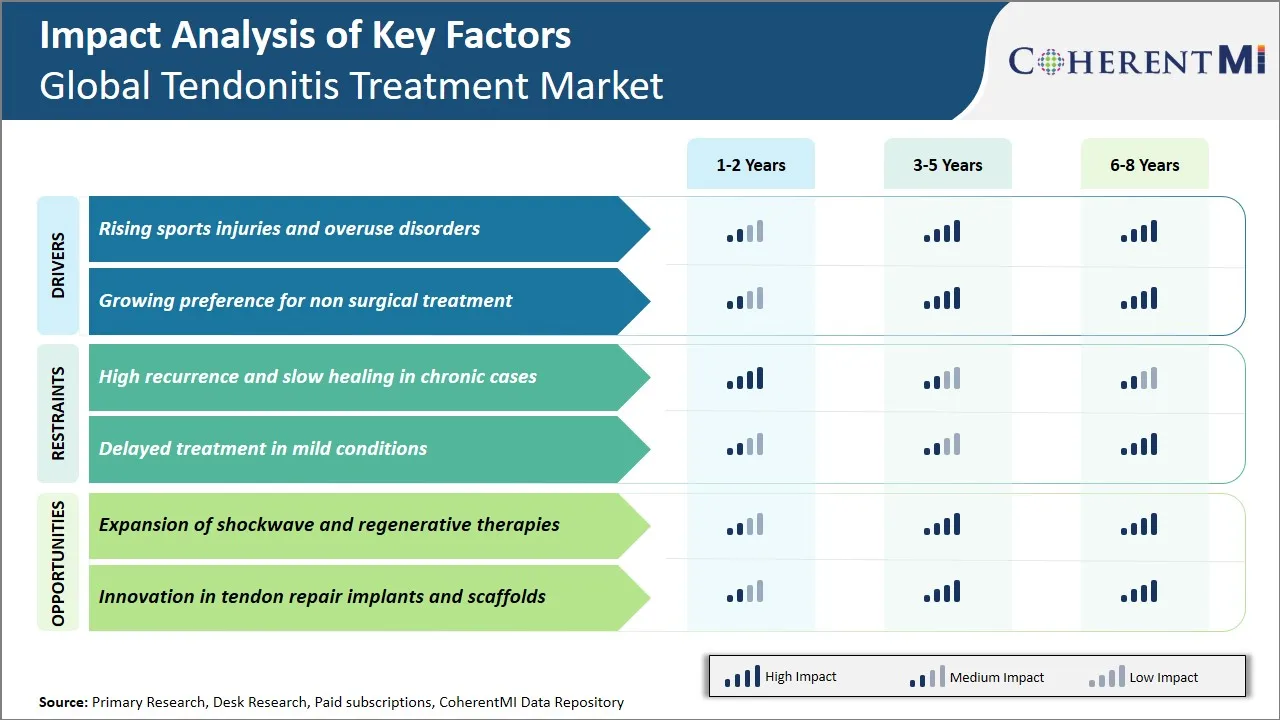
Market Driver- Growing Preference for Non-Surgical Treatment
The healthcare paradigm has undergone a paradigm shift of conservative, minimally invasive treatment methods where patients and healthcare providers have begun to acknowledge the enormous benefits of a non-surgical treatment of tendonitis. This change is the reflection of the full awareness of the risks, complications and limitations related to surgical interventions as well as impressive development of non-invasive treatment technologies and evidenced-based conservative treatment guidelines.
This shift of preference has been scientifically supported by the increasing amount of clinical data showing similar or better results with non-surgical procedures, and has been aided by patient pressure towards less invasive methods of treatment, generating significant market opportunity in searching innovative methods of conservative treatment.
For instance, in June 2025, Net Health announced its acquisition of Limber Health to add a hybrid in-clinic and digital care model built around remote therapeutic monitoring and home exercise platforms for physical therapy. The deal is a clear market signal that companies are investing in scalable non-surgical musculoskeletal care models, which are highly relevant to tendonitis management and rehabilitation.
(Source- Limber Health)
Market Driver - Rising Sports Injuries and Overuse Disorders
 To learn more about this report, Request Free Sample Copy
The modern global environment has seen an all-time high in the number of people who have been engaging in sports activities irrespective of their age groups, and this has completely changed the epidemiological trends of musculoskeletal injuries and has brought about a high demand of the specialized tendonitis treatment options. This has been witnessed long past the professional sporting activities, not just to recreational sport enthusiasts, the weekend warriors, fitness lovers, but also to those who engage in professional sports at different levels of competitions in well organized sports events. The sports participation democratic process which has been enabled by the increased access to sporting facilities, increasing awareness concerning the benefits of staying physically fit and proliferation of organized sporting activities has unwittingly led to a massive surge in the number of tendon-related injuries that demand a multi-faceted approach to medical care.
Market Challenge - High Recurrence and Slow Healing in Chronic Cases
The global tendonitis treatment market faces a major challenge in managing the chronic and recurring nature of the condition, as tendon injuries often take a long time to heal and frequently relapse. The pathophysiology of chronic tendonitis, as in lateral epicondylitis (tennis elbow), rotator cuff tendinopathy and Achilles tendonitis, is complicated, and the current treatment modalities do not handle it adequately. Chronic tendinopathy is degenerative and is characterized by alterations in the structural composition of tendon tissue, collagen disorganization, increased vascularity, and neural ingrowth, all of which play a role in the long-term healing process, which may take months and even years. It is a chronic course with a high rate of patient quality of life and high cost of healthcare and research shows that up to 40% of patients with lateral epicondylitis still have symptoms more than a year after treatment.
Market Opportunity - Expansion of Shockwave and Regenerative Therapies
The market of tendonitis treatment has never had growth opportunities like these in the form of the fast development and technological advancement of shockwave therapy and regenerative medicine treatment modalities. Extracorporeal shockwave therapy (ESWT) has become one of the new treatment modalities that change the game because it has shown great effectiveness in cases of chronic tendonitis which modern methods have fallen short in treating.
ESWT clinical evidence suggests an overall 65-85% success in most tendinopathies and the capacity of the treatment to induce neovascularization, tissue regeneration, and the dissolution of calcium inside the body makes it an effective option in cases of treatment-resistant tendinopathy. Technological advances that have been done in the field of focused and radial shockwave devices add to the market opportunity, where better targeting and shorter treatment times increase patient experience and clinical adoption.
For instance, in March 2025, Smith+Nephew showcased REGENETEN, a bioinductive implant used to support tendon healing in rotator cuff repair, as part of its sports medicine portfolio at AAOS 2025. This is directly related to the expansion of regenerative therapies because the implant is designed to stimulate new tendon-like tissue growth and improve healing outcomes rather than rely only on conventional repair methods.
(Source- Smith+Nephew)
Sports Medicine Infrastructure Supporting the Global Tendonitis Treatment Market
|
Infrastructure indicator |
Latest data point / proxy |
Relevance to Global Tendonitis Treatment Market |
|
Global rehabilitation need base |
~2.41 billion people worldwide live with conditions that could benefit from rehabilitation; the need has increased 63% since 1990. |
This is the biggest structural support for tendonitis treatment demand because tendon disorders sit inside the wider musculoskeletal rehab pool. |
|
Global musculoskeletal disease burden |
~1.71 billion people globally live with musculoskeletal conditions. |
Tendonitis treatment demand rises with the scale of musculoskeletal disorders, which feed orthopedic, sports medicine, and physiotherapy utilization. |
|
Organized sports medicine infrastructure worldwide |
FIMS recognizes national associations of sports medicine, with no more than one per country eligible for membership. |
This shows sports medicine is institutionally organized across countries, supporting referral networks for tendonitis diagnosis, rehabilitation, and return-to-sport monitoring. |
|
Primary care sports medicine fellowship programs |
In the 2025 NRMP Sports Medicine Match, there were 234 active programs, 392 certified positions, and 388 filled positions. |
This is a strong proxy for the depth of sports injury rehabilitation capability, especially for non-surgical tendonitis care pathways. |
|
AMSSM-affiliated sports medicine training network |
AMSSM states its USA and Canada directory lists all affiliated accredited sports medicine fellowship programs participating in the NRMP Sports Medicine Fellowship Match. |
This supports the clinical training pipeline that feeds sports injury clinics, orthopedic practices, and rehab programs managing tendonitis cases. |
|
Orthopaedic sports medicine fellowship centers |
AANA’s fellowship directory lists 98 orthopaedic sports medicine fellowship programs in the directory shown. |
This is a direct proxy for advanced orthopedic sports medicine infrastructure relevant to tendon repair, imaging, injections, and surgical escalation. |
|
Musculoskeletal specialist base |
AAOS reports more than 39,000 members, describing itself as the world’s largest medical association of musculoskeletal specialists. |
A large specialist base supports growing capacity for tendonitis treatment across orthopedic centers, ambulatory surgery, and sports medicine clinics. |
|
Global demand trend for rehab capacity |
WHO says rehabilitation demand will continue to rise due to ageing, injury burden, and chronic disease growth. | This strengthens long-term demand for tendonitis treatment services, especially rehab-heavy care such as physiotherapy, exercise therapy, and digital monitoring. |
Key winning strategies adopted by key players of Tendonitis Treatment Market
- Portfolio expansion beyond basic pain relief- Mainstream players are not depending just on NSAIDs or normal positioning in physiotherapy. The more intelligent solution is to develop more comprehensive products in the conservative care, biologics, shockwave therapy, rehabilitation and post-procedure recovery so that they can tap both the newly-onset and chronic tendinopathy market. Studies indicate that the field is no longer focused on the symptom control but on biologic products, regenerative strategies and combined tendon repair strategies.
- Combination therapy positioning for refractory cases- One of the biggest winning strategies is combating the tendency and propaganda of pushing combination treatment models and not selling a single modality as a panacea. PRP, extracorporeal shockwave therapy and structured rehab are now increasingly used sequentially or as an integration to enhance pain and functional outcomes particularly in challenging sport related cases. That provides companies with a greater premium-treatment narrative and greater differentiation.
- Digital rehab and remote monitoring integration- The other important stakeholders are also prevailing through the extension of treatment outside the clinic. Online rehabilitation systems, exercise monitoring applications, and remote monitoring provide better adherence, intensity of follow-up care, and lessen the reliance on regular visits. Remote programs can be supported by musculoskeletal digital care studies as realistic and scalable models, which is why it is a reality of a commercial strategy, and not a technological supplement.
- Focus on faster recovery and return-to-activity outcomes- The most powerful brands are matching the value proposition with that which is actually important to patients and sports-medicine providers: reduction of pain faster, functional recovery, and faster return to play. That is the reason why the players are focusing on the minimally invasive treatments, personalized rehab strategies, and outcome-centered treatment plans rather than the treatment claims which are generic.
Segmental Analysis of Tendonitis Treatment Market
 To learn more about this report, Request Free Sample Copy
Digital Health and Remote Rehabilitation Expanding Tendonitis Treatment Access
- Digital health and distance rehabilitation are also emerging as high-growth opportunities in the global tendonitis treatment market with a number of tendon disorders able to be treated through guided exercises therapy, symptom monitoring, and subsequent treatment not necessarily needing regular visits to the clinic. Rehabilitation with telehealth is particularly applicable in the case of tendinopathy where recovery does not rely on a single intervention, but long-term structured loading, patient education, and adherence.
- The market impact is clear: digital rehab platforms, wearable sensors, and app-based monitoring tools are improving access, supporting home-based recovery, and helping clinicians track movement quality, pain levels, and exercise compliance remotely. This is creating stronger demand for tech-enabled rehabilitation models in sports medicine and musculoskeletal care, while also opening opportunities for digital therapeutics and wearable-assisted tendon monitoring solutions.
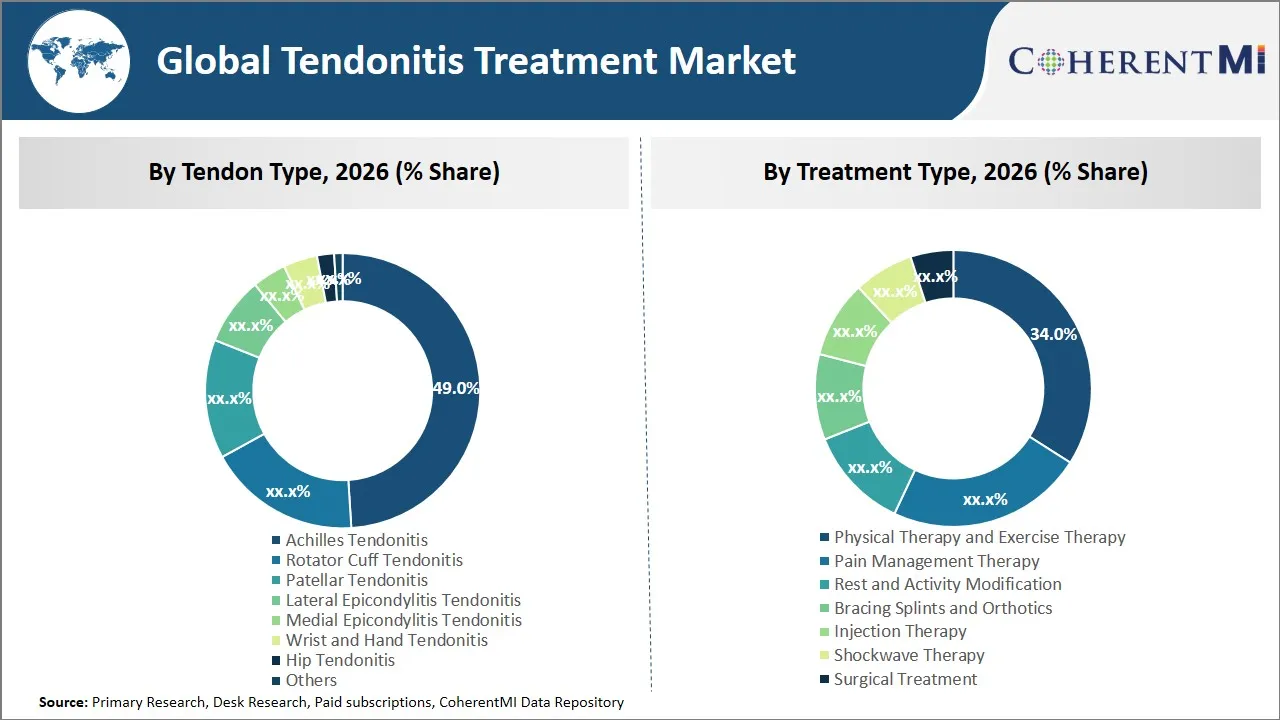
Insights, By Tendon Type: Achilles Tendonitis is Driven by Rising Athletic Participation and Sports-Related Injuries
By tendon type, Achilles tendonitis takes the largest portion of the market with an estimated share of 49% in 2026, owing to the increasing prevalence of sports-related injuries and the growing participation in high-impact athletic activities worldwide. The Achilles tendon, being the largest and strongest tendon in the human body, bears tremendous stress during physical activities, making it particularly susceptible to inflammatory conditions and micro-tears that characterize tendonitis.
Achilles tendonitis has dominated the market in terms of treatment due to a number of interrelated factors which have increased the clinical relevance of Achilles tendonitis. The growth in number of recreational running, marathons and high intensity fitness programmes has significantly contributed to the number of Achilles tendon injuries in a wide variety of age groups. Compared to other tendon disorders, which might implicate certain individuals, the Achilles tendonitis disorder affects both the professional and weekend warriors, making it a wide patient base that needs therapeutic care.
Insights, By Treatment Type: Physical Therapy and Exercise Therapy Drives Growth Through Non-Invasive Treatment Preferences and Proven Clinical Efficacy
By treatment type, the physical therapy and exercise therapy segment takes the largest portion of the market with an estimated share of 34% in 2026, due to the widespread clinical adoption of evidence-based rehabilitation protocols and the growing preference for conservative, non-invasive treatment approaches among both patients and healthcare providers. The segment's dominance reflects the fundamental shift toward functional restoration rather than purely symptom management in tendonitis care.
The main motivator of the market leadership of physical therapy is the demonstrated effectiveness of this treatment in various tendon problems and groups of patients. The use of structured exercise regimens especially eccentric strengthening programs has proven to have better long-term effects over and above the passive mode of treatment making physical therapy the ultimate goal of managing tendonitis treatment. Physical therapy is a critical part of the whole treatment of tendinopathy because it can tackle both acute symptoms and underlying pathophysiology of biomechanical disorders.
Additional Insights of Tendonitis Treatment Market
- Global tendonitis treatment market demand is mainly driven by sports injuries, repetitive strain, occupational overuse, and ageing-related tendon degeneration, since tendonitis and tendinopathy are strongly tied to chronic overuse and repeated biomechanical stress.
- Conservative treatment remains the core of the market, with physiotherapy, exercise-based rehabilitation, rest, anti-inflammatory drugs, and supportive orthopedic care still forming the first line of treatment in most tendon disorders.
- The market is shifting toward advanced non-surgical and regenerative options such as platelet-rich plasma, extracorporeal shockwave therapy, and combination treatment approaches for chronic or refractory cases. Recent studies show growing clinical interest in PRP-plus-ESWT and similar multimodal strategies.
- A major growth opportunity lies in digital health and remote rehabilitation, because tendon recovery depends heavily on guided exercise adherence, follow-up monitoring, and long-duration rehab rather than one-time intervention alone. This is pushing the market beyond clinics into hybrid and home-based care models.
Competitive overview of Tendonitis Treatment Market
The major players operating in the global tendonitis treatment market include Pfizer, Sanofi, Bayer, Teva Pharmaceutical Industries, Viatris, Sun Pharmaceutical Industries, Dr Reddy’s Laboratories, Zydus Lifesciences, Haleon, Johnson & Johnson MedTech, Smith+Nephew, Stryker, Zimmer Biomet, Arthrex, and Bioventus.
Tendonitis Treatment Market Leaders
- Pfizer
- Sanofi
- Bayer
- Teva Pharmaceutical Industries
- Viatris
- Sun Pharmaceutical Industries
- Dr Reddy’s Laboratories
- Zydus Lifesciences
- Haleon
- Johnson & Johnson MedTech
- Smith+Nephew
- Stryker
- Zimmer Biomet
- Arthrex
- Bioventus
Recent Developments in Tendonitis Treatment Market
- On January 22, 2026, Smith & Nephew completed the acquisition of Integrity Orthopaedics, developer of the Tendon Seam biomechanical repair system for rotator cuff and tendon repair procedures. The deal expands Smith & Nephew’s orthopedic and sports medicine product portfolio, supporting advanced surgical treatment options for tendon injuries.
- In September 2025, Medline UNITE announced the launch of the FORCECORD Midsubstance Achilles Repair System and DEXLOCK Knotless Double Row Achilles Repair System at the AOFAS 2025 Annual Meeting. The launch expanded Medline’s foot and ankle sports medicine portfolio and is directly relevant to the tendonitis treatment market because Achilles tendon disorders often progress into surgical repair demand when conservative management fails.
- In July 2024, Stryker announced the acquisition of Artelon, Inc., a company specializing in soft-tissue fixation and biomaterial technologies used in tendon and ligament reconstruction procedures. The acquisition strengthens Stryker’s sports medicine portfolio and expands its capabilities in soft-tissue repair solutions used in orthopedic and tendon injury treatments.
Tendonitis Treatment Market Segmentation
- By Tendon Type
- Achilles Tendonitis
- Rotator Cuff Tendonitis
- Patellar Tendonitis
- Lateral Epicondylitis Tendonitis
- Medial Epicondylitis Tendonitis
- Wrist and Hand Tendonitis
- Hip Tendonitis
- Others
- By Treatment Type
- Physical Therapy and Exercise Therapy
- Pain Management Therapy
- Rest and Activity Modification
- Bracing Splints and Orthotics
- Injection Therapy
- Shockwave Therapy
- Surgical Treatment
- By Drug Class
- Non-Steroidal Anti-Inflammatory Drugs
- Analgesics
- Corticosteroids
- Biologics and Regenerative Therapies
- Others
- By Therapy Type
- Conservative Treatment
- Minimally Invasive Treatment
- Surgical Treatment
- By End User
- Hospitals
- Orthopedic Clinics
- Sports Medicine Centers
- Physiotherapy and Rehabilitation Centers
- Ambulatory Surgical Centers
- Homecare Settings

Would you like to explore the option of buying individual sections of this report?
Vipul Patil is a dynamic management consultant with 6 years of dedicated experience in the pharmaceutical industry. Known for his analytical acumen and strategic insight, Vipul has successfully partnered with pharmaceutical companies to enhance operational efficiency, cross broader expansion, and navigate the complexities of distribution in markets with high revenue potential.