White Cement Market SIZE AND SHARE ANALYSIS - GROWTH TRENDS AND FORECASTS (2026 -2033)
White Cement Market is segmented By Product Type (White Portland Cement, White Masonry Cement, Other...
White Cement Market Size - Analysis
The Global White Cement Market is estimated to be valued at USD 10.23 Bn in 2026 and is expected to reach USD 14.58 Bn by 2033, exhibiting a compound annual growth rate (CAGR) of 5.2% from 2026 to 2033. This substantial market expansion reflects the increasing demand for premium construction materials across residential, commercial, and infrastructure development projects worldwide.
Market Size in USD Bn
CAGR5.2%
| Study Period | 2026 -2033 |
| Base Year of Estimation | 2025 |
| CAGR | 5.2% |
| Market Concentration | Medium |
| Major Players | Cementir Holding N.V., Çimsa Çimento Sanayi ve Ticaret A.Ş, Royal White Cement, LafargeHolcim, Aditya Birla (Grasim Industries Limited) and Among Others |

please let us know !
White Cement Market Trends
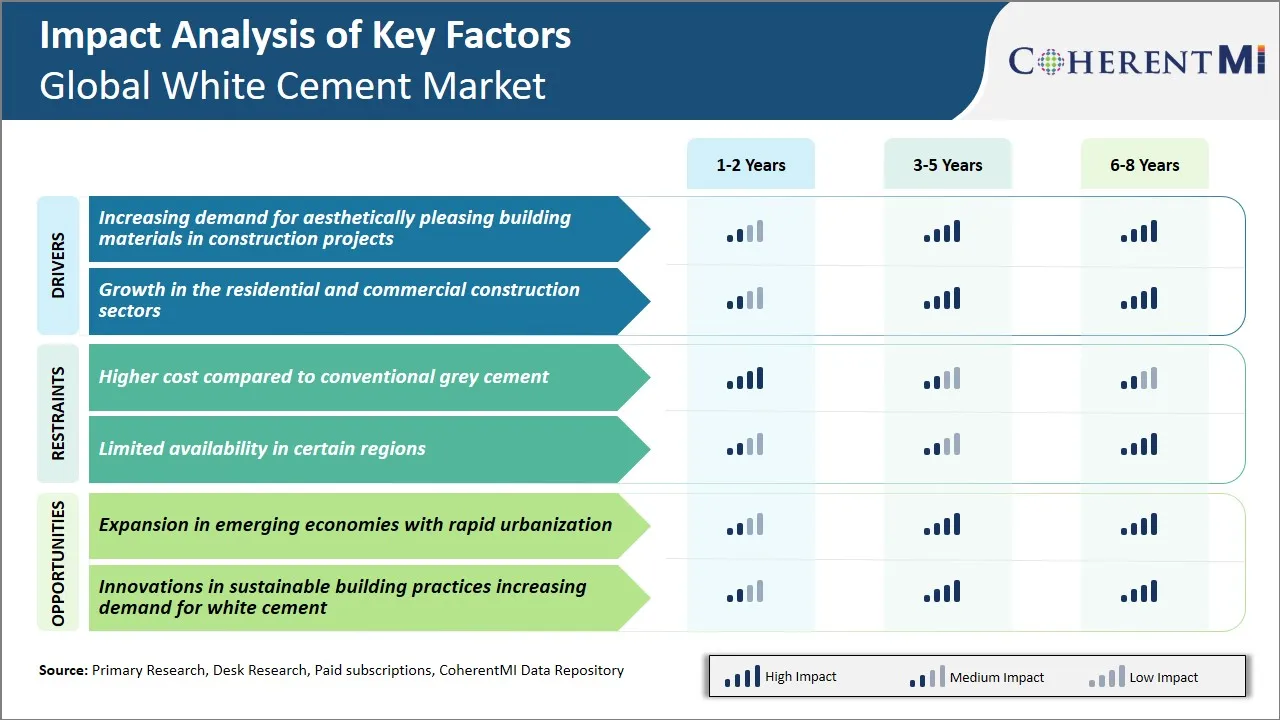
Market Driver - Increasing Demand for Aesthetically Pleasing Building Materials in Construction Projects
The modern construction environment has been characterized with a radical change in the attitude concerning the selection of building materials with aesthetics becoming a significant factor of influencing the decision of materials procurement. This transition can be seen as a larger cultural transformation in which the architectural design has moved beyond its utilitarian purpose and adopted a visual aesthetics as part and parcel of the contemporary infrastructure construction. White cement has led the way in this new aesthetic revolution and the product has provided architects, designers and construction professionals with an unmatched medium through which to achieve their creative images and at the same time retain integrity and durability of the structure.
White cement is uniquely applicable in the production of aesthetically amazing architectural features that gray cement cannot accomplish due to its unique characteristics. Its pure white color is a perfect foundation to all sorts of decorative applications to create complex patterns, textures, and color blends that add value of beauty to the buildings in totality. This flexibility has rendered white cement an indispensable component in projects such as decorative fronts and decorative components as well as sculptural features and artistic installations in the interior and exterior layouts.
Market Driver - Growth in the Residential and Commercial Construction Sectors
Construction has registered a significant growth in both residential and commercial sectors providing a strong platform on which more white cement can be consumed. This trend in growth is an indication of various intersecting attributes such as fast urbanization, population, and economic development, and changing lifestyle choices that all lead to the demand for new dry construction projects. The residential construction industry has been dynamic especially due to the demographic changes.
The growth in urban development projects in the world has provided unmatched prospects in terms of construction growth as the government and private developers have joined forces in dealing with the housing crunch and infrastructure shortage in the great metropolitan cities of the world. These massive development constructions tend to include high standards of designing and structure that incline to high quality building materials such as white cement.
 To learn more about this report, Request Free Sample Copy
Market Challenge - Higher Cost Compared to Conventional Grey Cement
High costs of production in comparison with traditional grey cement are a huge setback to the global white cement market causing issues in price sensitivity in different segments of the market. White cement is normally sold at a premium of 40-60 percent of the normal Portland cement because of the complicated manufacturing process, which involves the requirement of high value raw material with low content of iron oxide, special kiln conditions, and other quality control factors.
The high iron content of limestone and clay required in production means that the raw materials need to be of low iron content, and this requires mining certain quarries hence costs of the raw materials are high as well as the sources are limited. Moreover, the production takes great care in managing temperatures and tends to isolate production lines to avoid cross contamination leading to increased energy use and diminished economies of scale. This cost difference is especially challenging in markets that are price sensitive and on huge construction projects where budget is the main factor.
Market Opportunity - Expansion in Emerging Economies with Rapid Urbanization
Growing urbanization in emerging economies offers a paradigm shift to the manufactures of white cement to exploit the changing construction taste and the increase in disposable income. The unparalleled growth in urban population is being witnessed in countries in Asia Pacific, Latin America, and sections of Africa with the UN estimating that urban population growth in emerging markets will be 90 percent of the total world population growth by 2030. The trend is provoking the need to find solutions in modern architecture and construction materials of higher quality as residents of such cities become more interested in aesthetics when it comes to residential and commercial buildings. The growing population of the middle-income group in these areas exhibits an increasing tendency of spending money on high-quality building materials that can accelerate the appearance of the house and its value.
Key winning strategies adopted by key players of White Cement Market
- Product Innovation: Companies are developing advanced white cement products with improved performance, sustainability, and special-use formulations. Major players are focusing on innovations such as low‑carbon white cement variants and high‑performance blends that improve strength, durability, and reduce environmental impact. For example, Dyckerhoff introduced a pozzolanic white cement product (Dyckerhoff Weiss Blue Star) with ~15% lower CO₂ emissions than traditional white cement.
- Market Expansion: White cement producers are expanding production capacities and geographic footprints to capture rising demand in emerging and high‑growth markets (e.g., Asia Pacific and the Middle East). Companies are investing in new plants and regional capacity - Asian Paints launched a white cement facility in the U.A.E and reduce import dependency.
Segmental Analysis of White Cement Market
 To learn more about this report, Request Free Sample Copy
Insights, By Product Type - White Portland Cement’s Dominance is Driven by Superior Technical Properties and Widespread Construction Applications
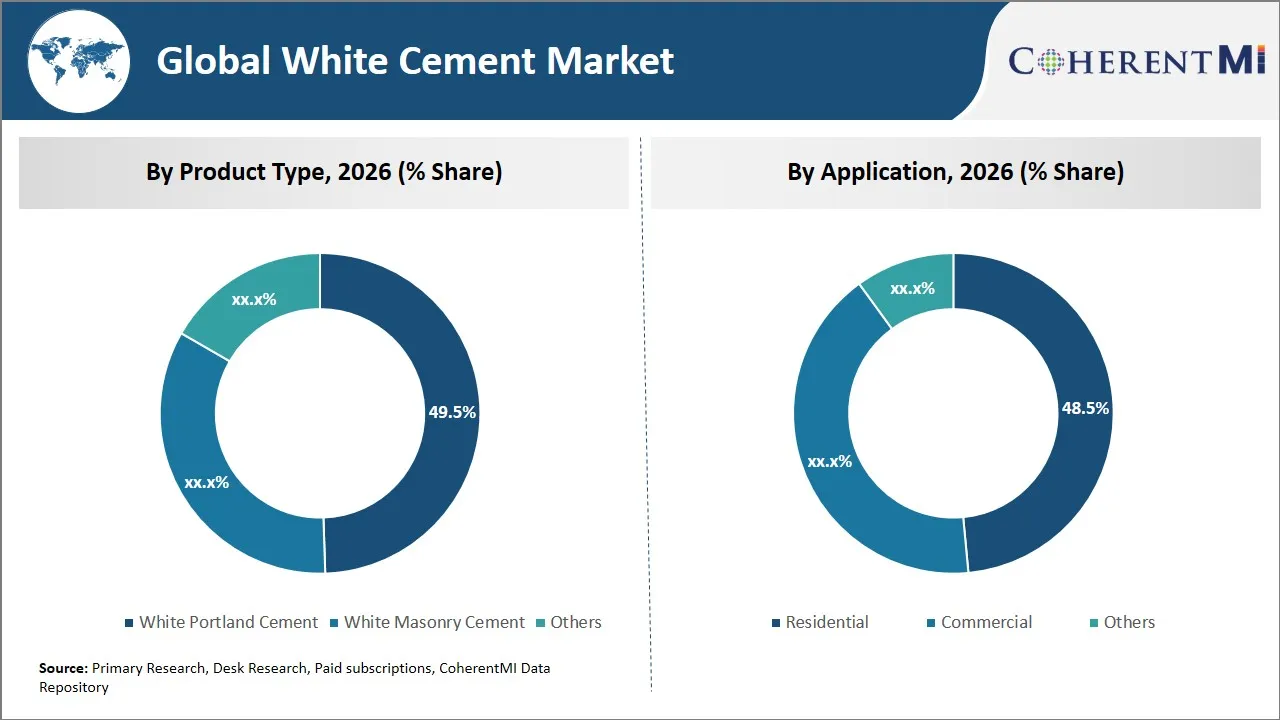
White Portland Cement segment is expected to contribute 49.5% share of the market in 2026, owing to its exceptional technical characteristics and versatility across diverse construction applications. White Portland cement has been able to infiltrate into the choice of architects, contractors and manufacturing companies of building material, given its particular kind of good look and high-performance qualities that cannot be equaled by the conventional gray cement.
White Portland Cement’s market leadership is mainly due to the fact that there is no other material that can be used as a structural as well as decorative building material. In contrast with the conventional gray cement, white Portland cement will give architect and designers full creativity in attaining the preferred aesthetic effects without impairing the structural integrity.
Insights, By Application - Residential Segment Dominates the Market Due to Rising Premium Housing Demand and Aesthetic Consciousness
The residential segment is projected to contribute 48.5% share of the market in 2026, due to the exponential growth in luxury housing projects and homeowners putting higher preferences in terms of architecture and value addition of their property. The growth of the residential construction industry, driven by more advanced design preferences, has made white cement a crucial material in creating modern housing aesthetics. The dominance of the residential segment can be attributed to the global trend of luxury and semi-luxury residential developments, where the visual appeal of a property plays a significant role in its market value.
In the contemporary housing market especially in the urban sector, people have become more demanding of architectural designs, and superior finishes which white cement allows. Developers are aware of the fact that the use of white cement in residential development develops unique selling points that merit high-pricing and high sales rate in competitive real-estate markets.
Additional Insights of White Cement Market
- In the white cement market, the Asia Pacific region is the dominant player, driving the largest share of global demand. The construction sector in China and India experiences expansion because these nations perform substantial investments to develop their residential and commercial projects.
- The increasing demand for high-quality, aesthetic, and sustainable/green building materials has led to a surge in the use of white cement for decorative concrete applications, façades, and other architectural features. The Asian Pacific governments promote energy-efficient building standards which drive up white cement usage because of its ability to reflect light and reduce energy consumption.
- The Asia Pacific region maintains its market leadership because manufacturers in this area create affordable products by using regional resources and improving their manufacturing processes to produce goods for both high-end and budget-friendly construction markets. This region experiences rising demand for both standard white cement uses and new products which include self-cleaning surfaces and 3D-printed building materials.
Competitive overview of White Cement Market
The major players operating in the global white cement market include Cementir Holding N.V., Çimsa Çimento Sanayi ve Ticaret A.Ş, Royal White Cement, LafargeHolcim, Aditya Birla (Grasim Industries Limited), Cimsa, Dyckerhoff GMBH, Federal White Cement, India Cements Ltd, and J.K. Cement Company.
White Cement Market Leaders
- Cementir Holding N.V.
- Çimsa Çimento Sanayi ve Ticaret A.Ş
- Royal White Cement
- LafargeHolcim
- Aditya Birla (Grasim Industries Limited)
Recent Developments in White Cement Market
- In April 2025, the Board of Directors of UltraTech Cement Ltd. approved the purchase of 100% equity of Wonder WallCare at an Enterprise Value not exceeding USD 2.83 Mn. The company has executed a Share Purchase Agreement with the existing shareholders of Wonder WallCare. The deal is expected to close in the next 90 days, subject to applicable regulatory approvals and compliances.
- In 2022, UltraTech Cement, a subsidiary of Aditya Birla Group, inaugurated a state-of-the-art putty plant in Rajasthan, India with an annual capacity of 400,000 metric tons. This facility is dedicated to producing UltraTech's renowned WallCare brand of white cement-based putty.
- In 2022, Cementir Holding introduced its innovative Futurecem limestone calcined clay cement into the Benelux and French cement markets. This groundbreaking cement leverages Cementir Holding's patented processes to replace over 35% of clinker in cement with limestone and calcined clay. This substitution not only maintains the cement's strength and quality but also significantly reduces its carbon footprint by approximately 30% compared to ordinary Portland cement (OPC).
White Cement Market Segmentation
- By Product Type
- White Portland Cement
- White Masonry Cement
- Others
- By Application
- Residential
- Commercial
- Others

Would you like to explore the option of buying individual sections of this report?
Yash Doshi is a Senior Management Consultant. He has 12+ years of experience in conducting research and handling consulting projects across verticals in APAC, EMEA, and the Americas.
He brings strong acumen in helping chemical companies navigate complex challenges and identify growth opportunities. He has deep expertise across the chemicals value chain, including commodity, specialty and fine chemicals, plastics and polymers, and petrochemicals. Yash is a sought-after speaker at industry conferences and contributes to various publications on topics related commodity, specialty and fine chemicals, plastics and polymers, and petrochemicals.