Catechin Market SIZE AND SHARE ANALYSIS - GROWTH TRENDS AND FORECASTS (2026 - 2033)
Catechin Market By Source (Green Tea, Black Tea, Cocoa, Apples, Others), By Application (Food & Beve...
Catechin Market Size - Analysis
The global catechin market is estimated to be valued at USD 19.12 Bn in 2026 and is expected to reach USD 26.02 Bn by 2033, exhibiting a compound annual growth rate (CAGR) of 4.5% from 2026 to 2033. Such a strong growth pattern shows the rising consumer awareness of health benefits linked with catechins, especially their antioxidant effects and possible preventive effect on chronic diseases. The main factors which have contributed to the market expansion include an increase in demand for pharmaceutical, nutraceutical and functional foods alongside growing health awareness among consumers all over the world.
The catechin market is experiencing massive change due to changing preferences of consumers for natural and organic products. The main tendencies are the growing use of catechins as a dietary supplement, cosmetic preparation, and as functional drinks, especially products made of green tea. Asia Pacific is becoming a dominant market owing to the traditional consumption pattern of tea and developed supply-chains. Moreover, technological developments in the extraction technology and increasing research on the therapeutic benefits of catechins in cardiovascular diseases, weight control, and anti-aging effects are influencing product innovation in different end markets.
Market Size in USD Bn
CAGR4.5%
| Study Period | 2026 - 2033 |
| Base Year of Estimation | 2025 |
| CAGR | 4.5% |
| Market Concentration | Medium |
| Major Players | Nestlé, The Coca-Cola Company, Tata Global Beverages, Unilever, Kirin Holdings Company and Among Others |

please let us know !
Catechin Market Trends
Market Driver - Technological Advancements in Catechin Extraction
The global catechin market is witnessing a massive momentum due to ground breaking technological changes in the extraction processes that have completely revolutionized the way catechins are extracted, purified, and concentrated in different sources of plants. Traditional extraction mechanisms that mainly used conventional solvent extraction techniques have advanced to high levels that encompass the latest technologies of supercritical fluid extraction, microwave-assisted extraction, ultrasound-assisted extraction, and enzyme-assisted extraction mechanisms. These new technologies of extraction have greatly improved the efficiency, purity and yield of catechin compounds, and at the same time, it has minimized the time for processing, energy, and environmental effects. Carbon dioxide extraction has been developed as one of the most promising methods that can be conducted at mild conditions and will retain bioactive properties of catechins without the requirement of using harmful organic solvents that were widely used in previous extraction procedures.
For instance, a study at the Thapar Institute of Engineering & Technology in Punjab, India, highlighted work on catechin‑producing endophytic fungi isolated from tea leaves, focusing on chemical characterization and bioactivities. This research underscores ongoing scientific interest in alternative catechin sources that could influence future extraction and commercial applications of catechins in nutraceuticals and cosmetics.
(Sources - https://pubs.rsc.org/en/content/articlelanding/2024/ra/d4ra05758a)
Market Driver- Rising Consumer Preference for Natural Antioxidants
The global catechin market is being propelled by an unprecedented surge in consumer preference for natural antioxidants, reflecting a fundamental shift in health consciousness and wellness priorities that has permeated across diverse demographic segments and geographical regions. This growing inclination toward natural antioxidant compounds stems from increasing awareness about the potential health risks associated with synthetic additives and preservatives, coupled with a deeper understanding of the beneficial properties inherent in naturally occurring antioxidants like catechins. Consumers are increasingly educated about the role of antioxidants in combating oxidative stress, supporting immune function, and potentially reducing the risk of chronic diseases, leading to a deliberate choice to seek products that contain natural antioxidant compounds rather than their synthetic counterparts.
Market Challenge - Limited Availability of Raw Materials
The limited availability of raw materials is a major supply chain limitation to the catechin market in the world, mainly owing to the fact that tea farming is concentrated in certain geographical areas and the production is seasonal. Catechins are mostly produced by green tea leaves, which is mostly dependent on the tea plantation in countries such as China, India, Japan, and Sri Lanka. Thus, the market is susceptible to region shocks such as bad weather conditions, political instability, and changes in trade policies. This has been further complicated by climate change which has led to the tendency of unpredictable rainfall patterns and extreme weather conditions that have impacted the quality and quantity of tea crops. The rising demand for high-quality catechin products and especially epigallocatechin gallate (EGCG) in the global market has also put pressure on the supply chain as producers fight over quality raw materials.
Market Opportunity - Expanding Applications in Pharmaceuticals
The pharmaceutical industry is offering an evolutional door to the global catechin market through the wide research that has proven the medicinal value of catechins and increased the acceptability of active pharmaceutical ingredients of plants. Clinical trials have shown the effectiveness of catechins in the treatment of most health ailments such as cardiovascular diseases, diabetes, cancer prevention, and neurodegenerative disorders making the compounds potential pharmaceutical formulations. Incorporation of catechins into new methods of drug delivery, combination therapies, and into preventive medicine are few applications of catechins under pharmaceutical research and development.
For instance, in December 2025, Sinecatechins, a green tea extract, received expanded clinical approval in the U.S. and Europe for treating skin conditions and supporting immune health. This approval has spurred increased R&D investment by pharmaceutical companies into catechin‑based therapeutic products, marking a significant growth in the pharmaceutical applications of catechins beyond dietary supplements.
Key winning strategies adopted by key players of Catechin Market
- Diversification of Product Applications Across High‑Growth End Uses- Leading companies are expanding catechin offerings into nutraceuticals, functional beverages, dietary supplements, cosmetics, and pharmaceutical formulations to capture demand from health‑conscious consumers and high‑margin sectors, leveraging catechin’s antioxidant, anti‑inflammatory, and metabolic health claims.
- Investment in Sustainable Sourcing and High‑Purity Extraction Technologies- Market leaders are focusing on eco‑friendly extraction methods, green chemistry processes, and traceable supply chains to ensure higher purity catechin products with premium positioning, while meeting regulatory standards and differentiating on quality in global markets.
Segmental Analysis of Catechin Market
 To learn more about this report, Request Free Sample Copy
Insights, By Source: Green Tea Dominates Driven by Superior Catechin Concentration and Processing Advantages
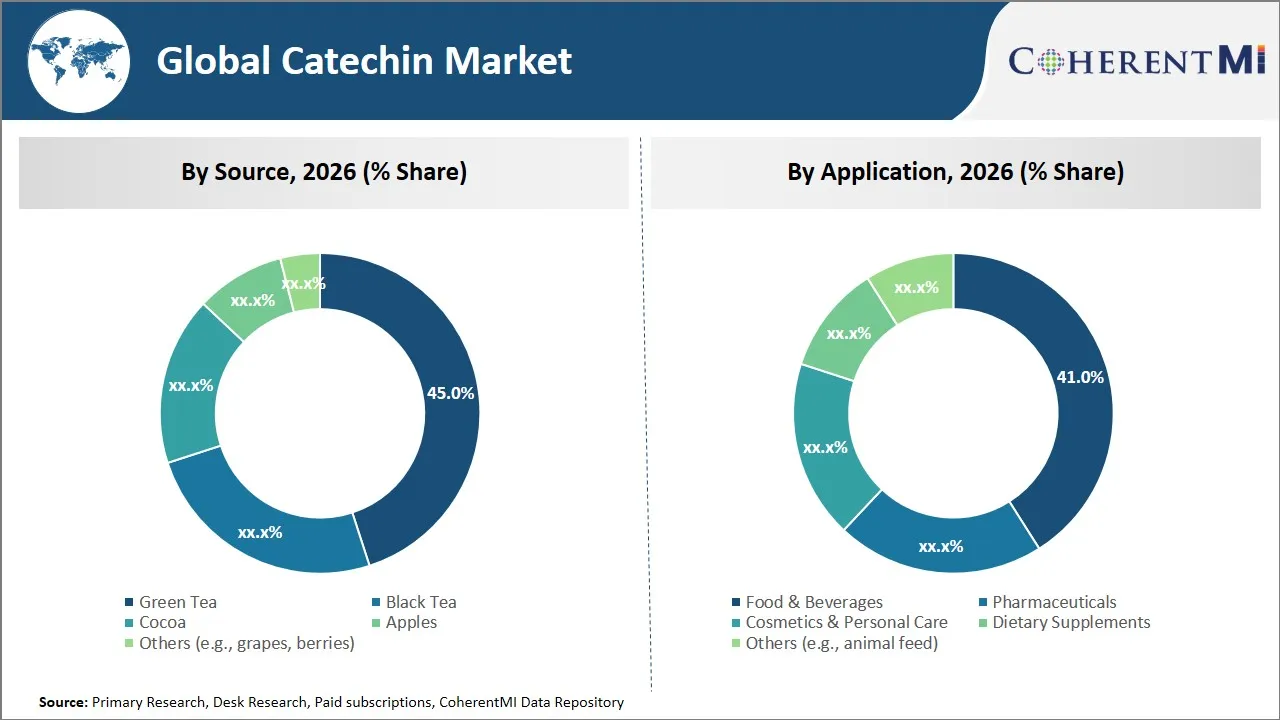
By source type, green tea is expected to contribute the highest share of 45% in 2026, By source type, green tea is expected to contribute the highest share of 45% in 2026, owing to its exceptionally high catechin content and minimal processing methodology that preserves these valuable compounds. The manufacturing process of green tea which entails steaming or pan-frying fresh tea leaves immediately after harvesting prevents oxidation and preserves the natural catechin structure, especially epigallocatechin gallate (EGCG) which is the strongest and commercially useful catechin form. High-quality green tea types are cultivated under controlled environment and a certain shade of shading that enhances the amino acids and raises the level of catechin.
For instance, multiple brands in the U.S. expanded green tea polyphenol extract product lines, introducing enhanced bioavailability ingredients and novel functional formulations targeting antioxidant, metabolic support, and wellness benefits. This reflects rising consumer demand for natural health actives and accelerated deployment of catechin‑rich products in supplements and beverages.
(Source- https://finance.yahoo.com/news/aquafit-weight-loss-supplement-investigation-023300001.html)
Insights, By Application: Food & Beverages’ Leadership Fueled by Health-Conscious Consumer Trends and Functional Ingredient Demand
By application, food & beverages take the largest portion of the market with an estimated share of 41% in 2026, driven by accelerating consumer shift toward functional foods and the industry's response to growing health consciousness. Combining catechins into food and beverage preparations is able to fulfill several consumer needs at the same time, such as antioxidant protection, natural preservation and wellness improvement, thus it is an essential ingredient to food producers aiming to provide a competitive advantage in the market.
Growing Role of Catechins in Functional Beverages: Innovation and Consumer Demand
- Rising Demand for Functional Beverages: Catechins are also being added to functional beverages like green tea, ice teas, and energy drinks in increasing amounts because of their antioxidant effect and health effects including immunity, weight loss, and enhanced metabolism.
- Product Innovation: Beverage companies are innovating, coming up with catechin-enriched beverages with clean label ingredients, aiming to reach out to health-conscious consumers to offer a natural substitute source of energy, hydration, and wellness in both the mainstream and niche markets.
Supply Dynamics and Import/Export Flow of Catechins: Key Producing and Consuming Nations
- Key Producing Nations: Catechins are majorly produced in China, India and Kenya and massive cultivation of tea leads to the production of high-quality green tea extracts which are the primary source of catechins in the different industries such as food, beverages, and pharmaceuticals.
- Key Consuming Nations: North America, Europe, and sections of Asia Pacific are among the major consumers of catechins whose demand is largely influenced by the health-conscious population who are seeking functional food products, dietary supplements, and skincare items which has resulted in a stable flow of imports by leading producing countries.
Additional Insights of Catechin Market
- The catechin market is expanding globally, driven by the increasing demand for natural antioxidants and functional ingredients across sectors like food, beverages, pharmaceuticals, and personal care.
- Innovations in extraction technologies and formulation methods are improving product quality, efficiency, and sustainability, enabling broader applications in various industries.
- The growing applications of catechins in pharmaceuticals, cosmetics, and functional beverages offer significant opportunities for market expansion and product diversification.
- Rising consumer interest in natural, clean-label products, particularly in health and wellness, is driving demand for catechins as key ingredients in dietary supplements, skincare, and functional foods.
Competitive overview of Catechin Market
The major players operating in the global catechin market include Nestlé, The Coca-Cola Company, Tata Global Beverages, Unilever, Kirin Holdings Company, Amorepacific Corporation, Hainan Nutra Food, Hunan Zhongtai Biotech Co., Ltd, Indena S.p.A, Teavana, McCormick & Company, Suntory Holdings Limited, BASF SE, DuPont, and SodaStream.
Catechin Market Leaders
- Nestlé
- The Coca-Cola Company
- Tata Global Beverages
- Unilever
- Kirin Holdings Company
Recent Developments in Catechin Market
- On January 13, 2026, GURU Organic Energy unveiled its latest product, GURU Zero Dragon Fruit Cherry Sorbet, a zero‑sugar energy drink formulated with natural green tea catechins (EGCG), L‑theanine, and caffeine to meet growing demand for plant‑based functional beverages. The new flavor will be available across Canada and in select U.S. retailers, supported by an integrated digital and retail marketing strategy aimed at strengthening the brand’s presence in the clean‑label energy drink segment.
- In February 2025, Daewoong Pharmaceutical rolled out 26 health functional food products under its Bear brand at 200 Daiso stores across South Korea, including formulations that contain green tea catechin extracts for body fat management and antioxidant support. The expanded product lineup was made available, aiming to increase consumer access to functional supplements through Daiso’s nationwide retail network.
- In November 2021, Unilever announced the sale of its global tea business, Ekaterra, to CVC Capital Partners Fund VIII for USD 4.5 billion. This move impacts the global tea ingredient market, where catechins, key bioactive compounds found in green tea, are significant. Ekaterra, which includes leading tea brands such as Lipton and PG Tips, has been a major player in the tea industry. These brands are widely recognized for their green tea offerings, which are rich in catechins and other health-promoting antioxidants.
Catechin Market Segmentation
- By Source
- Green Tea
- Black Tea
- Cocoa
- Apples
- Others (e.g., grapes, berries)
- By Application
- Food & Beverages
- Pharmaceuticals
- Cosmetics & Personal Care
- Dietary Supplements
- Others (e.g., animal feed)
- By Form
- Powder
- Liquid
- Capsules/Tablets
- By Type
- Epigallocatechin Gallate (EGCG)
- Epicatechin
- Epicatechin Gallate (ECG)
- Catechin
- Others (e.g., gallocatechin, catechin gallate)
- By End User
- Healthcare & Pharmaceuticals
- Food & Beverage
- Cosmetic & Personal Care
- Dietary Supplements
- Others (e.g., animal nutrition)
- By Distribution Channel
- Online
- Offline

Would you like to explore the option of buying individual sections of this report?
Sakshi Suryawanshi is a Research Consultant with 6 years of extensive experience in market research and consulting. She is proficient in market estimation, competitive analysis, and patent analysis. Sakshi excels in identifying market trends and evaluating competitive landscapes to provide actionable insights that drive strategic decision-making. Her expertise helps businesses navigate complex market dynamics and achieve their objectives effectively.