Prostate Health Market SIZE AND SHARE ANALYSIS - GROWTH TRENDS AND FORECASTS (2026 - 2033)
Prostate Health Market, By Disease Type (Benign Prostatic Hyperplasia, Prostate Cancer, Prostatitis,...
Prostate Health Market Size - Analysis
The global prostate health market is estimated to be valued at USD 46.03 Bn in 2026 and is expected to reach USD 84.69 Bn by 2033, growing at a compound annual growth rate (CAGR) of 9.1% from 2026 to 2033. This high market growth is an indication of the rising prevalence of prostate related disorders in the world especially in the developed economies as the older men age. The strong growth trend is influenced by the increased level of healthcare spending, improved diagnostic abilities and increasing awareness among different population groups in managing prostate health all over the world.
The market in prostate health is undergoing radical changes due to technological solutions in the form of minimal invasive procedures, individualized medicine technology, and modern diagnostic methods such as AI-based imaging solutions. The main tendencies are the expansion of the usage of combination therapies, the preference to outpatient procedures, and the expanding need in the preventive healthcare solutions.
Market Size in USD Bn
CAGR9.1%
| Study Period | 2026 - 2033 |
| Base Year of Estimation | 2025 |
| CAGR | 9.1% |
| Market Concentration | Medium |
| Major Players | Astellas Pharma Inc, Pfizer Inc, Johnson & Johnson, Bayer AG, Ferring Pharmaceuticals, AbbVie Inc, AstraZeneca PLC, Merck & Co Inc, Novartis AG, Ipsen Group, Takeda Pharmaceutical Company Limited, Sanofi, Endo International plc, OPKO Health Inc, Bio Rad Laboratories Inc and Among Others |

please let us know !
Prostate Health Market Trends
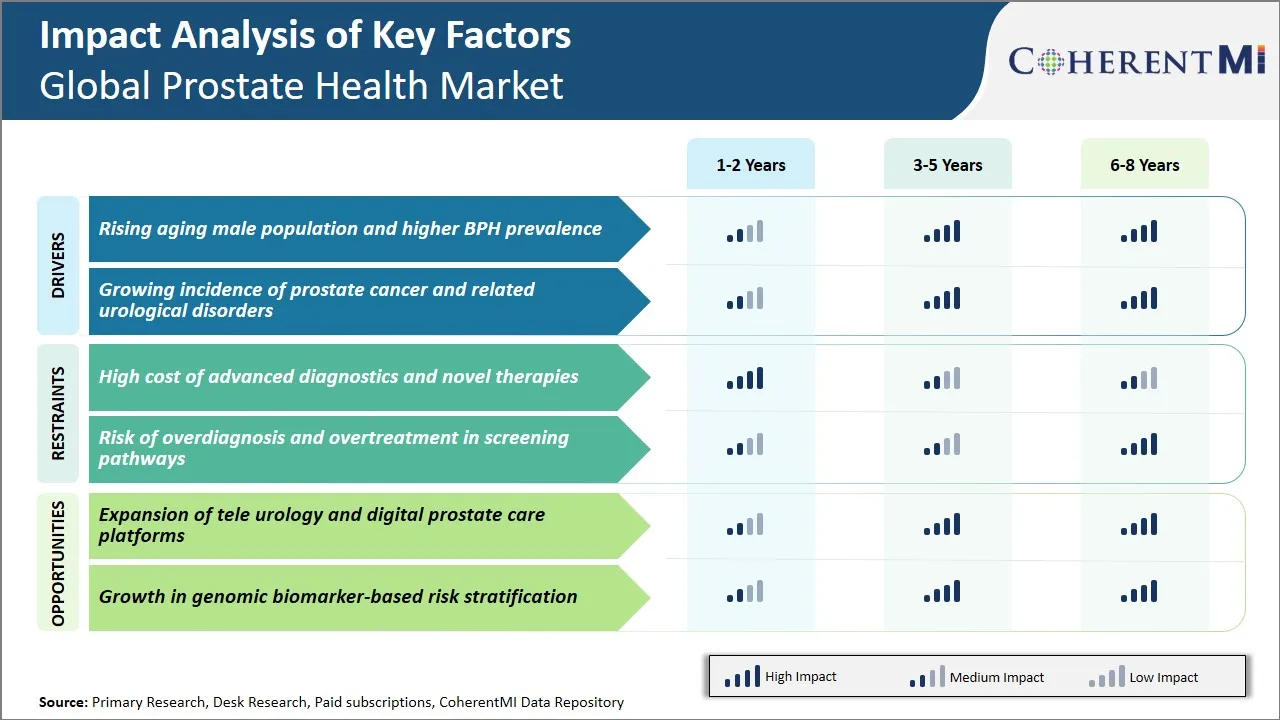
Market Driver - Rising Aging Male Population and Higher BPH Prevalence
The worldwide population shift towards elderly population can be regarded as one of the greatest forces that drive the prostate health market, and Benign Prostatic Hyperplasia (BPH) is a major issue impacting millions of men across the globe. With life expectancy rising steadily in both developed and developing countries, the number of older men developing age related prostate disorders has grown exponentially, offering a significant market size among the elderly age group in terms of the need to seek prostate health solutions, treatments, and preventive care products. The specified demographic change is especially marked in some parts of the world like North America, Europe, or even a part of the Asia Pacific with the increased longevity due to better medical care, nutrition, and living conditions yielding a higher number of men aged above 50 years, the most vulnerable group to prostate-related health comorbidities.
For instance, in December 2025, Zenflow Inc. announced that the U.S. Food and Drug Administration (FDA) approved the Zenflow Spring Implant and Delivery System, a minimally invasive device designed for the treatment of symptoms associated with benign prostatic hyperplasia (BPH). The implant provides a first-line interventional therapy that relieves urinary symptoms caused by prostate enlargement while preserving natural anatomy and avoiding long-term catheterization.
(Source- U.S. Food and Drug Administration (FDA))
Market Driver - Growing Incidence of Prostate Cancer and Related Urological Disorders
The rising case of prostate cancer and related urological complications can be viewed as a fundamental catalyst that is fundamentally redefining the prostate health market because the malignancy remains one of the most commonly diagnosed diseases in men worldwide, affecting people of various demographic variables and different geographical locations. Prostate cancer, in contrast to benign prostate conditions, is associated with its own set of unique problems which require the use of complex diagnostic technologies, modality of treatment and overall long-term management strategies that go across various medical specialties and healthcare environments. The intricacy of the prostate cancer care business presents a lot of market potential throughout the entire medical care continuum, both in terms of early cancer diagnosis and screening modalities through to the most technologically advanced treatment modalities and post treatment survivorship services that address the secondary effects of cancer therapy.
 To learn more about this report, Request Free Sample Copy
Market Challenge - High Cost of Advanced Diagnostics and Novel Therapies
Global prostate health market is threatened by massive head wind of heavy financial burden that comes with advanced diagnostic technologies and new modalities of treatment. Premium prices are charged on advanced diagnostic tests including multiparametric MRI (mpMRI), PET-CT scan, and genomic testing panels, which can demand USD 2,000 to USD 5,000 per test, and pose expensive accessibility challenges to patients in different socioeconomic groups. This upsurge is further enhanced by the availability of new types of therapeutic procedures such as robotic assisted surgery systems, HIFU (High Intensity Focused Ultrasound) treatment and next generation hormone therapy, which demand huge capital expenditures by the health care facilities. The economic burden is especially strong in the developing markets where funds are limited to support healthcare expenses and insurances to cover the advanced prostate treatment are rare.
Market Opportunity - Expansion of Tele-urology and Digital Prostate Care Platforms
The exponential growth of tele-urology and digital health services offers an unprecedented chance to transform the process of providing prostate care and increase the market share at an exponential rate. The strong growth trend of the global telemedicine market that was boosted by the COVID-19 has created an excellent opportunity to carry out special teleconsultations in urology, and the results have improved by more than 300 percent since 2020. With the help of artificial intelligence and machine learning algorithms, digital prostate care services are improving the accuracy of the diagnosis and making patient monitoring more organized and offering personalized prescriptions, which save healthcare expenses and make them more accessible. These platforms make continuous care pathways that were impossible before possible with remote patient monitoring via wearable devices and smartphone apps that track their symptoms, medication adherence, and treatment response.
For instance, on January 15, 2026, Digital health company Verana Health launched an upgraded version of its Site Explorer platform, expanding the tool to incorporate extensive real-world data collected from urology practices. The enhancement improves access to clinical insights and supports better research and decision-making in urology care. The platform helps researchers and healthcare providers analyze patient data, identify clinical trial sites, and better understand prostate and other urological disease populations. The launch strengthens the use of digital platforms and real-world data tools in prostate disease research and care management.
(Source- Verana Health)
Global Trends in PSA Screening Volumes and Participation Rates
- The volume of screening of prostate-specific antigen (PSA) has been on the rise in most countries due to the ever-growing awareness of the prostate cancer and the regular check-ups of men above the age of 50. In westernized societies like North America and Europe, PSA testing has grown into a widely used initial screening instrument, with a significant number of the target population of men subjecting to periodic tests as a part of routine preventive healthcare services. Increased healthcare expenditure, good urology network, and access to diagnostic laboratories have facilitated steady screening level in these areas.
- Participation rates however differ greatly across geographical locations with regards to the level of awareness, screening rules, and accessibility of health care. There is a tendency of higher screening attendance by aging men in developed markets and lower but also consistently growing screening attendance by emerging economies because of growing diagnostic facilities and public health campaigns. The increasing level of awareness and accessibility to diagnostic services coupled with cancer screening programs that are being led at the government level is likely to boost the level of PSA screening around the world.
Key winning strategies adopted by key players of Prostate Health Market
- Advanced Diagnostics and Targeted Therapy Expansion- The pioneer businesses in the worldwide prostate health market are working to expand their oncology holdings by creating improved diagnostics and targeted treatment. Most players are investing in PSMA-targeted imaging agents, radioligand therapies and precision oncology drugs to enhance early diagnosis and treatment outcomes of prostate cancer. The presence of sustained product innovation and regulatory approval in key market locations is enhancing the competitiveness of key pharmaceutical and biotechnology companies.
- Strategic Collaborations and Global Market Expansion- The other important strategy is merger, acquisition and strategic collaborations to hasten the research and expand therapeutic pipelines. Another trend that companies are focusing on is the minimally invasion treatment technologies and genomic biomarker-based diagnostics in order to be able to offer personalized prostate care. Moreover, the increased representation in growing markets and the enhancement of distribution systems across the world are assisting market leaders in seizing the rising demand of prostate health solutions.
Segmental Analysis of Prostate Health Market
 To learn more about this report, Request Free Sample Copy
Insights, By Disease Type: Benign Prostatic Hyperplasia (BPH) is Driven by Aging Demographics and Lifestyle Factors
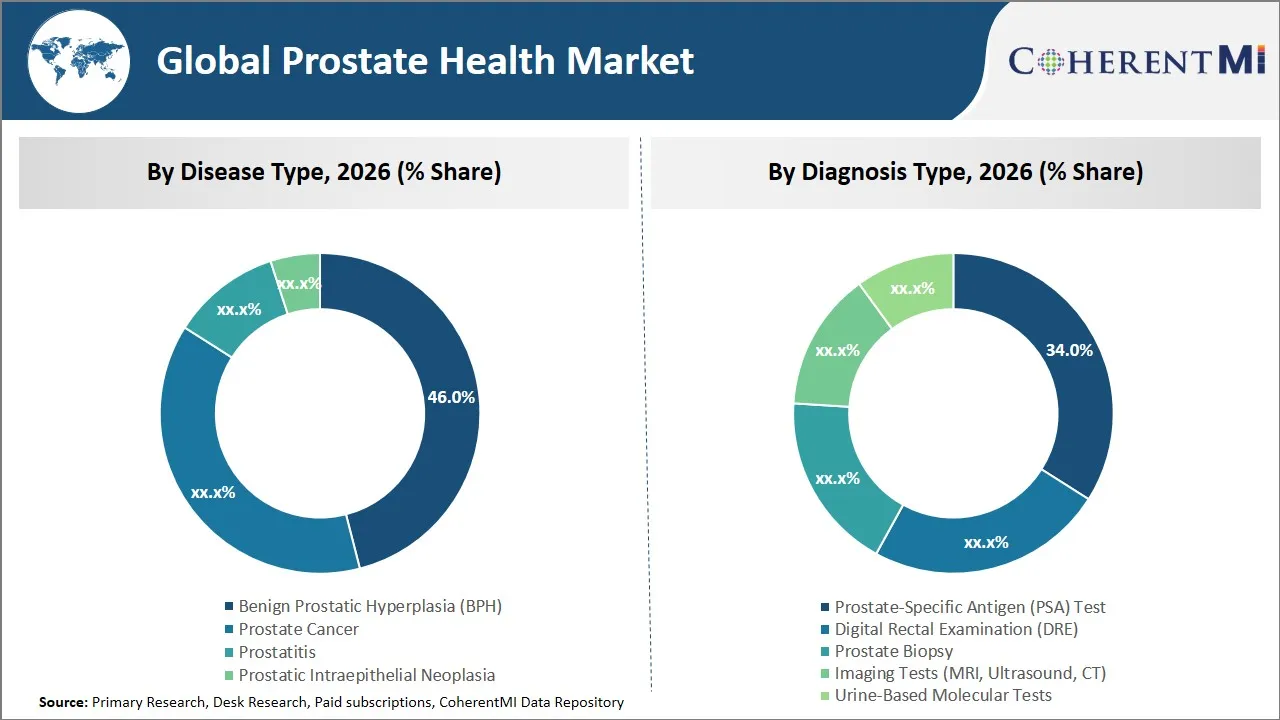
By disease type, Benign Prostatic Hyperplasia (BPH) takes the largest portion of the market with an estimated share of 46% in 2026, owing to the natural aging process affecting the majority of men over 50 years. BPH becomes much more common in the later years of life, with a half of men developing symptoms by the age of sixty and the percentage rising to more than 80 by the age of eighty. This is a demographic trend, not to mention rising life expectancy in the world, that poses a significant and expanding number of patients that need treatment. The pathophysiology of BPH includes the process of natural enlargement of the prostate gland, which happens as a part of the aging process because of hormonal alteration, most prominently change of testosterone to dihydrotestosterone (DHT). BPH is also non-malignant as compared to prostate cancer and therefore is a more manageable disease that is likely to make patients seek treatment unlike cancer diagnosis which is accompanied by psychological factors. This factor of accessibility plays a great role in increasing the uptake of treatment and penetration of the market.
Insights, By Diagnosis Type: Prostate-Specific Antigen (PSA) Test Driven by Widespread Clinical Adoption and Screening Programs
By diagnosis type, Prostate-Specific Antigen (PSA) test takes the largest portion of the market with an estimated share of 34% in 2026, owing to its non-invasive nature and widespread integration into routine healthcare screening protocols. The ease of PSA testing, which only involves a routine blood sample test, has ensured that the test is readily available in different medical facilities, both in primary care clinic and in the urology departments. This has made it be embraced as a first-line screening tool used in case of prostate conditions especially among aging male populations.
Most healthcare systems around the world have included PSA testing as part of the routine preventive medical care to men aged above 50 years and some of these guidelines also apply to men who are younger and have risk factors. This is a systematic method of prostate health screening that has developed a regular need of PSA testing that has been facilitated by insurance coverage and health policy systems. The capacity of the test to be a screening and a monitoring device is an added advantage since patients diagnosed with prostate conditions need regular PSA monitoring as an evaluation of the response to treatment and the progress of the disease.
Age-Related Rise in Benign Prostatic Hyperplasia Prevalence
- Benign Prostatic Hyperplasia (BPH) is closely linked to aging and is one of the most prevalent prostate diseases among men all over the world. The onset commences at an alarming rate beyond the 40s age, and clinical studies show that in their 50s, approximately 20-30 percent of men have some symptoms of the enlargement of the prostate. This increase in prevalence with age is one of the main reasons why the prostate health diagnostics, medications, and less invasive treatments are in demand.
- The burden increases significantly in the elderly populations with almost half to almost three-quarters of men in the 60s and almost half to three-quarters of men in the 70 years and above having histological evidence of BPH. With the rise in global life expectancy and the growth in the geriatric population of men, the count of individuals who need screening, long-term control, as well as therapeutic treatment in BPH, would continue to rise, fueling the prostate health market in general.
Additional Insights of Prostate Health Market
- The global prostate health market growth is being driven by the rising burden of prostate disorders, particularly benign prostatic hyperplasia (BPH) and prostate cancer, which continue to increase demand for diagnostics, drugs, and long-term disease management solutions.
- Screening and imaging are becoming more central to market expansion, with PSMA-based PET diagnostics gaining traction because they improve lesion detection in suspected metastatic or recurrent prostate cancer.
- Growing global burden of prostate cancer is driving demand for early diagnosis, imaging, drug therapy, and long-term disease management.
- Higher awareness of prostate health and routine screening among older men is supporting earlier detection and treatment uptake.
Competitive overview of Prostate Health Market
The major players operating in the global prostate health market include Astellas Pharma Inc, Pfizer Inc, Johnson & Johnson, Bayer AG, Ferring Pharmaceuticals, AbbVie Inc, AstraZeneca PLC, Merck & Co Inc, Novartis AG, Ipsen Group, Takeda Pharmaceutical Company Limited, Sanofi, Endo International plc, OPKO Health Inc, and Bio Rad Laboratories Inc.
Prostate Health Market Leaders
- Astellas Pharma Inc
- Pfizer Inc
- Johnson & Johnson
- Bayer AG
- Ferring Pharmaceuticals
- AbbVie Inc
- AstraZeneca PLC
- Merck & Co Inc
- Novartis AG
- Ipsen Group
- Takeda Pharmaceutical Company Limited
- Sanofi
- Endo International plc
- OPKO Health Inc
- Bio Rad Laboratories Inc
Recent Developments in Prostate Health Market
- In November 2025, Johnson & Johnson announced the acquisition of Halda Therapeutics for approximately USD 3.05 billion to strengthen its oncology pipeline, particularly in prostate cancer treatments. The acquisition adds Halda’s clinical-stage therapy HLD-0915, a novel precision drug designed to selectively destroy cancer cells and overcome resistance mechanisms in prostate cancer.
- In April 2025, Telix Pharmaceuticals announced that the U.S. Food and Drug Administration (FDA) approved Gozellix (TLX007-CDx), a gallium-68 diagnostic imaging agent used to detect metastatic or recurrent prostate cancer. The product helps physicians visualize prostate-specific membrane antigen (PSMA) expression during PET scans, improving diagnostic accuracy and supporting treatment decision-making in prostate cancer patients.
- In March 2025, Novartis received U.S. FDA approval for Pluvicto (lutetium Lu-177 vipivotide tetraxetan) for earlier treatment of patients with PSMA-positive metastatic castration-resistant prostate cancer. The radioligand therapy targets PSMA-expressing tumor cells and allows clinicians to delay chemotherapy while improving targeted treatment outcomes.
Prostate Health Market Segmentation
- By Disease Type
- Benign Prostatic Hyperplasia (BPH)
- Prostate Cancer
- Prostatitis
- Prostatic Intraepithelial Neoplasia
- By Diagnosis Type
- Prostate-Specific Antigen (PSA) Test
- Digital Rectal Examination (DRE)
- Prostate Biopsy
- Imaging Tests (MRI, Ultrasound, CT)
- Urine-Based Molecular Tests
- By Treatment Type
- Medications
- Minimally Invasive Therapies
- Surgical Procedures
- Radiation Therapy
- Hormone Therapy
- Immunotherapy
- By Drug Class
- Alpha Blockers
- 5-Alpha Reductase Inhibitors
- Phosphodiesterase-5 Inhibitors
- Antibiotics
- Chemotherapy Agents
- Hormonal Therapy Drugs
- By End User
- Hospitals
- Specialty Urology Clinics
- Ambulatory Surgical Centers
- Diagnostic Laboratories
- Research and Academic Institutes

Would you like to explore the option of buying individual sections of this report?
Ghanshyam Shrivastava - With over 20 years of experience in the management consulting and research, Ghanshyam Shrivastava serves as a Principal Consultant, bringing extensive expertise in biologics and biosimilars. His primary expertise lies in areas such as market entry and expansion strategy, competitive intelligence, and strategic transformation across diversified portfolio of various drugs used for different therapeutic category and APIs. He excels at identifying key challenges faced by clients and providing robust solutions to enhance their strategic decision-making capabilities. His comprehensive understanding of the market ensures valuable contributions to research reports and business decisions.
Ghanshyam is a sought-after speaker at industry conferences and contributes to various publications on pharma industry.