Hyperglycemia Treatment Market SIZE AND SHARE ANALYSIS - GROWTH TRENDS AND FORECASTS (2026 - 2033)
Hyperglycemia Treatment Market is segmented By Care Setting (Inpatient / hospital-managed hyperglyce...
Hyperglycemia Treatment Market Size - Analysis
The global hyperglycemia treatment market is estimated to be valued at USD 7.76 Bn in 2026 and is expected to reach USD 11.36 Bn by 2033, exhibiting a compound annual growth rate (CAGR) of 5.6% from 2026 to 2033. This healthy growth trend indicates the global trend of increasing the incidence rates of diabetes and metabolic disorders, as well as the growth of health care spending and the awareness of hyperglycemia management. The market growth is also enhanced by growing old population in the world, sedentary living, and diets leading to increased cases of hyperglycemic diseases in the developed and the emerging economies.
The market of hyperglycemia treatment is undergoing a drastic change due to the tremendous use of technology in glucose monitoring devices such as continuous glucose monitors and smart devices of insulin delivery. The main trends are the creation of individualized medicine strategies, artificial intelligence inclusion in treatment regimens, and more frequent use of combination therapy to manage the glucose level better.
Market Size in USD Bn
CAGR5.6%
| Study Period | 2026 - 2033 |
| Base Year of Estimation | 2025 |
| CAGR | 5.6% |
| Market Concentration | Medium |
| Major Players | Novo Nordisk, Eli Lilly and Company, Sanofi, AstraZeneca, Boehringer Ingelheim and Among Others |

please let us know !
Hyperglycemia Treatment Market Trends
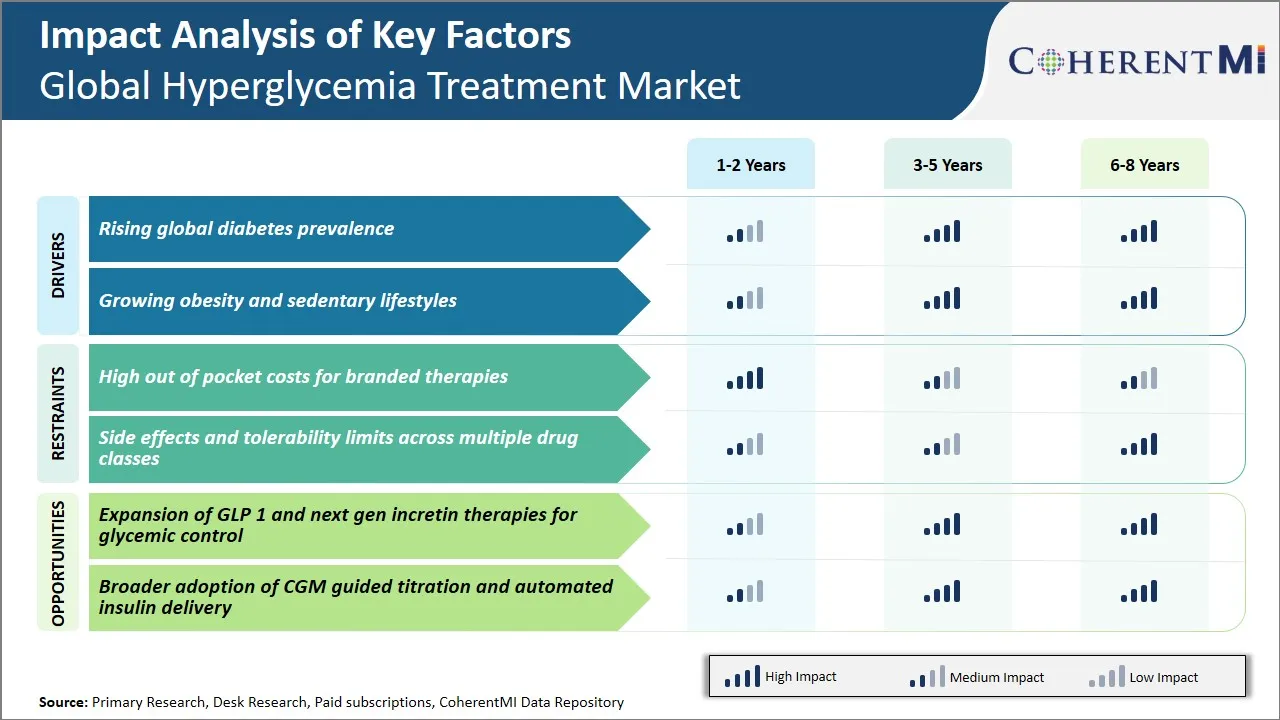
Market Driver - Rising Global Diabetes Prevalence
The increasing world diabetes prevalence is one of the strongest forces that is driving the treatment of hyperglycemia market across the world. The epidemic has acquired the levels that never existed, has altered the healthcare environment radically, and has left a massive need in the effective hyperglycemia management tools. The rapid increase in diabetes cases cuts across the borders of geographical regions and demographics to be a global health problem requiring holistic treatment interventions. The rates of explosion in Type 2 diabetes, in particular, have been observed to be tremendous, which is largely due to the modification of the diet, urbanization, and lifestyle changes that have become typical of contemporary society.
For instance, International Diabetes Federation (IDF), specifically its 11th edition of the IDF Diabetes Atlas. The Atlas reports that approximately 589 million adults aged 20–79 years were living with diabetes in 2024 and projects this number will rise to about 853 million by 2050. These figures are widely cited internationally for understanding the global diabetes burden.
(Source- https://idf.org/about-diabetes/diabetes-facts-figures/)
Market Driver- Growing Obesity and Sedentary Lifestyles
Hyperglycemia treatment market is being fueled by the dramatic rise in the prevalence of obesity and the popularization of sedentary lifestyles among the population groups in the world, which forms an intricate scheme of metabolic dysfunction, predisposing people to the development of glucose regulation disorders. The shift towards more sedentary forms of life in modern society, with long periods of sitting, little exercise and very little energy expenditure has offered a background in which metabolic health worsens over an extended period. This change in lifestyle coupled with the increase in the amount of calorie-rich, nutrient-deficient foods has created an ideal situation of insulin resistance, metabolic syndrome, and further hyperglycemic attacks that need to be addressed by pills.
 To learn more about this report, Request Free Sample Copy
Market Challenge - High Out of Pocket Costs for Branded Therapies
Significant out-of-pocket costs of branded therapeutic interventions are a major obstacle to the global hyperglycemia treatment market, especially with regards to patient compliance and market penetration. Premium insulin formulations, such as rapid-acting analogs and long-acting basal insulin formulations, usually have price premiums in the range of 300-500 percent of the traditional human insulin formulations, and this poses severe financial strain on patients with all socioeconomic groups. Such cost difference is especially acute in markets where few people are covered by insurance or have high-deductible health care where patients can pay as much as 200-800 dollars a month on branded insulin therapy regimens.
Market Opportunity - Expansion of GLP-1 and Next-Generation Incretin Therapies for Glycemic Control
The untapped global hyperglycemia treatment market offers unparalleled growth potential due to the blistering development and clinical maturity of GLP-1 receptor agonists and next generation incretin-based therapies, which is a paradigm shift in the overall metabolic treatment, rather than the conventional glycemic control. The GLP-1 therapeutics business area has shown superior market momentum, where the major products have been shown to be blockbusters having a growth rate of sales well above 25 and year after year, with ever-growing clinical evidence of significant reduction of cardiovascular risk, massive weight loss benefits, and possible neuroprotective benefit that further increases therapeutic value propositions beyond the diabetes management on its own.
For instance, on February 23, 2026, Eli Lilly and Company announced that the U.S. FDA approved and commercially released a four-dose, multi-dose KwikPen version of its obesity and metabolic therapy Zepbound (tirzepatide). The new pen delivers a full month of treatment in a single device, enhancing convenience versus weekly pens and expanding delivery options for patients via the company’s LillyDirect channel.
Advancements in Technology and Drug Delivery Transforming Hyperglycemia Treatment
- Smart Insulin & Automated Delivery Systems- The market is shifting toward closed-loop insulin pumps, smart pens, and AI-driven dosing algorithms that integrate with continuous glucose monitoring (CGM). These systems automate insulin titration, reduce hypoglycemia risk, and improve time-in-range metrics. Integration with mobile apps and cloud-based platforms enables remote monitoring and data-driven treatment optimization, improving both adherence and clinical outcomes.
- Advanced Drug Delivery & Long-Acting Formulations- Innovation is directed to once-weekly injectables, oral GLP-1 agonists, dual agonists and ultra-long-acting insulins to enhance convenience and compliance. Corporations are also working on needle-free delivery products and fixed-dose combinations, which combine glucose management with body-weight advantages and cardiovascular, and place therapies as complete metabolic products, as opposed to pure glucose-lowering medications.
Key winning strategies adopted by key players of Hyperglycemia Treatment Market
- Portfolio Expansion Toward Incretin & Combination Therapies- The major glucose-controlling, weight-reducing, and cardiovascular-risk-reducing combinations have its competitors aggressively transitioning to portfolio models based on GLP-1 receptor agonists, dual GIP/GLP-1 agonists, and fixed-dose co-formulations. Such strategy adds value of therapy to each patient and enhances pricing power. Companies are also creating lifecycle value by offering higher-dose formulations, oral dosage and once-weekly injectables that enhance adherence and also provide a distinction above generics.
- Technology Integration & Digital Ecosystem Partnerships- Top players are integrating continuous glucose monitoring (CGM), insulin pumps, smart pens, and connected apps into treatment ecosystems. he collaboration of pharma and medtech companies creates strategic partnerships that allow offering bundled solutions (drug + device + data platform), which enhance real-world performance and enhance patient stickiness in the long term. Data-driven dosing algorithms and AI-enabled titration tools are emerging as competitive differentiators.
Segmental Analysis of Hyperglycemia Treatment Market
 To learn more about this report, Request Free Sample Copy
Insights, By Care Setting: Critical Care Infrastructure and Immediate Medical Intervention Drive Inpatient / Hospital-Managed Hyperglycemia
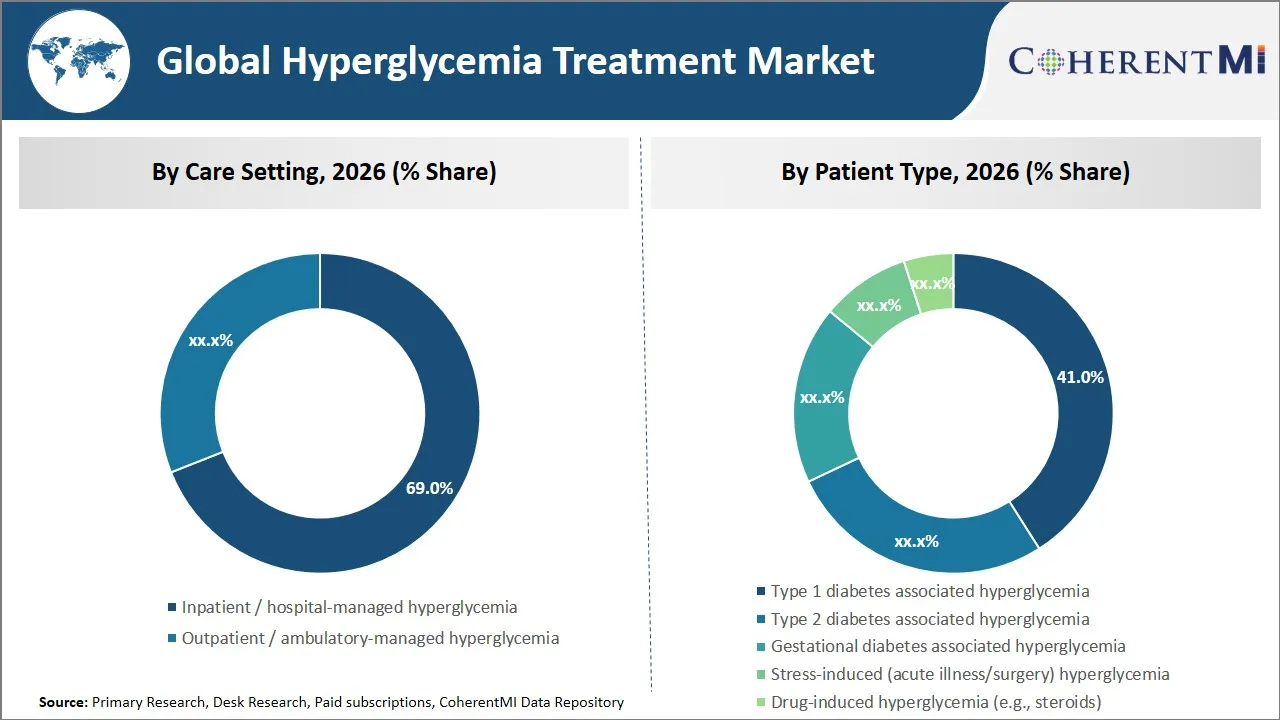
By care setting, inpatient / hospital-managed hyperglycemia takes the largest portion of the market with an estimated share of 69% in 2026, owing to the critical nature of acute hyperglycemic episodes that require immediate medical attention and comprehensive monitoring capabilities available only in hospital settings. The severity and complexity of cases that require the constant medical attention is the major contributor to the treatment of hyperglycemia carried out by the hospital. Patients that develop severe cases of hyperglycemia especially those with diabetic ketoacidosis or hyperosmolar hyperglycemic syndrome are in need of an immediate intervention that can only be offered in hospital settings. These facilities also provide 24/7 surveillance, the fastest time to get laboratory tests, and direct access to emergency care in cases where the level of blood sugar is considerably high.
For instance, in July 2025, Glytec’s FDA-cleared Glucommander is an AI-powered, EHR-integrated software designed to standardize inpatient hyperglycemia management through personalized insulin dosing. Used in over 400 hospitals, it helps reduce severe hypoglycemia by up to 73% and prepares facilities for 2026 CMS quality reporting requirements.
Insights, By Patient Type: Type 1 diabetes associated hyperglycemia is driven by Chronic Disease Burden and Long-term Management Complexities
By patient type, Type 1 diabetes–associated hyperglycemia takes the largest portion of the market with an estimated share of 41% in 2026, owing to the inherent characteristics of this autoimmune condition that create persistent hyperglycemia management challenges requiring continuous medical intervention and specialized treatment approaches. The prevalence of this segment is driven by the fundamental pathophysiology of Type 1 diabetes and the lifelong nature of hyperglycemia management requirements.
Autoimmune destruction of pancreatic beta cells in Type 1 diabetes type renders patients absolutely insulin-deficient and, therefore, fully reliant on external insulin injected to maintain glucose homeostasis.
AI-Driven Transformation in Hyperglycemia Treatment and Management
- AI and digital technology are reshaping hyperglycemia management from reactive treatment to predictive control. Integration of Continuous Glucose Monitoring (CGM), smart insulin pens, closed-loop insulin pumps, and AI-driven dosing algorithms enables automated insulin titration and real-time glucose optimization. Machine learning models analyze glucose variability, meal patterns, physical activity, and insulin sensitivity to improve time-in-range and reduce hypoglycemia risk. Hospitals are also adopting AI-powered inpatient glycemic management platforms that integrate with EHR systems to standardize insulin protocols and improve clinical outcomes.
- Beyond devices, AI is expanding into remote monitoring, digital therapeutics, and population-level risk stratification. Platforms that are connected to a cloud enable a clinician to monitor the patients in real time, whereas predictive analytics can determine the patients at risk before the patient experiences extreme hyperglycemic events. Drug-tech drug-data ecosystems are being formed through collaborations between pharma and MedTech firms in order to enhance compliance and free up value-based care frameworks. This change puts AI as not a supporting tool, but as a fundamental growth driver in the market of hyperglycemia treatment.
Additional Insights of Hyperglycemia Treatment Market
- The hyperglycemia treatment market covers insulin (rapid, long-acting, biosimilars), oral antidiabetics, GLP-1 receptor agonists, dual incretin therapies, and combination regimens used in type 1, type 2, gestational, and stress-induced hyperglycemia management.
- Rapidly rising global diabetes prevalence and expanding prediabetic population are structurally increasing demand for glucose-lowering therapies, particularly in emerging markets with improving diagnosis rates.
- GLP-1 receptor agonists and next-generation dual agonists (e.g., GIP/GLP-1) are gaining share due to superior A1C reduction, weight loss benefits, and cardiovascular risk reduction, reshaping revenue concentration within the market.
- Adoption of continuous glucose monitoring (CGM), smart insulin delivery systems, and AI-driven titration tools is enhancing treatment precision and improving patient adherence, particularly in insulin-dependent populations.
Competitive overview of Hyperglycemia Treatment Market
The major players operating in the global hyperglycemia treatment market include Novo Nordisk, Eli Lilly and Company, Sanofi, AstraZeneca, Boehringer Ingelheim, Merck and Co, Takeda Pharmaceutical Company, Johnson and Johnson Janssen, Abbott Laboratories, Dexcom, Medtronic, Insulet, Tandem Diabetes Care, Roche Diabetes Care, and Ypsomed.
Hyperglycemia Treatment Market Leaders
- Novo Nordisk
- Eli Lilly and Company
- Sanofi
- AstraZeneca
- Boehringer Ingelheim
Recent Developments in Hyperglycemia Treatment Market
- On February 4, 2026, Novo Nordisk announced that it will launch an oral semaglutide tablet under the brand name Ozempic in the second quarter of 2026 for adults with type 2 diabetes, following U.S. Food and Drug Administration approval of 1.5 mg, 4 mg, and 9 mg formulations. This new Ozempic pill is designed to expand treatment options and leverage brand recognition for oral glucose-lowering therapy in the U.S. diabetes market.
- On January 7, 2026, Eli Lilly and Company announced that it had entered a definitive agreement to acquire Ventyx Biosciences for approximately USD 1.2 billion in cash, acquiring all outstanding shares at USD 14.00 per share. The transaction, targeting oral therapies for inflammatory-mediated and cardiometabolic conditions, is expected to close in the first half of 2026, subject to stockholder and regulatory approvals.
- In September 2025, Innovent Biologics announced that China’s National Medical Products Administration has approved mazdutide, the first dual GCG/GLP-1 receptor agonist for glycemic control in adults with Type 2 diabetes, offering a new therapeutic option for comprehensive glucose management in the country’s large T2D population.
Hyperglycemia Treatment Market Segmentation
- By Care Setting
- Inpatient / hospital-managed hyperglycemia
- Outpatient / ambulatory-managed hyperglycemia
- By Patient Type
- Type 1 diabetes associated hyperglycemia
- Type 2 diabetes associated hyperglycemia
- Gestational diabetes associated hyperglycemia
- Stress-induced (acute illness/surgery) hyperglycemia
- Drug-induced hyperglycemia (e.g., steroids)
- By Treatment Modality
- Pharmacological therapy
- Non-pharmacological management (diet, activity, weight management, education)
- By Drug Class
- Insulin therapies
- Rapid-acting insulin
- Short-acting (regular) insulin
- Intermediate-acting insulin
- Long-acting insulin
- Ultra-long-acting insulin
- Premixed insulin
- Non-insulin injectables
- GLP-1 receptor agonists
- Amylin analogs
- Oral antidiabetic agents
- Biguanides (metformin)
- Sulfonylureas
- Meglitinides
- Thiazolidinediones (TZDs)
- DPP-4 inhibitors
- SGLT2 inhibitors
- Alpha-glucosidase inhibitors
- Insulin therapies
- By Therapy Regimen
- Monotherapy
- Dual therapy
- Triple therapy
- Intensive insulin therapy
- Basal-only
- Basal–bolus
- Premixed regimen
- Correction-scale / sliding-scale (typically inpatient)
- By Route of Administration
- Oral
- Subcutaneous injection
- Intravenous infusion (acute/inpatient)
- By Technology-Enabled Management
- Insulin delivery devices
- Pens
- Syringes
- Pumps (CSII)
- Patch pumps
- Glucose-guided dosing support
- SMBG-guided titration
- CGM-guided titration
- Automated insulin delivery (AID/closed-loop systems)
- By Distribution Channel
- Hospital pharmacy
- Retail pharmacy
- Online pharmacy
- Diabetes clinics / specialized centers

Would you like to explore the option of buying individual sections of this report?
Ghanshyam Shrivastava - With over 20 years of experience in the management consulting and research, Ghanshyam Shrivastava serves as a Principal Consultant, bringing extensive expertise in biologics and biosimilars. His primary expertise lies in areas such as market entry and expansion strategy, competitive intelligence, and strategic transformation across diversified portfolio of various drugs used for different therapeutic category and APIs. He excels at identifying key challenges faced by clients and providing robust solutions to enhance their strategic decision-making capabilities. His comprehensive understanding of the market ensures valuable contributions to research reports and business decisions.
Ghanshyam is a sought-after speaker at industry conferences and contributes to various publications on pharma industry.