Metformin Hydrochloride Market SIZE AND SHARE ANALYSIS - GROWTH TRENDS AND FORECASTS (2026 - 2033)
Metformin Hydrochloride Market, is segmented By Product Form (Tablets, Liquid Formulations, Extended...
Metformin Hydrochloride Market Size - Analysis
The Global Metformin Hydrochloride Market is estimated to be valued at USD 21.19 Bn in 2026 and is expected to reach USD 34.03 Bn by 2033, exhibiting a compound annual growth rate (CAGR) of 7% from 2026 to 2033. This strong growth trend is in line with the rising prevalence of diabetes mellitus especially Type 2 diabetes worldwide, accompanied by the growing healthcare awareness and ease of accessing pharmaceutical medication in the emerging economies. The large market growth is also underpinned by the proven efficacy profile of the drug, lower price as compared to the newer antidiabetic drugs, and the recommendation of the drug as a first-line treatment option by major medical organizations across the globe.
Market Size in USD Bn
CAGR7%
| Study Period | 2026 - 2033 |
| Base Year of Estimation | 2025 |
| CAGR | 7% |
| Market Concentration | Medium |
| Major Players | Shouguang Fukang Pharmaceutical, CR Double‑Crane, Wanbury, Keyuan Pharmaceutical, Aarti Drugs and Among Others |

please let us know !
Metformin Hydrochloride Market Trends
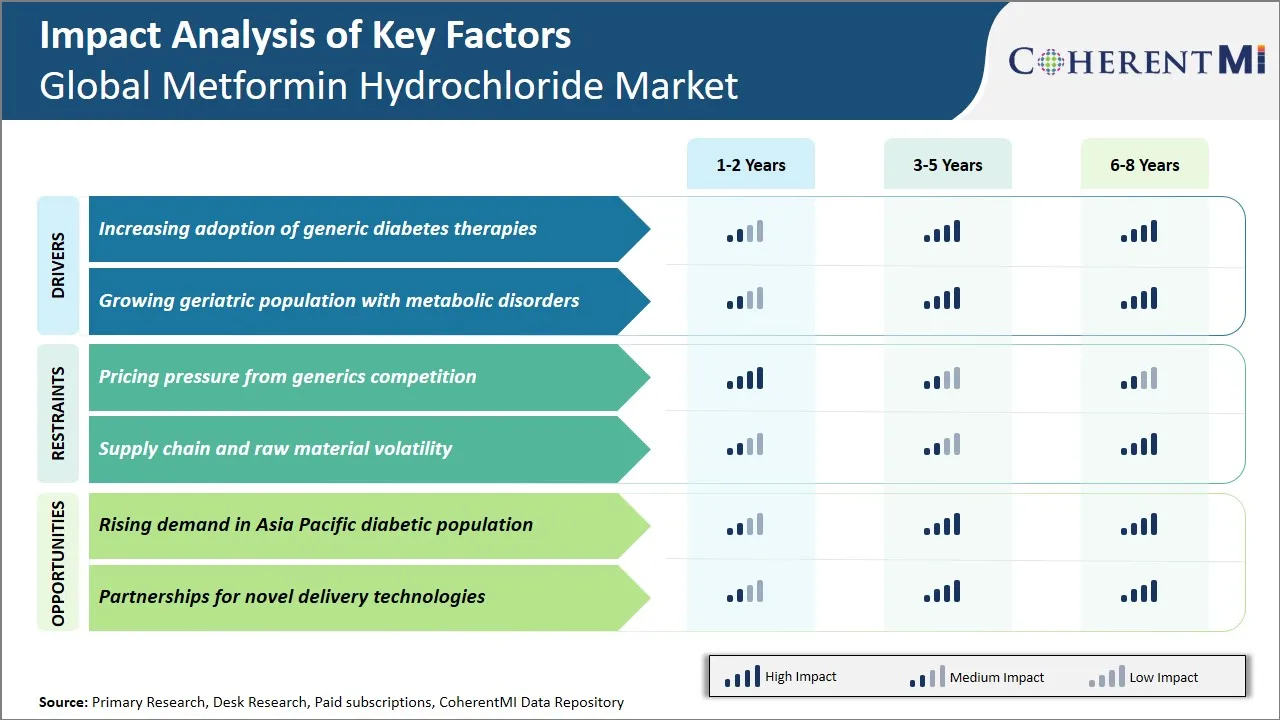
Metformin Hydrochloride Market Driver - Increasing Adoption of Generic Diabetes Therapies
The pharmaceutical sector has experienced a phenomenal revolution over the past few years as healthcare systems across the globe have begun to focus more on cost-efficient treatment options without compromising on therapeutic results. The new paradigm shift has provided an especially positive opportunity to generic drugs, particularly in the diabetes care sector with metformin hydrochloride as a cornerstone treatment.
The increasing use and acceptance of generic diabetes treatments are one of the core forces that are transforming the market forces and patterns of accessibility within various healthcare systems. Healthcare practitioners, patients, and policymakers are now coming to the realization that generic preparations can provide nearly the same therapeutic effect as that of their brand counterparts at a greater economic benefit that transcends well beyond the cost of treating an individual patient.
For instance, approximately 589 million adults aged 20–79 is living with diabetes worldwide as of 2024, representing 11.1% of the global adult population. This figure is projected to rise to 853 million by 2050. With over 4 in 5 affected individuals living in low- and middle-income countries, the growing burden demands increased access to diabetes medication, including affordable generics.
(Source- https://idf.org/about-diabetes/diabetes-facts-figures/)
Metformin Hydrochloride Market Driver - Growing Geriatric Population with Metabolic Disorders
The population shift that is taking place in both the developed and the developing countries has presented both challenges and opportunities in healthcare that have never been experienced before especially in the treatment of age-related metabolic disorders. The growing geriatric population is a strong demographic trend that is essentially transforming the trend in healthcare demand, and metabolic disorders have become one of the most common and clinically challenging diseases that occur in the elderly. This change in demographics has significant consequences in the use of metformin hydrochloride because older populations have shown to have significantly increased incidences of type 2 diabetes, prediabetes and other elements of metabolic syndrome.
For instance, globally, approximately 135.6 million people aged 65 years and older were living with diabetes in 2019 about 19.3% of the older adult population and this number is projected to rise to 195.2 million by 2030 and 276.2 million by 2045 due to aging populations and increased life expectancy.
(Source- https://www.frontiersin.org/journals/public-health/articles/10.3389/fpubh.2025.1655640/full)
 To learn more about this report, Request Free Sample Copy
Metformin Hydrochloride Market Challenge - Pricing Pressure from Generics Competition
The metformin hydrochloride market is also undergoing a lot of headwinds due to the increasing generic competition, thus posing a lot of pricing pressure that is threatening to reduce the profit margins of all the stakeholders in the value chain. Since the patent protection of metformin has already expired, several generic manufacturers are in the market and offer bioequivalent preparations at significantly lower prices than branded preparations. This commoditization has led to price war, where generic products usually sell at 70-80 per cent the prices of original branded products. It is especially severe in the developed markets, like in the case of the U.S. and Europe, where healthcare systems and insurance companies actively encourage the use of generic substitution by providing preferential reimbursement policies and requiring the use of generic dispensing laws. Drug manufacturers are also facing tight margins trying to retain their market share with the pressure of downward prices, being exerted by competitors and the agencies that are supposed to procure their drugs. It is further complicated by the fact that the industry has several suppliers based in cost effective manufacturing centers in India and China who use the low cost of production to provide aggressive pricing policies.
Metformin Hydrochloride Market Opportunity - Rising Demand in Asia Pacific Diabetic Population
Asia Pacific offers a good growth prospect for the metformin hydrochloride market due to the disturbing increase in the number of diabetics and the changing infrastructure in healthcare systems of the emerging economies. It is estimated by the International Diabetes Federation that the Asia Pacific region will become the location of about 60 percent of the world diabetic population by 2030, with nations such as China and India spearheading the population change. This outbreak has been explained by the booming urbanization rates, sedentary lifestyles, dietary transformations, and an aging population which has generated an unprecedented demand for effective diabetes management solutions. As the first-line therapy prescribed by all diabetes authorities around the globe, Metformin will gain a lot out of this epidemiological development.
For instance, in 2021, China had approximately 145.4 million adults living with diabetes and India had around 74.2 million, making them the top two countries globally in terms of diabetic population numbers. Together, these figures illustrate the massive diabetes burden in the broader Asia Pacific region.
(Source- https://www.ncbi.nlm.nih.gov/books/NBK581940/table/ch3.t4/#:~:text=T)
Segmental Analysis of Metformin Hydrochloride Market
 To learn more about this report, Request Free Sample Copy
Insights, By Product Form - Tablets Dominate Through Superior Patient Adherence and Manufacturing Scalability
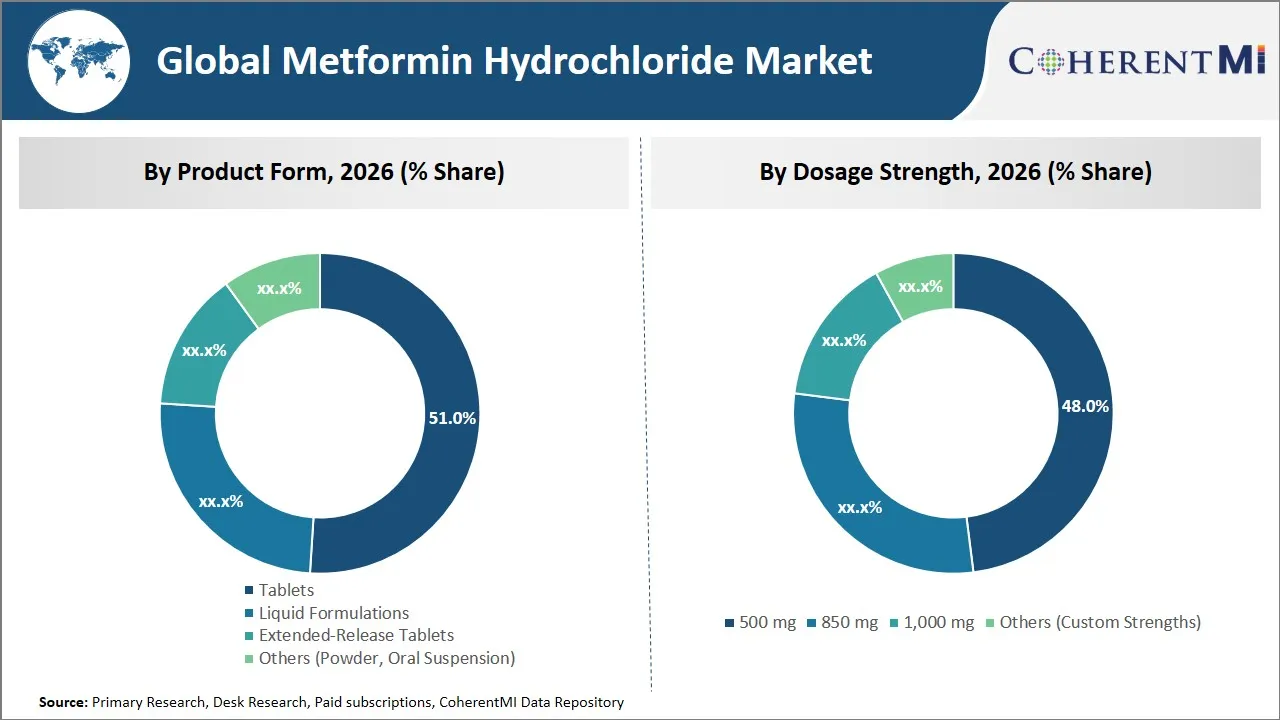
By product form, the tablets segment is expected to contribute the highest share of 51% in 2026, owing to their exceptional combination of patient convenience, manufacturing efficiency, and clinical reliability that makes them the preferred choice across diverse healthcare settings globally. The monopoly of the tablet market in metformin hydrochloride is based mainly on the unmatched convenience of administration and enhanced patient compliance benefits. The hard dosage form also overcomes the compliance problems that are largely linked with liquid formulations because the bitter taste of metformin is actually countered by coating the tablets. This palatability aspect becomes critical in the management of diabetes over the long term where adherence by patients is directly related to therapeutic success.
For instance, over 150 million people worldwide are currently using oral Metformin as a therapy for type 2 diabetes, making it one of the most widely prescribed oral antidiabetic medications globally.
(Source- https://pmc.ncbi.nlm.nih.gov/articles/PMC7915435/#:~:text=Since%20th)
Insights, By Dosage Strength - 500 mg Dosage Strength Leads Through Optimal Therapeutic Flexibility and Safety Profile
By dosage strength, 500 mg takes the largest portion of the market with an estimated share of 48% in 2026, owing to its optimal balance between therapeutic efficacy and dose titration flexibility, making it the preferred starting point for metformin therapy across diverse patient populations. The 500 mg strength's market dominance reflects its strategic positioning as the standard initial dose recommended by major diabetes management guidelines worldwide. This dosage strength allows healthcare providers to implement gradual dose escalation protocols that minimize gastrointestinal side effects, which represent the primary barrier to metformin therapy continuation. Starting with 500 mg enables physicians to assess individual patient tolerance before progressing to higher doses, significantly improving treatment adherence rates and reducing therapy discontinuation.
Supply Chain Vulnerabilities in the Metformin Hydrochloride Market: The Impact of China and India's API Dependency
- The Metformin Hydrochloride market is very dependent on China and India in providing active pharmaceutical ingredients (APIs). The biggest producer of the raw materials including the key intermediates utilized in the manufacture of Metformin Hydrochloride is China with India being the major competitor in the generic formulation market where it manufactures a large percentage of Metformin Hydrochloride tablets to supply globally. Such dependence on the two nations has underscored the market to be subject to supply interruptions which are instigated by regulatory modifications, geopolitical conflicts, or trade prohibitions that affect these areas.
- With such a concentration, the market of Metformin Hydrochloride is under pressure to diversify the supply chains. Firms are seeking an escape by increasing production capacity elsewhere in Europe and Latin America to limit dependence on China and India. Also, there is an increasing emphasis on local manufacturing in key pharmaceutical markets, such as the U.S. and Europe, to reduce the risks related to the shortage of APIs and enhance the resilience of the supply chain in case of unexpected disruptions.
Impact of Regulatory Alerts and Recalls on the Metformin Hydrochloride Market
- In the pharmaceutical business, regulatory alerts and product recalls particularly of the vital drugs such as Metformin Hydrochloride might have a major effect on the supply chains as well as reputation in the market. The most prominent recalls in the recent years have been the ones caused by risk contamination, including the N-Nitrosodimethylamine (NDA) found in Metformin products, which led to a nationwide regulatory investigation and subsequent product recalls. The U.S. FDA and other international regulatory organizations have taken the initiative to recall its products to protect the health of the consumers which has caused supply interruptions and manufacturers have had to restart their quality control measures. Such recalls likely result in greater regulatory compliance and enforcement leading to slowing of production and higher costs.
- History of Regulatory Alerts: Long-term implications of the history of regulatory alerts have been in relation to the Metformin Hydrochloride market wherein manufacturers and distributors will undertake better product tests and Good Manufacturing Practices (GMP). The issue associated with recall does not only interrupt the supply of Metformin Hydrochloride, but also affects consumer confidence and health-care expenditures because of the necessity to use other treatment methods. Companies have, in turn, responded by putting more effort in improving regulatory compliance systems, making more transparency in production processes and ensuring that they invest in more sophisticated testing systems to avoid future problems. These measures will be vital towards stability of the market and the safety and effectiveness of Metformin Hydrochloride in diabetes management across the globe.
Additional Insights of Metformin Hydrochloride Market
- The metformin hydrochloride market is evolving with a growing emphasis on extended-release formulations that improve patient adherence and treatment outcomes. Additionally, there is a rising adoption of Metformin in emerging therapeutic areas like PCOS and weight management, along with a shift towards combination therapies involving newer antidiabetic agents.
- The metformin hydrochloride market is seeing increased generic competition following patent expirations, which is enhancing affordability and accessibility for patients. At the same time, pharmaceutical companies are exploring novel drug delivery systems and investigating Metformin's potential for anti-aging and cardiovascular protection, opening up new revenue opportunities beyond traditional diabetes treatment.
- Pharmaceutical companies are investing in novel drug delivery systems and exploring combination therapies with newer antidiabetic agents, further expanding the scope of Metformin's therapeutic applications.
- The expansion of Metformin’s therapeutic applications, such as in the management of polycystic ovary syndrome (PCOS) and weight management, is further boosting its market demand, particularly in emerging regions where these conditions are increasingly diagnosed.
Competitive overview of Metformin Hydrochloride Market
The major players operating in the global metformin hydrochloride market include Shouguang Fukang Pharmaceutical, CR Double‑Crane, Wanbury, Keyuan Pharmaceutical, Aarti Drugs, Farmhispania Group, Harman Finochem, Exemed Pharmaceuticals, Vistin Pharma, Shijiazhuang Polee Pharmaceutical, USV, Auro Laboratories, Ipca Laboratories, Bayer, and Fengchen Group Co.
Metformin Hydrochloride Market Leaders
- Shouguang Fukang Pharmaceutical
- CR Double‑Crane
- Wanbury
- Keyuan Pharmaceutical
- Aarti Drugs
Recent Developments in Metformin Hydrochloride Market
- In November 2025, Granules Life Sciences Private Limited (GLS), a wholly-owned subsidiary of Granules India Limited, received its first approval from the U.S. Food and Drug Administration (FDA) for Metformin Hydrochloride (HCl) tablets, marking a key regulatory milestone for the company’s Hyderabad facility.
- In January 2025, Zydus Lifesciences has announced a strategic agreement with CVS Caremark, one of the nation's leading pharmacy benefit managers, to include its Zituvio, Zituvimet, and Zituvimet XR (sitagliptin and sitagliptin-metformin hydrochloride) products on the CVS template formulary. This move is expected to significantly expand the market access for metformin-based combination therapies, offering enhanced treatment options for type 2 diabetes patients.
- In July 2024, Zydus Lifesciences Limited announced that it has received final approval from the U.S. Food and Drug Administration (FDA) for its New Drug Application (NDA) to market Zituvimet XR (sitagliptin and metformin hydrochloride) extended‑release tablets indicated for adults with type 2 diabetes mellitus.
Metformin Hydrochloride Market Segmentation
- By Product Form
- Tablets
- Liquid Formulations
- Extended-Release Tablets
- Others (Powder, Oral Suspension)
- By Dosage Strength
- 500 mg
- 850 mg
- 1,000 mg
- Others (Custom Strengths)
- By Application
- Type 2 Diabetes Mellitus
- Polycystic Ovary Syndrome (PCOS)
- Weight Management
- Others (Gestational Diabetes, Pre-diabetes)
- By End User
- Hospital pharmacies
- Retail Pharmacies
- Online Pharmacies
- Clinics
- Others (Long-term Care Facilities)
- By Distribution Channel
- Online
- Offline
- By Route of Administration:
- Oral
- Injectable
- Others (Topical, Nasal)

Would you like to explore the option of buying individual sections of this report?
Ghanshyam Shrivastava - With over 20 years of experience in the management consulting and research, Ghanshyam Shrivastava serves as a Principal Consultant, bringing extensive expertise in biologics and biosimilars. His primary expertise lies in areas such as market entry and expansion strategy, competitive intelligence, and strategic transformation across diversified portfolio of various drugs used for different therapeutic category and APIs. He excels at identifying key challenges faced by clients and providing robust solutions to enhance their strategic decision-making capabilities. His comprehensive understanding of the market ensures valuable contributions to research reports and business decisions.
Ghanshyam is a sought-after speaker at industry conferences and contributes to various publications on pharma industry.