Vutrisiran Market SIZE AND SHARE ANALYSIS - GROWTH TRENDS AND FORECASTS (2026 - 2033)
Vutrisiran Market is segmented By Indication (Hereditary transthyretin-mediated amyloidosis, Other t...
Vutrisiran Market Size - Analysis
The Global Vutrisiran Market is estimated to be valued at USD 1,425.4 Mn in 2026 and is expected to reach USD 5,797.6 Mn by 2033, exhibiting a compound annual growth rate (CAGR) of 22.2% from 2026 to 2033. This substantial market expansion reflects the increasing adoption of RNA interference therapeutics and the growing prevalence of hereditary transthyretin-mediated amyloidosis (hATTR). The robust growth trajectory is driven by vutrisiran's superior efficacy profile, improved dosing convenience compared to existing treatments, and expanding patient population awareness across key geographic markets including North America and Europe. The vutrisiran market is experiencing transformative trends characterized by accelerated clinical adoption and enhanced patient access initiatives.
Market Size in USD Mn
CAGR22.2%
| Study Period | 2026 - 2033 |
| Base Year of Estimation | 2025 |
| CAGR | 22.2% |
| Market Concentration | Medium |
| Major Players | Alnylam Pharmaceuticals Inc, Ionis Pharmaceuticals Inc, AstraZeneca plc, Pfizer Inc, Sanofi S.A and Among Others |

please let us know !
Vutrisiran Market Trends
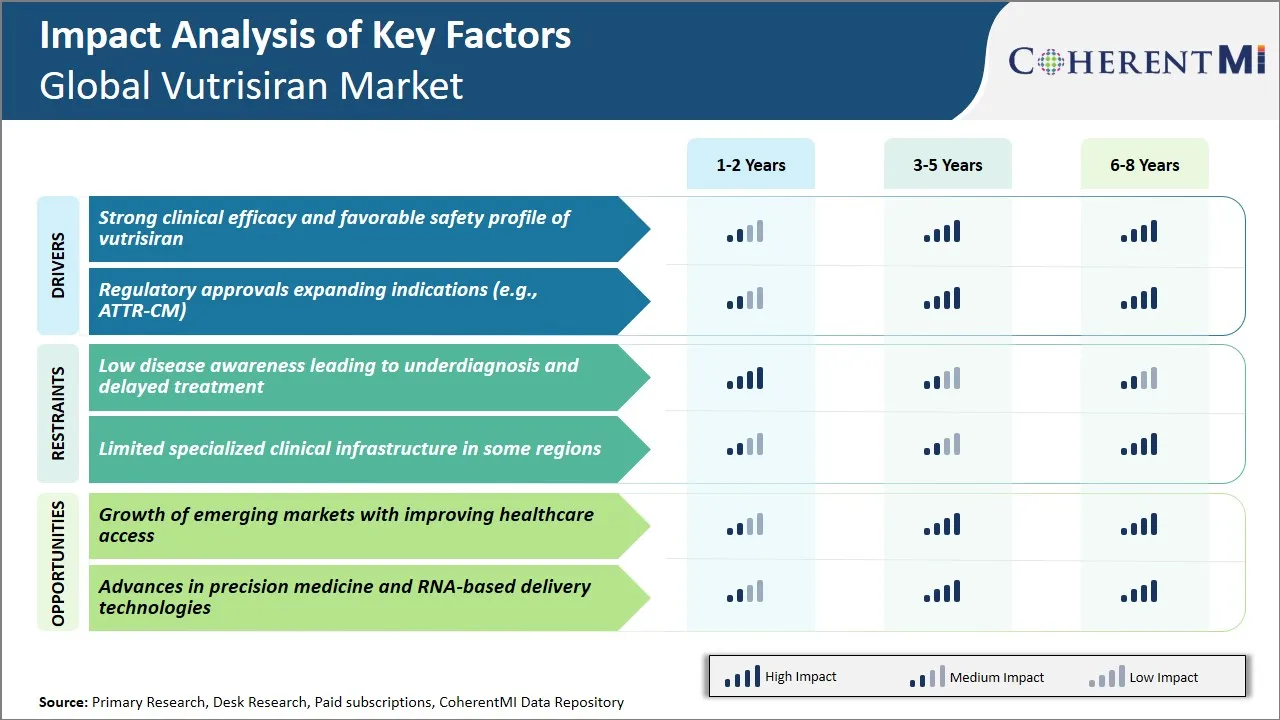
Global Vutrisiran Market Driver - Strong Clinical Efficacy and Favorable Safety Profile of Vutrisiran
The unprecedented clinical efficacy of vutrisiran has become one of the fundamental drivers that are driving the market, making the treatment a ground-breaking treatment option in patients with hereditary transthyretin-mediated amyloidosis. Its remarkable efficacy profile, evident in its extensive clinical trials, has entirely transformed the treatment landscape by providing the patients with a highly efficacious treatment intervention that considerably decelerates the progress of the disease and leads to better quality of life outcomes.
Clinical trials have also demonstrated that vutrisiran can produce significant and sustained lowering of disease-causing transthyretin protein levels, and patients would undergo significant amelioration of neurological function, a decrease in the evolution of neuropathy, and an increase in overall functional capability. The consistency of therapeutic effects of the therapy on a wide range of patients, has established it as a treatment option when compared to other treatment methodologies as it has been found to be able to effect changes in pathways of the disease in a manner that was not possible previously using standard treatment therapies.
For instance, in May 2025, secondary analyses conducted by the Journal of the American College of Cardiology as a part of Phase 3 HELIOS‑B trial reported that vutrisiran lowered the risk of cardiovascular mortality, hospitalizations for heart failure, urgent heart failure visits, and other CV events compared with placebo. In these analyses, reductions were consistent across multiple clinically relevant endpoints (e.g., ACM, CV mortality, HF hospitalizations), affirming broad cardiovascular benefit beyond the primary endpoint.
(Source- https://www.sciencedirect.com/science/article)
Global Vutrisiran Market Driver - Regulatory Approvals Expanding Indications and Market Access
The continued broadening of regulatory authorities in vutrisiran in various indications and geographic settings has offered previously unseen opportunities in the market that radically changed the therapeutic environment of patients with transthyretin-mediated amyloidosis and transtheoretic-related disorders. Global regulatory authorities have expressed remarkable trust in the therapeutic potential of vutrisiran through approvals of more and more uses of the drug, with the most notable of these being the means of treating transthyretin-mediated amyloid cardiomyopathy, which is a major expansion of the original indications of the drug in the neurological field.
This extension into the treatment of cardiomyopathy has been especially transformative, in that it covers previously underserved patient markets with few therapeutic options and expands vast new market segments, previously unreachable by targeted RNA interference therapies.
 To learn more about this report, Request Free Sample Copy
Global Vutrisiran Market Challenge - Low Disease Awareness Leading to Underdiagnosis and Delayed Treatment
There is a major hindrance in the global vutrisiran market due to insufficient disease awareness about hereditary transthyretin-mediated amyloidosis (hATTR), which has led to a high rate of underdiagnosis and a high rate of treatment delays. Medical staff, especially in primary care practices, tends to have low knowledge of the complex symptomology of hATTR, that is manifested in a variety of ways such as peripheral neuropathy, cardiomyopathy, and autonomic dysfunction.
This gap in knowledge generates a domino effect in the sense that patients go through long diagnostic journeys, which in most cases take several years before they are accurately diagnosed. The rarity of hATTR is further complicated by the heterogeneity in phenotype as well as by the overlap with more prevalent disorders, including idiopathic peripheral neuropathy or heart failure.
Global Vutrisiran Market Opportunity - Growth of Emerging Markets with Improving Healthcare Access
Countries in Asia Pacific, Latin America, and some African countries are undergoing unprecedented modernization in healthcare systems which has been marked by growing government spending on healthcare, growth of insurance coverage, and the creation of a tertiary care system with the capacity to handle complex genetic disorders such as hATTR amyloidosis.
This advancement of infrastructure is associated with the increased knowledge in managing rare diseases among physicians and the availability of more sophisticated diagnostic technology such as genetic testing capability, which is critical to the diagnosis of hATTR. Interestingly, most of the emerging markets are also experiencing the development of specialized amyliidosis centers and neurology units that have the required resources to diagnose and treat patients who need vutrisiran therapy.
For instance, emerging markets are home to a large share of the global population and a rapidly expanding middle class, which increases the demand for healthcare services, insurance, and advanced treatments. Rising incomes and urbanization are enabling more families to afford higher‑quality care, fueling market growth.
Segmental Analysis of Vutrisiran Market
 To learn more about this report, Request Free Sample Copy
Insights, By Indication: Hereditary Transthyretin-Mediated Amyloidosis’ Dominance is Driven by High Unmet Medical Needs and Established Clinical Evidence
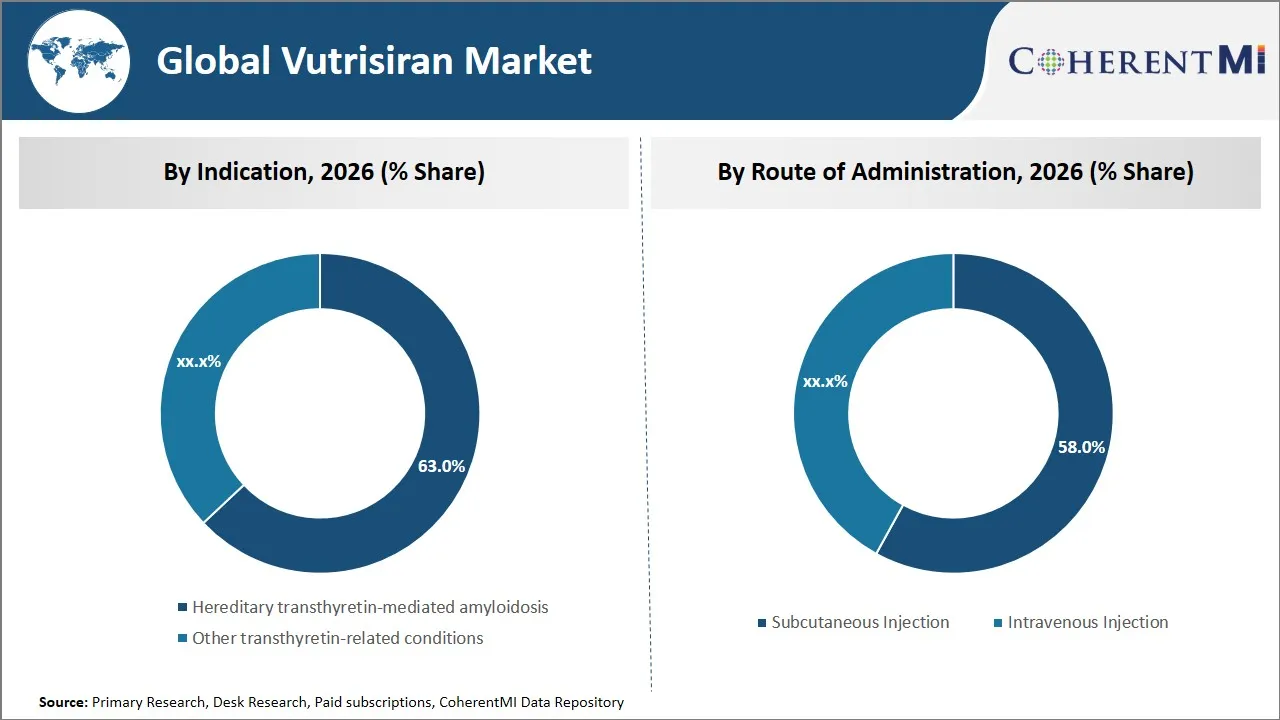
By indication, hereditary transthyretin-mediated amyloidosis takes the largest portion of the market with an estimated share of 63% in 2026, owing to substantial unmet medical needs and well-established clinical efficacy profile of vutrisiran in this therapeutic area. Hereditary transthyretin-mediated amyloidosis represents a devastating genetic disorder characterized by the progressive accumulation of misfolded transthyretin protein deposits in various organs, particularly affecting the nervous system and heart.
The main reasons behind the dominance of subcutaneous injection are patient autonomy and convenience, with this method allowing them to self-administer or have the procedure performed by trained caregivers at home. This feature decreases the number of visits to medical facilities to get treatment, which reduces the disturbance of the usual routine of patients and enhances the overall experience of the treatment. In patients with transthyretin-mediated amyloidosis, in whom mobility may be impaired and thus may cause fatigue, home-based treatment is a significant quality-of-life enhancement that promotes treatment initiation and adherence.
For instance, Alnylam Pharmaceuticals' vutrisiran (Amvuttra) significantly improved cardiac structure and function in ATTR-CM patients, according to data from the phase 3 HELIOS-B trial. The study demonstrated reduced mortality, fewer cardiovascular events, and improved quality of life, reinforcing its efficacy for both hereditary and wild-type forms of the disease.
(Source- https://investors.alnylam.com/press-release)
Insights, By Route of Administration: Subcutaneous Injection Route Leads Market Through Enhanced Patient Convenience and Treatment Adherence
By route of administration, subcutaneous injection takes the largest portion of the market with an estimated share of 58% in 2026, due to superior patient convenience, improved treatment adherence, and reduced healthcare system burden compared to alternative delivery methods. The subcutaneous administration route offers significant practical advantages that align with both patient preferences and healthcare delivery efficiency, making it the preferred choice for vutrisiran therapy across diverse clinical settings.
Patient autonomy and convenience serve as primary drivers for subcutaneous injection dominance, as this route enables self-administration or administration by trained caregivers in home settings. This capability reduces the frequency of healthcare facility visits required for treatment, minimizing disruption to patients' daily routines and improving overall treatment experience. For patients with transthyretin-mediated amyloidosis, who often experience mobility limitations and fatigue, the ability to receive treatment at home represents a substantial quality-of-life improvement that encourages treatment initiation and continuation.
Vutrisiran vs. Other ATTR Therapies: Efficacy, Convenience, and Market Position
- RNAi Vutrisiran, a quarterly subcutaneous injection, provides an alternative to patisiran, which needs every 3 weeks of IV injections. Its excellent clinical performance in terms of mortality reduction and enhancement functional capacity makes it a promising therapeutic option in the treatment of transthyretin amyloidosis, which competes with tafamidis, which has convinced the market since it could be taken orally and functioned effectively. The less common dosing of vutrisiran and gene-silencing action has its positive features, however, in patient convenience.
- Although there is a market leadership of tafamidis, the growth of vutrisiran is remarkable, particularly in polyneuropathy and cardiomyopathy indications. The improved safety profile of vutrisiran and the reduced administration burden compared to patisiran may motivate the latter to be one of the preferred treatment regimens in patients and health professionals.
Pricing, Reimbursement and Access Barriers
- Vutrisiran (marketed as Amvuttra) is highly priced, with an average list cost per year of about USD 476,000 to USD 572,000 annually (list price about 119,351 per quarterly dose × 4 doses = 235,468, annual economic assessment about 572,164 in certain health systems) higher than the cost of a drug dosage. These high prices and hence its cost effectiveness have led to questions by the public health technology assessment bodies regarding its cost effectiveness at list price and have led to price bargaining in the list price to bring it to the lowest cost reimbursement treatment which results in payer pressure on pricing conditions.
- Likewise, reimbursement schemes and patient access schemes are core to uptake, irrespective of pricing difficulty. In the U.S., coverage is frequently given with pre-authorization conditions and programs such as Alnylam Assist are used to reduce out of pocket expenses faced by the patients. The barriers to access are the complicated process of reimbursement navigation, potentially leading to delay in treatment, and the inconsistency in the coverage policy between different regions and payers. In publicly funded systems, access decisions are often based on cost-effectiveness evaluations and price negotiations. As a result, routine coverage may be delayed unless health economic outcomes are demonstrated or special offers are provided.
Additional Insights of Vutrisiran Market
- By indication, hereditary transthyretin-mediated amyloidosis is expected to hold the largest market share at 63% in 2026.
- In terms of route of administration, subcutaneous injection is expected to account for the highest share at 58% in 2026.
- Based on end user, the hospitals segment leads the market with an estimated share of 43% in 2026.
- North America is expected to lead the market, holding a share of 37% in 2026. Asia Pacific is anticipated to be the fastest-growing region, with 24% share in 2026.
Competitive overview of Vutrisiran Market
The major players operating in the Global Vutrisiran Market include Alnylam Pharmaceuticals Inc, Ionis Pharmaceuticals Inc, AstraZeneca plc, Pfizer Inc, Sanofi S.A, Novartis AG, Roche Holding AG, Regeneron Pharmaceuticals Inc, BridgeBio Pharma Inc, Moderna Inc, Intellia Therapeutics Inc, Prothena Corporation plc, SomaLogic Inc, Bristol‑Myers Squibb Company, and Eli Lilly and Company.
Vutrisiran Market Leaders
- Alnylam Pharmaceuticals Inc
- Ionis Pharmaceuticals Inc
- AstraZeneca plc
- Pfizer Inc
- Sanofi S.A
Recent Developments in Vutrisiran Market
- In March 2025, the U.S. FDA approved Alnylam’s RNAi therapy vutrisiran (Amvuttra) for treating cardiomyopathy associated with wild‑type or hereditary transthyretin amyloidosis (ATTR‑CM) in adults, reducing cardiovascular mortality, hospitalizations, and urgent heart failure visits — marking its expanded indication beyond polyneuropathy.
- In September 2025, new analyses from the HELIOS‑B Phase 3 study showed vutrisiran treatment was associated with 37-49% lower rates of gastrointestinal events in ATTR‑CM patients compared with placebo, reinforcing its safety and quality‑of‑life impact.
- In October 2025, Alnylam Pharmaceuticals reported Q3 2025 financial results, highlighting robust global net product revenues for AMVUTTRA (vutrisiran) and continued broad adoption across patient segments.
- In June 2025, the European Commission granted approval for Amvuttra (vutrisiran) to treat wild‑type or hereditary transthyretin amyloidosis with cardiomyopathy in adults, expanding its regulatory footprint beyond the U.S.
Vutrisiran Market Segmentation
- By Indication
- Hereditary transthyretin-mediated amyloidosis
- Other transthyretin-related conditions
- By Route of Administration
- Subcutaneous Injection
- Intravenous Injection
- By Age Group
- Adult
- Pediatric
- Neonatal
- By End User
- Hospitals
- Clinics
- Homecare Settings
- By Distribution Channel
- Online
- Offline

Would you like to explore the option of buying individual sections of this report?
Ghanshyam Shrivastava - With over 20 years of experience in the management consulting and research, Ghanshyam Shrivastava serves as a Principal Consultant, bringing extensive expertise in biologics and biosimilars. His primary expertise lies in areas such as market entry and expansion strategy, competitive intelligence, and strategic transformation across diversified portfolio of various drugs used for different therapeutic category and APIs. He excels at identifying key challenges faced by clients and providing robust solutions to enhance their strategic decision-making capabilities. His comprehensive understanding of the market ensures valuable contributions to research reports and business decisions.
Ghanshyam is a sought-after speaker at industry conferences and contributes to various publications on pharma industry.