Finasteride Market SIZE AND SHARE ANALYSIS - GROWTH TRENDS AND FORECASTS (2026 - 2033)
Finasteride Market is segmented By Type (Branded, Generic, Branded Generic), By Route of Administrat...
Finasteride Market Size - Analysis
The Global Finasteride Market is estimated to be valued at USD 462.3 Mn in 2026 and is expected to reach USD 713.7 Mn by 2033, exhibiting a compound annual growth rate (CAGR) of 6.4% from 2026 to 2033. This substantial market expansion reflects the increasing global prevalence of androgenetic alopecia and benign prostatic hyperplasia, coupled with rising consumer awareness about available treatment options.
The market's steady growth trajectory is further supported by expanding healthcare infrastructure in emerging economies, growing geriatric population worldwide, and increasing disposable income levels that enable greater access to pharmaceutical treatments for hair loss and prostate conditions.
Market Size in USD Mn
CAGR6.4%
| Study Period | 2026 - 2033 |
| Base Year of Estimation | 2025 |
| CAGR | 6.4% |
| Market Concentration | Medium |
| Major Players | Merck & Co., Inc, Teva Pharmaceutical Industries Ltd, Sandoz (Novartis subsidiary), Viatris (Mylan), Sun Pharmaceutical Industries Ltd and Among Others |

please let us know !
Finasteride Market Trends
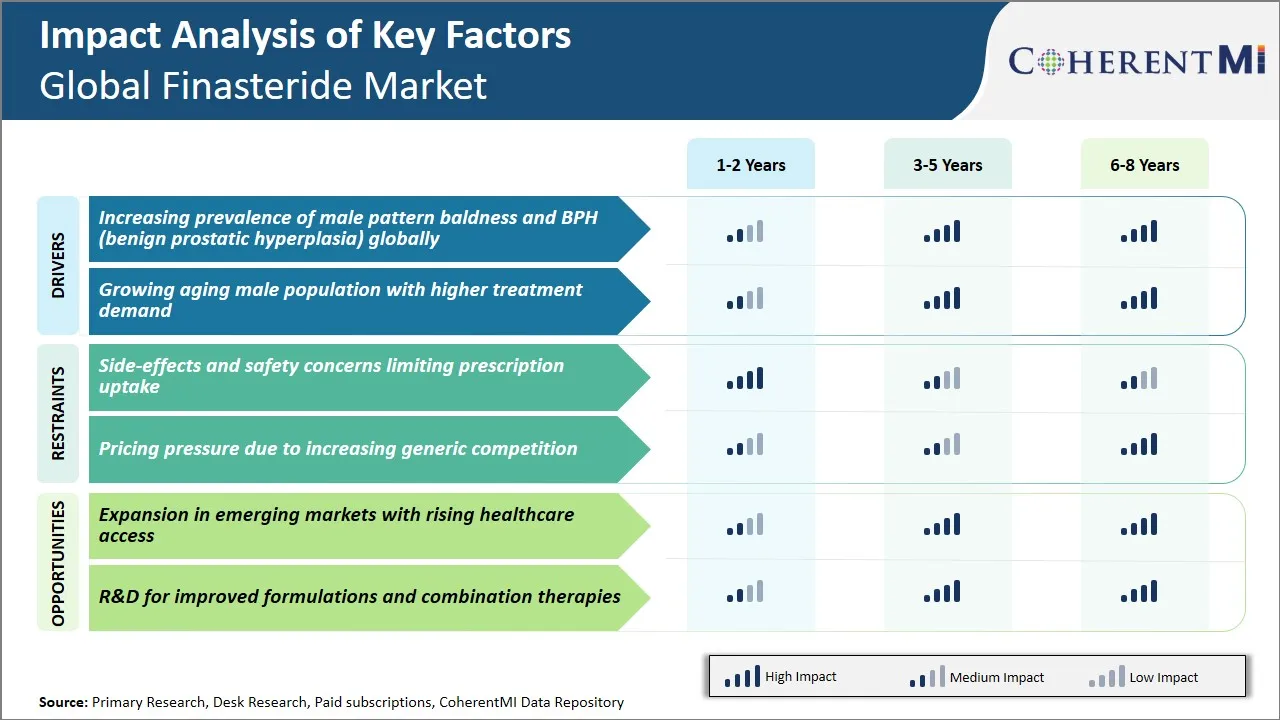
Global Finasteride Market Driver - Increasing Prevalence of Male Pattern Baldness and Benign Prostatic Hyperplasia (BPH) Globally
The healthcare environment worldwide is experiencing a high rate of the onset of androgenetic alopecia (or male pattern baldness) as well as benign prostatic hyperplasia, and this offers huge market potential to finasteride-based products. A large percentage of adult men in the world have male pattern baldness, and the disease occurs in the form of a progressive pattern of hair loss, which usually starts with a receding hairline and thinning of the crown.
This is an inheritable disorder primarily caused by the fact that testosterone is converted to dihydrotestosterone (DHT) by the action of 5-alpha reductase enzyme, and therefore finasteride is an appropriate therapeutic intervention in that it acts by inhibiting 5-alpha reductase. The growing awareness and diagnosis of the condition in the various geographical locations especially in the developing economies where healthcare awareness is fast growing has also helped to increase the number of patients who are seeking good treatment solutions.
For instance, it is estimated that over 50% of men will experience some degree of Male Pattern Baldness (MPB) by the age of 50. The condition is mainly influenced by genetics and testosterone levels, leading to hair thinning or complete baldness.
(Source- https://www.ncbi.nlm.nih.gov/books)
Global Finasteride Market Driver - Growing Aging Male Population with Higher Treatment Demand
The aging global population is a key factor shaping the finasteride market, as both androgenetic alopecia and benign prostatic hyperplasia become more prevalent and severe with advancing age. This population shift is taking place not only in the developed countries but also in the developing ones forming a growing patient base with increased healthcare requirements and expectations of treatment.
Aging in men is accompanied by major hormonal changes such as the changes in the testosterone metabolism and the heightened sensitivity to the effect of dihydrotestosterone, which are especially vulnerable to the older demographics. Gradually increased effects of genetic inclination, environmental and hormonal changes become increasingly evident as men enter the middle age and old age, which is why pharmaceutical interventions are necessary to keep the quality of life and consider age-related health issues.
 To learn more about this report, Request Free Sample Copy
Global Finasteride Market Challenge - Side‑effects and Safety Concerns Limiting Prescription Uptake
The international finasteride market is undergoing a lot of headwinds in terms of increasing awareness and concerns of possible adverse effects which is having a great effect on the prescription rates and patient compliance. The clinical trials and post-marketing surveillance reports have reported a number of side effects including the more common ones like reduced libido, erectile dysfunctions and ejaculation disorders and the more contentious ones such as chronic sexual dysfunction, depression, and cognitive deficits.
The appearance of Post- Finasteride Syndrome (PFS) when people experience the same sexual, neurological, and psychological symptoms even after stopping the use, has created a lot of controversy in the medical community and among the patients themselves. U.S. Food and Drug Administration and European Medicines Agency have required more safety warnings and labeling changes, which have increased physician apprehension to prescribe finasteride. This regulatory pressure has made the prescribing environment more conservative and healthcare providers are increasingly seeking alternative treatment or they are demanding greater patient counseling before they can prescribe a treatment.
Global Finasteride Market Opportunity - Expansion in Emerging Markets with Rising Healthcare Access
The global finasteride market presents substantial growth opportunities through strategic expansion into emerging markets, where improving healthcare infrastructure and increasing disposable incomes are creating favorable conditions for pharmaceutical market penetration. Also witnessed are countries in Asian Pacific, Latin America, and even some parts of Africa which are undergoing rapid economic growth leading to growing middle-class populations with more healthcare spending power and with heightened awareness about cosmetic and wellness products.
The increasing accessibility of prescription drugs by the government through attempts such as the implementation of universal health care and the improvement of insurance coverage is rendering prescription drugs affordable and accessible to the wider segments of the population. The population composition of these new markets is also exceptionally favorable, whereby huge populations are entering the optimal age brackets to treat male pattern baldness, as aesthetic consciousness increases, yet stigma about cosmetic medical procedures also declines.
For instance, emerging markets are increasingly seen by investors as critical growth zones, especially in sectors like healthcare, technology, and consumer goods. These regions—primarily in Asia, Africa, Latin America, and parts of Eastern Europe—are undergoing rapid transformations driven by several key factors, including expanding infrastructure, rising demand for advanced technologies, and underpenetrated service layers.
Segmental Analysis of Finasteride Market
 To learn more about this report, Request Free Sample Copy
Insights, By Type: Brand Trust and Physician Preference Drive Branded Finasteride Market Dominance
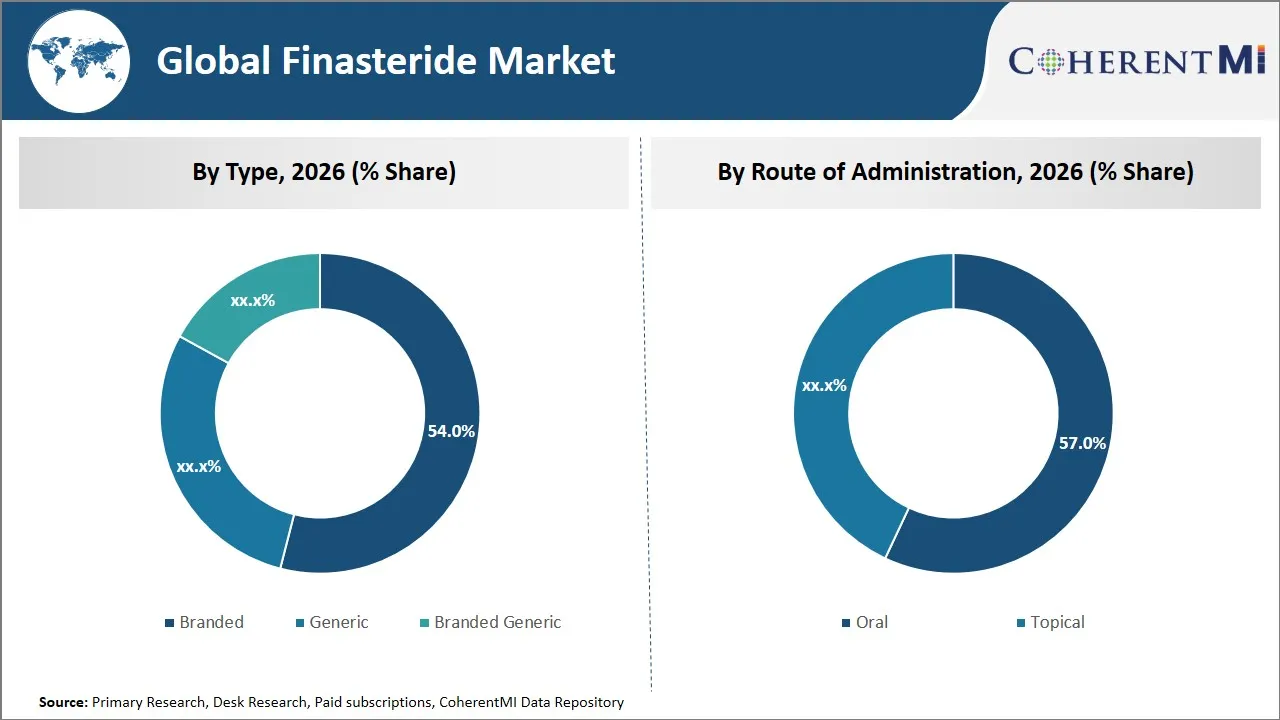
By type, the branded segment holds the largest portion of the market with an estimated share of 54% in 2026, owing to the strong physician confidence in established pharmaceutical brands and patient preference for proven therapeutic options. The dominance of branded finasteride products stems from several interconnected factors that reinforce their market position across both androgenetic alopecia and benign prostatic hyperplasia treatment segments.
Prescription patterns by physicians give a high preference to branded preparations of finasteride based on the numerous clinical trials with successful outcomes, and the long safety profiles available through original manufacturers. This is because medical practitioners will be more confident in prescribing branded versions especially on sensitive conditions such as male pattern baldness where the result of treatment directly affects the quality of life of the patient.
For instance, branded finasteride formulations (e.g., Propecia for hair loss and Proscar for BPH) continue to capture a major share of the global finasteride market, largely because physicians and patients associate established brands with longer clinical histories and perceived reliability.
(Source- https://onlinedoctor.superdrug.com/finasteride-vs-propecia)
Insights, By Route of Administration: Convenience and Bioavailability Advantages Fuel Oral Route’s Dominance
By route of administration, the oral segment takes the largest portion of the market with an estimated share of 57% in 2026, owing to superior patient convenience, established pharmacokinetic profiles, and comprehensive clinical evidence supporting systemic finasteride administration. The dominance of oral formulations reflects fundamental advantages in drug delivery, patient compliance, and therapeutic effectiveness across both androgenetic alopecia and benign prostatic hyperplasia treatment applications.
The convenience of the patient and the ease of treatment is one of the key factors advocating oral route in finasteride therapy. Oral delivery removes complicated application protocols of topical therapy preventing the burden of treatment per day, and enhancing the adherence rates of treatment in the long term.
For instance, from a pharmacokinetic perspective, oral bioavailability and predictable plasma levels support its efficacy across indications, encouraging physician preference for this route. The relatively straightforward drug absorption profile and convenience of oral dosing reinforce its dominance in both clinical practice and consumer adoption compared with alternative delivery methods.
(Source- https://www.ncbi.nlm.nih.gov/books/NBK513329/?utm)
Trends in Distribution, Demographics, and Prescribing Behavior in the Finasteride Market
- Distribution Channel Development & Demographics of the Patients
Finasteride distribution is also becoming more decentralized to online pharmacies and telehealth, which offer a higher level of access and particularly in rural and emerging markets. The use of digital consultations to obtain male pattern baldness treatment is on the rise among young men (20-30 years). Physical pharmacies still hold significance, yet the direct-to-consumer delivery is becoming popular.
- Prescription of Behavior and Adherence Patterns
Finasteride is mostly used by middle age men (30-60 years) although there is an increase in demand from younger adults. Telehealth has also enhanced the adherence process through continuous follow-ups. Finasteride is used among older groups (60 and above years) in the treatment of age-related thinning, but side effects can affect compliance.
Impact of E-commerce on Finasteride Market Distribution and Consumer Access
- Widening the Use of E-commerce in the Finasteride market
Distribution of finasteride has changed due to the emergence of online pharmacy which is a leading avenue of acquiring the drug as a result of e-commerce. The change is highly motivated by the comfort and privacy that e-commerce provides to the patients since they can now obtain hair loss medicines such as finasteride without having to go to the physical outlets. The growing credibility of online prescriptions and telehealth nomenclature has increased access to finasteride especially in rural and underserved areas, and men find it easier to treat male pattern baldness and benign prostatic hyperplasia (BPH).
- E-commerce Development and Trends
Direct to consumer models have become more popular as the market has rapidly developed in the context of e-commerce, which has gained popularity. Online prescriptions of finasteride with subsequent delivery to the patient are becoming popular with many patients. The growing digital literacy, the availability of convenient payment methods and subscription services that allow constant supply contribute to this trend, which leads to a higher adherence level. As other sites provide comparable prices, the cost and availability of finasteride have increased significantly and many buyers choose it over others.
Additional Insights of Finasteride Market
- By type, branded is expected to hold the largest market share at 54% in 2026.
- In terms of route of administration, oral is expected to account for the highest share at 57% in 2026.
- Based on indication, the male pattern baldness (androgenetic alopecia) segment leads the market with an estimated share of 63% in 2026.
- North America is expected to lead the market, holding a share of 42% in 2026. Asia Pacific is anticipated to be the fastest-growing region, with 26% share in 2026.
Competitive overview of Finasteride Market
The major players operating in the Global Finasteride Market include Merck & Co., Inc, Teva Pharmaceutical Industries Ltd, Sandoz (Novartis subsidiary), Viatris (Mylan), Sun Pharmaceutical Industries Ltd, Cipla Ltd, Dr. Reddy’s Laboratories Ltd, Cerata Pharmaceuticals LLP, Aurobindo Pharma Ltd, Curia (formerly Albemarle/Nalco), DEAFARMA, Nishchem International Pvt. Ltd, Pure Chem India, Horster Life Science, and Welox Pharma Private Limited.
Finasteride Market Leaders
- Merck & Co., Inc
- Teva Pharmaceutical Industries Ltd
- Sandoz (Novartis subsidiary)
- Viatris (Mylan)
- Sun Pharmaceutical Industries Ltd
Recent Developments in Finasteride Market
- Sun Pharmaceutical Industries - Sun Pharmaceutical Industries has a market share of about 7% of the world finasteride market with a solid presence in India, the U.S. and some of the fast-growing emerging markets. Its generic product and competitively priced products combined with its urology and dermatology franchises growing are contributing to the growth of the company. Specialization in dermatology and especially specialty and aesthetic dermatology is likely to increase demand of finasteride directly via hair-loss treatment.
- Merck & Co.- Merck have got a strong branded legacy of finasteride in BPH and alopecia with approximately 16% worldwide share. This motivation can be attributed to the medical branding and market safety-proven products of Merck that contributes to the effectiveness of Merck on financial sustain revenues.
Finasteride Market Segmentation
- By Type
- Branded
- Generic
- Branded Generic
- By Route of Administration
- Oral
- Topical
- By Indication
- Male Pattern Baldness (Androgenetic Alopecia)
- Benign Prostatic Hyperplasia (BPH)
- By Dosage Form
- Tablets
- Spray
- Solution
- Others (Gel, etc.)
- By Formulation Regimen
- Monotherapy
- Combination Therapy
- By Distribution Channel
- Online
- Offline
- By End User
- Hospitals
- Specialty clinics
- Others (Homecare Settings, etc.)

Would you like to explore the option of buying individual sections of this report?
Ghanshyam Shrivastava - With over 20 years of experience in the management consulting and research, Ghanshyam Shrivastava serves as a Principal Consultant, bringing extensive expertise in biologics and biosimilars. His primary expertise lies in areas such as market entry and expansion strategy, competitive intelligence, and strategic transformation across diversified portfolio of various drugs used for different therapeutic category and APIs. He excels at identifying key challenges faced by clients and providing robust solutions to enhance their strategic decision-making capabilities. His comprehensive understanding of the market ensures valuable contributions to research reports and business decisions.
Ghanshyam is a sought-after speaker at industry conferences and contributes to various publications on pharma industry.