Flavored Whiskey Market SIZE AND SHARE ANALYSIS - GROWTH TRENDS AND FORECASTS (2026 - 2033)
Flavored Whiskey Market is segmented By Type (Bourbon, Scotch, Malted, Blended, Others), By Flavor T...
Flavored Whiskey Market Size - Analysis
The global flavored whiskey market is estimated to be valued at USD 33.61 Bn in 2026 and is expected to reach USD 55.76 Bn by 2033, exhibiting a compound annual growth rate (CAGR) of 7.5% from 2026 to 2033. This robust growth trajectory reflects the increasing consumer appetite for premium and innovative alcoholic beverages, particularly among millennials and Gen-Z demographics who seek unique flavor experiences and artisanal products that differentiate from traditional whiskey offerings.
Market Size in USD Bn
CAGR7.5%
| Study Period | 2026 - 2033 |
| Base Year of Estimation | 2025 |
| CAGR | 7.5% |
| Market Concentration | Medium |
| Major Players | Diageo plc, Brown-Forman Corporation, Pernod Ricard S.A., Beam Suntory, Inc., Crown Royal and Among Others |

please let us know !
Flavored Whiskey Market Trends
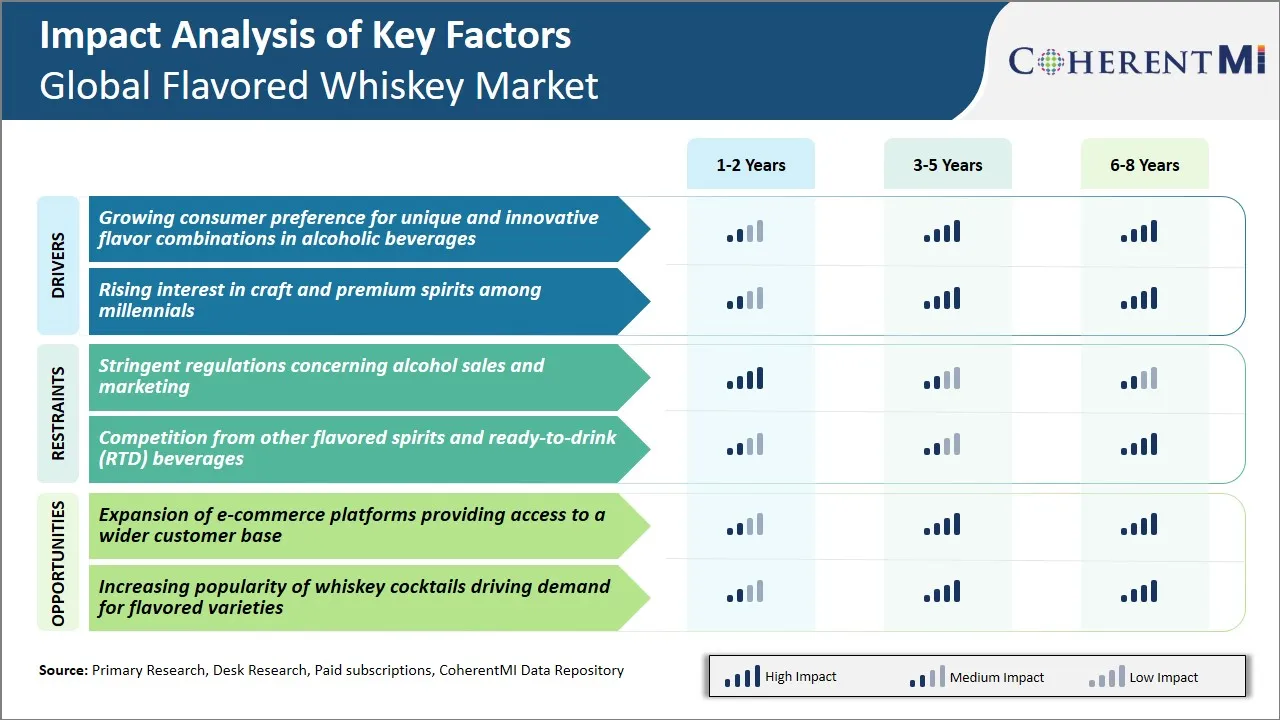
Market Driver - Growing Consumer Preference for Unique and Innovative Flavor Combinations in Alcoholic Beverages
The flavored whiskey market in the world is on an unmatched wave due to the changing palate of consumers and their growing need to have unique tastes to differentiate them off the usual whiskey product in the market. Consumers in today’s world, especially in urban markets and younger groups of consumers, are aggressively pursuing alcohol brands that offer memorable sensory experiences above the traditional grain-based profiles of traditional whiskeys. This change is one of the most paradigm shifts in the consumer behavior where experimentation and novelty are now primary factors of purchase and flavored versions, adding honey and vanilla to more exotic blends like cinnamon spice, maple, and even fruit-based directions like apple, cherry and peach, are now widely accepted.
The rise in the number of flavored whiskey products is a positive indication of a larger cultural trend toward food adventuring and culinary experimentation, in which consumers perceive their beverage purchasing decisions as a continuation of their personality and lifestyle inclinations. This has been most evident in the markets that had historically low levels of whiskey consumption, which flavor additions are a convenient point of entry to the market by consumers who would otherwise consider straight whiskey too harsh or learned.
Market Driver - Rising Interest in Craft and Premium Spirits Among Millennials
The influence of the millennial generations on the alcoholic drink sector has been especially drastic towards the flavored whiskey segment since this age group has persistently shown readiness to spend on high-quality and craft drinks that meet their attitudes of genuineness, quality as well as significant brand experiences.
Contrary to the past generations where value and brand recognition were highly valued, millennials have a very different attitude towards purchasing spirits, which focuses on provenance, production methods, and the narrative behind the brand, which leaves craft distilleries and producers of premium flavored whiskey with a fertile market profile to develop meaningful market presence. This generation difference is not a mere shift in tastes, but rather a radical redefinition of the role to which alcoholic beverages are assigned in the lifestyle decision-making process, socialization, and the expression of personal identity, and the millennials are considering their spirit purchasing as an investment in experience and not simply a subject to find a product to buy.
 To learn more about this report, Request Free Sample Copy
Market Challenge - Stringent Regulations Concerning Alcohol Sales and Marketing
The international flavored whiskey market is experiencing strong head winds which are manifested in increasingly difficult and limiting regulatory systems of alcohol sales and marketing in major jurisdictions. Tight labeling and age certification standards, and advertising restrictions by regulatory agencies like the TTB in the U.S., CDSCO in India, and other European authorities have established significant compliance load on manufacturers and distributors.
The difference in these regulations across the markets is drastic, as certain nations have absolute prohibitions on alcohol advertising, whereas others limit marketing efforts to particular hours, or the likes. The whiskey flavor market is under extra scrutiny since it is being feared that flavored variants are more likely to attract young consumers, and thus more regulatory control might be implemented over the segment and flavor profile limitations may occur. The complexity of cross-border trade is also caused by the variation in alcohol content laws, packaging, and licensing of imports, which are imposing a big burden on the expenses of operation and entry into the market.
Market Opportunity - Expansion of E-commerce Platforms Providing Access to a Wider Customer Base
The fast growth of e-commerce platforms is a game-changing business prospect to the flavored whiskey producers in increasing their market size and capacity to connect with customers tremendously. E-commerce facilitates direct-to-consumer, which avoids the use of traditional three-level distribution channels, and provides the brand with an opportunity to achieve higher margins with direct customer relationships using personalized marketing and subscription platforms.
Trade Discount & Promotional Spend Impact
|
Metric |
Description |
Impact on Flavored Whiskey Market |
|
Trade Discounts |
Discounts offered by whiskey producers to distributors or retailers for bulk purchases or to incentivize sales. |
Helps increase sales volume through attractive pricing for retailers. |
|
Promotional Spend |
Money spent on marketing campaigns, advertising, sponsorships, and events to raise brand awareness. |
Increases consumer awareness and brand visibility. Drives consumer demand, especially in highly competitive markets. |
|
Impact on Consumer Demand |
Reflects how discounts and promotional activities influence consumer purchasing behavior. |
Temporary sales spikes during promotions. Attracts new customers who are price-sensitive or seeking a deal. |
|
Retailer Margins |
The profit margin retailers make after the discount is applied. |
Higher trade discounts reduce the margin for retailers but can drive higher sales volume. |
Key winning strategies adopted by key players of Flavored Whiskey Market
- Product Innovation: Major Brands are constantly coming up with new and distinctive flavored whiskey brands to suit the changing consumer tastes. As an example, Jack Daniels launched a range of flavored whiskeys, such as Honey and Apple, to meet the increased need of new flavors and brand image interest.
- Market Expansion: The companies are in the process of expanding their market, particularly in other emerging markets such as Asia Pacific that are experiencing increasing demand for premium spirits. Diageo used this to expand its presence in India by introducing new flavored whiskey products that are optimized to meet the tastes and preferences of the Indian market to tap into the growing middle class.
- Sustainability Focus: Sustainability is one of the core ideas, as brands start to become more environmentally friendly and eco-packaged. As an example, Crown Royal launched a series of flavored whiskey bottles made of recycled bottle materials, and the producers of flavored whiskey are also concerned about acquiring environmentally-friendly ingredients and minimizing carbon footprints during their manufacturing.
Segmental Analysis of Flavored Whiskey Market
 To learn more about this report, Request Free Sample Copy
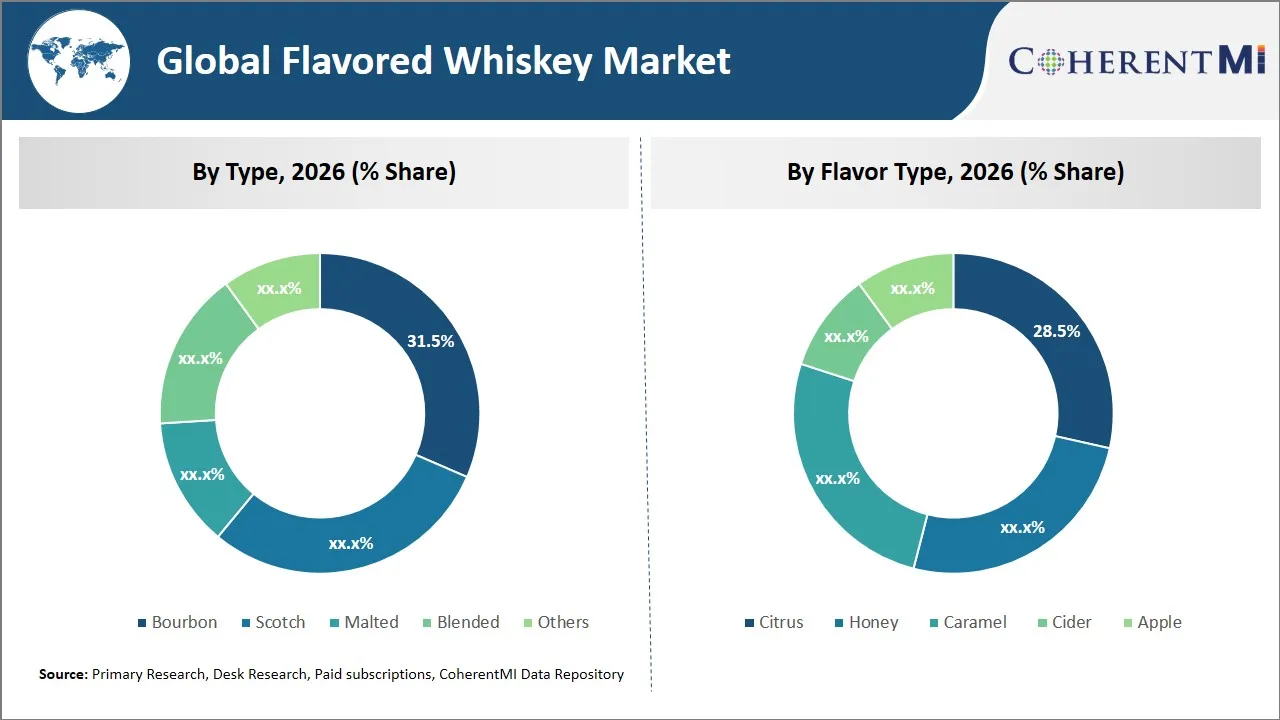
Insights, By Type – Bourbon Segment Dominates the Market Due to American Heritage and Premium Positioning
Bourbon segment is expected to contribute 31.5% of the market share in 2026, owing to its deeply rooted American heritage and the successful transition of traditional bourbon distilleries into the flavored whiskey segment. Bourbon has conquered the world flavored whiskey market due to a number of factors that have been intertwined to make it a strong platform to lead the market.
The aspect of authenticity is a very important element in the market dominance of bourbons. Bourbon being the native spirit of America has the intrinsic credibility and prestige which easily connects with consumers who demand authenticity. This authenticity will be especially important in the flavored whiskey category, where the users tend to doubt the authenticity of the artificially enhanced spirits. Bourbons controlled the level of production such as new charred oak barrels and particular grain bill formulations give the quality assurance to the premium consumers who are actively pursued.
Insights, By Flavor Type - Citrus Segment Dominates the Market Due to Refreshing Appeal and Mixability
Citrus segment is expected to contribute 28.5% of the market share in 2026, because of its universalness and outstanding versatility both in neat use and cocktail use. The over-powering presence of citrus flavoring in the flavored whiskey market worldwide is a portrayal of basic consumer tastes in refreshing and friendly flavor profiles that complement but do not suppress the underlying whiskey personality.
The accessibility factor drives citrus flavoring to market leadership position. Unlike more acquired tastes such as cocoa, smoky, or herbal profiles, citrus flavors provide immediate palatability for consumers transitioning from other spirit categories or those new to whiskey consumption entirely. Orange, lemon, and lime flavoring creates familiar taste experiences that reduce the intimidation factor often associated with traditional whiskey consumption, particularly among younger demographics and female consumers.
Additional Insights of Flavored Whiskey Market
- North American markets lead flavored whiskey industry because customers prefer high-quality craft spirits. The region's established whiskey traditions together with its growing demand for new and flavored products enable it to maintain its status as the top whiskey market worldwide.
- Health-conscious consumers drive product development because they want flavored whiskey products with lower alcohol content and reduced sugar and natural ingredients. Manufacturers create health-oriented beverages which preserve whiskey's deep and intricate tastes that consumers prefer.
- Flavored whiskey carries health advantages because consumers increasingly choose products which provide health benefits and wellness results. Brands promote these advantages which drive the trend of flavored whiskey as a premium yet functional drink that provides indulgence.
Competitive overview of Flavored Whiskey Market
The major players operating in the global flavored whiskey market include Diageo plc, Brown-Forman Corporation, Pernod Ricard S.A., Beam Suntory, Inc., Crown Royal, Sazerac Company, Inc., Bacardi Limited, Jefferson’s Bourbon, New Amsterdam Spirits, MGP Ingredients, Inc., William Grant & Sons Ltd., and Radico Khaitan Ltd.
Flavored Whiskey Market Leaders
- Diageo plc
- Brown-Forman Corporation
- Pernod Ricard S.A.
- Beam Suntory, Inc.
- Crown Royal
Recent Developments in Flavored Whiskey Market
- In October 2024, Bacardi Limited, a global leader in the alcoholic beverage industry, announced a strategic investment to support the future production of both blended and single malt whiskeys.
- In August 2025, Crown Royal unveiled its latest flavor, Crown Royal Chocolate Flavored Whisky. This limited-edition blend combines carefully selected Crown Royal whiskies with rich chocolate flavor for a velvety finish that pairs in ways you might not expect. Aromas of vanilla, creamy chocolate and oak open each sip, leading to delicate hints of caramel and toffee on the palate and finishing with lingering notes of dark cacao and Crown Royal's unmistakable smoothness.
Flavored Whiskey Market Segmentation
- By Type
- Bourbon
- Scotch
- Malted
- Blended
- Others
- By Flavor Type
- Citrus
- Honey
- Caramel
- Cider
- Apple
- By Distribution Channel
- Modern Store Formats
- Hypermarket/Supermarket
- Departmental Stores
- Liquor Stores
- Traditional Store Formats
- Food & Drink Specialty Stores
- Independent Liquor Stores
- Others (Convenience Stores, Duty-Free Shops, Kiosks)
- E-commerce
- Modern Store Formats

Would you like to explore the option of buying individual sections of this report?
Sakshi Suryawanshi is a Research Consultant with 6 years of extensive experience in market research and consulting. She is proficient in market estimation, competitive analysis, and patent analysis. Sakshi excels in identifying market trends and evaluating competitive landscapes to provide actionable insights that drive strategic decision-making. Her expertise helps businesses navigate complex market dynamics and achieve their objectives effectively.