Couscous Market SIZE AND SHARE ANALYSIS - GROWTH TRENDS AND FORECASTS (2026 -2033)
Couscous Market is segmented By Product Type (Moroccan Couscous, Israeli (Pearl) Couscous, Lebanese ...
Couscous Market Size - Analysis
The global couscous market is estimated to be valued at USD 1.95 Bn in 2026 and is expected to reach USD 3.15 Bn by 2033, exhibiting a compound annual growth rate (CAGR) of 7.1% from 2026 to 2033. This robust growth trajectory reflects the increasing global adoption of Mediterranean and Middle Eastern cuisines, coupled with rising health consciousness among consumers seeking nutritious whole grain alternatives.
Market Size in USD Bn
CAGR7.1%
| Study Period | 2026 -2033 |
| Base Year of Estimation | 2025 |
| CAGR | 7.1% |
| Market Concentration | Medium |
| Major Players | Ainsley Harriott, Belazu Ingredient Company, Bia S.p.A., Bob's Red Mill Natural Foods, Dari and Among Others |

please let us know !
Couscous Market Trends
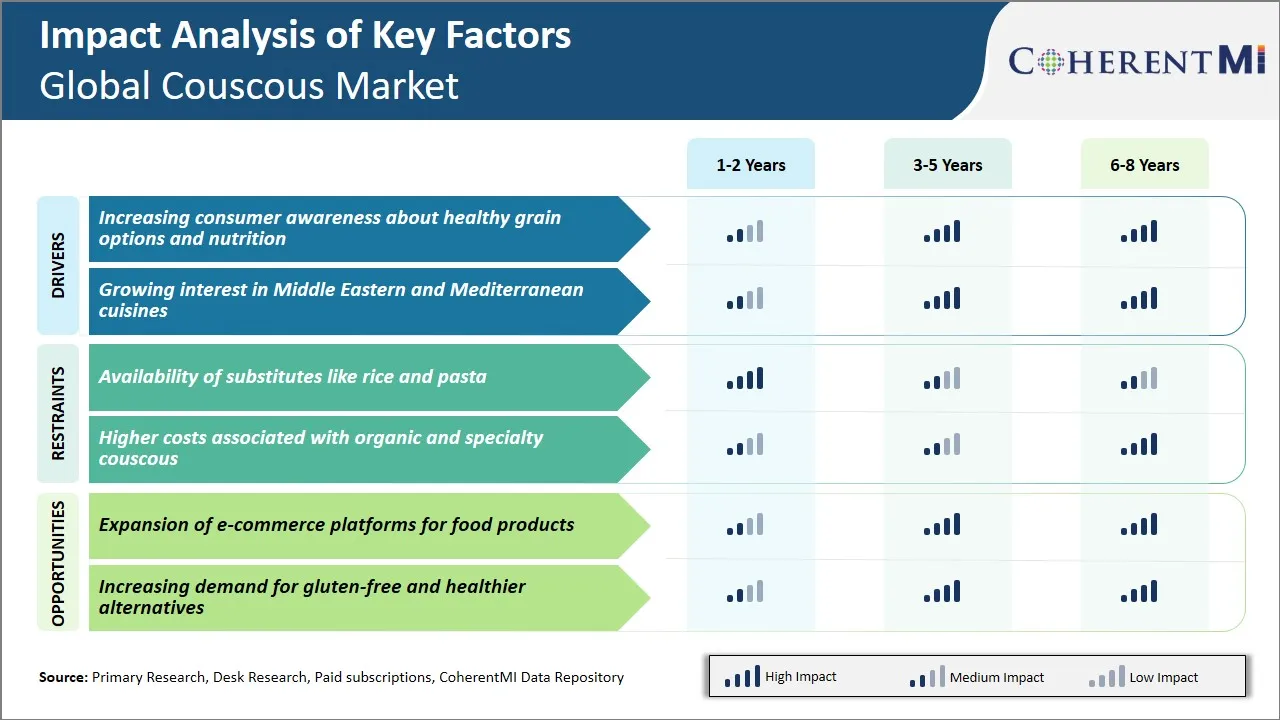
Market Driver - Increasing Consumer Awareness About Healthy Grain Options and Nutrition
The modern food environment has seen an unprecedented shift in consumer awareness when it comes to food consumption and the couscous has been a winner of this increased awareness over healthy grains consumption. The contemporary consumer is becoming more critical of food labels and demanding products that can fit in their health-conscience product selections and shunning highly processed foods, green food in favor of whole grains and nutrient-dense products. The couscous especially whole wheat varieties have overtaken the market by health conscious consumers who have found its high nutritional value over refined grains and the conventional pasta products. This trend is an essential alteration in the dietary trend with the large amount of research that has been done pointing to the advantages of adding the variety of grains to the daily nutrition, vitamin ingredients programs.
Market Driver - Growing Interest in Middle Eastern and Mediterranean Cuisines
The global culinary landscape has experienced an unprecedented expansion of interest in Middle Eastern and Mediterranean cuisines, with couscous serving as a gateway ingredient that introduces consumers to the rich flavors and cooking traditions of these regions. Such an interest can be attributed to several issues such as the expanding cultural exchange via travel, immigration, and exposure to digital media that have all contributed to the opening of the palates and demand of genuine international ingredients. The number of restaurants serving Mediterranean and Middle Eastern cuisines has increased in leading metropolitan regions across the world which have exposed people to the conventional ways of preparing couscous that reveal its versatility and cultural importance. The fact that these establishments have succeeded has been a ripple effect, whereby home cooks are tempted to replicate such meals in their kitchens hence retailing couscous and its products.
 To learn more about this report, Request Free Sample Copy
Market Challenge - Availability of Substitutes Like Rice and Pasta
The couscous market in the world has a high competitive threat of the established carbohydrate substitutes, especially rice and pasta, which present a strong challenge to market penetration. As one of the staple foods of more than a half of the world population, rice is closely connected with cultures and accepted by a large number of people living in various geographic areas. Its competitiveness, longer shelf life as well as its cost-effectiveness make it a strong formidable competitor particularly in the price-sensitive markets of Asia Pacific, Africa and Latin America. Pasta has also experienced an unprecedented international market penetration going beyond its sister regions in the Mediterranean to a global household commodity with massive market campaigns, product differentiation and distribution networks.
The problem is further aggravated by consumer knowledge and cooking skills in relation to these alternatives. Though couscous has excellent nutritional values and convenience in cooking, most consumers, especially in new market economies, do not know how to prepare and to use it in cooking. The rice and pasta enjoy the advantage of the expertise of generations of cooking and are associated with the proven traditions of recipes which form the stable consumer loyalty and the habit of returning to the purchase. Also these substitutes tend to have economies of scale of production and distribution, allowing them to price them competitively against couscous products.
Market Opportunity - Digital Commerce Transformation Driving Market Accessibility
The quick growth of online food product distribution systems creates an opportunity of transformation of the global couscous production and marketing industry to break the habitual distribution barriers and reach otherwise closed consumer demographics. The digital marketplace has radically changed the food purchasing patterns, especially due to the COVID-19 pandemic, in which online grocery purchases are showing unprecedented growth rates of over 50% in most developed markets. This change puts couscous manufacturers in a favorable position to create a direct to consumer relationship circumventing the influence of the traditional retail gatekeepers who might be allocating less shelf space to specialty grains.
E-commerce sites will allow couscous companies to use advanced targeting methods, accessing healthy as well as ethnic and gastronomic users who are interested in alternative grain options but might not be able to find them in standard retail spaces. The digital space supports the sophisticated product education system with the descriptive feature, nutritional values, cooking techniques, and customer feedbacks resolving the knowledge gap that tends to hold down the uptake of couscous.
Couscous vs Alternative Grains Switching Rate
|
Year |
Couscous to Alternatives (%) |
Alternatives to Couscous (%) |
Total Switching Rate (%) |
|
2023 |
14.2% |
10% |
24.2% |
|
2024 |
11.5% |
9.8% |
21.3% |
|
2025 |
13.3% |
11.0% |
24.3% |
Key winning strategies adopted by key players of Couscous Market
- Product Innovation: Manufacturers are coming up with new forms of couscous in order to serve a wider market. As an illustration, gluten-free, whole grain and organic couscous is being offered by companies that are responding to the need to offer healthier alternatives. Furthermore, there are new flavors that are winning favor especially in the ready-to-eat category i.e. savory and spiced couscous mixes.
- Market Expansion: Determined companies are as well exploring growing markets especially in Asia Pacific, Africa in order to expand their presence. Such brands as Osem (which is included in the Nestle Group) are expanding their distribution networks in the rising markets where the consumption of couscous is rising particularly due to the rising popularity of the Mediterranean and North African cuisine.
- Sustainability Focus: This-sustainability is becoming a central issue among couscous manufacturers. Business enterprises are turning toward environmentally friendly packaging, including biodegradable and recyclable materials, and sustainable sourcing of raw materials including durum wheat. An example is a major producer of couscous, Barilla, which is seeking to lessen its impact on the environment through incorporation of sustainable agricultural methods into its supply chain.
Segmental Analysis of Couscous Market
 To learn more about this report, Request Free Sample Copy
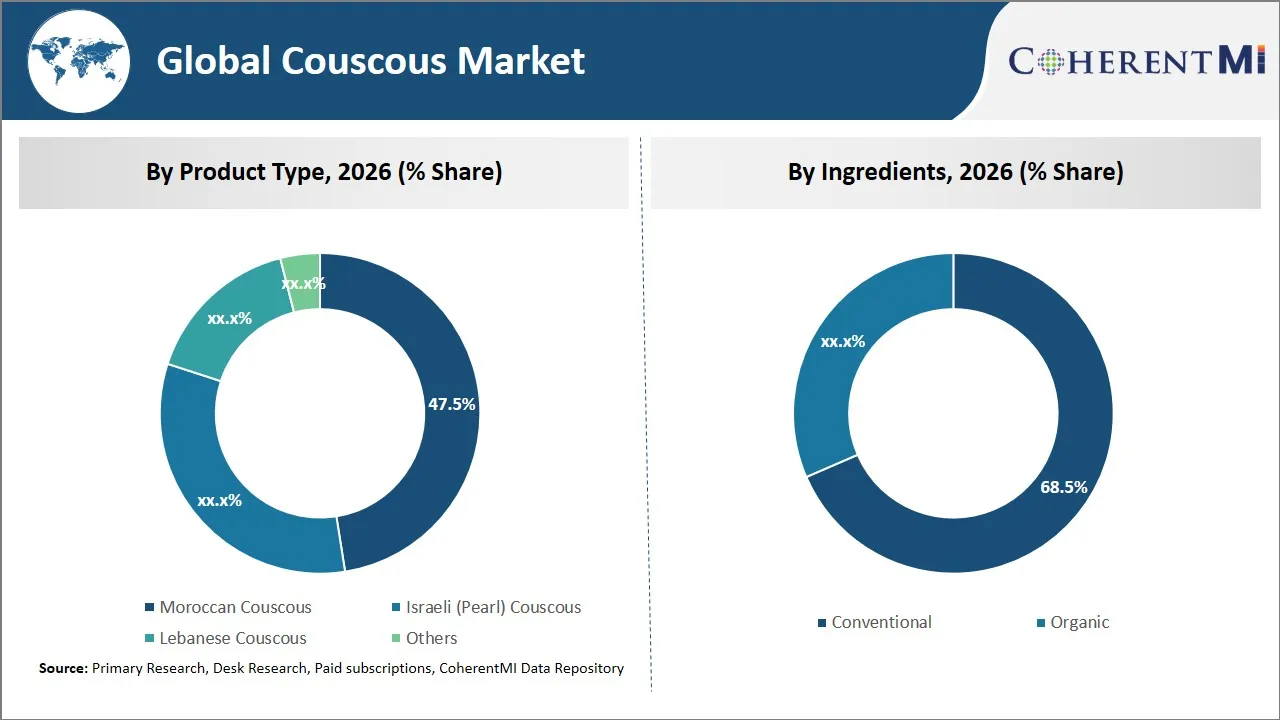
Insights, By Product Type - Moroccan Couscous Dominates the Market due to its Cultural Authenticity and Traditional Appeal
Moroccan couscous segment is expected to contribute 47.5% of the market share in 2026, because of its long cultural attachment and the general acceptance of the sector as the original and most true couscous. The classic North African dish has become the standard of couscous products in the whole world, enjoying the twenties of cooking culture that appeals both to ethnic minorities and to average customers, who want to experience the authentic global cuisine.
The popularity of Moroccan couscous is mainly attributed to its flexibility and convenience in preparation such that it is a popular food among busy people in the modern world. Moroccan couscous is the best blend of convenience and authenticity as opposed to other types of couscous that might need special cooking methods or take longer to prepare. It has a fine granular texture that enables it to absorb flavors very fast and is thus a good base ingredient in various culinary preparations starting with the traditional tagines to the modern fusion foods. This has led to flexibilities that have allowed manufacturers to place Moroccan couscous at various meal times, whether it is a fast weeknight meal or an extended weekend party.
Insights, By Ingredients - Cost Efficiency and Market Accessibility Drive Conventional Ingredients’ Dominance
Conventional segment is projected to contribute 68.5% of the couscous market share in 2026, because of its high cost benefits and availability which will enable couscous to be consumed by a large group of consumers. The traditional market has the advantage of an established agricultural production and supply chain that allows massive production at low price levels, which remains important in ensuring that couscous will continue to be a pantry important staple in various socioeconomic strata.
Conventional couscous market leadership is also a core factor of manufacturing scalability. Masses of agricultural activities that apply traditional farming approaches can yield semolina wheat and other base products in volumes that provide the necessary support to global distribution programs. This is capacity to produce which allows manufacturers to address the changes in demand trends without having to compromise the quality and stable price system. The predictability of traditional sourcing of ingredients minimizes the risks and issues in the supply chain and enables the management of the inventory in the distribution chain.
Competitive overview of Couscous Market
The major players operating in the global couscous market include Ainsley Harriott, Belazu Ingredient Company, Bia S.p.A., Bob's Red Mill Natural Foods, Dari, Ebro Foods S.A., Forafric, Near East (Golden Grain Company), Riso Gallo SpA, Roland Foods, LLC, San Remo, and US Durum Products Ltd.
Couscous Market Leaders
- Ainsley Harriott
- Belazu Ingredient Company
- Bia S.p.A.
- Bob's Red Mill Natural Foods
- Dari
Recent Developments in Couscous Market
- In November 2025, PM&Partners and Armònia acquire majority stake in couscous maker, Bia. Bia is renowned for its presence in the private-label channel, holding leadership positions in Italy, France, and Spain, and is a prominent player in the rapidly growing gluten-free and organic couscous segments.
- In November 2025, Italian agribusiness group, BF agreed to sell a controlling stake in its couscous business, Bia to private-equity firms PM&Partners and Armònia.
Couscous Market Segmentation
- By Product Type
- Moroccan Couscous
- Israeli (Pearl) Couscous
- Lebanese Couscous
- Others
- By Ingredients
- Conventional
- Organic
- By Distribution Channel
- Online Retail
- Offline Retail
- Supermarkets/Hypermarkets
- Health Food Stores
- Specialty Stores

Would you like to explore the option of buying individual sections of this report?
Pankaj Poddar is a seasoned market research consultant with over 12 years of extensive experience in the fast-moving consumer goods (FMCG) and plastics material industries. He holds a Master’s degree in Business Administration with specialization in Marketing from Nirma University, one of India’s reputed institutions, which has equipped him with a solid foundation in strategic marketing and consumer behavior.
As a Senior Consultant at CMI for the past three years, he has been instrumental in harnessing his comprehensive understanding of market dynamics to provide our clients with actionable insights and strategic guidance. Throughout his career, He has developed a robust expertise in several key areas, including market estimation, competitive analysis, and the identification of emerging industry trends. His approach is grounded in a commitment to understanding client needs thoroughly and fostering collaborative relationships. His dedication to excellence and innovation solidifies his role as a trusted advisor in the ever-evolving landscape of not only FMCG but also chemicals and materials markets.