Wine Cork Market SIZE AND SHARE ANALYSIS - GROWTH TRENDS AND FORECASTS (2026 - 2033)
Wine Cork Market is segmented By Types (Natural, Synthetic), By Distribution Channel (Offline, Onlin...
Wine Cork Market Size - Analysis
The Global Wine Cork Market is estimated to be valued at USD 5.89 Bn in 2026 and is expected to reach USD 8.12 Bn by 2033, exhibiting a compound annual growth rate (CAGR) of 4.7% from 2026 to 2033. This steady growth trajectory reflects the resilient demand from the global wine industry, driven by increasing wine consumption across emerging markets and the premiumization trend in developed regions. The market expansion is further supported by the wine industry's continued preference for traditional cork closures, particularly in premium wine segments where cork is perceived as essential for maintaining wine quality and brand prestige.
Market Size in USD Bn
CAGR4.7%
| Study Period | 2026 - 2033 |
| Base Year of Estimation | 2025 |
| CAGR | 4.7% |
| Market Concentration | Medium |
| Major Players | Amorim Cork, S.A, Ltd., Jelinek Cork Group, Waterloo Container Company, J. C. Ribeiro, S. A., We Cork Inc. and Among Others |

please let us know !
Wine Cork Market Trends
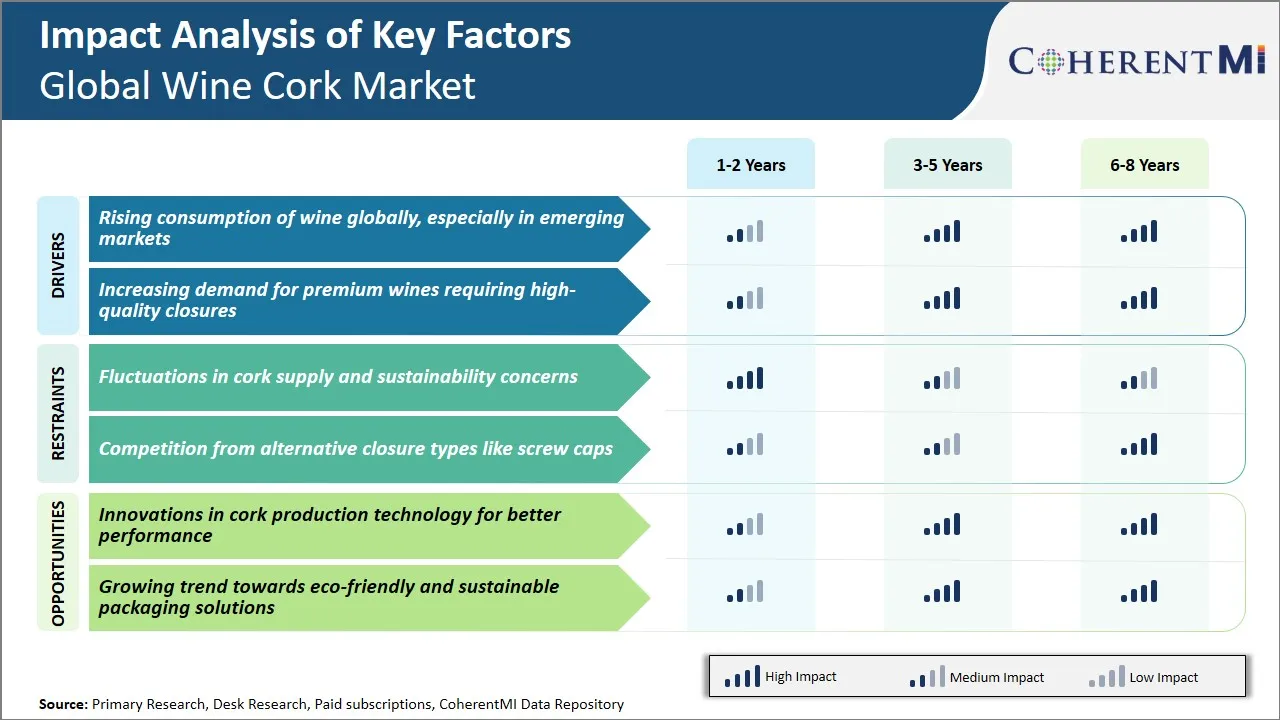
Wine Cork Market Driver - Rising Consumption of Wine Globally, Especially in Emerging Markets
The global wine consumption has already changed for the better in the last 10 years and rising demand from the emerging markets has been the major force behind it. China, India, Brazil, and some Southeast Asian countries have all recorded considerable increases in wine consumption. This shift has completely changed the market dynamics, which were previously dominated by European and North American customers. This change is not merely a question of changing consumer preferences but also a reflection of larger socioeconomic trends such as increased disposable incomes, urbanization, and cultural change in these areas. The middle class in the emerging markets has started consuming wine not only as a lifestyle but also as a status symbol, which in turn, has become a factor behind the ongoing demand that is directly correlated to the increased production of wine cork products.
In 2025, China surpassed France to become the second-largest wine-consuming country globally, driven by rising disposable incomes and changing social norms. This shift has directly impacted the demand for wine packaging products, including corks, as local wine production scales up to meet the growing consumer demand.
Market Driver - Increasing Demand for Premium Wines Requiring High-Quality Closures
The global wine industry is undergoing a significant transformation in terms of premiumization, with consumers preferring high-quality wines that are priced at a premium and the use of superior closure solutions for maintaining the wines' characteristics and value propositions. The premium wine consumption trend indicates the growing sophistication of consumers, where wine buying is not seen as mere commodity trading but as a way of investing in experiences, quality, and prestige.
 To learn more about this report, Request Free Sample Copy
Market Challenge - Fluctuations in Cork Supply and Sustainability Concerns
The wine cork market worldwide has to keep fighting through the cork supply fluctuations and sustainability issues coming up. Cork oak trees need to be grown for 25-30 years before the most first harvesting is done and then only after every 9-12 years are the next harvests. Thus, the supply chain is so inflexible that it cannot rapidly respond to demand changes in the market. This rigid supply situation has been the cause of price volatility with cork prices going up and down by 15-25% every year over the last ten years.
Sustainability issues that are being raised are on top of the supply difficulties as new environmental regulations come into place in the major cork producing areas. Among the measures introduced by the European Union are the Green Deal and biodiversity strategies which are likely to limit the harvest volume due to the stricter forest management requirements. Moreover, rising temperatures and changed rain patterns are claiming cork oak forests as one of the most vulnerable ecosystems to climate change with href quality and yield being affected. Competition between cork and other agricultural activities in the Mediterranean area has been continuously aggravated by the water scarcity phenomenon.
Market Opportunity - Innovations in Cork Production Technology for Better Performance
Amazing developments in cork production technology are influencing the market and performance improvements that the wine cork industry has been dreaming of. With the help of cutting-edge techniques for manufacturing such as precision grinding, controlled porosity, and surface treatment, it is now possible for manufacturers to make corks up to 40% mistake-free and super consistent. The implementation of computer vision systems and AI-controlled quality assurance processes has made it possible to detect minute defects instantly. It also enables automatic grading, ensuring product consistency that meets the required standards. This technology has resolved the issue of variability in corks and wine spoilage caused by contamination.
Key winning strategies adopted by key players of Wine Cork Market
- Product Innovation: Companies are engaging in the development of advanced cork solutions, including natural corks with additional sealing properties and alternatives such as synthetic corks and screw caps. For example, Amorim Cork, in particular, has laid out a plan to develop a new type of cork that would have a high likelihood of being free of cork taint and would therefore be ideal for the preservation of wine.
- Market Expansion: The wine cork makers are pushing their way into new regions, with Asia Pacific being the main one, as it is the area where wine drinking is increasing immensely. Corticeira Amorim, a company from Portugal, has increased its presence in the Chinese market, taking advantage of the growing demand for high-quality wines.
- Sustainability Focus: Since sustainability is now a major factor determining business practices, manufacturers are using environmentally friendly and renewable sourcing methods. Companies such as Cork Supply are already ahead in the game with their corks coming from ecologically friendly forests, and some companies are already using biodegradable packaging and carbon-neutral production methods to lessen their environmental impact.
Segmental Analysis of Wine Cork Market
 To learn more about this report, Request Free Sample Copy
Insights, By Types: Traditional Preferences and Quality Assurance Drive Natural Cork’s Dominance
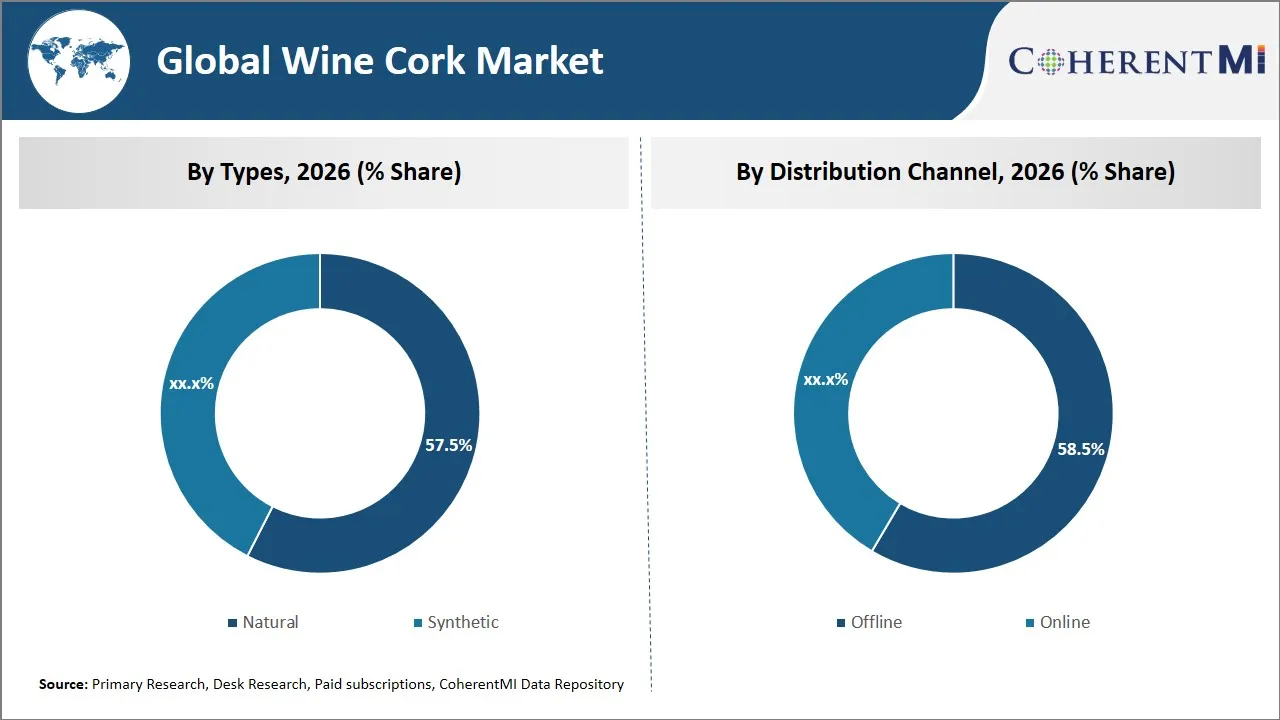
In terms of Types, the Natural segment is expected to contribute 57.5% share of the market in 2026, which is due to consumer’s perceptions regarding wine quality and authenticity that are deeply rooted. Natural cork is still the preferred option among premium wine manufacturers and consumers who have a good taste and who link the material with traditional wine-making practices and the best wine preservation. The unique properties of natural cork, which is made from the bark of cork oak, give it the benefit of being organic and that no artificial alternative can ever completely replicate it.
A natural cork’s ability to breathe is a basic reason for its leading position in the market. This semi-permeable property allows a small amount of oxygen to be absorbed by the wine during storage which helps the wine to properly age and develop its flavors that are already appreciated by many wine lovers. The wineries that produce premium wines, especially those intended for long-term cellar storage, rely on cork's quality to provide the wine with just the right amount of oxygen. This balance prevents excessive air from entering the bottle, which could spoil the wine.
For example, wineries in Bordeaux, France, have long relied on high-quality corks to age their red wines, allowing them to develop complex flavors over several decades without premature oxidation.
Insights, By Distribution Channel: Established Distribution Networks and Consumer Shopping Habits Fuel Offline Channel’s Leadership
Offline segment is projected to contribute 58.5% share of the market in 2026, mainly because wine cork acquisition is a specialized process and there is already good rapport between cork suppliers and wine producers. The main reason why the offline distribution channel has reached the top position is that wine cork purchasing decisions involve complex technical requirements and quality assurance needs, especially in the professional winemaking sector.
The purchasing behavior of wine producers is the main factor that backs the supremacy of the offline distribution channel. Wineries usually enter into long-term collaborations with cork suppliers that necessitate comprehensive technical discussions, quality testing, and individualized solutions all of which are best achieved through face-to-face communication. The selection of the cork involves a number of people within the wine production facilities like the winemaker, quality control, and procurement manager who prefer to engage directly with the suppliers for such critical packaging components.
Supply Chain Risk & Cork Oak Habitat Sustainability:
|
Risk Driver |
What it impacts (Wine Cork Value Chain) |
Risk Level |
Evidence signal (what to track) |
|
Geographic concentration of cork supply |
Number of cork oak suppliers per region |
High |
Portugal held 62.4% of world cork exports |
|
Cork oak forest area constraints |
Long-term raw material security |
High |
Cork oak stands estimated ~2.2 million total |
|
Climate change: heat + drought stress |
Tree health, cork growth, harvest quality |
Very High |
IPCC notes higher heat/drought can trigger dieback in Mediterranean oak species |
Additional Insights of Wine Cork Market
- Europe's Dominance: The European region has taken the world's wine cork market by storm as its wine culture and production get to the heights of more than 14 million crossbred wines in France, Italy, and Spain. Besides that, the region's wine cork consumption regularly moves in accordance with the traditional wine packaging preferences and the high number of vineyards.
- Sustainability Trends Impacting Market Growth: With the rising environmental awareness among consumers worldwide, the wine cork market is increasingly moving towards the sustainable solutions. Cork has been singled out as a renewable resource and it is more preferred for its ecological advantages over synthetic ones, with brands concentrating on eco-friendly production methods and getting certifications like FSC (Forest Stewardship Council).
- Innovation in Cork Alternatives: Besides the cork taint issue and the traditional cork production environmental impact concerns, the development of alternative closures has been going on vigorously: synthetics, screw caps, and glass stoppers are the major contenders. The use of cork alternatives is increasing in some wine categories like white wines especially in countries like Australia and New Zealand.
Competitive overview of Wine Cork Market
Major players operating in the global wine cork market include Amorim Cork, S.A, Ltd., Jelinek Cork Group, Waterloo Container Company, J. C. Ribeiro, S. A., We Cork Inc., Elkem Silicones limited, Precision Elite limited company, WidgetCo, Inc., Allstates Rubber & Tool Corp, and M.A. Silva USA.
Wine Cork Market Leaders
- Amorim Cork, S.A, Ltd.
- Jelinek Cork Group
- Waterloo Container Company
- J. C. Ribeiro, S. A.
- We Cork Inc.
Recent Developments in Wine Cork Market
- In August 2022, Waterloo Container announced the renewal of its agreement with Amcor Flexibles Capsules, a leading distributor of the STELVIN brand wine closure. This renewed partnership with Amcor allowed Waterloo Container to grow as a premier packaging provider in the wine sector.
- In February 2021, A. Silva USA collaborated with M. A. Silva Portugal to launch their latest cork technology and product NEOTECH for the wine industry. This micro-agglomerate cork is an upgraded version of the previous Pearl and Pearl Prestige corks, designed to offer cork with non-detectable levels of TCA.
Wine Cork Market Segmentation
- By Types
- Natural
- Synthetic
- By Distribution Channel
- Offline
- Online

Would you like to explore the option of buying individual sections of this report?
Gautam Mahajan is a Research Consultant with 5+ years of experience in market research and consulting. He excels in analyzing market engineering, market trends, competitive landscapes, and technological developments. He specializes in both primary and secondary research, as well as strategic consulting across diverse sectors.