Mobile Cardiac Telemetry Market SIZE AND SHARE ANALYSIS - GROWTH TRENDS AND FORECASTS (2026 - 2033)
Mobile Cardiac Telemetry Market is segmented By Product Type (Lead‑based devices, Patch‑based device...
Mobile Cardiac Telemetry Market Size - Analysis
The Global Mobile Cardiac Telemetry Market is estimated to be valued at USD 1.41 Bn in 2026 and is expected to reach USD 3.16 Bn by 2033, exhibiting a compound annual growth rate (CAGR) of 12.2% from 2026 to 2033. This robust growth trajectory reflects the increasing adoption of remote patient monitoring technologies and the rising prevalence of cardiovascular diseases worldwide. The market expansion is primarily driven by technological advancements in wireless communication, miniaturization of medical devices, and growing healthcare digitization initiatives across developed and emerging markets.
Market Size in USD Bn
CAGR12.2%
| Study Period | 2026 - 2033 |
| Base Year of Estimation | 2025 |
| CAGR | 12.2% |
| Market Concentration | High |
| Major Players | BioTelemetry, Inc., ScottCare Cardiovascular Solutions, Biotricity, Inc., Welch Allyn, Applied Cardiac Systems, Inc. and Among Others |

please let us know !
Mobile Cardiac Telemetry Market Trends
Market Driver - Growing Prevalence of Cardiovascular Diseases Globally
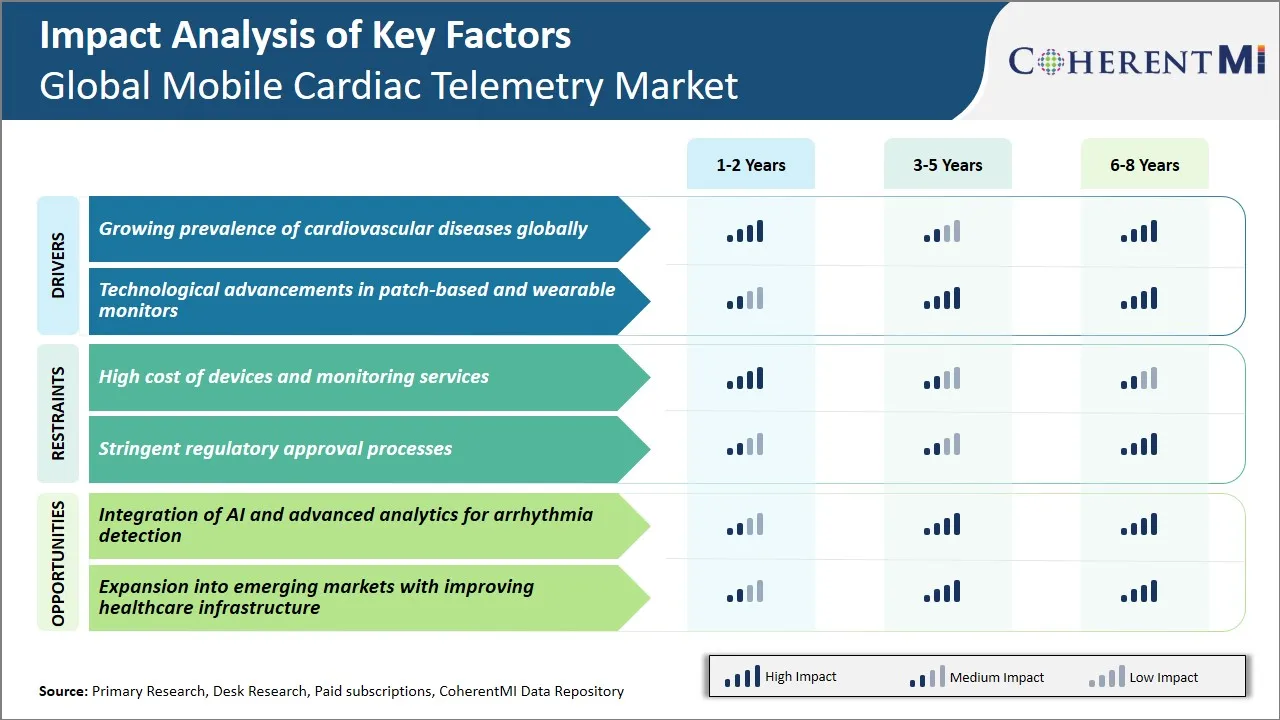
The growing trend in the occurrence of cardiovascular diseases in the world is one of the most critical drivers of the mobile cardiac telemetry market. Heart diseases have become the number one cause of deaths across the globe bringing a new challenge to the healthcare field that requires new ways of monitoring. The new lifestyle that is marked by sedentary living, stressful work conditions, intake of processed food, and deficiency of exercise has significantly changed the cardiovascular health landscape in both developed and developing countries. This has led to a drastic increase in heart-related conditions such as arrhythmia, coronary artery disease, heart failure and sudden cardiac incidents and hence requiring the ongoing and uninterrupted cardiac observation systems, which the current healthcare facilities have failed to offer.
For instance, in July 2025, the World Health Organization, the United Nations’ global public health authority, reaffirmed cardiovascular diseases as the leading global killer. WHO reported 19.8 million deaths in 2022, increasing the demand for early diagnostics including Cardiac Troponin testing. Moreover, in September 2025, American College of Cardiology, a global cardiology association, reported rising cardiovascular deaths worldwide. Institute for Health Metrics and Evaluation, a population health center, analyzed trends. Deaths increased from 13.1 million in 1990 to 19.2 million in 2023.
(Source: https://www.who.int/news-room/fact-sheets/detail/cardiovascular-diseases-(cvds))
Market Driver - Technological Advancements in Patch-Based and Wearable Monitors
Designing and developing revolutionary technological innovation in the area of patch-based and wearable cardiac monitoring technologies has revolutionized the mobile cardiac telemetry environment by developing advanced and easy to use technologies that simply fit into the routine life of a patient. These advancements in technology have overcome most of the conventional obstacles that have restricted patient adherence and quality of data in the use of cardiac monitoring systems.
The patch-based monitors of today are a major advancement over the large and cumbersome traditional monitoring devices, with the latest miniaturization techniques allowing the development of lightweight, flexible, and almost unnoticeable patches of monitoring patches to be used during periods of extended duration by being worn without adding to the overall weight or causing discomfort or interference to the normal functioning of the body. Advanced adhesive technologies and breathable material have helped to solve most of the skin irritation and comfort problems that had bedeviled chronic cardiac monitoring regimes in the past since patients could now remain on their monitoring regimens to full prescribed length without cutting down on the device removal prematurely because they found it uncomfortable.
 To learn more about this report, Request Free Sample Copy
Market Challenge - High Cost of Devices and Monitoring Services
The high cost of monitoring devices as well as the continuity of the services is a major headwind affecting the global mobile cardiac telemetry market because it is prohibitively costly. Modern cardiac telemetry devices are generally very expensive and costly to replicate, in terms of both hardware (i.e. multi-lead ECG sensors, wireless transmitter, and long-term battery solutions) and software (i.e. required algorithms), pricing them between USD 300-800 each (base models) and USD 1,500 (premium models). Such high prices pose significant market entry barriers especially in the new economy where healthcare expenditures are still limited. Moreover, the monitoring services are recurring costs that pose a constant financial challenge to both the health care systems and the patients. Hotlines of monitors necessitate 24/7 presence of trained cardiac technicians and nurses, data analysis on special software platforms, as well as strong telecommunications facilities, which ultimately increase monthly monitoring costs to USD 200-500 per patient.
The adoption of insurance reimbursement policies also creates additional problems because most payers have restrictive coverage requirements or have lower reimbursement rates that do not meet complete device and service expenses. This cost system is especially affecting rural healthcare providers and smaller healthcare institutions that do not have the capital resources as their large hospital systems. The economic impact goes to the patients who might incur substantial out-of-pocket costs, leading to healthcare equity problems of cardiac monitoring being available to only the wealthy groups.
Market Opportunity - Integration of AI and Advanced Analytics for Arrhythmia Detection
The intersection of artificial intelligence and high analytics features creates a disruptive opportunity to the mobile cardiac telemetry market, especially in terms of reshaping the effectiveness and precision of arrhythmia detection. Machine learning algorithms that are trained using large-scale data sets of cardiac rhythm variations are now able to detect subtle pattern variations and anomalies that can be difficult to detect by humans and reach more than 95% diagnostic accuracy with many common arrhythmias including atrial fibrillation, ventricular tachycardia, and premature ventricular contractions. The technological development fills a key market requirement where conventional methods of monitoring have been capable of producing high false-positive results that burden clinical processes and add to healthcare expenses. Continuous ECG streams can be handled by AI-based systems in real time and important events can be automatically prioritized, and motion artifacts and noise are filtered out which normally cause false alarms.
For instance, in May 2025, AliveCor, a leader in the USFDA-cleared personal ECG technology, unveiled the KardiaMobile 6L Max, an AI-powered personal ECG system. The system includes the new KardiaAlert feature, which monitors ECG data over time for subtle changes. KardiaAlert compares each ECG to the user’s baseline and alerts patients to any significant changes.
Segmental Analysis of Mobile Cardiac Telemetry Market
 To learn more about this report, Request Free Sample Copy
Insights, By Product Type - Clinical Reliability and Physician Familiarity Drive Lead-Based Devices’ Market Dominance
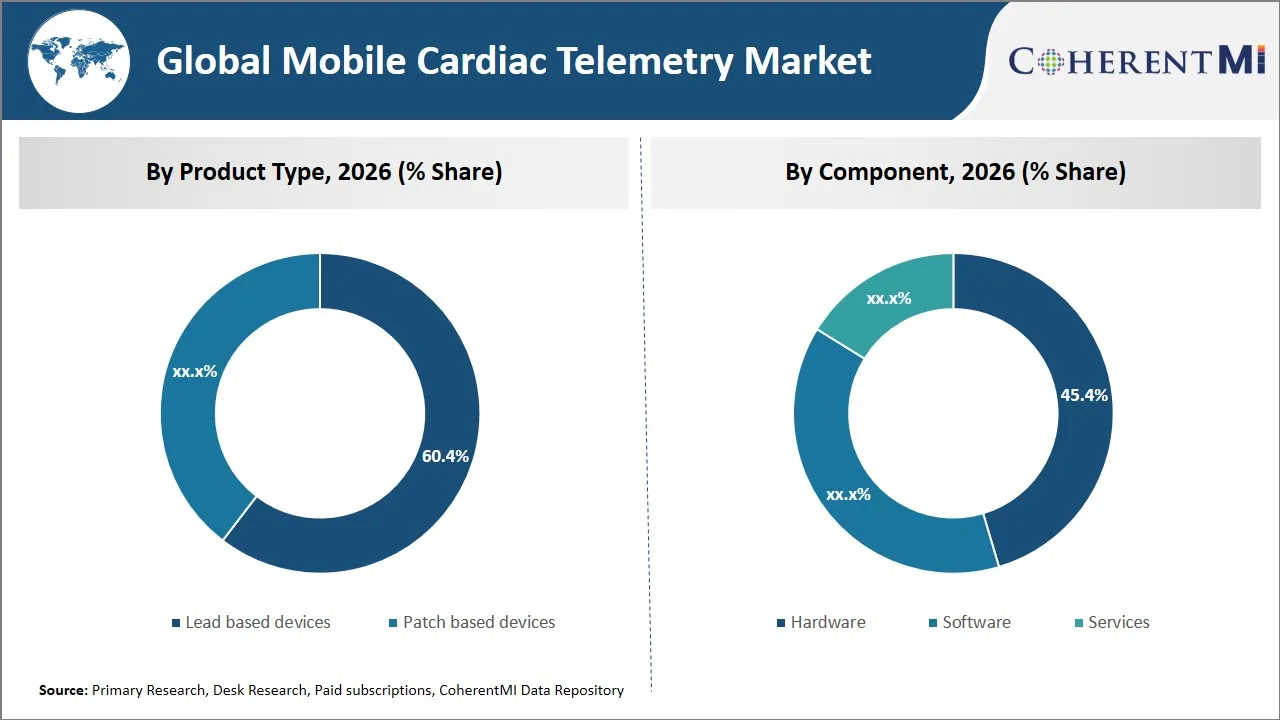
By product type, the lead-based devices segment will become the greatest contributor of the market with a share of 60.4% in 2026 due to its proven clinical authority and high-quality diagnostic results in cardiac monitoring devices. Health practitioners exhibit a great deal of favor towards the use of lead-based systems since it has a track record of providing high fidelity electrocardiogram readings that could assist in the accurate diagnosis of cardiac anomalies and arrhythmias.
These devices are characterized by the presence of a multi-lead configuration, which does not only offer clinicians extensive cardiac monitoring capabilities, but also enables them to see the electrical activity of various parts of the heart at the same time. Such multi-dimensional approach is invaluable in the diagnosis of complex heart diseases, such as delicate arrhythmias that could otherwise not be detected using one-lead diagnostic devices. Remote 12-lead ECG is able to capture cardiac diagnostics of the gold standard and grants the ability to monitor outside of the regular clinical.
Insights, By Component - Infrastructure Requirements and Integration Capabilities Establish Hardware Component Leadership
The hardware segment is anticipated to dominate the market with a share of 45.4% in 2026, driven by the essential role of physical infrastructure in the development of comprehensive mobile cardiac telemetry systems. The hardware element contains all the necessary technological basis to provide the mobile cardiac monitoring system with the reliability of cardiac signal acquisition, processing and transmission, so it cannot be overlooked as an essential component of the system.
The difficulty of the cardiac signal processing requires advanced hardware architectures to process high-resolution data acquisition with power efficiency to operate over long durations of monitoring. Superior analog to digital converters, signal amplification circuit and noise suppression technologies incorporated in hardware modules assure that delicate cardiac electrical activities are recorded with clinical-level capabilities. Such technical demands require massive investment for the development and production of hardware, which is added as the market share of the segment is large.
For instance, in August 2022, Mawi Inc., a company focused on innovative heart monitoring solutions, launched the Mawi Heart Patch in the U.S. This lightweight, wireless device offers seven days of continuous cardiac monitoring using a disposable two-lead system. It provides a detailed report within 24 hours, reducing diagnosis time by 97%. The patch aims to enhance Mobile Cardiac Telemetry, offering a faster and more efficient way to monitor heart health.
(Source: https://www.mawiheart.com/)
Advanced Analytics & AI Adoption in the Mobile Cardiac Telemetry Market
- The adoption of advanced analytics and AI in the mobile cardiac telemetry market is revolutionizing patient monitoring. Companies like AliveCor with its KardiaMobile device, and Zoll Medical Corp with its Zoll Arrhythmia Management System (AMS), are integrating AI algorithms to enhance real-time data analysis, enabling more accurate arrhythmia detection and predictive insights. These technologies allow for the identification of subtle patterns in ECG data, offering early detection of heart abnormalities and improving decision-making for clinicians. As AI-driven solutions evolve, they provide personalized treatment recommendations, optimizing patient care and reducing hospital readmission rates.
- Advanced analytics also plays a crucial role in streamlining workflows and enhancing operational efficiency. For example, Octagos Health’s OctaLink platform processes large volumes of cardiac data, prioritizing critical alerts and reducing alarm fatigue. Additionally, Vivalink integrates advanced arrhythmia detection algorithms into its solution, enhancing the accuracy of ECG readings and offering remote monitoring. By enabling proactive healthcare management, these companies are improving clinical outcomes while reducing costs, driving significant growth in the mobile cardiac telemetry market. The continued adoption of these technologies offers more effective and efficient cardiac care solutions.
Additional Insights of Mobile Cardiac Telemetry Market
- In 2026, lead-based devices will account for the largest market share, contributing 60.4%.
- In terms of component, hardware will lead the market with a share of 45.4%.
- Regarding type, real-time monitoring will hold the highest market share at 40.3%.
- North America is expected to lead the market, holding a share of 39.5% in 2026. Asia Pacific is anticipated to be the fastest-growing region, with 24.5% share in 2026.
Competitive overview of Mobile Cardiac Telemetry Market
The major players operating in the global mobile cardiac telemetry market include BioTelemetry, Inc., ScottCare Cardiovascular Solutions, Biotricity, Inc., Welch Allyn, Applied Cardiac Systems, Inc., Medicomp Inc., Preventice Solutions, Telerhythmics LLC, Zoll Medical Corporation, iRhythm Technologies, Inc., Koninklijke Philips N.V., Medtronic, Infobionic, AliveCor, BPL Medical Technologies, and Nexus Lifecare.
Mobile Cardiac Telemetry Market Leaders
- BioTelemetry, Inc.
- ScottCare Cardiovascular Solutions
- Biotricity, Inc.
- Welch Allyn
- Applied Cardiac Systems, Inc.
Recent Developments in Mobile Cardiac Telemetry Market
- In September 2025, Philips, a global health technology leader, launched an innovative smart telemetry platform. The platform addresses challenges in healthcare, including staff shortages and alarm management. It features the Telemetry Monitor 5500, offering continuous connectivity and data-driven insights for cardiac monitoring. The platform helps reduce alarm overload and streamlines clinical tasks.
- In May 2025, Octagos, a leader in AI-powered cardiac remote monitoring, launched OctaLink, a mobile app for clinicians. OctaLink provides secure, real-time access to critical cardiac data and alerts, enabling faster decision-making. The app is designed to support clinicians' mobility while maintaining workflow efficiency. It offers AI-driven alerts, secure biometric login, and effortless e-signature workflow.
- In May 2024, Vivalink, a digital healthcare solutions provider, launched a turnkey ambulatory cardiac monitoring solution for Mobile Cardiac Telemetry (MCT) and Holter monitoring. The solution integrates remote patient monitoring (RPM) and advanced arrhythmia detection algorithms, enhancing patient care and streamlining service delivery. It features a reusable ECG patch with a 14-day rechargeable battery and up to 30 days of data storage.
- In April 2022, Zoll Medical Corp launched its Zoll Arrhythmia Management System (AMS), a next-gen mobile cardiac telemetry (MCT) solution. The system integrates biometric data, such as heart rate, activity, respiratory rate, and body posture, with traditional ECG data. Initially available in select U.S. markets, Zoll AMS will expand nationwide. A new study, the MAPS Trial, involving 583 patients, demonstrated the system’s clinical value.
Reimbursement & Adoption Barriers for Mobile Cardiac Telemetry Market
- Reimbursement Challenges:
- Inconsistent reimbursement policies across regions and healthcare systems.
- Mobile Cardiac Telemetry (MCT) services, especially those involving advanced Artificial Intelligence (AI) and remote monitoring, are not fully covered by insurance.
- Varying reimbursement rates across insurance providers, limiting accessibility for patients and healthcare providers.
- Adoption Barriers:
- Integration issues: Difficulty incorporating MCT devices into existing Electronic Health Record (EHR) systems, leading to operational inefficiencies and increased costs.
- Lack of standardized protocols for MCT usage and data sharing across healthcare systems.
- Data privacy and security concerns: Hesitancy in sharing sensitive health information via mobile and cloud-based platforms due to potential breaches.
Mobile Cardiac Telemetry Market Segmentation
- By Product Type
- Lead‑based devices
- Patch‑based devices
- By Component
- Hardware
- Monitoring Devices/Patches
- Accessories (electrodes, batteries, cables)
- Monitoring Devices/Patches
- Software
- Analytics and Reporting Platforms
- Patient Management Software
- Analytics and Reporting Platforms
- Services
- Monitoring and Technical Support
- Data Interpretation and Diagnostic Services
- Monitoring and Technical Support
- Hardware
- By Type
- Real-Time Monitoring
- Store-and-Forward Monitoring
- Event-Triggered Monitoring
- By Application
- Arrhythmia Monitoring
- Heart Disease Diagnosis
- Post-Surgical Monitoring
- Remote Patient Monitoring
- Preventive Healthcare
- By End User
- Hospitals and Clinics
- Home Healthcare
- Ambulatory Surgical Centers
- Diagnostic Laboratories
- By Distribution Channel
- Online
- Offline

Would you like to explore the option of buying individual sections of this report?
Ramprasad Bhute is a Senior Research Consultant with over 6 years of experience in market research and business consulting. He manages consulting and market research projects centered on go-to-market strategy, opportunity analysis, competitive landscape, and market size estimation and forecasting. He also advises clients on identifying and targeting absolute opportunities to penetrate untapped markets.