Robotic Wheelchair Market SIZE AND SHARE ANALYSIS - GROWTH TRENDS AND FORECASTS (2026 - 2033)
Robotic Wheelchair Market, By Type (Mid Wheel Drive, Rear Wheel Drive, Front Wheel Drive, Hybrid/Sma...
Robotic Wheelchair Market Size - Analysis
The global robotic wheelchair market is estimated to be valued at USD 223.6 Mn in 2026 and is expected to reach USD 470.12 Mn by 2033, exhibiting a compound annual growth rate (CAGR) of 11.2% from 2026 to 2033. This strong growth pattern indicates how advanced mobility solutions are in high demand with aging population in the world, increased occurrence of mobility related disabilities, and increased awareness regarding assistive technologies. The market growth is also enhanced by significant investment in healthcare infrastructure, good reimbursement policies, and development of new technologies that have facilitated the increased accessibility of robotic wheelchairs and affordability of end users in various economic groups.
There is a pronounced technological development of the robotic wheelchair market with the introduction of the functions of artificial intelligence, machine learning, and Internet of Things (IoT) that allow autonomous movement, detection of obstacles, and voice control. The main directions are the creation of brain-computer interface systems, with a focus on the neural control of wheelchairs, the creation of better battery systems which offer more time of operation, and the use of lightweight materials that can enhance the portability of wheelchairs.
Market Size in USD Bn
CAGR11.2%
| Study Period | 2026 - 2033 |
| Base Year of Estimation | 2025 |
| CAGR | 11.2% |
| Market Concentration | Medium |
| Major Players | Permobil AB, Invacare Corporation, Sunrise Medical LLC, Ottobock SE & Co. KGaA, WHILL Inc., Meyra GmbH, Karman Healthcare Inc., DEKA Research & Development Corp., UpnRIDE Robotics Ltd., Airwheel Holdings Ltd., Tmsuk Co. Ltd., Pride Mobility Products Corp., Centaur Robotics Limited, Toyota Motor Corporation, Honda Motor Co. Ltd. and Among Others |

please let us know !
Robotic Wheelchair Market Trends
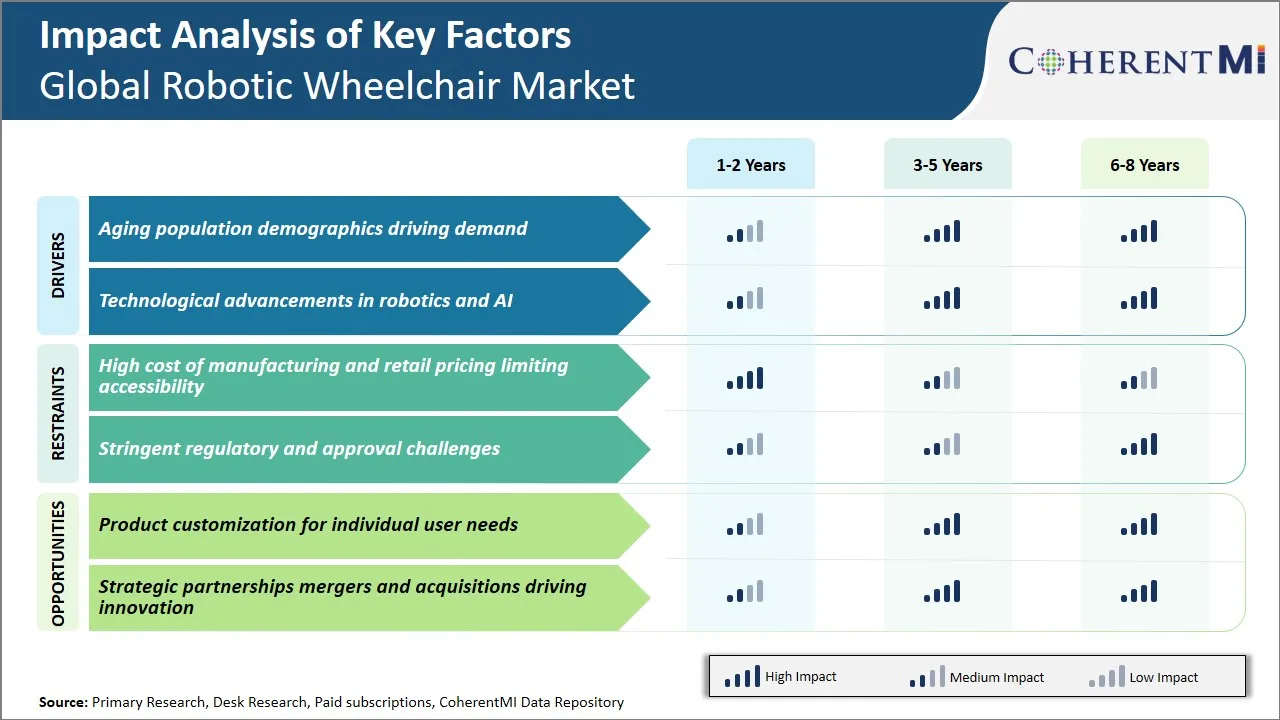
Market Driver - Aging Population Demographics Driving Demand
The worldwide demographic trend towards an aging population is one of the largest socioeconomic changes of the 21st century with an unprecedented demand of inventive mobility solutions such as robotic wheelchairs. Since life expectancy has been on the increase in both the developed and developing countries, the population of elderly people who need the assistance of mobility aids has increased tremendously. This generational shift is not just a statistical anomaly, but a complete reshaping of society that has a direct impact on the healthcare infrastructure, family life, and the assistive technology market as a whole.
The elderly population presents a special mobility problem in which an ordinary wheelchair is sometimes not able to fully fulfill the needs, which is a huge market potential of the robotic wheelchair manufacturers. The healthcare systems across the global spectrum are under increasing pressure to offer highly detailed care to the rising elderly populations as they deal with the rising expenses.
For instance, in January 2024, Robooter showcased its Innovative Power Wheelchair X40, an intelligent mobility solution at CES 2024, specifically designed to support elderly users and individuals with limited mobility, featuring enhanced ease of use and robotics‑based functionality to improve daily life independence.
(Source- Robooter)
Market Driver - Technological Advancements in Robotics and AI
The recent boom of the robotics and artificial intelligence technologies has fundamentally changed the functions and market opportunities of robotic wheelchair and developed advanced mobility solutions that used to be the preserve of the science fiction era. State-of-the-art sensors, machine learning programs, and autonomous navigation systems make modern robotic wheelchairs capable of unprecedented user assistance and interaction with the environment.
The resulting technological progression has propelled the robotic wheelchair beyond just motorized mobility aids and turned into a smart friend capable of coming to know the likes of the users, predicting their needs and responding to complex real world situations. The intersections of various fields of technology such as computer vision, natural language processing, and Internet of Things connectivity have provided robotic wheelchair platforms that provide complete mobility solutions to the unique requirements of each user.
 To learn more about this report, Request Free Sample Copy
Market Challenge - High Cost of Manufacturing and Retail Pricing Limiting Accessibility
High cost of manufacture has become a major challenge to the global robotic wheelchair market as it drives up the retail prices, which in turn limits penetration hence access to the market. The advanced and hi-tech elements that come with robotic wheelchairs, such as the advanced sensors, artificial intelligent processing units, high voltage batteries, and high precision motors are also costly to manufacture. Such advanced elements may demand expert production methods and quality assurance and add to the cost even more. Also, the comparatively small volumes of production in relation to the traditional wheelchairs allow manufacturers not to gain economies of scale, retaining their costs per unit.
Market Opportunity - Product Customization for Individual User Needs
The rising need of individualized healthcare products is an attractive opportunity to robotic wheelchair manufacturers to distinguish its products and become a market leader in premium market segments by fully customizing its products. The needs of individual users are highly customized depending on the aspects of particular mobility constraints, lifestyle necessities, environmental circumstances, and personal choices, posing considerable pressure on the creation of individual solutions. Modular design and 3D printing manufacturing innovations, among others, allow cost-efficient customization that does not require a significant investment of production lines. This customization strategy enables manufacturers to meet the needs of different users, including special seating layouts to fit the special needs of certain medical conditions, or more advanced navigation systems in case of outdoor users.
For instance, in July 2025, the Indian Institute of Technology Madras (IIT Madras) announced the launch of YD One, a fully customized active wheelchair designed to match each user’s body, posture, and daily mobility needs; the ultra‑light precision model weighs just 9 kg and is tailored to individual requirements, reflecting the trend toward bespoke assistive solutions in the mobility markets.
(Source- Indian Institute of Technology Madras (IIT Madras))
Reimbursement and Funding Landscape for Robotic Mobility Devices
|
Funding / Reimbursement Type |
Key Details |
Geographic Focus / Notes |
|
Insurance Coverage |
Robotic wheelchairs and advanced mobility devices may be partially covered by private health insurance or national healthcare plans. |
U.S., Canada, and Europe; coverage varies by policy and medical necessity |
|
Government Subsidies |
Financial assistance programs or grants to support purchase of assistive mobility devices |
Japan, Australia, Germany, and U.S.; often targeted at elderly, disabled, or low‑income users |
|
Veteran / Specialized Programs |
Dedicated funding for veterans or specific patient groups for mobility aids |
U.S. Department of Veterans Affairs, U.K. Ministry of Defense support programs |
|
Nonprofit / NGO Support |
Grants or low‑interest loans from nonprofit organizations for assistive technology |
Global; examples include local disability foundations and international NGOs |
Key winning strategies adopted by key players of Robotic Wheelchair Market
- Product Innovation and Technological Leadership- In the global robotic wheelchair market, the major players have taken a keen interest in the production of an upgraded wheelchair, equipped with AI and sensorized capabilities as a way of distinguishing their products. The ongoing development of autonomous navigation, IoT connectivity, and adaptive control systems can help companies to improve user safety, comfort, and independence and become the leader in the technological environment and take the leading market segments.
- Strategic Partnerships and Market Expansion- Top firms embrace partnerships, mergers and distribution alliances to grow geographically and create market share. They also take advantage of government initiatives, insurance reimbursement vehicles and pilot deployments to enhance uptake. This strategic alliance, regulatory alignment, and focused marketing combination can help it to grow and lead the market in the fast-changing robotic wheelchair market.
Segmental Analysis of Robotic Wheelchair Market
 To learn more about this report, Request Free Sample Copy
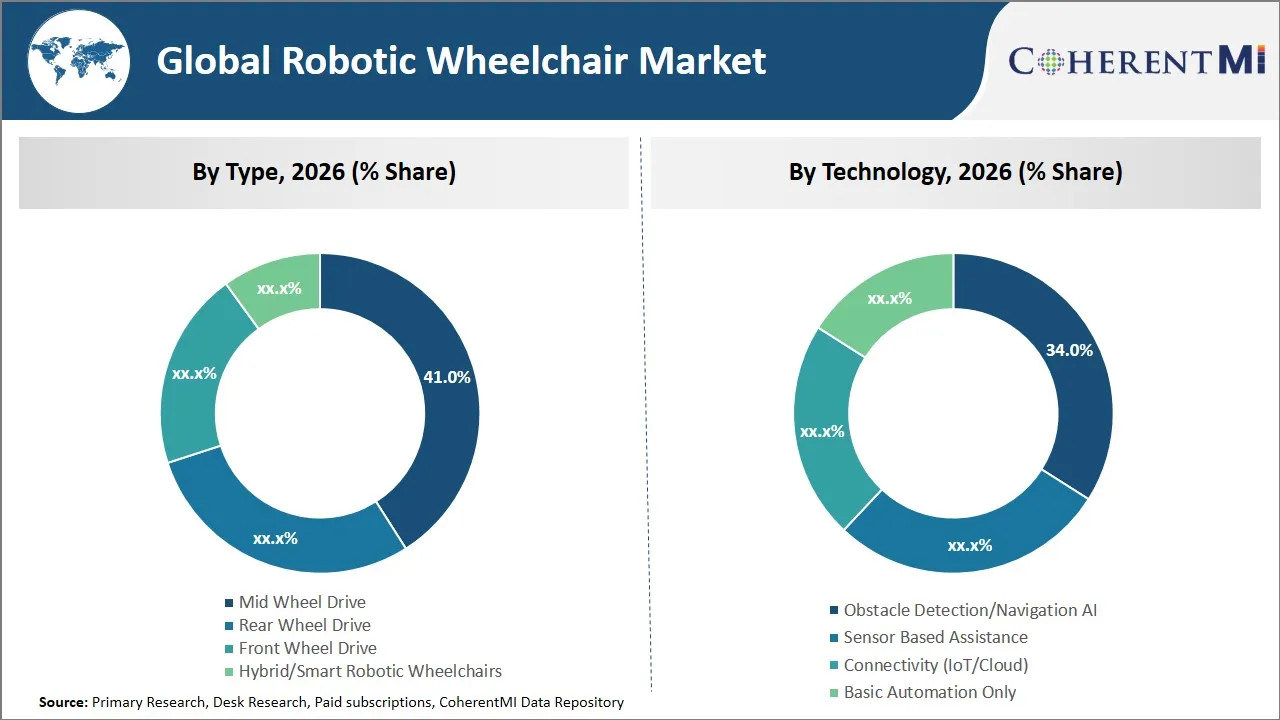
Insights, By Type: Mid Wheel Drive is Driven by Superior Maneuverability and Stability
By type, mid wheel drive takes the largest portion of the market with an estimated share of 41% in 2026, owing to its exceptional balance of maneuverability, stability, and user comfort that addresses the diverse mobility needs of wheelchair users across various environments. Mid-wheel drive systems place the drive wheels in the middle of the chair, thus producing a turning radius that is much smaller than others, rendering these wheelchairs especially useful in the indoor environment and in small spaces.
The main reason behind the superiority of the mid wheel systems has been the turning ability of the systems. The wheels of the chairs are placed directly below the center of gravity of the user so that, these wheelchairs can almost spin in place turning almost 360 degrees that it needs very little space to maneuver. This feature is very useful in the home premises, the work place, health care and shopping places where one often needed to move through furniture, equipment and other barriers. This capability of performing accurate motions without the need to have a large clearance area is of great benefit in terms of user autonomy and minimizing the physical and mental effort required of the user in operating the wheelchair.
For instance, in June 2023, Permobil introduced its M Corpus VS mid‑wheel drive standing power wheelchair featuring a mid‑wheel drive base combined with power standing functionality and enhanced suspension for improved maneuverability and user comfort; the model became widely available for demonstrations and purchase.
(Source- Permobil)
Insights, By Technology: Obstacle Detection/Navigation AI Drives Growth Through Advanced AI Navigation Capabilities
By technology, the obstacle detection/navigation AI segment takes the largest portion of the market with an estimated share of 34% in 2026, owing to the transformative impact of artificial intelligence in addressing fundamental safety and independence challenges faced by wheelchair users. The integration of sophisticated AI-powered navigation systems represents a paradigm shift from traditional manual wheelchair operation to intelligent, semi-autonomous mobility solutions that significantly enhance user safety and operational efficiency.
The core driving factor behind the dominance of obstacle detection and navigation AI lies in its ability to provide real-time environmental awareness and predictive safety measures. Advanced sensor arrays combined with machine learning algorithms enable robotic wheelchairs to continuously scan the surrounding environment, identify potential hazards, and automatically adjust navigation paths to avoid collisions or unsafe situations. This technology proves particularly valuable for users with visual impairments, cognitive challenges, or limited reaction times who may struggle to identify and respond to environmental obstacles quickly enough to prevent accidents.
For instance, in January 2024, Sunrise Medical launched its “Switch” robotic wheelchair featuring advanced AI and sensor integration for autonomous navigation and obstacle detection capabilities. This product was introduced to enhance mobility for users with limited movement and includes technology designed to detect obstacles and adjust navigation paths to improve safety and ease of use.
(Source- Sunrise Medical)
Emerging Technologies and Innovations in Robotic Wheelchairs
- AI, IoT, and Sensor-Based Navigation- AI-based navigation, IoT, and sensor-based robotic wheelchair navigation (LIDAR and ultrasonic sensors) are rapidly being integrated into the market. These technologies make it possible to plan routes independently, detect obstacles in real time, and predictive maintenance, thus making the use of these technologies to enhance safety, efficiency, and independent mobility. The features are becoming more and more common in premium and mid-range models, whereas cloud-enabled devices can enable remote monitoring and data-driven insights to caregivers and healthcare providers.
- Brain-Computer Interfaces and Voice Control- New technologies such as brain-computer interfaces (BCI) and voice control are also increasing access by users with severe mobility impairments. BCI enables the use of neural inputs to operate the computer hands-free, and voice and gesture control features give it some of the most intuitive command options, increasing their independence and ease of use. These technologies are at the early adoption stage, but they are the future of intelligent assistive mobility especially in the high-end prototypes and research-oriented models.
Additional Insights of Robotic Wheelchair Market
- The global robotic wheelchair market is growing rapidly, driven by aging populations, increasing disability prevalence, and demand for independent mobility solutions.
- AI, IoT, and sensor-based technologies are transforming wheelchair capabilities, enabling autonomous navigation and smart control.
- Market growth is supported by government subsidies, insurance coverage, and funding programs for assistive devices.
- Rising investments in R&D by key players to develop lightweight, foldable, and terrain-adaptive wheelchairs.
Competitive overview of Robotic Wheelchair Market
The major players operating in the global robotic wheelchair market include Permobil AB, Invacare Corporation, Sunrise Medical LLC, Ottobock SE & Co. KGaA, WHILL Inc., Meyra GmbH, Karman Healthcare Inc., DEKA Research & Development Corp., UpnRIDE Robotics Ltd., Airwheel Holdings Ltd., Tmsuk Co. Ltd., Pride Mobility Products Corp., Centaur Robotics Limited, Toyota Motor Corporation, and Honda Motor Co. Ltd.
Robotic Wheelchair Market Leaders
- Permobil AB
- Invacare Corporation
- Sunrise Medical LLC
- Ottobock SE & Co. KGaA
- WHILL Inc.
- Meyra GmbH
- Karman Healthcare Inc.
- DEKA Research & Development Corp.
- UpnRIDE Robotics Ltd.
- Airwheel Holdings Ltd.
- Tmsuk Co. Ltd.
- Pride Mobility Products Corp.
- Centaur Robotics Limited
- Toyota Motor Corporation
- Honda Motor Co. Ltd.
Recent Developments in Robotic Wheelchair Market
- In October 2025, Toyota showcased its “Walk Me” four‑legged autonomous mobility chair at the Japan Mobility Show 2025 on October 29, 2025, designed to navigate stairs and uneven terrain, reflecting its “Mobility for All” initiative to expand accessibility beyond traditional wheelchairs.
- In April 2025, WHILL Inc., in partnership with Unifi Aviation and Wayne County Airport Authority, launched a pilot autonomous wheelchair service at Detroit Metropolitan Wayne County Airport to enhance passenger mobility and efficiency while collecting operational and satisfaction data.
- In March 2025, Chulalongkorn University introduced its Exoskeleton Wheelchair, unveiling a wearable robotic device that combines a wheelchair and exoskeleton to help users stand, walk, and move more independently, developed by Assoc. Prof. Dr. Ronnapee Chaichaowarat from the Faculty of Engineering.
Robotic Wheelchair Market Segmentation
- By Type
- Mid Wheel Drive
- Rear Wheel Drive
- Front Wheel Drive
- Hybrid/Smart Robotic Wheelchairs
- By Technology
- Obstacle Detection/Navigation AI
- Sensor‑Based Assistance
- Connectivity (IoT/Cloud)
- Basic Automation Only
- By Application
- Daily Mobility Assistance
- Rehabilitation Support
- Enhanced Independence Tech
- By Control Mode
- Joystick Control
- Gesture Control
- Voice Control
- Brain‑Computer Interface (BCI)
- Smartphone/Remote App Control
- By End User
- Hospitals & Clinics
- Elderly Care Facilities
- Home Users
- Rehabilitation Centers
- Research & Development Institutions
- Other Commercial (Airports, Malls, Public Places)

Would you like to explore the option of buying individual sections of this report?
Ramprasad Bhute is a Senior Research Consultant with over 6 years of experience in market research and business consulting. He manages consulting and market research projects centered on go-to-market strategy, opportunity analysis, competitive landscape, and market size estimation and forecasting. He also advises clients on identifying and targeting absolute opportunities to penetrate untapped markets.