Ureteroscope Market SIZE AND SHARE ANALYSIS - GROWTH TRENDS AND FORECASTS (2026 - 2033)
Ureteroscope Market is segmented By Product Type (Flexible Ureteroscope, Rigid Ureteroscope, Semi-Ri...
Ureteroscope Market Size - Analysis
The global ureteroscope market is estimated to be valued at USD 1.50 Bn in 2026 and is expected to reach USD 2.26 Bn by 2033, exhibiting a compound annual growth rate (CAGR) of 6% from 2026 to 2033. This steady growth trajectory reflects the increasing prevalence of urological disorders, particularly kidney stones and urinary tract complications, coupled with rising healthcare expenditure across developed and emerging markets. Market growth is also encouraged by the increasing awareness of minimally invasive surgery and the development of endoscopic equipment technology. Improved imaging features, design issues, and disposable ureteroscopes are becoming highly popular in the market because they have better safety records and low cross-contaminant potential.
Market Size in USD Bn
CAGR6%
| Study Period | 2026 - 2033 |
| Base Year of Estimation | 2025 |
| CAGR | 6% |
| Market Concentration | Medium |
| Major Players | Olympus Corporation, Stryker Corporation, Boston Scientific Corporation, Richard Wolf GmbH, KARL STORZ SE & Co. KG and Among Others |

please let us know !
Ureteroscope Market Trends
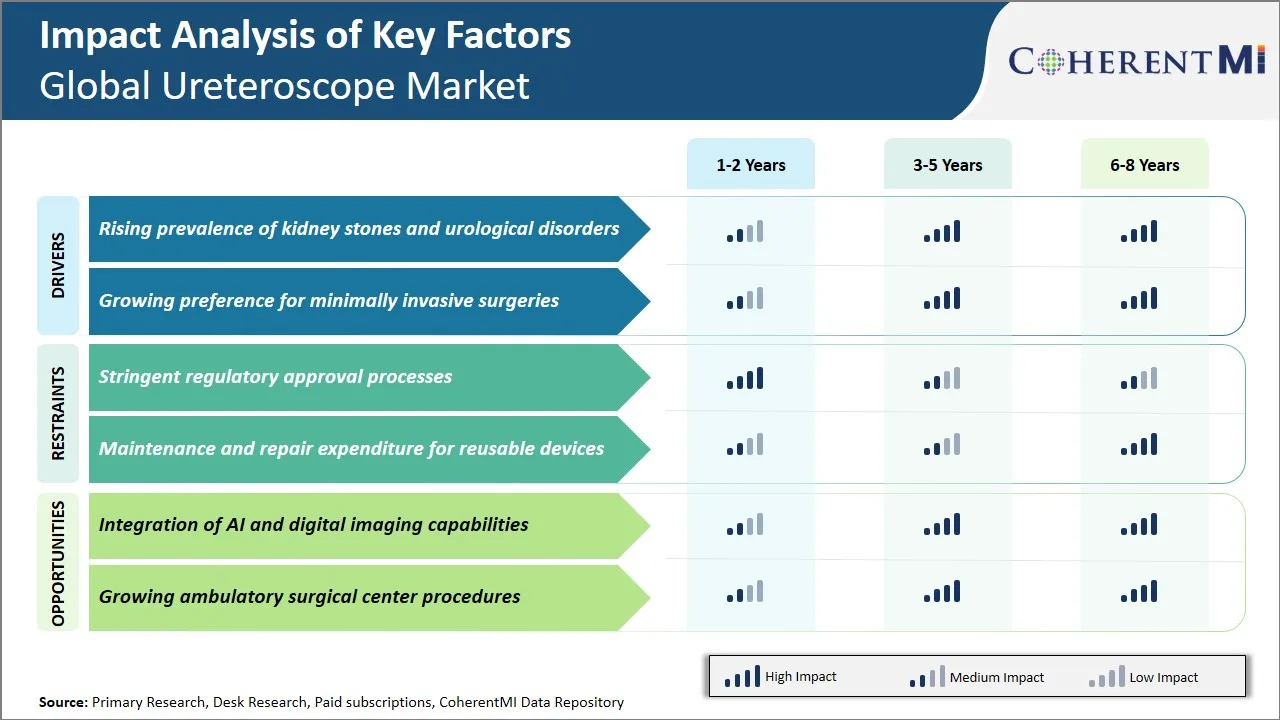
Global Ureteroscope Market Driver - Rising Prevalence of Kidney Stones and Urological Disorders
The rising prevalence of kidney stones and other urological diseases is one of the most influential aspects of the development of the ureteroscope market in the whole world. This is an intensifying health burden because it is a complicated combination of lifestyle, dietary, environmental, and demographic aspects which have radically changed the disease burden situation in both developed and developing countries.
New dietary habits that are characterized by salt overconsumption, low water intake, high intake of processed food, and sedentary living conditions have provided favorable conditions towards formation of stones. The Western diet that is rich in animal proteins, refined sugars and low in fiber have especially been associated with the increased cases of calcium oxalate stones which make most of kidney stone cases in the world.
For instance, a new study conducted by Urology Times reports that kidney stone prevalence among women aged 20 to 39 years has risen significantly over recent years, narrowing historical gender gaps and indicating broader population risk increases.
(Source- https://www.urologytimes.com/view)
Global Ureteroscope Market Driver - Growing Preference for Minimally Invasive Surgeries
There has been a paradigm shift in the healthcare system towards the use of less invasive surgical procedures and ureteroscopy has become one of the treatment modalities of choice to deal with most cases of urological conditions. This change portrays a larger scale shift in medical practice due to better patient outcomes, more positive recovery experiences, and higher cost-effectiveness relative to traditional open surgical operations.
Minimally invasive procedures especially ureteroscopies have gained widespread acceptance among both the healthcare practitioners and patients because they can accomplish the therapeutic goals with minimum tissue traumas, short recovery time, and normal anatomical structures.
The preferences of patients have radically shifted since healthcare consumers have become more educated and they are now involved in decision-making processes in treatments.
 To learn more about this report, Request Free Sample Copy
Global Ureteroscope Market Challenge - Stringent Regulatory Approval Processes
The ureteroscope market is experiencing considerable headwinds because of the rising stricter regulation approval procedures in healthcare markets. The manufacturers of medical devices have to deal with elaborate regulatory frameworks developed by the regulatory agencies like the FDA within the U.S., EMA within the European region and other regulatory agencies across the world, each with its own specifications regarding clinical trials, safety forms, and demonstrations of efficacy.
There has been an increase in the duration of approval of new ureteroscope technologies, with ureteroscopes taking 3-5 years of intense testing and documentation before they are introduced to the market. This is a lengthy process of approval, which poses significant financial challenges to manufacturers, which can easily cost USD 10-15 million each product line, especially on new technologies using new materials or new imaging functionality.
The complexity of the regulatory process is further increased by the fact that different geographical markets will also need their own approvals with each of them requiring clinical data specific to the region and adherence to the local standards. Another complexity is the post-market surveillance where they require constant monitoring and reporting of device performance, adverse events, and long-term safety outcomes. Such regulatory pressures especially affect the smaller firms and startups that are trying to bring disruptive technology since they might not be resource endowed or have the regulatory understanding to go through the approval maze successfully.
Global Ureteroscope Market Opportunity - Integration of AI and Digital Imaging Capabilities
Integration of artificial intelligence with sophisticated digital imaging is an opportunity that is transformational to the global ureteroscope market and is expected to revolutionize the urology procedure and enlarge the market potential substantially. AI-powered ureteroscopes which have machine learning algorithms can assist in providing real time diagnostics with automatic detection of kidney stones, tumors, and anatomical abnormalities with unlike ever before accuracy rates of above 95%.
These smart devices are capable of assessing tissue properties, predetermining the type of stone, and prescribing the most effective treatment options, which is the effect of digital surgical assistants that improve the decision-making of physicians. The integration of 4K and 8K ultra-high-definition imaging and AI-assisted image processing provide high-quality visualization that allows identifying the slightest pathologies and performing a more accurate surgery.
For instance, the clinical study detailing the development and validation of an AI‑assisted system for real‑time kidney stone detection during flexible ureteroscopy was published in the journal, npj Digital Medicine. The research team, led by Mr. Chenfeng Wang and colleagues, reported the work in npj Digital Medicine in 2025, showcasing high accuracy in detecting, classifying, and measuring stones using AI integrated with endoscopic video imaging, demonstrating practical use of AI in operative imaging workflows.
(Source- https://www.nature.com/articles/s41746-025-02109-9?utm)
Segmental Analysis of Ureteroscope Market
 To learn more about this report, Request Free Sample Copy
Insights, By Product Type: Advanced Maneuverability and Enhanced Clinical Outcomes Drive Flexible Ureteroscope’s Market Dominance
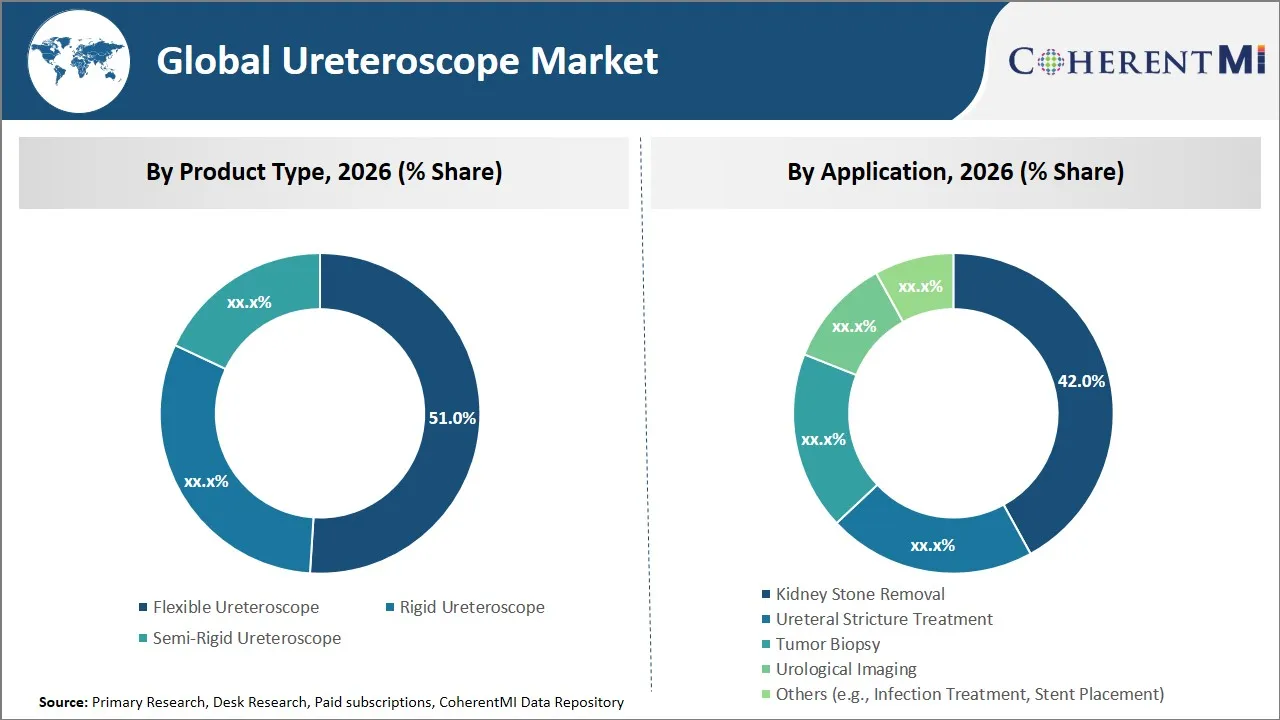
By product type, flexible ureteroscope is expected to contribute the highest share of 51% in 2026 owing to its superior navigational capabilities and enhanced patient outcomes in complex urological procedures. The flexibility of ureteroscope makes it bend and navigate through the complex structure of the urinary tract, which is a major technological breakthrough that has transformed minimally invasive urological procedures.
The main reason that leads to the supremacy of flexible ureteroscopes is the fact that they have an exceptional capability of reaching the areas that are difficult to reach in the kidney and the upper urinary tract. In contrast to their rigid counterparts, flexible ureteroscopes are able to maneuver around the natural curves and bends of the ureter, and as a result, doctors are able to access the stones, which were traditionally more difficult to reach, a stone in the lower pole of the kidney. The increased flexibility has seen flexible ureteroscopes becoming the most preferred in treating complex kidney stones and in the conduct of diagnostic measures in difficult anatomical sites.
For instance, Olympus’ URF‑P7 flexible ureteroscope continues to be highlighted in industry and clinical sources as a leading example of a flexible ureteroscope used in urology procedures, combining slim profile, high image quality, and enhanced maneuverability for navigating the urinary tract to diagnose and treat kidney stones and other conditions.
(Source- https://www.olympus-europa.com/medical)
Insights, By Application: Rising Nephrolithiasis Prevalence and Stone Disease Complexity Propel Kidney Stone Removal Applications
By application, kidney stone removal takes the largest portion of the market with an estimated share of 42% in 2026 owing to the escalating global prevalence of nephrolithiasis and the increasing complexity of stone disease presentations. The increasing prevalence of kidney stones in different demographic groups has generated significant need to develop advanced ureteroscopic solutions, which makes the removal of stones the major application that leads to the market growth.
The growing popularity of the risk factors linked to the occurrence of kidney stones is a core stimulus influencing the growth of this segment. The change in modern lifestyle such as dietary alterations, lack of physical activity, increase in consumption of processed foods, and increased sodium intake have increased rates of stone formation in the world. Also, diabetes, obesity, and metabolic syndrome are metabolic conditions that are emerging as more common across the world and which are closely linked with the risk of kidney stones, which is expanding patient population that is already in need of ureteroscopic procedure.
Reusable vs Single-Use Cost-Per-Procedure for Ureteroscope Market
- Reusable Ureteroscopes: Reusable ureteroscopes generally have a higher upfront cost due to their durable construction and the need for sterilization equipment. Nevertheless, when used repeatedly, the cost-per-procedure is reduced considerably. The primary expenses to be incurred with reusable devices are maintenance, repair and sterilization, and as such, it is cheaper to use in facilities with a high volume of procedures.
- Single-Use Ureteroscopes: Although single-use ureteroscopes cost more per unit, it does not require sterilization, maintenance, and repair. Single-use devices cost-per-procedure is comparatively steady and reliable, not to mention the possibility of minimizing the risk of cross-contamination. Hospitals or surgical facilities with lower procedure volumes normally prefer them or those that do not want to incur the long-term maintenance costs.
Durability vs Case Volume Correlation for the Ureteroscope Market
- Durability of Ureteroscopes: Durability of ureteroscopes is one of the major factors of cost-effectiveness of ureteroscopes in the long run. Reusable ureteroscopes are designed with the ability to undergo repeated procedures and the durability of these devices is that the initial high investment is recovered over a period due to their repeated use. They would be acquired in high-volume settings and can be utilized more often with no decline in performance, so they would have a lower cost-per-procedure in the long term.
- Case Volume and its Effect: Case volume is a vital factor in the choice of reusable or single-use ureteroscopes. The resiliency of reusable devices is advantageous to the high-volume centers since it warrants the initial investment by ensuring that the devices are utilized more frequently and the cost per procedure is spent less. However, low- to medium-volume environments may use single-use ureteroscopes, which are not subject to expensive maintenance, repairs, and sterilization, although they are more expensive per unit.
Additional Insights of Ureteroscope Market
- By product type, flexible ureteroscope is expected to hold the largest market share at 51% in 2026.
- In terms of application, kidney stone removal is expected to account for the highest share at 42% in 2026.
- Based on end user, the hospitals segment leads the market with an estimated share of 48% in 2026.
- North America is expected to lead the market, holding a share of 39.9% in 2026. Asia Pacific is anticipated to be the fastest-growing region, with 25.5% share in 2026.
Competitive overview of Ureteroscope Market
The major players operating in the Global Ureteroscope Market include Olympus Corporation, Stryker Corporation, Boston Scientific Corporation, Richard Wolf GmbH, KARL STORZ SE & Co. KG, ELMED Medical Systems, Pentax Medical (HOYA Group), Dornier MedTech, Maxer Endoscopy GmbH, Vimex Endoscopy, Advin Health Care, OTU Medical Inc., Rocamed, ProSurg, and Coloplast.
Ureteroscope Market Leaders
- Olympus Corporation
- Stryker Corporation
- Boston Scientific Corporation
- Richard Wolf GmbH
- KARL STORZ SE & Co. KG
Recent Developments in Ureteroscope Market
- On January 12, 2026, Boston Scientific announced an acquisition agreement with Valencia Technologies Corporation to expand its urology offerings, marking strategic growth beyond scopes into broader urologic device solutions that could support overall market strength.
- In September 2025, Dornier has rolled out the Hoover Flexible and Navigable Suction (FANS) access sheath and the Axis II Slim single‑use ureteroscope with a 5.6 Fr distal tip, expanding FDA‑cleared options for kidney stone treatment and reinforcing single‑use device uptake in the ureteroscopy and kidney stone treatment market.
- In September 2025, The VISERA S video imaging system (OTV-S500), announced by Olympus, is a versatile, all-in-one, high-definition (HD) platform designed to enhance visualization and streamline workflow efficiency in urology and Ear, Nose, and Throat (ENT) procedures.
Ureteroscope Market Segmentation
- By Product Type
- Flexible Ureteroscope
- Rigid Ureteroscope
- Semi-Rigid Ureteroscope
- By Application
- Kidney Stone Removal
- Ureteral Stricture Treatment
- Tumor Biopsy
- Urological Imaging
- Others (e.g., Infection Treatment, Stent Placement)
- By End User
- Hospitals
- Ambulatory Surgical Centers (ASCs)
- Clinics
- Others (e.g., Specialized Urology Centers)
- By Material
- Stainless Steel
- Titanium
- Composite Materials
- By Technology
- Digital Ureteroscope
- Fiberoptic Ureteroscope
- By Distribution Channel
- Online
- Offline
- By Design
- Single Use Ureteroscope
- Reusable Ureteroscope

Would you like to explore the option of buying individual sections of this report?
Ghanshyam Shrivastava - With over 20 years of experience in the management consulting and research, Ghanshyam Shrivastava serves as a Principal Consultant, bringing extensive expertise in biologics and biosimilars. His primary expertise lies in areas such as market entry and expansion strategy, competitive intelligence, and strategic transformation across diversified portfolio of various drugs used for different therapeutic category and APIs. He excels at identifying key challenges faced by clients and providing robust solutions to enhance their strategic decision-making capabilities. His comprehensive understanding of the market ensures valuable contributions to research reports and business decisions.
Ghanshyam is a sought-after speaker at industry conferences and contributes to various publications on pharma industry.