Intracranial Aneurysm Market SIZE AND SHARE ANALYSIS - GROWTH TRENDS AND FORECASTS (2026 - 2033)
Intracranial Aneurysm Market is segmented By Aneurysm Type (Saccular Aneurysm, Fusiform Aneurysm, Di...
Intracranial Aneurysm Market Size - Analysis
The global intracranial aneurysm market is estimated to be valued at USD 1.90 Bn in 2026 and is expected to reach USD 2.80 Bn by 2033, exhibiting a compound annual growth rate (CAGR) of 5.7% from 2026 to 2033. This rising trend is attributable to the rise in the prevalence of cerebrovascular diseases in the world, as well as to the high healthcare spending and diagnostic opportunities. The main factors contributing to the growth of the market are in the aging population, increased awareness within the neurology disorders and the development of technology in these treatments modalities such as endovascular coiling, surgical clipping and flow diverter devices.
The market of intracranial aneurysm is undergoing great change due to minimally invasive treatment procedures and new medical technology of devices. Among the key trends, one can state the increased use of flow diversion therapy, the creation of bioactive coils with increased healing capacity, and the role of artificial intelligence in diagnostic image to recognize the disease at an early stage. Also, the new markets experience the augment of healthcare infrastructure, and stable regions concentrate on the developed treatment procedures and patient-centered care models. There is also the recent positive influence on the market by strategic partnerships between medical devices manufacturers and healthcare institutions that allow streamlining product development and promoting better patient outcomes in a wide variety of demographic groups.
Market Size in USD Bn
CAGR5.7%
| Study Period | 2026 - 2033 |
| Base Year of Estimation | 2025 |
| CAGR | 5.7% |
| Market Concentration | Medium |
| Major Players | B Braun, Balt Group, Integra LifeSciences, Johnson and Johnson MedTech, Medtronic and Among Others |

please let us know !
Intracranial Aneurysm Market Trends
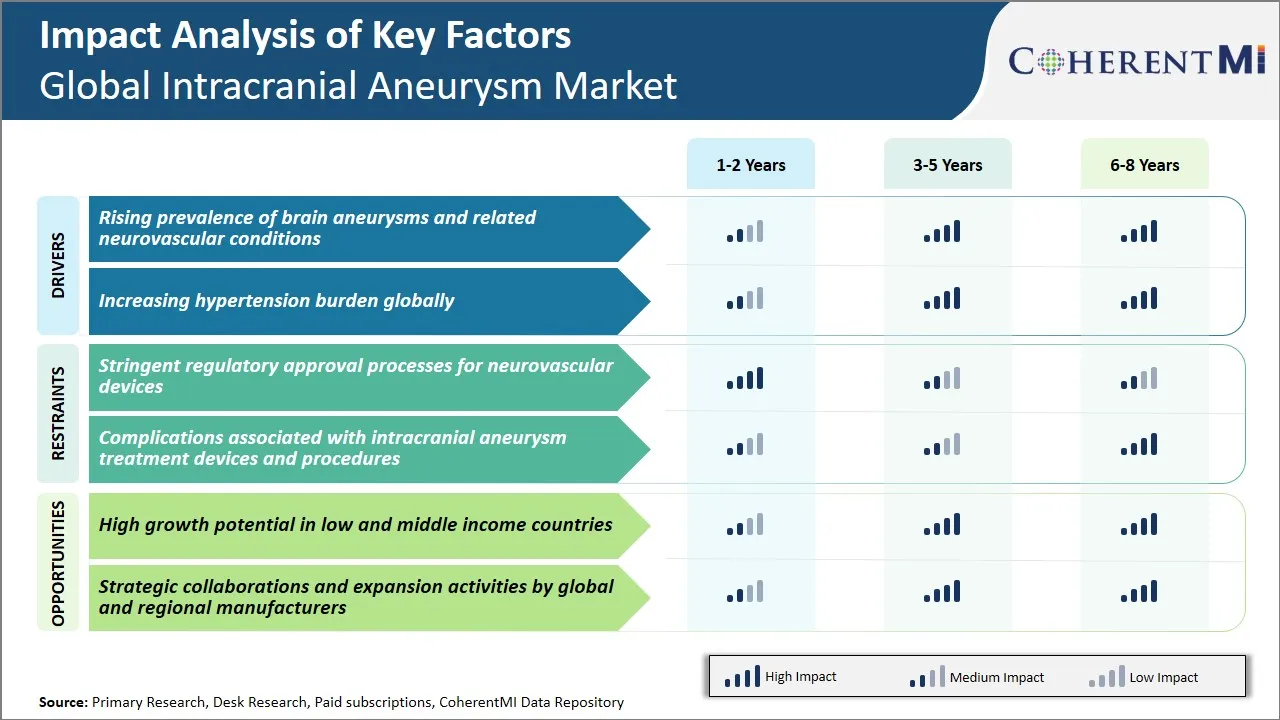
Market Driver - Rising Prevalence of Brain Aneurysms and Related Neurovascular Conditions
The worldwide healthcare environment is experiencing an alarming trend on cases of brain aneurysm and related neurovascular conditions, which essentially is overhauling the forces of demand in the intracranial aneurysm repair markets. The rising popularity is one of the most influential triggers that stimulate market growth, with healthcare systems across the world struggling to cope with a growing number of patients that demand complex diagnostic and treatment procedures. This trend is not merely a complex tally of increasing statistics but rather a multifaceted range of factors that, in combination, will cause significant pressure on the healthcare infrastructure, but at the same time, generate considerable opportunities to the manufacturers of medical devices, pharmaceutical manufacturing companies, and specialized treatment centers.
For instance, in the U.S., an estimated 6.7 million people live with an unruptured brain aneurysm, roughly 1 in 50 adults, highlighting the substantial underlying prevalence of this condition.
(Sources-https://www.bafound.org/wp-content/uploads/2023/08/Stats-and-Facts_download.pdf)
Market Driver - Increasing Hypertension Burden Globally
Hypertension has developed into a characteristic issue of the twenty-first century in the context of the formation of the market of intracranial aneurysms, becoming one of the principal causes of increasing the market of cerebral vascular pathology with direct causal relations. The worldwide epidemic of high blood pressure has been so massive that it is no longer a geographical and socioeconomic issue as it cuts across all demographic groups. Such a high incidence of hypertension generates a large risk pool in the development of an aneurysm, as intense short-term and permanent mechanical forces on cerebral arterial walls by constant high blood pressure undermine vessel integrity and stimulate aneurysm formation and development. Pathophysiological pathways between hypertension and intracranial aneurysm formation are associated with the complex hemodynamic forces, which act continuously in the cerebral circulation.
 To learn more about this report, Request Free Sample Copy
Market Challenge - Stringent Regulatory Approval Processes for Neurovascular Devices
The global market of intracranial aneurysm is also facing a lot of head winds due to the stricter regulatory approvals processes in the key markets, especially in the U.S., the European Union and Japan. The stringent premarket approval (PMA) route offered by the U.S. FDA to Class III neurovascular devices need to undergo rigorous clinical trials over a number of years with comprehensive data on safety and efficacy showing that this device is better than the current treatment. Such regulatory vigor is explained by the sensitivity of intracranial procedures, as malfunctioning of the device may lead to disastrous consequences such as stroke, irreversible neurological damage, or even death of a patient. European Medical Device Regulation (MDR), which was adopted in 2021, has gone a step higher and demanded high standards of approval, including improved clinical evidence, post-market monitoring, and distinct systems to identify devices.
Market Opportunity - High Growth Potential in Low and Middle-Income Countries
The Low- and Middle-Income Countries (LMICs) are a ground-breaking market in the world of intracranial aneurysms with the rising and advancing healthcare facilities, increasing populations of the middle-income with more healthcare spending power, and the growing awareness of neurological disorders. Other countries like China, India, Brazil, Mexico, and Southeast Asian countries are undergoing unprecedented modernization of their healthcare systems with governments spending lots of finances on tertiary care units and specialized neurovascular centers. The increasing occurrence of risk factors such as high blood pressure, diabetes, and lifestyle diseases in these areas is fueling an increase in the number of cases of intracranial aneurysms, which has generated significant unfulfilled medical requirements.
For instance, of the estimated 537 million adults (20-79 years) with diabetes in 2021, ~77 % were in middle-income countries and ~3.5 % in low-income countries, confirming concentration of cases in LMIC settings.
(Source-https://idf.org/about-diabetes/diabetes-facts-figures/)
Next-Generation Endovascular Technologies Reshaping the Intracranial Aneurysm Market
- Advanced Endovascular Device Innovation- Faster use of next-generation flow diverters, intrasaccular embolization systems, bioactive and hydrogel-coated coils, as well as low-profile stent-assisted coiling platforms and devices designed to work with complex anatomies like wide-neck, bifurcation, distal, and small vessels to enhance complete occlusion rate, recurrence, and increase treatable patient populations and minimally invasive endovascular procedure over surgery.
- Digital Integration & Procedural Intelligence- Integration of AI-driven imaging analytics, automated aneurysm detection software, advanced 3D rotational angiography, robotic-assisted neurointervention systems, and real-time navigation technologies enhancing diagnostic accuracy, optimizing pre-procedural planning, improving procedural precision, reducing radiation exposure, and enabling complex endovascular interventions in high-volume tertiary stroke centers.
Key winning strategies adopted by key players of Intracranial Aneurysm Market
- Major industry leaders of intracranial aneurysm are focusing on multiplying their portfolio by sustaining the pace of device development and speeding up regulatory reviews. Firms are spending on newer generation flow divertors, intrasaccular embolization systems, bioactive coils and low-profile stent platforms in complex and wide neck aneurysms. Early clinical trial execution, multi-center outcome data generation, and quick U.S. FDA and CE approvals are also being used to enhance competitive positioning. Minimal invasive endovascular dominance with strategic emphasis; supported by physician training and key opinion leaders has facilitated more rapid adoption in high volume neurovascular centers.
- Simultaneously, businesses are seeking focused acquisitions, technology alliances as well as geographical growth processes to merge market share. Neurovascular acquisitions of niche innovators assist large MedTech companies to diversify their portfolio with differentiated technologies and also save the time of commercialization. Growth in Asia Pacific and Latin America is being tapped through expansion into emerging markets, setting up regional manufacturing centers, and local reimbursement alignment. Also, the incorporation of AI-enabled imaging systems and robotic-assisted intervention systems is enhancing the control over the ecosystem, increasing switching costs, and establishing a long-term commitment to the procedure among neurosurgeons and interventional neuroradiologists.
Segmental Analysis of Intracranial Aneurysm Market
 To learn more about this report, Request Free Sample Copy
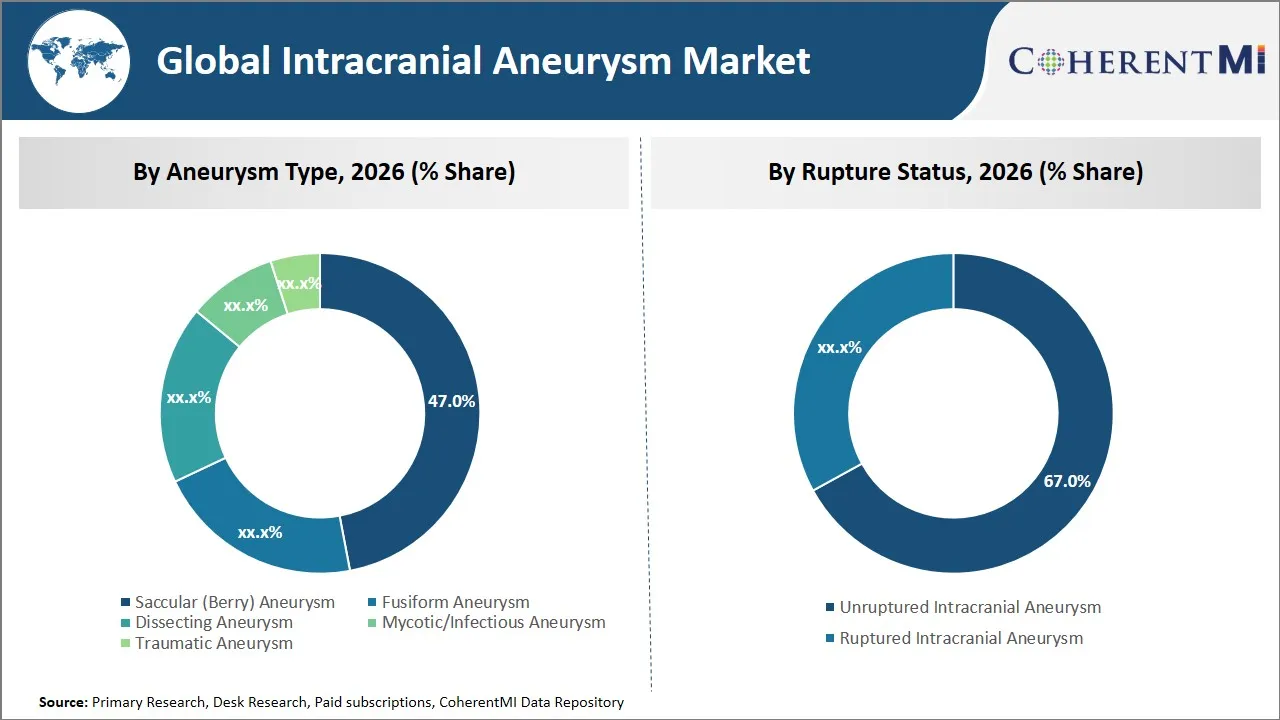
Insights, By Aneurysm Type: Saccular (Berry) Aneurysm Driven by Clinical Prevalence and Anatomical Predisposition
By aneurysm type, saccular (berry) aneurysm takes the largest portion of the market with an estimated share of 47% in 2026, owing to its overwhelming clinical prevalence and distinct anatomical characteristics that make it the most commonly encountered intracranial aneurysm type. Saccular aneurysms comprise about 85-90 percent of all intracranial aneurysms which are essentially motivated by how they come to be formed in points of arterial bifurcation where hemodynamic stress is concentrated. These aneurysms are formed by degenerative changes in the arterial wall, especially with the media and internal elastic lamina, which form focal weaknesses, which protrude as a result of the constant pressure of blood.
For instance, in August 2025, MicroPort NeuroScientific launched its Numen coil embolisation system in Egypt, enhancing local access to advanced endovascular coiling technology for aneurysm management in partnership with PentaMed.
Insights, By Rupture Status: Unruptured Intracranial Aneurysm Driven by Enhanced Screening Technologies and Conservative Management Approaches
By rupture status, unruptured intracranial aneurysm takes the largest portion of the market with an estimated share of 67% in 2026, owing to revolutionary advances in non-invasive screening technologies and the fundamental shift toward preventive neurological care. The widespread adoption of high-resolution imaging modalities, including CT angiography and MR angiography, has dramatically increased incidental aneurysm discovery rates during routine medical evaluations for unrelated conditions such as headaches, dizziness, or trauma assessments. This technological accessibility has unveiled a previously hidden population of asymptomatic aneurysm carriers, fundamentally expanding the addressable market for unruptured aneurysm management.
Rising Disease Burden and Evolving Clinical Management Trends in Intracranial Aneurysms
- Growing prevalence of intracranial aneurysms making up approximately 2-3 percent of the adult population as populations age; increased prevalence, caused by ageing, hypertension, smoking, genetic factors and enhanced ability to detect the aneurysms using advanced MRI and CT angiography- creating a larger number of diagnosed unruptured aneurysms.
- A shift toward less invasive endovascular-based clinical management techniques where early risk stratification is focused on aneurysm size, morphology and location where a major trend is the shift towards less invasive endovascular techniques due to reduced morbidity perioperative, shorter hospital stays and better long-term occlusion results than surgical clipping.
Additional Insights of Intracranial Aneurysm Market
- Growing global prevalence of intracranial aneurysms, with 2–3% of adults affected, increasing diagnosis rates due to advanced neuroimaging adoption.
- Strong shift toward minimally invasive endovascular procedures such as flow diversion, stent-assisted coiling, and intrasaccular devices over traditional surgical clipping.
- Continuous technological advancements including next-generation flow diverters, bioactive coils, AI-assisted imaging, and robotic neurointervention platforms.
- Increasing regulatory approvals and clinical evidence supporting early intervention for unruptured and complex aneurysms.
Competitive overview of Intracranial Aneurysm Market
The major players operating in the global intracranial aneurysm market include B Braun, Balt Group, Integra LifeSciences, Johnson and Johnson MedTech, Medtronic, MicroPort NeuroTech, Mizuho Medical, Penumbra, Peter Lazic GmbH, phenox GmbH, Shape Memory Medical, Stryker, Terumo Corporation, Wallaby Medical, and Zylox Tonbridge Medical Technology.
Intracranial Aneurysm Market Leaders
- B Braun
- Balt Group
- Integra LifeSciences
- Johnson and Johnson MedTech
- Medtronic
Recent Developments in Intracranial Aneurysm Market
- In January 2025, Kaneka Corporation announced the commercial launch of its i-ED COIL for brain aneurysm embolization across Europe following the successful receipt of EU Medical Device Regulation (MDR) certification. The certification enables the company to initiate sales of the device in key European markets, strengthening its neurovascular portfolio.
- In January 2025, Kaneka Corporation acquired a 8% stake in EndoStream Medical, an Israeli medical equipment firm focused on aneurysm technology (including the Nautilus device), consolidating R&D and expanding its neurovascular portfolio.
- In May 2023, Stryker Corporation announced the completion of its acquisition of Cerus Endovascular Ltd., a company specializing in neurointerventional devices for intracranial aneurysm treatment. The acquisition strengthens Stryker’s neurovascular portfolio, adding innovative intrasaccular and flow diversion technologies to its global offerings.
Intracranial Aneurysm Market Segmentation
- By Aneurysm Type
- Saccular (Berry) Aneurysm
- Fusiform Aneurysm
- Dissecting Aneurysm
- Mycotic/Infectious Aneurysm
- Traumatic Aneurysm
- By Rupture Status
- Unruptured Intracranial Aneurysm
- Ruptured Intracranial Aneurysm
- By Aneurysm Size
- Small (<7 mm)
- Medium (7–12 mm)
- Large (13–24 mm)
- Giant (≥25 mm)
- By Aneurysm Location
- Anterior Circulation
- Internal carotid artery (ICA)
- Anterior communicating artery (ACom)
- Middle cerebral artery (MCA)
- Anterior cerebral artery (ACA)
- Posterior Circulation
- Basilar artery
- Posterior communicating artery (PCom)
- Vertebral artery
- Posterior cerebral artery (PCA)
- Anterior Circulation
- By Diagnosis Modality
- Computed Tomography (CT)-Based
- CT
- CT Angiography (CTA)
- Magnetic Resonance (MR)-Based
- MRI
- MR Angiography (MRA)
- Catheter-Based Angiography
- Digital Subtraction Angiography (DSA)
- Other Diagnostic Tests
- Lumbar puncture (rupture susp
- Computed Tomography (CT)-Based
- By Treatment Modality
- Endovascular Treatment
- Coiling-based treatment
- Stent-assisted coiling
- Balloon-assisted coiling
- Flow diversion
- Intrasaccular flow disruption
- Liquid embolic/adjunct embolization
- Microsurgical Treatment
- Surgical clipping
- Bypass with trapping (select cases)
- Wrapping/other surgical approaches
- Conservative Management (Monitoring)
- Imaging surveillance
- Risk-factor management
- Endovascular Treatment
- By End User
- Hospitals
- Tertiary care hospitals
- Multi-specialty hospitals
- Specialty Neuroscience / Neurovascular Centers
- Ambulatory Surgical Centers (limited/select procedures)
- Academic & Research Institutes
- Hospitals

Would you like to explore the option of buying individual sections of this report?
Ghanshyam Shrivastava - With over 20 years of experience in the management consulting and research, Ghanshyam Shrivastava serves as a Principal Consultant, bringing extensive expertise in biologics and biosimilars. His primary expertise lies in areas such as market entry and expansion strategy, competitive intelligence, and strategic transformation across diversified portfolio of various drugs used for different therapeutic category and APIs. He excels at identifying key challenges faced by clients and providing robust solutions to enhance their strategic decision-making capabilities. His comprehensive understanding of the market ensures valuable contributions to research reports and business decisions.
Ghanshyam is a sought-after speaker at industry conferences and contributes to various publications on pharma industry.