Spinal Cord Stimulators Market SIZE AND SHARE ANALYSIS - GROWTH TRENDS AND FORECASTS (2026 - 2033)
Spinal Cord Stimulators Market is segmented By Product Type (Implanted Spinal Cord Stimulators, Exte...
Spinal Cord Stimulators Market Size - Analysis
The global spinal cord stimulators market is estimated to be valued at USD 3.51 Bn in 2026 and is expected to reach USD 6.80 Bn by 2033, exhibiting a CAGR of 9.9% from 2026 to 2033. This growth is driven by the increasing prevalence of chronic pain conditions, expanding geriatric population, and the rising adoption of minimally invasive procedures worldwide. The market is further supported by technological advancements in neurostimulation devices and growing healthcare expenditure across both developed and emerging economies. Additionally, the expanding use of spinal cord stimulators in treating inflammatory pain conditions is contributing to the market’s rapid growth, as more patients seek alternatives to traditional pain management therapies.
Market Size in USD Bn
CAGR9.9%
| Study Period | 2026 - 2033 |
| Base Year of Estimation | 2025 |
| CAGR | 9.9% |
| Market Concentration | Medium |
| Major Players | Medtronic plc, Boston Scientific Corporation, Abbott Laboratories, Nevro Corp, Saluda Medical Pty Ltd and Among Others |

please let us know !
Spinal Cord Stimulators Market Trends
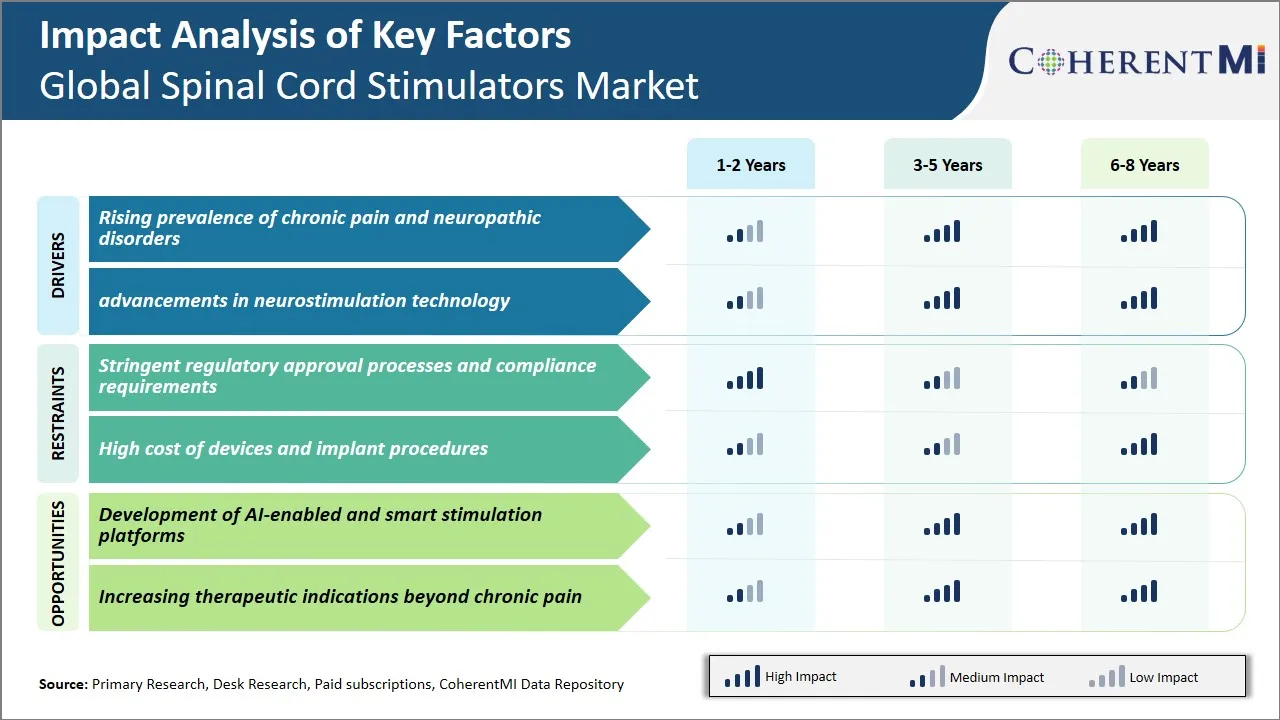
Market Driver - Rising Prevalence of Chronic Pain and Neuropathic Disorders
The world in healthcare is experiencing an unprecedented increase in chronic pain conditions and neuropathic disorders that are fundamental in changing the dynamics of demand for spinal cord stimulation devices. This epidemiological change is one of the most attractive growth drivers in the spinal cord stimulators market since conventional methods of pain management solutions are being outpaced in terms of countering the complex, persistent nature of the chronic pain syndromes. Chronic pains are experienced by millions of people across the globe, regardless of the demographic level, and pose significant challenges to the health care systems in most countries of the world.
Chronic pain has a complex nature that brings in several diseases such as failed back surgery syndrome, complex regional pain syndrome, diabetic peripheral neuropathy, post-herpetic neuralgia, and arachnoiditis among others. Such conditions are usually intractable to other standard treatment modalities and present an important unmet medical need that is uniquely covered by the spinal cord stimulation technology.
For instance, in April 2023, CDC reported that about 20.9% of U.S. adults experienced chronic pain in 2021, and 6.9% had high‑impact chronic pain restricting daily activities, with higher prevalence among non‑Hispanic American Indian or Alaska Native, bisexual, and divorced adults.
(Source: https://www.cdc.gov/mmwr/volumes/72/wr/mm7215a1.htm)
Market Driver - Advancements in Neurostimulation Technology
The spinal cord stimulators market is enjoying the phenomenal momentum due to the new technological inventions that are transforming the effectiveness, safety, and patient experience of the neurostimulation therapy. These technical breakthroughs are a revolution over ancient stimulation devices with advanced engineering solutions that overcome the old constraints as well as creating new therapeutic options in chronic pain management. The present day spinal cord stimulation systems are not the mere one and one parameter devices but very advanced platforms, capable of providing various waveforms, frequencies, and stimulation patterns with a higher level of precision and customization opportunities than ever before.
In October 2025, Medtronic Inc. announced that its BrainSense Adaptive Deep Brain Stimulation (aDBS) system was named to TIME's Best Inventions list. Medtronic, a leader in healthcare technology, developed the world’s first closed-loop DBS system for Parkinson's patients. This innovation personalizes therapy based on real-time brain activity, enhancing treatment outcomes.
 To learn more about this report, Request Free Sample Copy
Market Challenge - Stringent Regulatory Approval Processes and Compliance Requirements
The global market of spinal cord stimulators has serious headwinds such as tougher regulatory approval procedures and complicated compliance regulations to the key healthcare markets. The authorities like U.S. FDA in the U.S., EMA in Europe, and other national health authorities have put stringent pre-market assessment procedures which require extensive clinical trial reports, full safety testing and manufacture quality records.
Such requirements normally increase product development cycle by 2-4 years and may cost manufacturers USD 10-50 million per device approval, establishing a significant barrier to market entry, especially of novel startups and other smaller medical device firms.
Market Opportunity - Development of AI-Enabled and Smart Stimulation Platforms
The division of smart technology and artificial intelligence platforms is a paradigm shift in a global market of spinal cord stimulators, and a revolution that can change the way patients are treated and provide significant competitive advantages to the first-mover. Stimulation systems enabled by AI can make use of the machine learning algorithms to continuously resolve the response patterns of patients, physiological parameters, and stimulation effectiveness to optimize the therapy delivery in real-time without the need to visit the clinic frequently.
Such smart systems have the potential to process large volumes of patient data to determine the most appropriate stimulation settings, forecast the type of adjustments required in the treatment process to change the pain patterns, and even predict how to maintain the equipment, which significantly enhances the healing process at a lower cost to healthcare organizations.
For example, in November 2024, Nevro Corp., a global medical device company, announced that its HFX iQ spinal cord stimulation (SCS) system received CE Mark Certification in Europe. This makes HFX iQ the first AI-enabled SCS system combining high-frequency therapy with cloud data insights to deliver personalized pain relief. The system's AI technology provides real-time therapy adjustments based on patient inputs, optimizing chronic pain management.
(Source: https://intl.nevro.com/English/us/investors/investor-news/investor-news-)
Segmental Analysis of Spinal Cord Stimulators Market
 To learn more about this report, Request Free Sample Copy
Insights, By Product Type - Superior Therapeutic Efficacy and Precision Drive Implanted Spinal Cord Stimulators’ Dominance
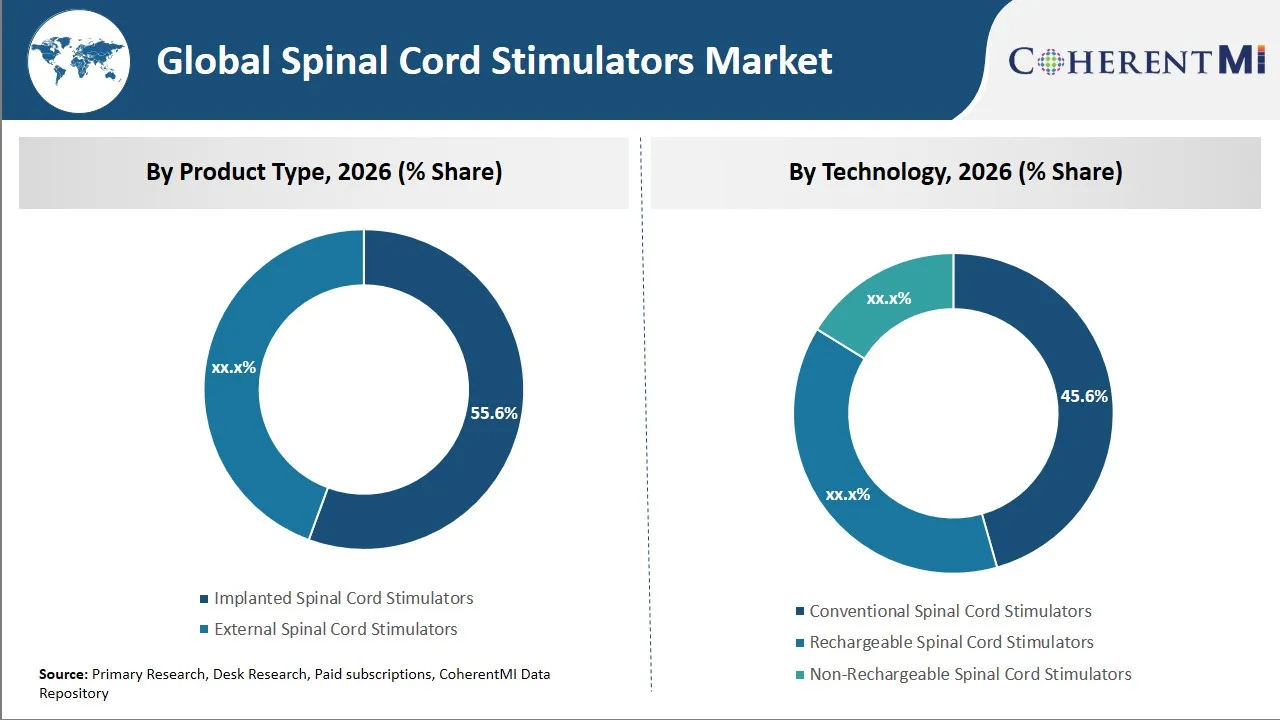
By product type, the largest portion of the market is contributed by implanted spinal cord stimulators that consumes an estimated 55.6% of the market share in 2026, due to its better therapeutic effectiveness, high patient adherence and technological advancement that the external substitute cannot match. The basic benefit of implanted devices is that they are in direct contact with the spinal cord so that they can provide electrical stimulations more precisely with reduced signal loss. Such positioning is also able to better target certain neural pathways that give rise to pain transmission, and therefore the effects of external stimulators will be much more successful in producing pain relief.
Implanted spinal cord stimulators are permanent and thus patients do not have the daily burden of managing the device as is the case with external systems. The patients will no longer have to be concerned with the correct placement of electrodes, skin irritation caused by adhesive patches and inconvenience of carrying external pulse generators. This smooth incorporation into the body of the patient has a tremendous ability to enhance quality of life and compliance of the treatment since the treatment becomes practically invisible to the patient and people around them.
In November 2024, Nevro Corp., a global medical device company specializing in chronic pain solutions, launched HFX AdaptivAI, the only AI-driven spinal cord stimulation (SCS) system. The system uses insights from over 100,000 patients and 100 million data points to provide personalized pain relief. It features real-time therapy optimization, enhanced remote monitoring for physicians, and smart power technology. Nevro expects a full market release of HFX iQ with HFX AdaptivAI in the U.S. by the fourth quarter of 2024.
(Source: https://intl.nevro.com/English/us/investors/investor-news/)
Insights, By Technology - Established Clinical Protocols and Proven Efficacy Sustain Conventional Spinal Cord Stimulators Leadership
By technology, conventional spinal cord stimulators takes over the largest estimated market share of 45.6% in 2026, because they have established clinical procedures, proven long-term effectiveness, and widespread knowledge of the use by physicians which generates confidence in treatment results. Clinical trials and real-life experiences documenting the safety and efficacy of conventional patterns of stimulation have led to decades of thorough investigation of the subject and have given health practitioners a strong evidence-based basis in the form of treatment guidelines that do not create confusion in patient selection and device programing.
The common knowledge that has been acquired by physicians in traditional technology poses a serious market strength that new technologies face challenges in breaking through. The training and experience of neurologists, pain management specialists, and neurosurgeons in conventional stimulation parameters and programming protocols, and trouble-shooting operations is vast. This institutional wisdom decreases learning curve on new practitioners and provides uniformity in the delivery of treatments in different health care facilities.
Reimbursement and Coding Changes Driving Growth in the Spinal Cord Stimulators Market:
- Reimbursement stability for spinal cord stimulators (SCS) is crucial for market growth, as consistent coverage allows for broader patient access. Many insurance providers and government programs, such as Medicare, offer reimbursement for SCS procedures, particularly for chronic pain management. However, reimbursement policies can vary by region and insurer, affecting market dynamics and patient affordability.
- Coverage depth in the market is expanding, with increasing acceptance of newer technologies like closed-loop systems and AI-enabled devices. Insurers are recognizing the long-term benefits of SCS, including improved quality of life and reduced healthcare costs. As the evidence base for SCS efficacy grows, coverage is likely to broaden, ensuring more patients have access to advanced spinal cord stimulation therapies.
- For example, in August 2024, new CPT coding changes took effect for neuromodulation procedures, differentiating traditional and integrated neurostimulation systems. Codes like 63685 and 64590 now apply only to systems with separate pulse generators. New codes for the insertion, replacement, and revision of percutaneous electrode arrays with integrated neurostimulators were introduced, along with programming codes for integrated spinal cord stimulators. These updates improve the categorization and reimbursement for advanced treatments.
(Source: https://www.ama-assn.org/system/files/cpt-assistant-neurostimulator-codes.pdf)
Additional Insights of Spinal Cord Stimulators Market
- By product type, implanted spinal cord stimulators are expected to hold the largest market share at 55.6% in 2026.
- In terms of technology, conventional spinal cord stimulators will lead the market with a share of 45.6% in 2026.
- Regarding application, chronic pain management is projected to account for the highest market share at 25.6% in 2026.
- North America is expected to lead the market, holding a share of 39.9% in 2026. Asia Pacific is anticipated to be the fastest-growing region, with 25.5% share in 2026.
Competitive overview of Spinal Cord Stimulators Market
The major players operating in the global spinal cord stimulators market include Medtronic plc, Boston Scientific Corporation, Abbott Laboratories, Nevro Corp, Saluda Medical Pty Ltd, Stimwave LLC, NeuroSigma Inc, Synapse Biomedical Inc, Cirtec Medical / Nuvectra Corporation, Beijing PINS Medical Co Ltd, Axonics Modulation Technologies Inc, SPR Therapeutics Inc, Inspire Medical Systems Inc, LivaNova PLC, and Integer Holdings Corporation.
Spinal Cord Stimulators Market Leaders
- Medtronic plc
- Boston Scientific Corporation
- Abbott Laboratories
- Nevro Corp
- Saluda Medical Pty Ltd
Recent Developments in Spinal Cord Stimulators Market
- In April 2024, Medtronic received U.S. FDA approval for its Inceptiv closed-loop spinal cord stimulator, designed to treat chronic pain. Inceptiv is the first Medtronic device to feature closed-loop technology, adjusting stimulation in real-time based on biological signals, ensuring personalized therapy. It is the smallest and thinnest implantable SCS device, offering full-body MRI access and comfort.
- In July 2024, Boston Scientific Corporation, a global leader in medical devices, received U.S. FDA approval for two new spinal cord stimulation (SCS) leads, the Linear 3-4 and Linear 3-6 Percutaneous Leads, for use with its Precision Plus system. These new leads offer wider contact spacing, providing more options for physicians in managing chronic pain. With this approval, Boston Scientific expands its lead offerings, enhancing treatment customization for patients suffering from chronic pain.
- In December 2022, Abbott received U.S. FDA approval for its Eterna spinal cord stimulation (SCS) system, the smallest rechargeable implantable SCS device for chronic pain. Eterna uses Abbott's low-dose BurstDR stimulation, proven to reduce pain more effectively than traditional approaches. The system is designed for comfort, requiring recharging only five times per year, minimizing patient burden.
- In December 2024, Onward Medical, a Netherlands-based company, received U.S. FDA approval for its ARC-EX System, the first noninvasive spinal cord stimulation (SCS) device for spinal cord injury (SCI) patients. This groundbreaking technology restores some hand strength and sensation lost from SCIs, even those that occurred decades ago. The system works by stimulating the spinal cord's nervous circuitry, making previously dormant nerve fibers more excitable.
Spinal Cord Stimulators Market Segmentation
- By Product Type
- Implanted Spinal Cord Stimulators
- External Spinal Cord Stimulators
- By Technology
- Conventional Spinal Cord Stimulators
- Rechargeable Spinal Cord Stimulators
- Non-Rechargeable Spinal Cord Stimulators
- By Application
- Chronic Pain Management
- Back Pain
- Neck Pain
- Leg Pain
- Failed Back Surgery Syndrome (FBSS)
- Complex Regional Pain Syndrome (CRPS)
- Arachnoiditis
- Others (Peripheral Neuropathy
- By End User
- Hospitals
- Ambulatory Surgical Centers
- Specialty Pain Clinics
- By Distribution Channel
- Online
- Offline

Would you like to explore the option of buying individual sections of this report?
Manisha Vibhute is a consultant with over 5 years of experience in market research and consulting. With a strong understanding of market dynamics, Manisha assists clients in developing effective market access strategies. She helps medical device companies navigate pricing, reimbursement, and regulatory pathways to ensure successful product launches.