Bone Densitometer Market SIZE AND SHARE ANALYSIS - GROWTH TRENDS AND FORECASTS (2026 - 2033)
Bone Densitometer Market is segmented By Technology Type (Dual-energy X-ray absorptiometry (DEXA), Q...
Bone Densitometer Market Size - Analysis
The Global Bone Densitometer Market is estimated to be valued at USD 295.9 million in 2026 and is expected to reach USD 402.6 million by 2033, exhibiting a compound annual growth rate (CAGR) of 4.5% from 2026 to 2033. This steady growth trajectory reflects the increasing global awareness of osteoporosis and bone-related disorders, particularly among aging populations worldwide. The market expansion is primarily driven by rising healthcare expenditure, technological advancements in diagnostic equipment, and growing emphasis on preventive healthcare measures across developed and emerging economies.
Market Size in USD Mn
CAGR4.50%
| Study Period | 2026 - 2033 |
| Base Year of Estimation | 2025 |
| CAGR | 4.50% |
| Market Concentration | High |
| Major Players | Hologic, GE HealthCare, FUJIFILM, Hitachi, DMS Imaging and Among Others |

please let us know !
Bone Densitometer Market Trends
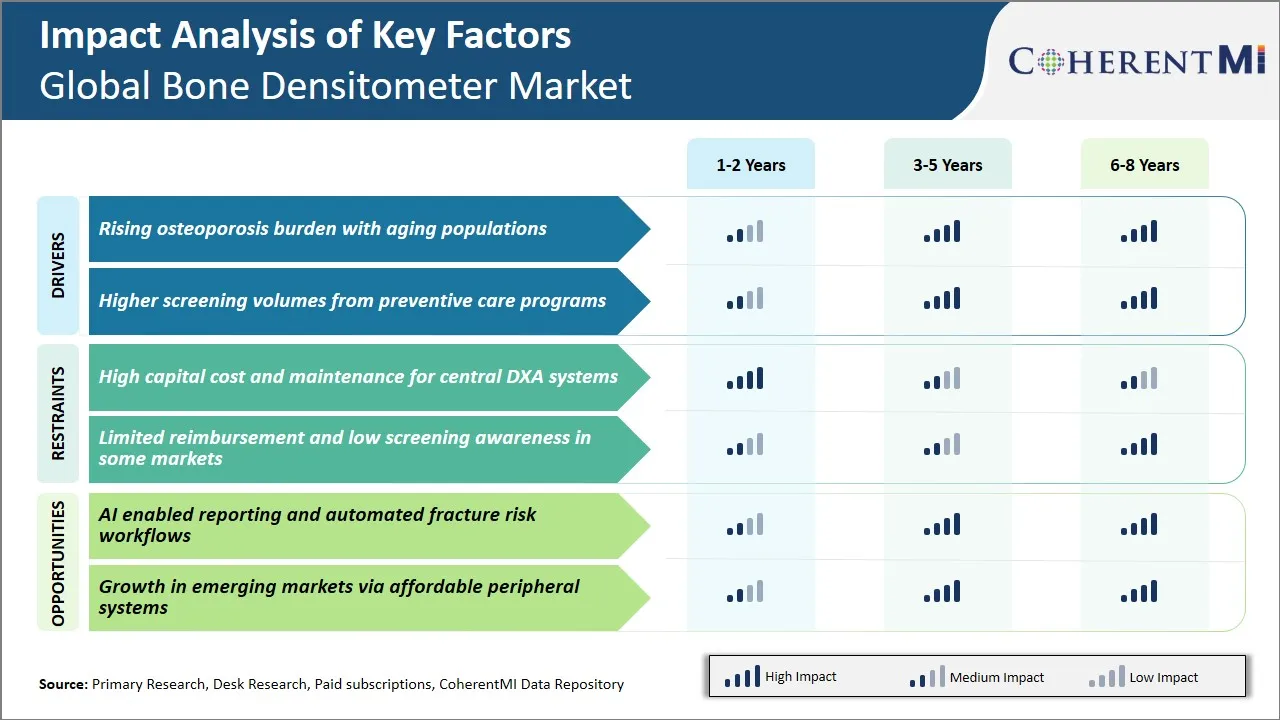
Bone Densitometer Market Driver - Rising Osteoporosis Burden with Aging Populations
The demographic change that has taken place in both developed and developing countries is among the greatest forces driving the bone densitometer market in the world. The global life expectancy has been steadily increasing, leading to a higher percentage of the aged population. This demographic shift has fundamentally changed the healthcare landscape, generating a high demand for specialized medical equipment to address age-related issues. Osteoporosis, commonly known as the disease without symptoms because of its insidious nature without showing any symptoms until the time of the fractures, has become a major health issue of concern among various populations in the world, and the postmenopausal women and older men are the main risk groups. Pathophysiology of osteoporosis entails the gradual disintegration of bone tissues and decrease of the bone mineral density and this results to greater bone fragility and vulnerability to fractures, especially to the hip, spine, and the wrist region.
For example, according to International Osteoporosis Foundation, osteoporosis remains a significant global health concern, affecting one in three women and one in five men over 50. The disease leads to fragility fractures, with initial fractures increasing the risk of future fractures. The incidence of osteoporosis is rising due to aging populations and lifestyle changes. It is estimated that 75 million people in Europe, the U.S., and Japan are affected, with osteoporosis often under-diagnosed in Asia Pacific. In China and India, many patients in rural areas receive conservative treatment for hip fractures instead of surgical intervention.
Bone Densitometer Market Driver - Higher Screening Volumes from Preventive Care Programs
The basic change of the healthcare delivery paradigm into the preventative one can be defined as a revolutionary force that redefines the market environment of the bone densitometers in the world. The strategic importance of introducing all-inclusive preventive care programs focusing on preventing and treating illnesses at an initial stage, instead of responding to the disease outbreak, has become apparent to healthcare systems across the world.
A growing body of evidence that has shown the clinical efficacy and cost-effectiveness of use of preventive healthcare methods has guided this paradigmatic shift, especially in the treatment of chronic diseases that are mostly prevalent in aging populations. Bone density screening has become the cornerstone of these preventive care programs, and healthcare institutions have adopted regular screening programs that are aimed at recognizing the people who are at risk of getting osteoporosis before the clinical features or fractures occur.
 To learn more about this report, Request Free Sample Copy
Bone Densitometer Market Challenge - High Capital Cost and Maintenance for Central DXA Systems
The huge amount of capital investment and continuous maintenance needs of central dual-energy X-ray absorptiometry (DXA) systems are tremendous headwinds to the global bone densitometer market. The cost of these advanced diagnostic machines is on average between USD 150,000 - USD 400,000., which deteriorates to a huge amount of money to smaller healthcare organizations, independent clinics and new players in the market. This is worsened by the fact that the cost of acquiring is very high and that there are strict infrastructure needs such as specialization on the space of installation with correct radiation shielding, climate systems and specific electrical structures.
In addition to the upfront cost, central DXA systems require ongoing maintenance systems, which require regular calibration measures, quality assurance measures, and preventive maintenance contracts which might require USD 15,000 to USD 30,000 per annum. These systems are too complex, which means that they require special technological support and certified service providers, and they may have to enter into costly contracts with the service providers of the equipment that they use. Also, central DXA equipment has a depreciation period of 8-10 years, within which technological obsolescence risk develops that might need expensive upgrades or a total replacement of the system.
Bone Densitometer Market Opportunity - AI-Enabled Reporting and Automated Fracture Risk Workflows
Artificial intelligence/automated fracture risk monitoring is a ground-breaking opportunity that can bring a disruption in the market of bone densitometers. The AI-based diagnostic capabilities will solve the main workflow inefficiencies and interpretation issues existing in the markets and impeding their development, especially in the areas of low concentration of specialized radiologists and rheumatologists.
Most of the newer machine learning techniques can now analyze DXA scan results with unprecedented accuracy, revealing subtle changes in bone density, vertebral fractures, and personal fracture risk scores with the help of full-fledged instruments such as FRAX. The technical development allows medical professionals to provide more accurate and quicker diagnostic outcomes and minimize the use of expert knowledge to interpret the results.
For instance, in November 2022, Medimaps Group, a Swiss medtech software company, partnered with OsteoSys, a South Korea-based Bone Densitometer manufacturer. The collaboration integrated Medimaps’ AI powered TBS iNsight technology into OsteoSys DXA Bone Densitometer systems. The solution enhances fracture risk assessment by analyzing bone microarchitecture alongside bone mineral density.
Segmental Analysis of Bone Densitometer Market
 To learn more about this report, Request Free Sample Copy
Insights, By Technology Type - DEXA technology’s Superior Clinical Accuracy and Established Healthcare Infrastructure Drive Market Leadership
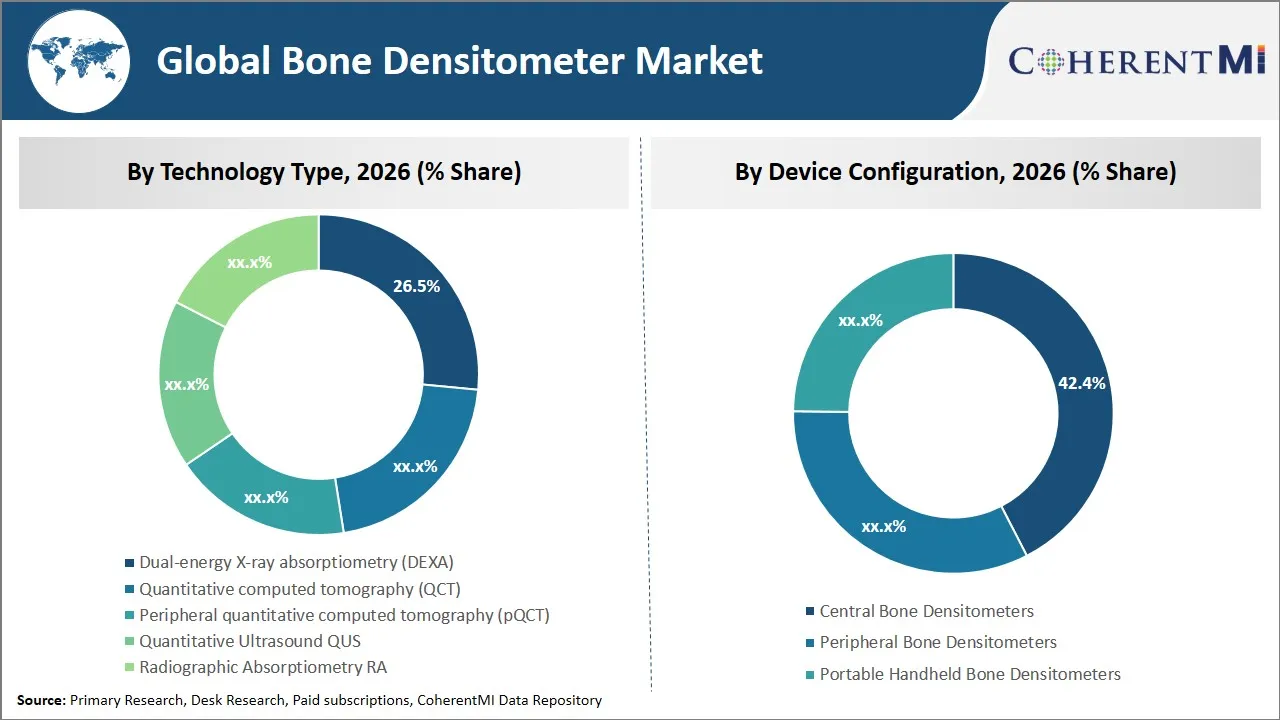
By technology type, Dual-energy X-ray absorptiometry (DEXA) is expected to hold the largest market share of 26.5% in 2026 attributable to its very high diagnostic accuracy and the overall acceptance of this type of diagnostic test among the healthcare facilities of the world. The DEXA technology has become the gold standard of bone density testing because it is capable of giving highly accurate and reproducible bone density data with minimal radiation exposure and it is, thus, preferred when testing osteoporosis patients initially and also when monitoring them over the long term.
The technological excellence of DEXA is that, it has a highly advanced mechanism of dual-energy photon beam that can successfully distinguish the bone mineral content and soft tissue, providing accurate bone mineral density results. With this high level of imaging, medical practitioners are able to capture even minute alterations in bone density which can be used to institute earlier intervention measures against osteoporosis and prevention of fractures.
For instance, in January 2026, DexaFit Scottsdale, a health and wellness provider, expanded its Dual-energy X-ray absorptiometry (DEXA) scan service to Scottsdale and surrounding areas, including Phoenix, Paradise Valley, and Fountain Hills. The DEXA scan measures body composition and bone density, offering accurate insights into fat, lean tissue, and bone health. This service, previously limited to clinical and research settings, is now available to the public, helping individuals make informed health and fitness decisions.
Insights, By Device Configuration - Central Bone Densitometers’ Clinical Precision and Comprehensive Diagnostic Capabilities Drive Healthcare Preference
Regarding device configuration, central bone densitometers take the largest portion of the market with an estimated share of 42.4% in 2026 mainly because of the better diagnostic accuracy and comprehensive measurement abilities of the machines that can help measure clinically sensitive skeletal areas. The spine and the hip are the most important areas of the body where the diagnosis of osteoporosis and the risk of fractures can be measured by the central densitometers that offer unparalleled accuracy in determining bone density at these locations as recommended by the known medical procedures and diagnostic parameters.
Bone densitometers are clinically better because of the high imaging and software algorithm that give accurate measurements of axial skeletal locations. They are precise in the evaluation of trabecular and cortical bone in the lumbar spine and the proximal femur due to high-resolution imaging and high-quality detection. Such accuracy is necessary to identify early changes in osteoporosis and when treating the disease, since they are the locations where the risk of fracture is identified and different medicines change them.
Technology & Innovation Levers in Bone Densitometer Market:
|
Technology/Innovation |
Description |
Impact on Market |
|
AI-based Fracture-Risk Scoring |
Integration of AI algorithms for personalized fracture risk assessment based on bone density scans. |
Enhances diagnostic accuracy, offers tailored treatment plans, and improves patient outcomes. |
|
Automated Analytics |
Automation of bone density analysis, reducing manual intervention and improving efficiency. |
Speeds up the diagnosis process, increases throughput, and reduces human error in assessments. |
|
Advanced Imaging Algorithms |
Use of advanced algorithms to detect subtle bone variations, vertebral fractures, and early signs of osteoporosis. |
Provides early detection, enabling timely interventions and personalized treatment strategies. |
|
Comprehensive Risk Assessment Tools |
Incorporation of tools like FRAX for calculating fracture risk scores based on multiple factors. |
Adds a predictive layer, helping clinicians make more informed decisions on patient care and prevention. |
Additional Insights of Bone Densitometer Market
- By technology type, Dual-energy X-ray absorptiometry (DEXA) is expected to hold the largest market share at 26.5% in 2026.
- In terms of device configuration, central bone densitometers are expected to account for the highest share at 42.4% in 2026.
- Regarding Measurement Site, the Spine leads the market with a share of 24.7% in 2026.
- North America is expected to lead the market, holding a share of 39.9% in 2026. Asia Pacific is anticipated to be the fastest-growing region, with 25.5% share in 2026.
Competitive overview of Bone Densitometer Market
The major players operating in the global bone densitometer market include Hologic, GE HealthCare, FUJIFILM, Hitachi, DMS Imaging, Medilink, OsteoSys, BeamMed, Echolight, Eurotec Medical Systems, Stratec Medizintechnik, Swissray International, Xingaoyi Medical Equipment, Demetech AB, and Shenzhen Xray Electric Co Ltd.
Bone Densitometer Market Leaders
- Hologic
- GE HealthCare
- FUJIFILM
- Hitachi
- DMS Imaging
Recent Developments in Bone Densitometer Market
- In June 2025 Nano-X Imaging LTD, presented HealthOST results at European congresses showing CT based AI improved bone densitometer driven refracture prevention.
- In March 2025 GE HealthCare received the U.S. FDA PMA for Invenia ABUS Premium 3D supporting future AI integration into bone densitometer software platforms.
- In February 2025 SimonMed Imaging deployed AI tools enabling opportunistic osteoporosis screening complementing routine bone densitometer scans across its U.S. network.
- In October 2024, Pharmed Limited, a leading pharmaceutical company in India, launched the India Bone Health Initiative (IBHI) to mark World Osteoporosis Day. The initiative focuses on raising awareness about osteoporosis, offering Bone Mineral Density (BMD) testing, and providing education on prevention. It builds on Pharmed’s successful BMD screening camps, aiming to improve bone health and foster early detection across India.
- In September 2024, the U.S. Food and Drug Administration released updated X ray radiation guidance, affecting compliance protocols for clinical bone densitometer systems.
Bone Densitometer Market Segmentation
- By Technology Type
- Dual-energy X-ray absorptiometry (DEXA)
- Quantitative computed tomography (QCT)
- Peripheral quantitative computed tomography (pQCT)
- Quantitative Ultrasound QUS
- Radiographic Absorptiometry RA
- By Device Configuration
- Central Bone Densitometers
- Peripheral Bone Densitometers
- Portable Handheld Bone Densitometers
- By Measurement Site
- Spine
- Hip
- Forearm
- Heel Calcaneus
- Whole Body
- By Patient Type
- Adults
- Geriatric
- Pediatric
- By Clinical Application
- Osteoporosis Diagnosis
- Fracture Risk Assessment
- Body Composition Analysis
- Bone Health Monitoring
- Therapy Effectiveness Monitoring
- By End User
- Hospitals
- Diagnostic Imaging Centers
- Specialty Clinics Orthopedic Rheumatology
- Research Academic Institutes
- Ambulatory Surgical Centers
- By Installation Type
- Fixed Installation
- Mobile Installation
- By Software Type
- Standalone
- Integrated

Would you like to explore the option of buying individual sections of this report?
Ghanshyam Shrivastava - With over 20 years of experience in the management consulting and research, Ghanshyam Shrivastava serves as a Principal Consultant, bringing extensive expertise in biologics and biosimilars. His primary expertise lies in areas such as market entry and expansion strategy, competitive intelligence, and strategic transformation across diversified portfolio of various drugs used for different therapeutic category and APIs. He excels at identifying key challenges faced by clients and providing robust solutions to enhance their strategic decision-making capabilities. His comprehensive understanding of the market ensures valuable contributions to research reports and business decisions.
Ghanshyam is a sought-after speaker at industry conferences and contributes to various publications on pharma industry.