Darier's Disease Market SIZE AND SHARE ANALYSIS - GROWTH TRENDS AND FORECASTS (2026 - 2033)
Dariers Disease Market is segmented By Type (Classic Dariers Disease, Variant Dariers Disease), By T...
Darier's Disease Market Size - Analysis
The global Dariers disease market is estimated to be valued at USD 49.9 Mn in 2026 and is expected to reach USD 66.5 Mn by 2033, exhibiting a compound annual growth rate (CAGR) of 4.2% from 2026 to 2033. This moderate growth trajectory reflects the rare disease nature of Dariers disease, which affects a limited patient population globally.
Market Size in USD Mn
CAGR4.2%
| Study Period | 2026 - 2033 |
| Base Year of Estimation | 2025 |
| CAGR | 4.2% |
| Market Concentration | High |
| Major Players | Bausch Health Companies Inc, AbbVie Inc, Amneal Pharmaceuticals Inc, BridgeBio Pharma Inc, Galderma SA and Among Others |

please let us know !
Darier's Disease Market Trends
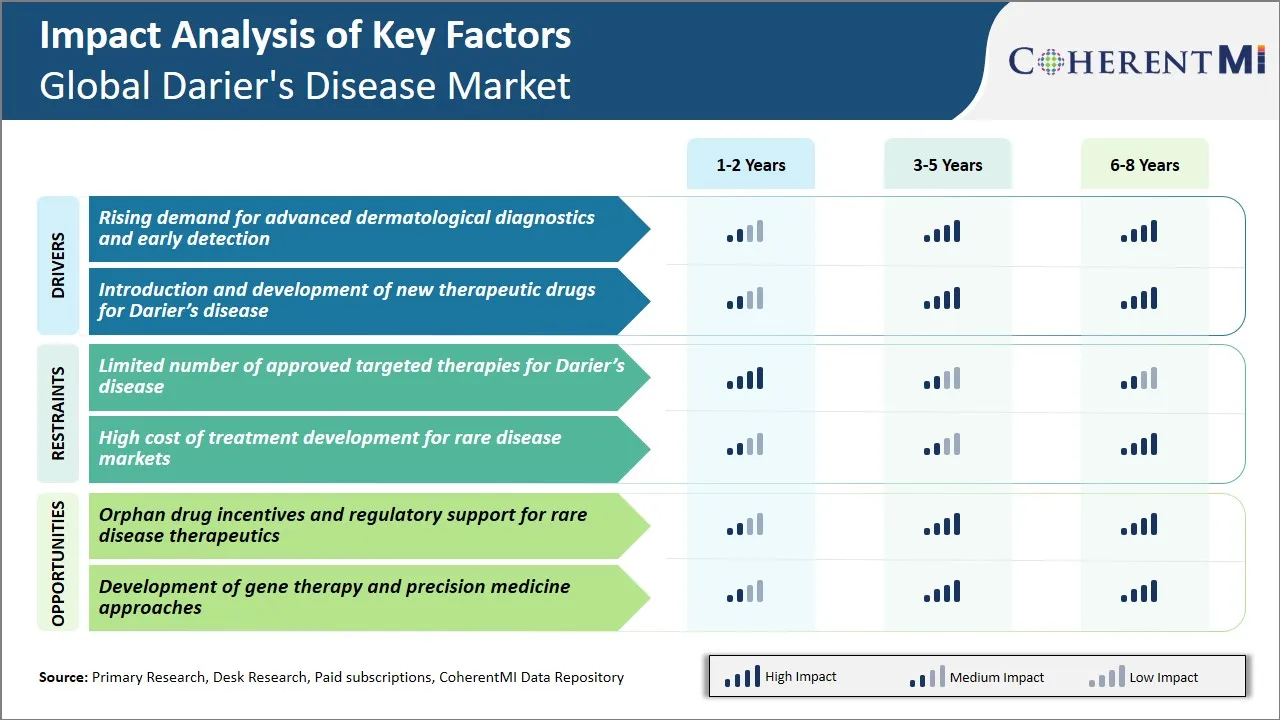
Market Driver - Rising Demand for Advanced Dermatological Diagnostics and Early Detection
The world healthcare environment is undergoing a paradigm shift to precision medicine and prompt disease treatment, and dermatological disorders are the focus field of health care practitioners and patients. This has changed especially in the handling of rare genetic skin diseases like Darier disease where sophisticated diagnostic skills are increasingly being vital to patient prognoses. The healthcare systems in the world are noting that early and proper diagnosis of Dariers disease can greatly enhance quality of life among patients and minimize the cost of long term healthcare of patients in complications and improper management of the disease. The conventional method of medical observation and the simple analysis of the histopathology is being complemented and, in most instances, substituted by advanced diagnostic methods that can detect the condition at the earliest and with greater accuracy.
For instance, in December 2025, Schweiger Dermatology Group, one of the largest U.S. dermatology practices, announced significant growth and innovation. The group saw over 2.5 million patient visits in 2025, with an emphasis on accessible care and skin cancer detection. Offering same-week appointments, Schweiger Dermatology has performed more than 36,000 Mohs surgeries in 2025, establishing itself as a leader in skin cancer treatment. The practice is committed to early detection and providing comprehensive care, including surgical excisions and long-term surveillance. Schweiger continues to focus on patient satisfaction, with over 90% of patients rating their experience highly.
Market Driver - Introduction and Development of New Therapeutic Drugs for Dariers Disease
There is an unprecedented increase in research and development efforts to find a drug to cure rare genetic conditions in the pharmaceutical industry and Darier disease is one of the fields where treatment is of high potential because the treatment choices available to patients are limited. Several factors have prompted this heightened interest amongst pharmaceutical companies and biotechnology firms and these include improved technology in drug development, improved knowledge of molecular pathogenesis of the disease and regulatory incentives to spur investment in orphan drug development.
The conventional treatment regimen of Darier disease has been more symptomatic in nature based on topical therapy, oral retinoid therapy, and general skin care precautions which offer only partial relief and have serious side effects in most cases. This large unfulfilled medical demand is causing innovative pharmaceutical companies to seek new therapeutic targets and are developing drugs that directly target the underlying pathophysiology of Dariers disease.
 To learn more about this report, Request Free Sample Copy
Market Challenge - Limited Number of Approved Targeted Therapies for Dariers Disease
The Dariers disease market in the world is challenged by the fact that there is indeed very few approved targeted therapies that are specifically tailored to treat this rare genetic skin disorder. Today, the therapeutic environment is characterized by the off-label prescription of traditional therapies like topical retinoids, systemic retinoids like acitretin, and other moisturizers which only offer symptomatic response to the disorder, but do not treat the genetic defect itself in the ATP2A2 gene. This relative lack of specific interventions leaves a very large gap in treatment of about 1 in 30,000 to 1 in 100,000 of the affected population in the global context. The lack of disease-modifying treatments results in the inefficient symptom management in the patients, which causes the continued appearance of skin lesions, the development of bacterial superinfections, and the severe reduction of the quality of life.
The heterogeneous clinical manifestation of the disease and the complicated pathophysiology of defective calcium pump functioning in the body of the keratinocytes present pharmaceutical companies with significant challenges in the development of targeted treatment. The small number of patients means that it will be difficult to perform large-scale clinical trials required to get regulatory approval, and the high costs of research and development required to create drugs that ensure the treatment of rare diseases usually make the market reimbursement insignificant. Moreover, the absence of standardized clinical endpoints and validated biomarkers in the disease of Darier also makes it hard to develop the drug, and the regulatory authorities may have a hard time determining the effectiveness of the therapy.
Market Opportunity - Orphan Drug Incentives and Regulatory Support for Rare Disease Therapeutics
The global Dariers disease market opportunity is also quite promising due to the broad range of orphan drug incentives and improved regulatory support strategies that were specifically crafted to speed-track the process of the development of therapeutic solutions targeting rare diseases. The Orphan Drug Act of the U.S. and similar acts in Europe, Japan and other major markets, offer considerable financial incentives such as tax credits on the cost of clinical trials, waived application fees at the USFDA and most importantly seven to ten years of market exclusivity upon approval. Such regulatory benefits have great beneficial effect on the business feasibility of creating therapies to treat ultra-rare diseases such as Dariers disease, where under normal market laws, pharmaceutical companies would not have been encouraged to invest in the development. The breakthrough therapy status and expedited approval routes by the USFDA are further simplifying the development process because it enables companies to develop novel treatment faster without compromising on safety standards.
For instance, in August 2024, the Centre for Innovation in Regulatory Science (CIRS) held a workshop focused on regulatory and reimbursement incentives for rare disease products. The workshop highlighted the importance of orphan drug designation and other incentives aimed at accelerating the development and market entry of treatments for rare diseases. These initiatives include tax credits, grants, and market exclusivity. The findings underscore the critical role of such incentives in encouraging investment in therapies for conditions with limited treatment options, including Dariers disease, a rare genetic skin disorder.
Prescribers preferences of Darier's Disease Market
Prescriber Preferences for Dariers Disease Treatment
Executive Summary
Dariers Disease (DD), a rare autosomal dominant genodermatosis, presents unique prescribing challenges due to limited treatment options and variable disease severity. This analysis examines prescriber preferences across treatment lines and disease stages.
Treatment Approach by Disease Stage
Mild Disease (Localized Lesions)
First-Line Treatment:
- Topical retinoids: Tretinoin 0.025-0.1% (Retin-A), Adapalene 0.1% (Differin)
- Topical corticosteroids: Triamcinolone acetonide 0.1% (Kenalog)
- Calcipotriol 0.005% (Dovonex) for localized plaques
Moderate Disease (Widespread Distribution)
Second-Line Treatment:
- Oral retinoids: Acitretin 10-25mg daily (Soriatane), Isotretinoin 0.5mg/kg (Accutane)
- Combination therapy with topical agents
Severe Disease (Extensive Involvement)
Third-Line Treatment:
- Higher-dose oral retinoids (Acitretin 25-50mg daily)
- Immunosuppressants: Cyclosporine 3-5mg/kg (Neoral)
- Investigational: Alitretinoin (Toctino)
Prescriber Preference Factors
Primary Considerations:
- Disease extent and severity - determines oral vs. topical approach
- Patient age and comorbidities - influences retinoid selection
- Pregnancy potential - critical for female patients due to teratogenicity
- Secondary infection risk - drives antibiotic prophylaxis decisions
Emerging Trends:
Dermatologists increasingly favor acitretin over isotretinoin for long-term management due to superior efficacy in keratinization disorders, despite requiring indefinite treatment duration.
Treatment Option Analysis of Darier's Disease Market
Disease Overview & Staging
Dariers Disease is a rare autosomal dominant geniculate disorder characterized by keratotic papules and plaques. Treatment approaches vary by disease severity:
- Mild Stage: Localized papules on seborrheic areas
- Moderate Stage: Widespread involvement with nail dystrophy
- Severe Stage: Extensive lesions with secondary infections
Treatment Algorithm by Stages
First-Line Treatments
Mild Disease:
- Topical Retinoids: Tretinoin 0.025-0.1% (Retin-A) or Adapalene 0.1% (Differin)
- Rationale: Direct keratinocyte normalization with minimal systemic exposure
Moderate Disease:
- Oral Retinoids: Acitretin 10-25mg daily (Soriatane) or Isotretinoin 0.5-1mg/kg/day (Accutane)
- Rationale: Systemic approach for widespread involvement, excellent efficacy in reducing hyperkeratosis
Second-Line Options
Severe/Refractory Cases:
- Combination Therapy: Acitretin + topical calcipotriol (Dovonex)
- Alternative Systemic: Naltrexone 50mg daily (emerging evidence)
- Procedural: CO2 laser therapy for localized resistant lesions
Adjunctive Treatments
- Antimicrobials: Mupirocin 2% (Bactroban) for secondary infections
- Keratolytics: Urea 10-40% or salicylic acid 2-6% preparations
Treatment Selection Rationale
Retinoids remain gold standard due to their ability to normalize keratinocyte differentiation and adhesion. Acitretin is preferred over isotretinoin for chronic management due to its shorter half-life and established long-term safety profile. Combination approaches maximize efficacy while minimizing individual drug dosages and associated adverse effects.
Efficacy of Current Care Pathways in Dariers Disease: Retinoids and Corticosteroids:
- The current care pathway for Dariers disease primarily involves the use of systemic and topical retinoids, with systemic retinoids like acitretin and isotretinoin showing high efficacy. Studies report that these treatments lead to significant lesion clearance in around 50% of patients, with 50-80% improvement in the remaining patients over a prolonged period of use. The treatment is generally well-tolerated, with discontinuation mainly due to side effects rather than inefficacy. Topical retinoids, such as tretinoin, tazarotene, and adapalene, also show moderate success in reducing hyperkeratosis, but results are often variable, with some patients experiencing relapse after cessation.
- Topical corticosteroids are commonly used but have limited evidence supporting their efficacy in treating Dariers disease. While corticosteroids may provide moderate improvement in some patients, clinical evidence is sparse compared to retinoids. Most of the available data comes from case reports and small cohort studies, making it difficult to draw firm conclusions. Overall, while retinoids remain the cornerstone of treatment, more robust clinical trials are needed to better define the long-term efficacy and safety of both retinoids and corticosteroids in managing Dariers disease.
Segmental Analysis of Darier's Disease Market
 To learn more about this report, Request Free Sample Copy
Insights, By Type: Classic Dariers Disease Dominance Driven by Higher Prevalence and Established Diagnostic Protocols
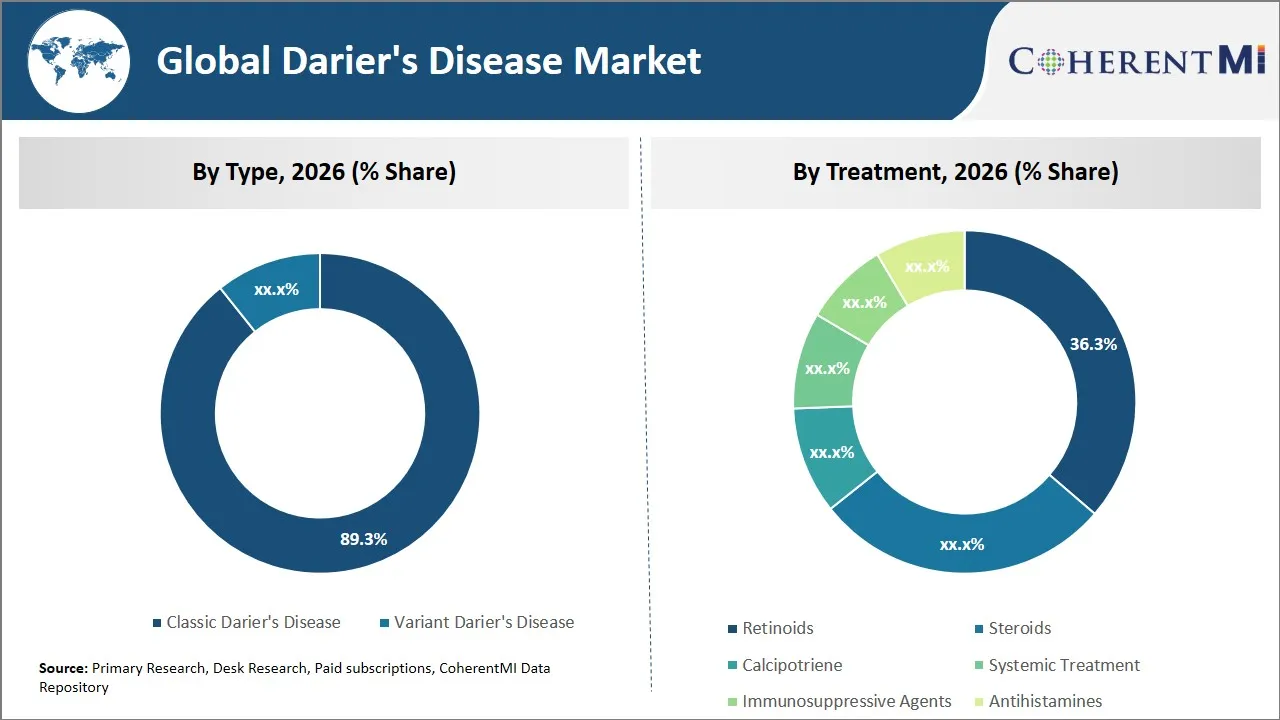
By type, classic Dariers disease is expected to occupy the largest market share of 89.3% in 2026, because it exhibits by far the highest rates of prevalence in relation to its variant forms and the established diagnostic and treatment fashways currently developed around this main form of the condition occurrence. Classic Darier disease is the most frequently observed type of this rare genetic disease that is known to typically present with similar patterns of keratotic papules, nail defects, and palmoplantar pits that classically follow the classic disease-pattern initially described in medical literature.
The predominance of Classic Dariers Disease in the market stems from several interconnected factors that collectively drive demand for therapeutic interventions. Ionis Pharmaceuticals focuses on genetic therapies, Alnylam Pharmaceuticals targets rare diseases with similar pathways, and Sanofi advances dermatological treatments, all contributing to the market for this common form of the disorder.
Insights, By Treatment: Retinoids Leading Treatment Segment Through Superior Efficacy and Comprehensive Disease Modification
By treatment, the retinoids will take the largest portion of the market with 36.3% share in 2026, due to their unrivaled ability to treat the underlying pathophysiology of the Darier Disease and their capability to offer a holistic ability to mitigate the symptoms of the disease in all its manifestations. Retinoids serve as the foundation of the treatment regimen as they directly manipulate the affected process of abnormal keratinization which forms the basis of the disease process, providing both symptomatic benefit as well as possible disease modifying effects unmatched by other treatment regimes.
The reason behind the dominance of retinoids in the market is the superiority of the mechanism of action that forms the basis of the treatment of the underlying cellular abnormalities in the disease known as Darier. In contrast to treatments that are symptomatic and merely offer a temporary fix, retinoids have a cellular effect of restoring normal keratinocyte differentiation and minimally affect the development of typical lesions known as keratotic lesions. It is this basic disease control methodology that causes prolonged therapeutic effects and less disease flare-up rate, which makes retinoids the therapy of choice in the long-term treatment of most patients and healthcare providers.
Additional Insights of Darier's Disease Market
- In 2026, classic Dariers disease holds the largest market share in the type category, accounting for 89.3% share.
- In the treatment segment, retinoids will dominate with a 36.3% of the market share in 2026.
- Regarding the severity of disease, the mild segment leads with an estimated market share of 45.6% in 2026.
- North America is expected to lead the market, holding a share of 39.5% in 2026. Asia Pacific is anticipated to be the fastest-growing region, with 24.5% share in 2026.
Competitive overview of Darier's Disease Market
The major players operating in the global Dariers disease market include Bausch Health Companies Inc, AbbVie Inc, Amneal Pharmaceuticals Inc, BridgeBio Pharma Inc, Galderma SA, GlaxoSmithKline Plc, Glenmark Pharmaceuticals Ltd, Johnson and Johnson, Mayne Pharma Group Ltd, Merck and Co. Inc, Novartis AG, Pfizer Inc, Sun Pharmaceutical Industries Ltd, Teva Pharmaceutical Industries Ltd, Sawai Pharmaceutical Co. Ltd.
Darier's Disease Market Leaders
- Bausch Health Companies Inc
- AbbVie Inc
- Amneal Pharmaceuticals Inc
- BridgeBio Pharma Inc
- Galderma SA
Recent Developments in Darier's Disease Market
- In August 2025, Sol-Gel Technologies (SLGL) hit a 52-week high of USD 18.66, fueled by anticipation of clinical results. The company, known for U.S. FDA-approved products EPSOLAY and TWYNEO, is progressing SGT-610 for Gorlin syndrome and SGT-210 for Dariers disease. SGT-610's Phase III trial results are expected in Q4 2026, with a USD600 million market potential. SGT-210, for Dariers disease, has Phase 1b results expected in Q4 2025, with peak sales potential of USD200-300 million. Sol-Gel's cash balance of USD24.2 million is expected to fund operations into Q1 2027.
- In August 2023, the Simpson Lab at the University of Washington published its first research paper on Dariers disease. The study shows that MEK inhibitors, which are used in cancer treatment, could help reduce skin breakdown in Dariers disease patients. This rare genetic condition causes blistering lesions and recurrent skin infections. The research was led by Dr. Cory Simpson, with contributions from the University of Michigan and the University of Pennsylvania. The paper highlights the potential of MEK inhibitors, already FDA-approved for melanoma, as a novel treatment for Dariers Disease.
Darier's Disease Market Segmentation
- By Type
- Classic Dariers Disease
- Variant Dariers Disease
- By Treatment
- Retinoids
- Steroids
- Calcipotriene
- Systemic Treatment
- Immunosuppressive Agents
- Antihistamines
- By Severity of Disease
- Mild
- Moderate
- Severe
- By End User
- Hospitals
- Dermatology Clinics
- Homecare Settings
- Ambulatory Surgical Centers
- Others
- By Distribution Channel
- Hospital pharmacies
- Retail Pharmacies
- Online Pharmacies

Would you like to explore the option of buying individual sections of this report?
Ghanshyam Shrivastava - With over 20 years of experience in the management consulting and research, Ghanshyam Shrivastava serves as a Principal Consultant, bringing extensive expertise in biologics and biosimilars. His primary expertise lies in areas such as market entry and expansion strategy, competitive intelligence, and strategic transformation across diversified portfolio of various drugs used for different therapeutic category and APIs. He excels at identifying key challenges faced by clients and providing robust solutions to enhance their strategic decision-making capabilities. His comprehensive understanding of the market ensures valuable contributions to research reports and business decisions.
Ghanshyam is a sought-after speaker at industry conferences and contributes to various publications on pharma industry.