Sleeping Pills Market SIZE AND SHARE ANALYSIS - GROWTH TRENDS AND FORECASTS (2026 - 2033)
Sleeping Pills Market is segmented By Product Type (Prescription Sleeping Pills, Over-the-Counter (O...
Sleeping Pills Market Size - Analysis
The global sleeping pills market is estimated to be valued at USD 90.44 Bn in 2026 and is expected to reach USD 132.44 Bn by 2033, exhibiting a compound annual growth rate (CAGR) of 5.6% from 2026 to 2033. This robust market expansion reflects the increasing prevalence of sleep disorders worldwide, driven by factors such as rising stress levels, urbanization, and changing lifestyle patterns. The substantial market valuation underscores the critical importance of sleep studies in the global healthcare landscape, with pharmaceutical companies investing heavily in developing innovative sleep aid solutions to meet growing consumer demand.
Market Size in USD Bn
CAGR5.6%
| Study Period | 2026 - 2033 |
| Base Year of Estimation | 2025 |
| CAGR | 5.6% |
| Market Concentration | High |
| Major Players | Pfizer Inc, Johnson & Johnson, F. Hoffmann-La Roche AG, Merck & Co Inc, Sanofi S.A and Among Others |

please let us know !
Sleeping Pills Market Trends
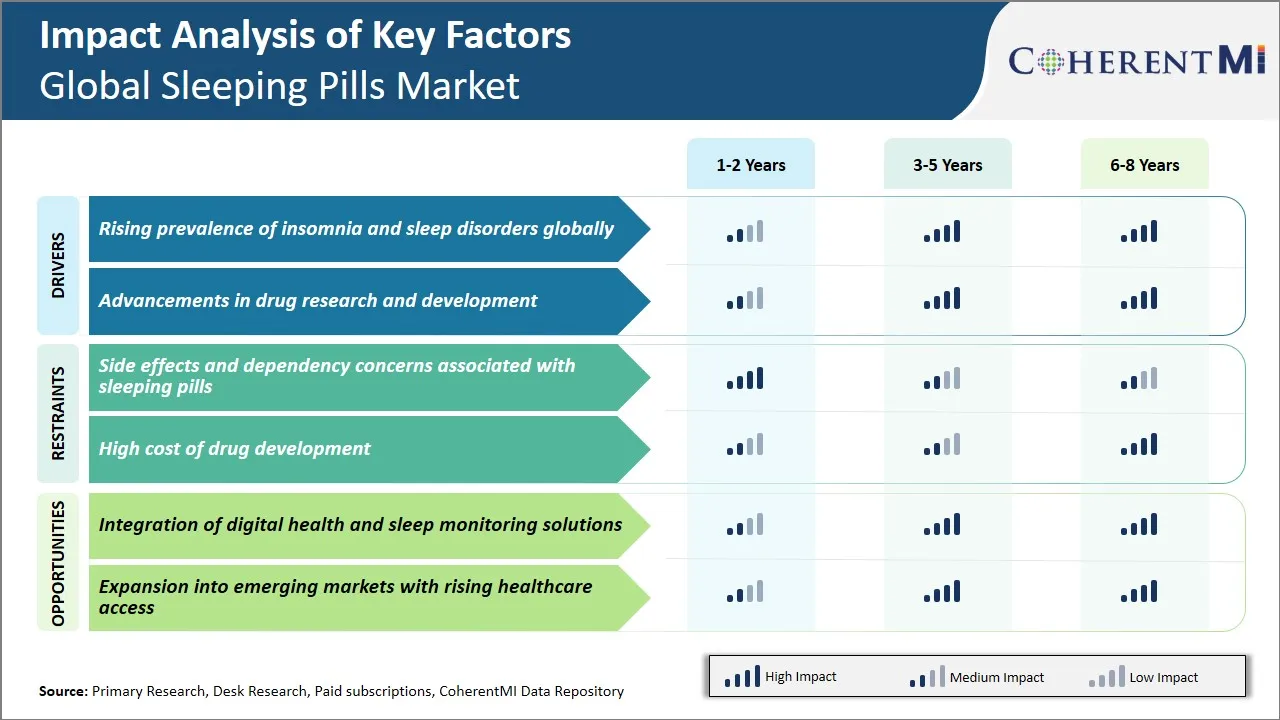
Market Driver - Rising Prevalence of Insomnia and Sleep Disorders Globally
In the modern international environment, there has been an unprecedented epidemic of sleep-related disorders, which has altered the healthcare storyline radically and established a significant need in the pharmaceutical intervention. Insomnia, the inability to fall asleep, to remain asleep, or to get a restorative sleep, has become one of the most widespread health issues of the population of all demographics and geographical regions. Such a rampant sleep crisis is the result of a combination of various interrelated factors that have collided in forming what other medical practitioners refer to as a silent epidemic in terms of quality of life, productivity, and final health outcomes.
For instance, in December 2023, Karuna Datta, Anna Bhutambare, and Hruda Nanda Mallick published a systematic review on sleep problems in India. The study found that 25.7% of people suffer from insomnia, 37.4% from obstructive sleep apnea (OSA), and 10.6% from restless legs syndrome (RLS). The prevalence is higher among those with diabetes, heart disease, and even healthy individuals. Insomnia affects 32.3% of patients, while 48.1% of patients have OSA. The study highlights the need for better sleep management and research to address the growing burden of sleep disorders.
(Source: https://www.medrxiv.org/content/10.1101/2023.12.29.23300624v1)
Market Driver - Advancements in Drug Research and Development
The active exploration of novel treatments of sleep disorders by pharmaceutical industry has spawned impressive changes in the idea of drug research and development which have essentially transformed the therapeutic modes and widened therapeutic choices of patients with different sleep-related disorders.
These advances in science are decades of rigorous investigation into the physiology of sleep, neuroscience and pharmacology, leading to highly complex pharmacological treatments of sleep disorders with much more specificity, effectiveness and safety profiles than conventional therapies. The history of the development of simple sedative agents into specific neurological treatment proves the pharma industry in its intentions to concentrate on the problem of complex sleep disorders with the help of evidence-based pharmaceutical manufacturing.
 To learn more about this report, Request Free Sample Copy
Market Challenge - Side Effects and Dependency Concerns Associated with Sleeping Pills
The market for sleeping pills has seen a threat of major headwinds as a result of the growing concerns regarding the side effects and danger of dependence that are linked with the use of traditional pharmaceutical sleep aids. Benzodiazepines and non-benzodiazepines hypnotics, and a significant part of the present market, have been well-established with such risks as cognitive impairment, morning drowsiness, memory issues, and the possibility of abuse and dependency. Authorities like the USFDA and EMA have passed several safety warnings about Z-drugs (zolpidem, zopiclone, eszopiclone) with reports of complicated sleep behaviors of sleepwalking, sleep-driving, and sleep-eating that can lead to severe injuries.
Market Opportunity - Integration of Digital Health and Sleep Monitoring Solutions
The overlap of digital health technologies with sleep monitoring solutions denotes an unexplored prospect of change and growth in the sleeping pills market worldwide. Sleep sensors based on wearables, smartphone applications, and Internet of Things (IoT) provide an opportunity to produce huge volumes of real-time sleep data, which can be used to tailor medications, as well as develop precision sleep medicine strategies.
Pharmaceutical manufacturers are also working with technology companies to come up with combined solutions that incorporate traditional sleeping drugs with digital therapeutic platforms to be able to monitor the sleep patterns, drug effectiveness, and even side effects. This can be integrated to allow the dynamic optimization of dose where AI algorithms can process each individual sleep parameter, environmental parameter, physiological reaction and provide an individualized treatment regimen that maximize therapeutic advantages with reduced adverse effects.
For instance, in December 2025, Sleep.ai launched Sleep Sense, a groundbreaking technology that turns smartphones into seamless, privacy-safe sleep sensors. Unlike wearables, Sleep Sense automatically gathers sleep data for nearly every user, eliminating the need for wearables, hardware, or manual input. The technology uses advanced AI, boundary detection, and multimodal inference to accurately track sleep patterns through motion, light, and device usage.
(Source: https://www.sleep.ai/news/sleep-sense-announcement/)
Treatment Option Analysis of Sleeping Pills Market
Treatment Options Analysis for Insomnia
Disease Stages and Treatment Approaches
- Acute Insomnia (Short-term)
- Duration: Less than 3 months
- First-line Treatment: Sleep hygiene education and cognitive behavioral therapy for insomnia (CBT-I)
- Pharmacological Options
- Short-term use of non-benzodiazepine hypnotics: Zolpidem (Ambien), Eszopiclone (Lunesta), Zaleplon (Sonata)
- Rationale: These Z-drugs offer rapid onset with reduced dependency risk compared to benzodiazepines
- Chronic Insomnia (Long-term)
- Duration: 3+ months with symptoms ≥3 nights/week
- Gold Standard: CBT-I as primary intervention
- Second-line Pharmacotherapy
- Suvorexant (Belsomra) - Orexin receptor antagonist, preferred for sleep maintenance issues
- Ramelteon (Rozerem) - Melatonin receptor agonist, ideal for sleep onset difficulties
- Doxepin (Silenor) - Low-dose tricyclic antidepressant for sleep maintenance
Treatment Selection Rationale
CBT-I remains the preferred first-line treatment due to sustained efficacy without tolerance or withdrawal risks. Pharmacological interventions are reserved for cases where behavioral therapy is insufficient or unavailable.
Suvorexant is increasingly favored for its novel mechanism targeting the wake-promoting orexin system, offering effective sleep maintenance with minimal next-day impairment. Ramelteon provides excellent safety profile for elderly patients and those requiring long-term treatment.
Combination approaches integrate CBT-I with short-term pharmacotherapy, particularly during acute exacerbations. Treatment selection considers patient age, comorbidities, substance abuse history, and specific sleep pattern disruptions to optimize therapeutic outcomes while minimizing adverse effects.
Segmental Analysis of Sleeping Pills Market
 To learn more about this report, Request Free Sample Copy
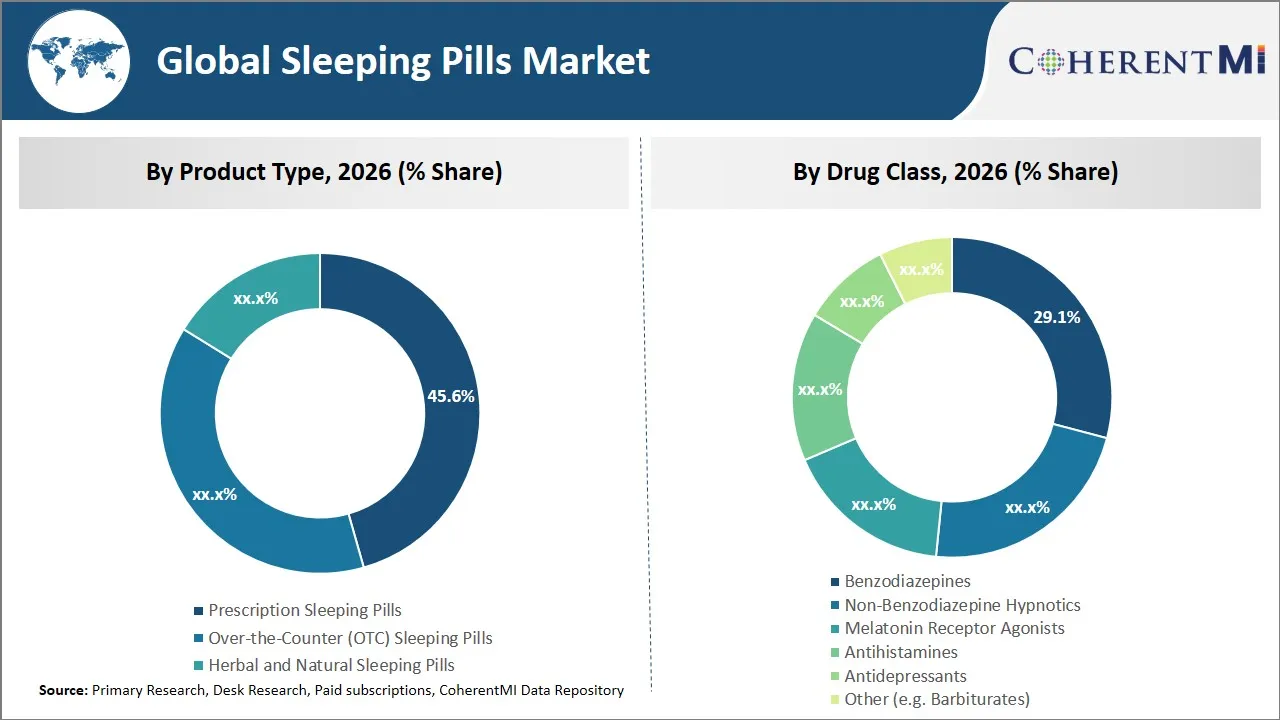
Insights, By Product Type: Prescription Sleeping Pills Contribute the Highest Market Share Owing to their Superior Clinical Efficacy and Stringent Regulatory Oversight that Ensure Therapeutic Reliability
Prescription sleeping pills are expected to hold a dominant share of 45.6% in 2026, due to their effectiveness in treating complex sleep disorders that necessitate medical supervision. The prescription medications have become the choice of the healthcare professionals to treat chronic insomnia and severe sleep disorder because of their established pharmacological mechanisms as well as dose-specific formulations that cannot be imitated in the over-the-counter medications. Patients with chronic insomnia or sleep disorders caused by psychiatric disorders or treatment-resistant sleep disturbances usually do not respond to OTC solutions, and prescription of drugs with controlled active components is necessary.
Physician preference is a key influencer of the market leadership of this segment. The prescribed sleeping pills are preferred by the medical professionals owing to the fact that they have predictable pharmacokinetics, and the respective dosages can be adjusted accurately as per the rate of reaction of an individual patient.
For example, on September 3, 2025, Resmed launched the Sleep Institute, a global clinical insights initiative aimed at advancing sleep health. The initiative collaborates with clinicians, researchers, and policymakers to deliver evidence-based insights, focusing on the diagnosis and treatment of sleep disorders like obstructive sleep apnea (OSA) and insomnia.
Insights, By Drug Class: Benzodiazepines Remains Dominant Due to Established Clinical Protocols and Broad-spectrum Efficacy
Benzodiazepines will contribute the largest proportion of the market with 29.1% share in 2026, due to their established clinical guidelines, their overall effectiveness in a wide range of sleeps disorders, and the decade-long familiarity with prescribing them by physicians that has established strong prescribing habits in the medical community. These drugs have a strong competitive advantage in the sleeping pills market due to the overall knowledge of how benzodiazepines work, their dosage regimen, and the care procedures that can be administered to a patient.
Coercion of benzodiazepines in the market is inherently based on the fact that they are versatile therapeutic agents that correct both sleep and anxiety-related sleep disorders. Comorbid anxiety disorders are quite common with many patients with insomnia, and therefore benzodiazepines are especially useful because of its dual anxiolytic and sedative effects. This two-fold effect enables health professionals to treat several symptoms with one drug, making the treatment process easier and more effective in retreating compliance.
Emerging Alternatives in the Sleeping Pills Market: A Move Towards Natural and Non-Pharmaceutical Solutions
- The sleeping pills market is witnessing a shift towards alternative and adjacent therapies as consumers seek non-pharmaceutical solutions to manage sleep disorders. Practices like cognitive behavioral therapy for insomnia (CBT-I), relaxation techniques, meditation, and mindfulness are becoming popular substitutes. These therapies focus on addressing the root causes of sleep issues, such as anxiety or stress, and improving sleep hygiene without the need for medication. With growing awareness about the potential side effects and dependency risks of sleeping pills, many individuals are opting for these holistic approaches to achieve better sleep naturally.
- In addition to behavioral interventions, there is a surge in the use of natural supplements, including melatonin, valerian root, and CBD-based products, which are gaining traction as sleep aids. These alternatives offer a gentler approach, with fewer side effects, compared to traditional sleeping pills. Moreover, innovations in wearable sleep technology and sleep tracking apps are providing users with data-driven insights to optimize their sleep patterns. These developments are reshaping the landscape of the sleep aid market, offering consumers more personalized and accessible options.
Additional Insights of Sleeping Pills Market
- In 2026, prescription sleeping pills will account for the largest market share, contributing 45.6% share.
- In terms of drug class, benzodiazepines will lead the market with a share of 29.10% in 2026.
- Regarding distribution channel, retail pharmacies will hold the highest market share at 40.3% in 2026.
- North America is expected to lead the market, holding a share of 39.5% in 2026. Asia Pacific is anticipated to be the fastest-growing region, with 24.5% share in 2026.
Competitive overview of Sleeping Pills Market
The major players operating in the global sleeping pills market include Pfizer Inc, Johnson & Johnson, F. Hoffmann-La Roche AG, Merck & Co Inc, Sanofi S.A, Abbott Laboratories, GSK plc, Takeda Pharmaceutical Company Limited, Eli Lilly and Company, Eisai Co Ltd, Sun Pharmaceutical Industries Ltd, Cipla Limited, Dr Reddy’s Laboratories Ltd, Lupin Limited, and Glenmark Pharmaceuticals Ltd.
Sleeping Pills Market Leaders
- Pfizer Inc
- Johnson & Johnson
- F. Hoffmann-La Roche AG
- Merck & Co Inc
- Sanofi S.A
Recent Developments in Sleeping Pills Market
- In May 2025, a new drug combination for sleep apnea showed remarkable success in a large clinical trial. The combination of atomoxetine and aroxybutynin, marketed as AD109 by Apnimed, stimulates muscles that keep the airway open, reducing breathing disruptions during sleep. In the trial with 646 participants, AD109 resulted in 56% fewer breathing disruptions and helped 22% of participants achieve complete control of the disease.
- In January 2025, Devan, a leader in sustainable textile finishes, launched "Devan Sleep Tight" at Heimtextil 2025. This sleep-promoting technology, inspired by the global "Beauty Sleep" trend, uses an active ingredient derived from an upcycled by-product of Australian Tea Tree oil. The technology enhances sleep quality and supports skin regeneration through inhalation and skin contact. It works by boosting melatonin, reducing reactive oxygen species, and stimulating collagen production.
- In May 2023, Idorsia Ltd received Health Canada's approval for QUVIVIQ (daridorexant) for managing insomnia in adults. QUVIVIQ works by blocking orexin receptors, reducing wakefulness to aid sleep. The company plans to make QUVIVIQ available by the end of the year in Canada. Insomnia affects over 2.2 million Canadians, with an annual GDP loss of USD 19.6 billion.
- In April 2025, NightWise launched a new line of sleep support supplements featuring patented release technology. The line includes a general sleep support product, along with formulations aimed at supporting nighttime menopause and prostate symptoms. NightWise’s approach moves beyond traditional sedative-based or single-ingredient melatonin supplements.
Sleeping Pills Market Segmentation
- By Product Type
- Prescription Sleeping Pills
- Over-the-Counter (OTC) Sleeping Pills
- Herbal and Natural Sleeping Pills
- By Drug Class
- Benzodiazepines
- Non-Benzodiazepine Hypnotics
- Melatonin Receptor Agonists
- Antihistamines
- Antidepressants
- Other (e.g. Barbiturates)
- By Distribution Channel
- Retail Pharmacies
- Online Pharmacies
- Hospital Pharmacies
- Drug Stores
- By Age Group
- Adults (18-60 years)
- Elderly (60+ years)
- By Application
- Insomnia
- Anxiety and Stress-Induced Sleep Disorders
- Sleep Apnea
- Jet Lag
- Other Sleep Disorders
- By Formulation
- Tablets
- Capsules
- Liquids/Syrups
- Powders
- Gummies

Would you like to explore the option of buying individual sections of this report?
Ghanshyam Shrivastava - With over 20 years of experience in the management consulting and research, Ghanshyam Shrivastava serves as a Principal Consultant, bringing extensive expertise in biologics and biosimilars. His primary expertise lies in areas such as market entry and expansion strategy, competitive intelligence, and strategic transformation across diversified portfolio of various drugs used for different therapeutic category and APIs. He excels at identifying key challenges faced by clients and providing robust solutions to enhance their strategic decision-making capabilities. His comprehensive understanding of the market ensures valuable contributions to research reports and business decisions.
Ghanshyam is a sought-after speaker at industry conferences and contributes to various publications on pharma industry.